Meet Vermont Bugatti Restoration Expert Scott Sargent: The Master Behind the World’s Rarest Cars
At his garage in a small Vermont town, Bugatti restoration expert Scott Sargent brings back to life some of the rarest and most valuable cars on the planet.
By Meg Lukens Noonan|Jul 01 2025|


Scott Sargent isn’t immune to falling in love with the machines in his care, and he singles out this 1937 Bugatti Type 57S—one of only 42 ever made, with a minimum $10 million value—as a treasure he’d give anything to own. Describing it as Bugatti’s most expensive and fastest automobile, Sargent also considers it the European automaker’s most special creation. “Cruella de Vil would have driven this car,” he says.
Credit: Corey HendricksonScott Sargent’s commute to his auto shop in Bradford, Vermont, takes him past Northstar Fireworks, the Whistle Stop mobile home park, and Farm-Way outfitters. Occasionally, he has to stop at the railroad crossing to let a freight train rumble through, but most days, the tracks are idle. He parks at Sargent Metal Works, a faded barn-red warehouse on dead-end Industrial Drive, and then, wearing what he always wears—jeans and an unbuttoned shirt over a tee, and broken-in Merrell slip-ons—he walks to the entrance. As he opens the door, he smells the shop’s familiar scent of motor oil and paint and piney floor cleaner.
No one would guess that Sargent, and anyone lucky enough to be trailing behind him, is about to be transported. But inside that high-ceilinged garage, another world awaits. It’s a world of roadsters and rallies, Grands Prix and grands crus, art deco elegance and Jazz Age abandon. It’s the world of Bugatti.
Scott Sargent is a renowned restorer of pre–World War II Bugattis: sculptural, swoopy, speedy French cars that are among the planet’s rarest and most valuable. His mechanical virtuosity and deep knowledge of the marque has earned him a slate of international clients, whose chartered helicopters sometimes tilt in over the Bradford cornfields to land in his parking lot. Most are billionaires.
“With a B,” he says quietly, for clarification, as he shows a visitor around.
Credit: Corey Hendrickson
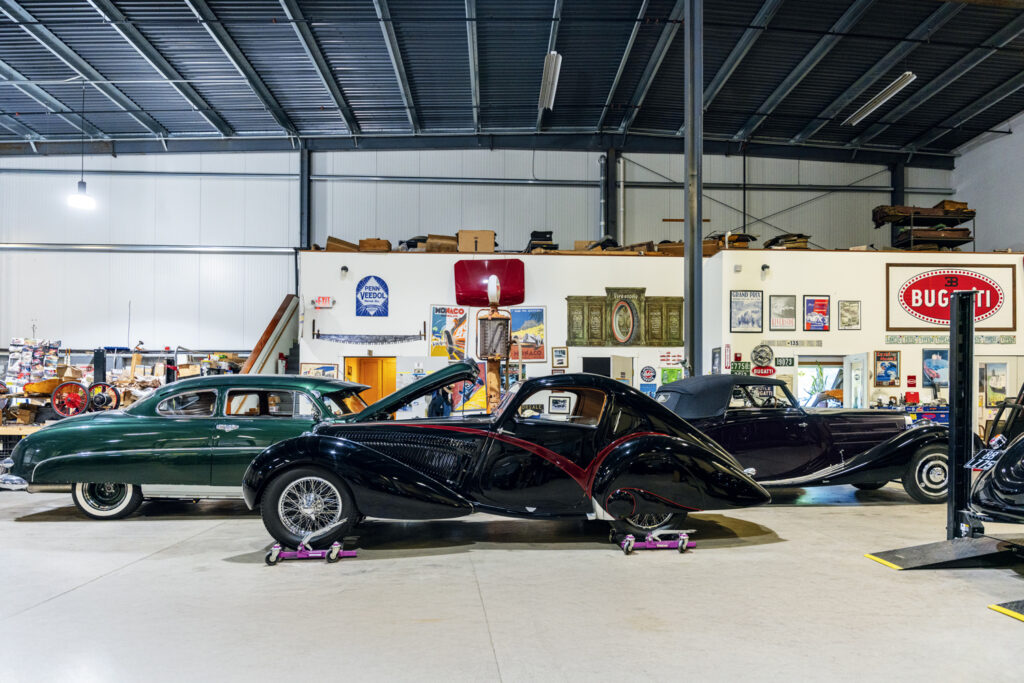
On this particular day, he and his small staff have 22 vehicles—worth roughly $40 million—in various stages of renewal. (Most are Bugattis, though he takes on other makes if the car has a compelling history.) Some are raised high on lifts. Others are ghostly humps under translucent plastic sheets. A few are masked, ready for paint. One skeletal chassis awaits its personality-bestowing body. Between the projects are tall red tool chests and long worktables strewn with engine parts, rags, open boxes, bottles of lubricants, wrenches, and containers full of bolts.
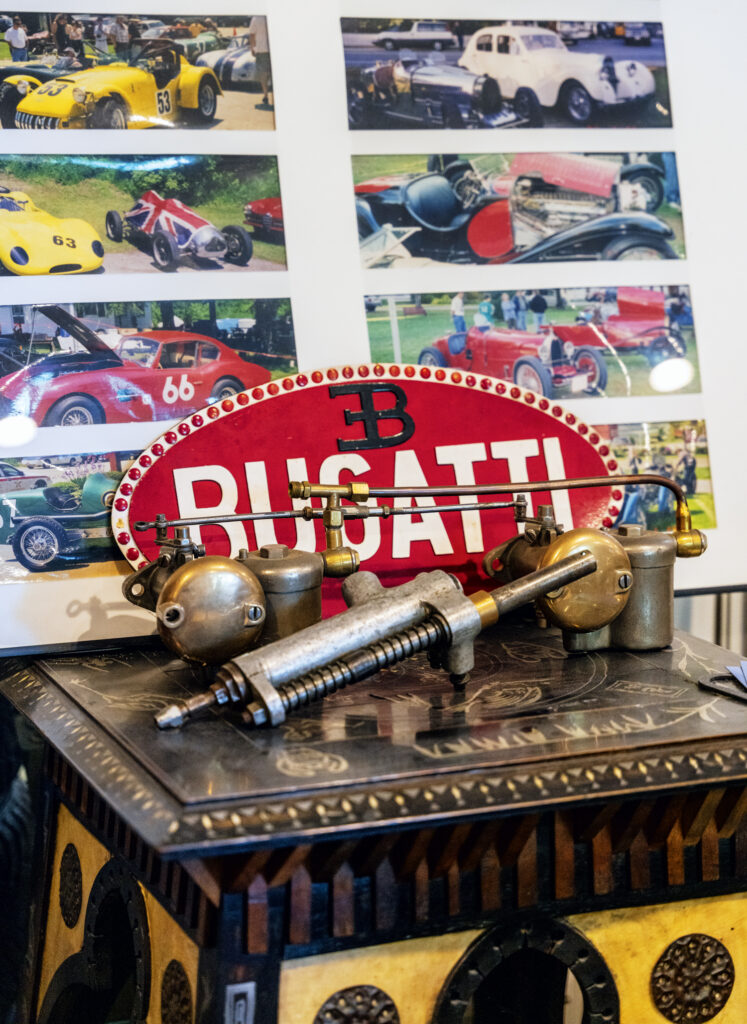
Sargent stops in front of a row of finished-looking cars and offers design specs and engineering details about each one. To a non-car person, that information doesn’t mean much. But nobody needs special knowledge to be moved by these beauties. There’s that rakish burgundy roadster with the cappuccino-colored leather seats, that torpedo-shaped French Blue soft-top with the delicate-looking wire-spoke wheels, that elongated obsidian touring car with the burled wood dashboard and voluptuous teardrop fenders—heart-stoppers all. Above them, a wall poster proclaims the Bugatti mantra: “Nothing is too beautiful, nothing is too expensive.” That sentiment has kept Sargent’s business thriving for decades.
So, just how did this unassuming, balding, bespectacled 63-year-old who grew up just down the road in rural Fairlee end up in this heady, high-stakes world?
It started with a lawnmower.
Credit: Corey Hendrickson
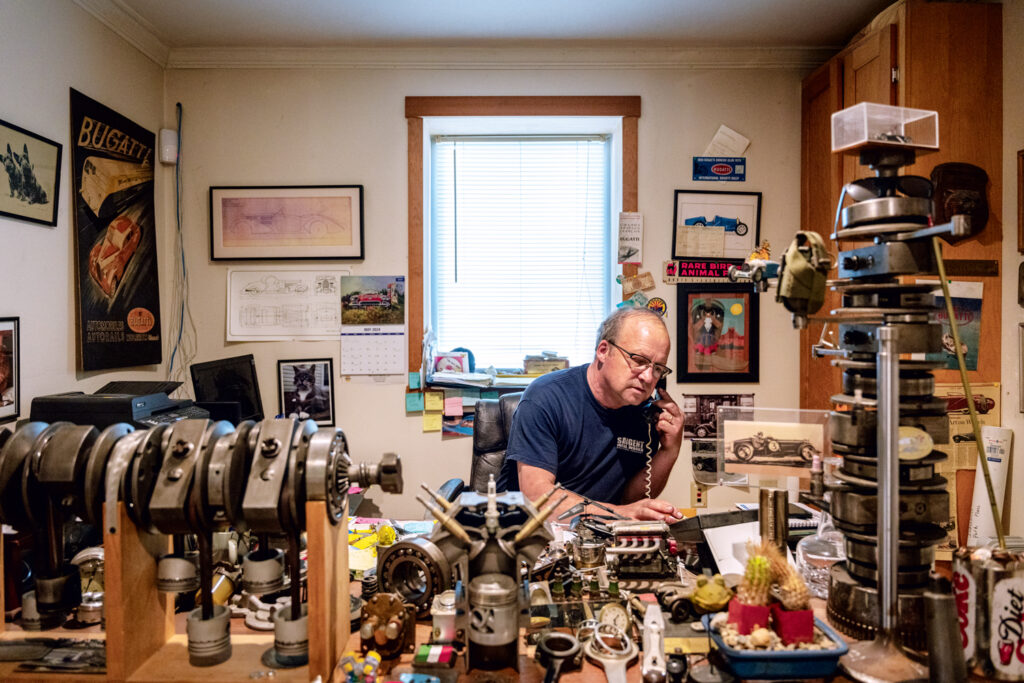
“My dad gave me an old Briggs & Stratton lawnmower when I was about 6,” says Sargent, who has moved to a desk in an office that is a cluttered marvel—equal parts Bugatti shrine, reference library, and spare-parts storage room. “It had no blade and the motor wasn’t running. I took it apart with his help and figured out it had a stuck valve in it. Then I got it back together, tied a rope on it, and pulled—and the thing started. That was just amazing. That was kind of an awakening for me, bringing that engine to life.”
Sargent’s childhood was filled with resurrected engines. His father was an enthusiastic collector of antique Fords who often took him and his brothers on outings to rescue another down-and-out vehicle. When Sargent was in fifth grade, his dad gave him a derelict two-door 1930 Ford Model A to tinker with.
“I worked on it for a few years and eventually made a doodlebug out of it—basically a big open go-kart. We could drive it around the field next to our house. But it was the history of the car that fascinated me as much as the mechanical issues, the fact that I could go to a book and see a picture of what it looked like when it was delivered.”
During high school, Sargent bought and restored a 1934 Ford pickup truck with money he’d earned from delivering newspapers and mowing lawns. He also started working part-time for David Patridge, a classic car restorer in Rumney, New Hampshire. After getting a business degree at the University of Arizona—paid for with earnings from a small auto shop he opened in Tucson while an undergrad—he made his way back to Vermont.
A visitor to his shop in the early 1990s changed his trajectory. Peter Williamson, a noted Dartmouth-Hitchcock Medical Center neurologist, avid car collector, and past president of the American Bugatti Club, who lived in nearby Lyme, New Hampshire, stopped in to invite him to see his 14 prewar Bugattis. At the time, it was one of the most significant private collections in the world.
“They were not like anything I’d ever seen,” says Sargent. “I mean, I’d been around a lot of old cars in my day—Packards and Fords and Chryslers and other domestic cars—but nothing like that. They were jewelry. It was sheer wonder.”
When Williamson asked him to maintain the cars, Sargent immersed himself in the marque’s history. He learned that the Bugatti heritage was as much about art as machinery. Carlo Bugatti, the patriarch, was an important maker of art nouveau furniture. (Sargent has two of his valuable pieces in his office.) Carlo’s youngest son, Rembrandt, was an acclaimed sculptor specializing in bronze animals. His eldest son, Ettore, a mechanical genius and gifted designer, found his calling in automobiles.
Credit: Corey Hendrickson
Ettore built his first car by the time he was 20 and went on to open the Bugatti factory in 1909 in the Alsatian village of Molsheim (part of Germany at the time; later ceded to France). His talented son, Jean, joined the company in his teens and designed some of the maker’s most stylish cars. For a time, they were also the world’s fastest race cars; in the 1920s and early 1930s, daring Bugatti drivers, in cloth helmets, leather goggles, and white coveralls, dominated the Grand Prix race circuit. Jean died testing a prototype in 1939; a year later, the Germans annexed the factory and began using it to produce amphibious vehicles and weapons components. Although the manufacturing operation was eventually returned to the family, Bugatti’s golden era was over. (The name has since been resurrected to produce a limited number of ultra-expensive supercars.)
The original factory turned out about 9,000 cars. A small fraction survive, including only two of what many consider the ultimate Bugatti: the Type 57SC Atlantic, a curvaceous, futuristic-looking, low-riding coupe with a distinctive riveted spine. One of them was in Williamson’s garage the day Sargent went to visit. (Ralph Lauren owns the other.) Though the physician had purchased the Atlantic in a Los Angeles auction in 1971 for $59,000, setting a record for the highest price ever paid for a car, it had come with a host of inauthentic parts and incorrect cosmetics. In 2000, Williamson asked Sargent to do a full restoration of his crown jewel.
“I was (a little) nervous,” he says of taking it on. “But I was pretty good with my hands by then.”
As with all his projects, Sargent’s goal was to return the car to its original condition. In the Atlantic’s case, that meant disassembling and rebuilding it to look and run just as it did when Lord Victor Rothschild took delivery in London on September 2, 1936. Sargent’s cache of historical Bugatti books and archival photos helped, as did his detective skills.
He discovered some light blue metallic paint on the fin of the car and took a piece of it to England to track down a man who had worked in the Surrey dealership that acquired the car in the mid 1940s. “He remembered pushing a broom around it in the showroom. And he said, yes, that was the blue.”
Sargent also hunted for parts in Paris at the Rétromobile classic car show. On one of those trips, during a Seine river cruise, he happened to meet a Bugatti company archivist who was carrying a small book containing the specs of every model, including Williamson’s Atlantic. That man confirmed that the patch of blue leather Sargent had discovered on an interior map pocket was indeed original. Sargent was then able to duplicate its exact hue and grain. (The leather work was done by Richmond Upholstery in Richmond, Vermont, with whom Sargent works regularly.)
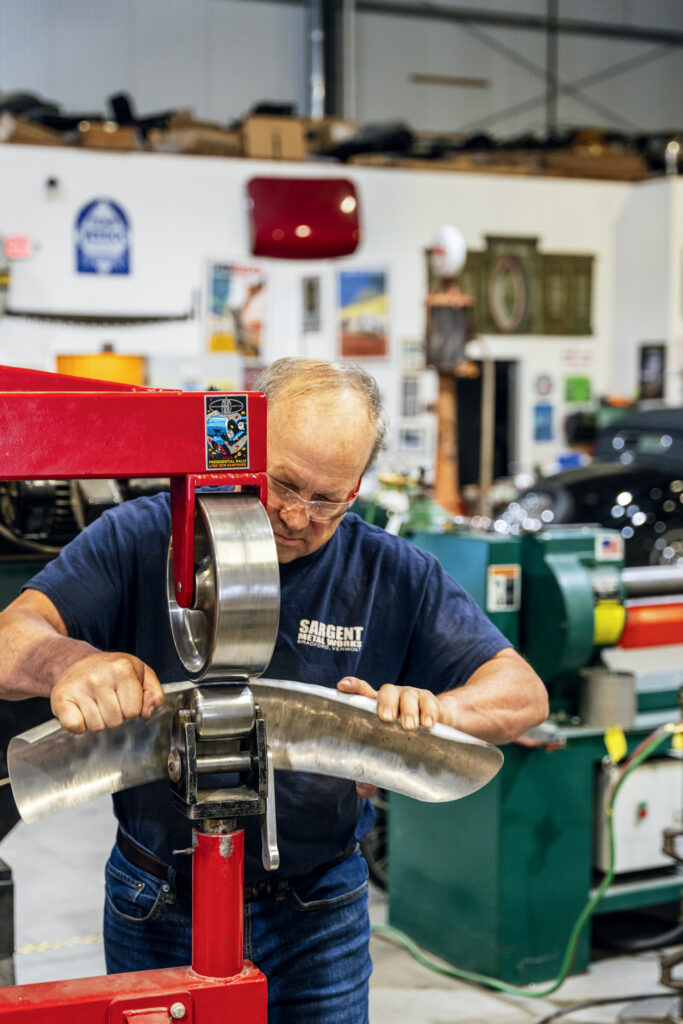
If he couldn’t find the components he needed, he got creative, hand-casting molds and pounding aluminum in much the same way the original makers did. He “dumbed down” modern shiny paint with thinner, then sanded and buffed the body to give it a “slightly off-gloss look.”
“My job is never to make it the most perfect car in the world,” he says. “These cars were not perfect. And I don’t want to leave my fingerprint on it. I want to preserve the fingerprints of the people who built the car.”
When the Atlantic’s exacting overhaul was complete in 2003, Williamson entered it into California’s Pebble Beach Concours d’Elegance, widely considered the world’s most prestigious auto exhibition. The annual event, attended by 15,000 spectators, culminates in the presentation of awards for style, technical merit, and restoration accuracy. The Atlantic won Best in Show.
“It was pretty mind-blowing. Confetti and cannons going off, big parties. I was floored. It was the first car I ever showed at Pebble Beach, and it basically won the world championship of automotive restoration.”
Credit: Corey Hendrickson
Over the years, Sargent and Williamson grew close. “He was like a dad and a brother to me all wrapped into one. We skied together. We’d get the Atlantic out and get gas at the Lyme Country Store and take it for a drive, maybe over to Wentworth (New Hampshire) and back. We drank scotch at night. It was a grand time.”
After Williamson died in 2008, his estate sold the Atlantic for more than $30 million to two buyers, one of whom was Rob Walton, heir to the Walmart fortune. Walton, now the sole owner of the car, is also Sargent’s client—and friend.
“Most of my clients do become friends,” says Sargent. “When you get into that stratosphere of people, they’re not letting you in the door if they don’t trust you. There are a lot of decisions that have to be made. They know I’m going to do the right thing for the car.”
And they also agree with Sargent that even the rarest of Bugattis are meant to be driven.
“I think it’s important to get these things out there so that people can see them and understand their history. Maybe they’ve heard about the new Bugatti supercars, but the old stuff is much more interesting,” he says.
Thousands of people turned out for the much-publicized 2018 International Bugatti Tour in Saratoga Springs, New York, during which the town’s main street was shut down for a parade of 80 vehicles. The field notably included both surviving Atlantics. Sargent drove the blue Williamson/Walton car—which by then was valued at about $40 million—alongside the black Ralph Lauren car.
“People were screaming and jumping up and down. They knew what they were seeing. It had never happened before, to have both Atlantics driving side by side. The driver of the Lauren car and I kept looking over at each other. We knew how rare it was to be looking at one Atlantic from the driver’s seat of the other.” Sometimes gatherings are more intimate, such as the four-day rally Sargent hosted last September for the American Bugatti Club. To kick it off, he’d welcomed his fellow members to an informal cocktail party in his garage. They’d parked their prized vehicles—most of which Sargent had worked on at some point—out front, sipped wine, commiserated over finicky starters, and admired the shop’s works in progress. Sargent stayed on call during the event to make sure all 18 cars started up in the morning chill and kept running through each of the 150-mile back-road days. There were no stopwatches or prizes—just the camaraderie of fellow enthusiasts.
“For most of us, the big experience is getting the car on the road … and being with other Bugattis.”

Credit: Corey Hendrickson
Envisioning what roads the cars might have traveled in the past, what hairpin curves they rounded, what sycamore-lined boulevards they may have cruised, and who might have loaded their luggage in them for honeymoons or holidays, adds to the thrill of driving—and restoring—them. One of Sargent’s own projects, a zippy 1930 Type 40 Grand Sport he bought six years ago, has him dreaming of the Austrian Alps.
“I know my little Bugatti was delivered to Austria. With a little more research, I can find out who it was delivered to and where they lived. I know that the Nazis got it and sold it at auction for the war effort, and I know that it came to the States in 1962,” he says. “My goal is to finish it and bring it back to Austria. I’ll probably leave it there for a year, do a few rallies. I want to drive it on the same little two-lane roads in the same villages, to put it in the same spot where it lived.”
In the meantime, Sargent continues to rack up awards at Pebble Beach. In 2023, a Bugatti Atalante coupe owned by prominent Swiss collector Fritz Burkard won first in class. (Second place went to another Sargent project.) Burkard, who has spent considerable time in Vermont, bought the car after seeing it mid-restoration at Sargent Metal Works. He was impressed with the restorer’s knowledge and integrity.
“Scott has such a good heart, on a personal level and as a craftsman. He’s honest. He doesn’t tell you bullshit,” Burkard said from his home in St. Moritz. “And he’s humble. That’s very refreshing in this world. It’s why I love to work with him and why we became friends.”
It’s a long way from the Alps and Paris and Pebble Beach to Bradford, Vermont, a long way from DIY backyard go-karts to unparalleled show cars. Sargent is aware of how far he’s come.
“I do think about that,” he says as he walks back out onto the shop floor. “I mean, I feel like the luckiest person in the world. I love what I do. I’ve got great clients, and they have entrusted me with these great things. I love to make their cars better. But it didn’t just happen to me. It’s taken 45 years of work to get to this point. A lot of late nights, a lot of weekends.”
And a lot of belief that what he’s been doing for the past nearly half-century amounts to far more than repainting bodies and rebuilding engines.
“You know, these cars, they’re not just an assembly of parts,” he says, looking around at his charges with obvious pride. “They have a kind of soul that lives on. And it’s very clear in my mind when I’m working on them that they will outlive us all.”
This feature was originally published as “Dream Machines” in the July/August 2025 issue of Yankee.