Tipping Point on Martha’s Vineyard
Amid extreme weather and an encroaching sea, Martha’s Vineyard must answer a critical question: Will the fabled island change, or be changed by, its climate future?
By Ian Aldrich|Jan 01 2024|

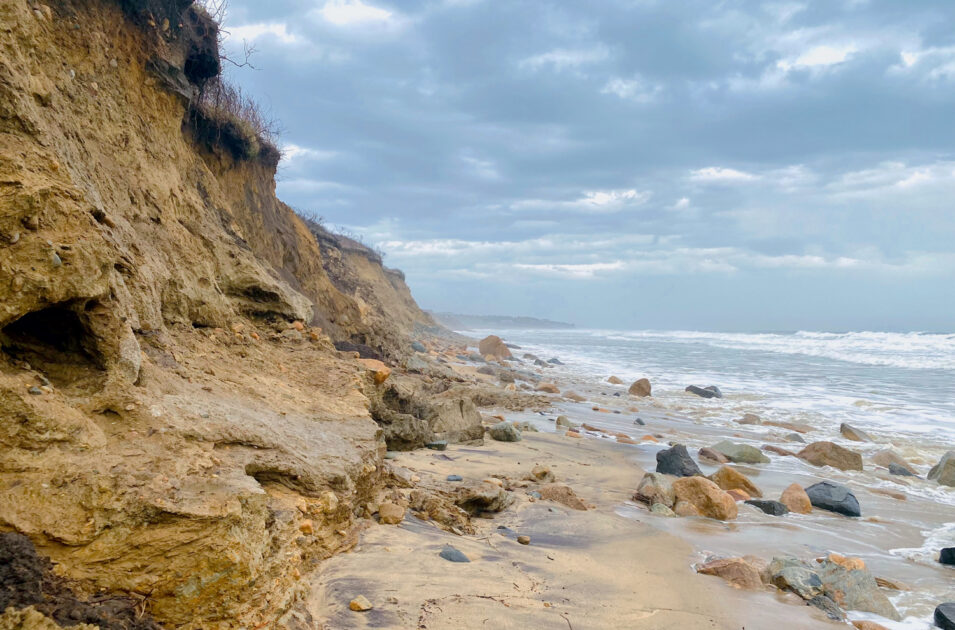
In the wake of a massive storm in December 2022, crumbling cliffs at Squibnocket Beach show the kind of erosion that’s increasingly being seen along the south shore of Martha’s Vineyard.
Credit: Tina MillerIn December 2022, just days before Christmas, a powerful storm slammed into the East Coast. Sleet and snow hit central Florida; the wind chill dropped to -11 in Richmond, Virginia; and frozen floodwaters held hostage the city of Edgewater, New Jersey. In New England, steady rains and heavy winds gave way to a sudden, fierce arctic blast that in some spots dropped the temperature by as much as 50 degrees in just a few hours. More than 250,000 Maine residents lost power, wind gusts topping 147 mph scoured New Hampshire’s Mount Washington, and rising sea levels brought coastal towns like Gloucester, Massachusetts, to a grinding halt.
Seven miles from the mainland, surrounded by water on all sides, the Massachusetts island of Martha’s Vineyard offered a portrait of not only the storm’s fury, but also a community’s vulnerability in the face of extreme weather. The rain and wind forced the cancellation of mainland ferries, while floodwaters lapped the front doors of downtown businesses in Oak Bluffs and Vineyard Haven. In anticipation of a long power outage, emergency planners in Aquinnah opened a warming shelter at the town hall.
For island residents, the immediacy of the moment was matched by its familiarity. The Vineyard is accustomed to nor’easters, but as the frequency and strength of these storms increase, the island’s sandy geography and contrary mix of isolation from and reliance on the mainland have exposed it to a climate threat that is no longer a projection.
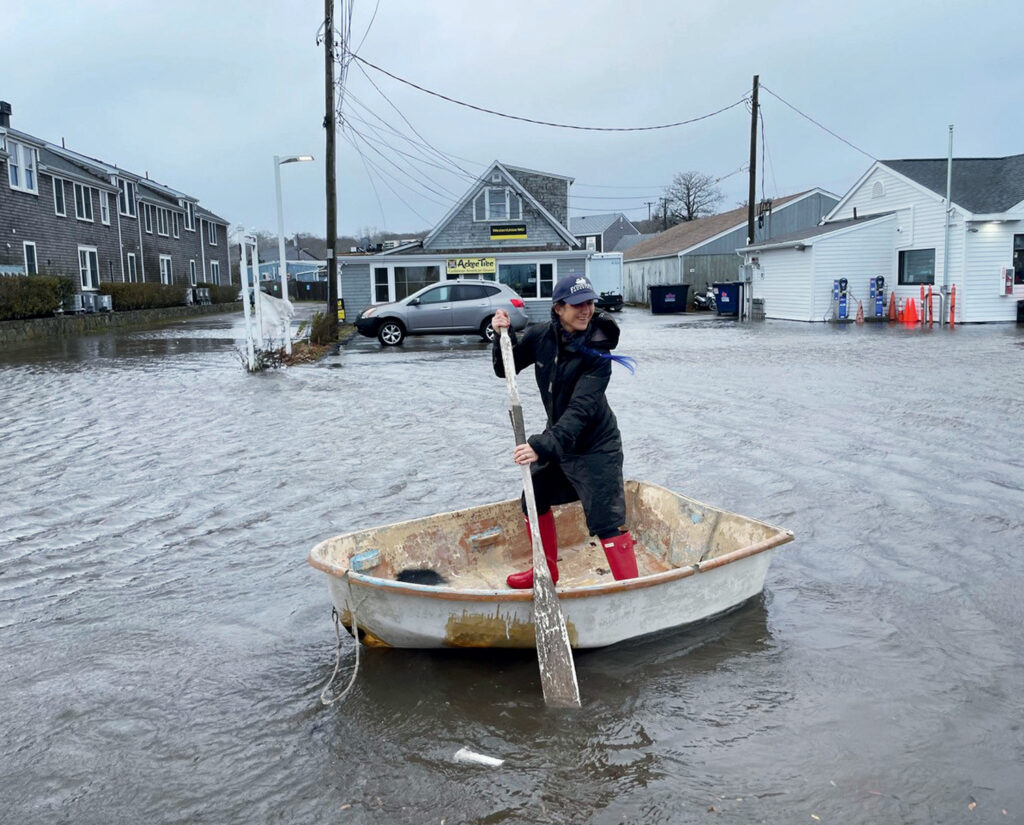
The Vineyard’s south-shore beaches have some of the most aggressive erosion rates on the Eastern Seaboard. Sunny-day floods have become more frequent—notably in downtown Vineyard Haven, where residents in low-lying areas sometimes find it easier to kayak to their mailbox when water washes over their driveways. Bigger storms have impacted the island’s comings and goings, too, forcing the cancellation of more than 1,700 ferry trips between 2018 and 2020 alone. There have been other upticks: in daily temperatures, in ocean acidification, in Lyme disease, in housing development and its accompanying freshwater demands on an island that relies on a single aquifer. The repercussions of all this touch everything, from food security to energy dependence to transportation to an economy built largely on building booms and tourist dollars.
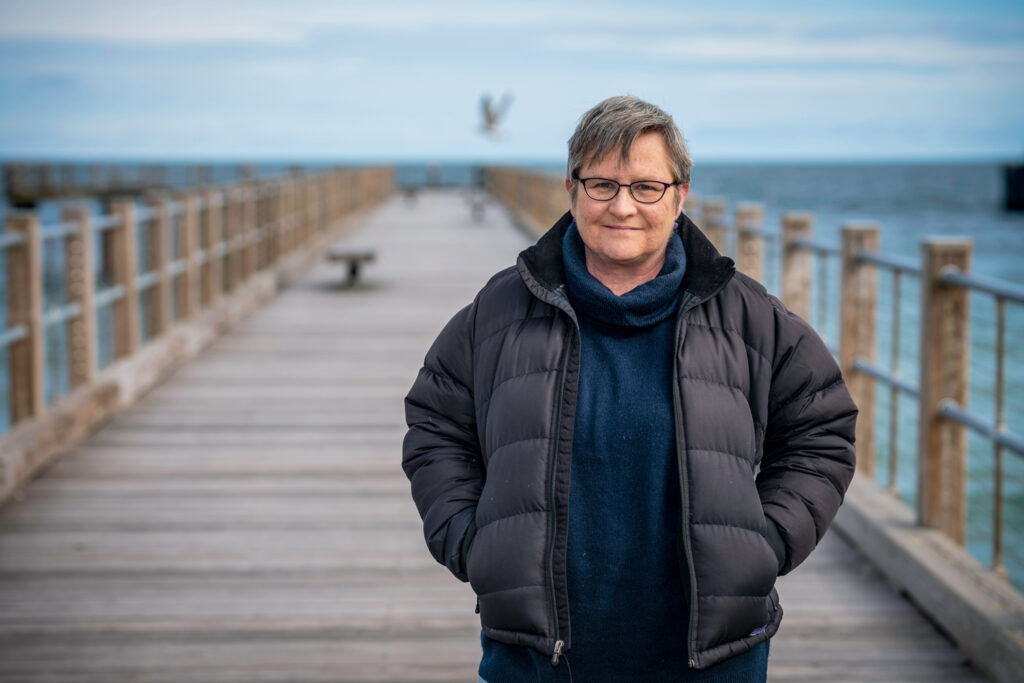
Credit: Jeremy Driesen
Credit: Ray Ewing/Vineyard Gazette
“We have these contradicting things that we’re trying to protect,” said Ben Robinson, an architect who grew up on the island and a member of the Martha’s Vineyard Commission (MVC), the regional planning agency. “There’s the economy and then there’s the environment of the island, and that can be a hard thing to reconcile—because we’re all eating and feeding our families and housing ourselves off that economy. But what does it mean to protect the economy, if we’re just giving it the ability to make more money by using more and more of the island’s resources?”
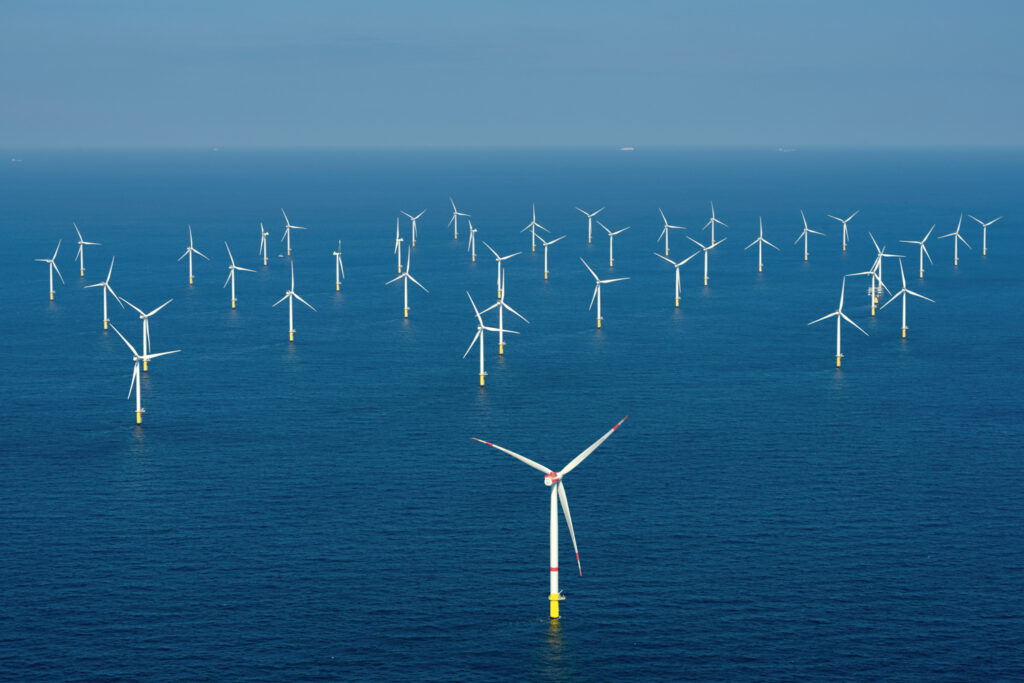
In light of such a question, the Vineyard has been spurred to confront not just climate issues but also how it contributes to them. Over the past few years, it’s become a hub for the development of the country’s first offshore wind farm, giving teeth to the Vineyard’s effort to eliminate the use of fossil fuels here by 2040—a full decade ahead of Massachusetts’s statewide initiative.
In addition, the MVC’s Climate Action Task Force, which guides island policy on resilience and adaptation projects, recently completed an ambitious plan for the next two decades. The product of more than 150 community sessions with the island’s six towns and the Wampanoag Tribe of Gay Head (Aquinnah), the lengthy document outlines a sweeping set of proposals on such things as biodiversity, land use, infrastructure, and food security. On an island so prized for its relationship to the ocean, delicate discussions have even begun about what it might mean to relocate houses and roads from some of the Vineyard’s most vulnerable coastal zones.
It’s not as though they have to look far to see what’s at stake.
As the 2022 Christmas storm unfolded, Edgartown’s Norton Point Beach took a beating. Stretching two and a half miles between the village center and Chappaquiddick, Norton is an important but fragile ribbon of sand that buffers the Katama Bay shoreline. In the few months leading up to the storm, however, the eastern end of the beach had eroded. Wash-overs and other small storms accelerated the process, putting further pressure on the Chappy bluffs that the beach protects.
Credit: Kristopher Rabasca for the MV Times
Credit: Dena Porter for the MV Times
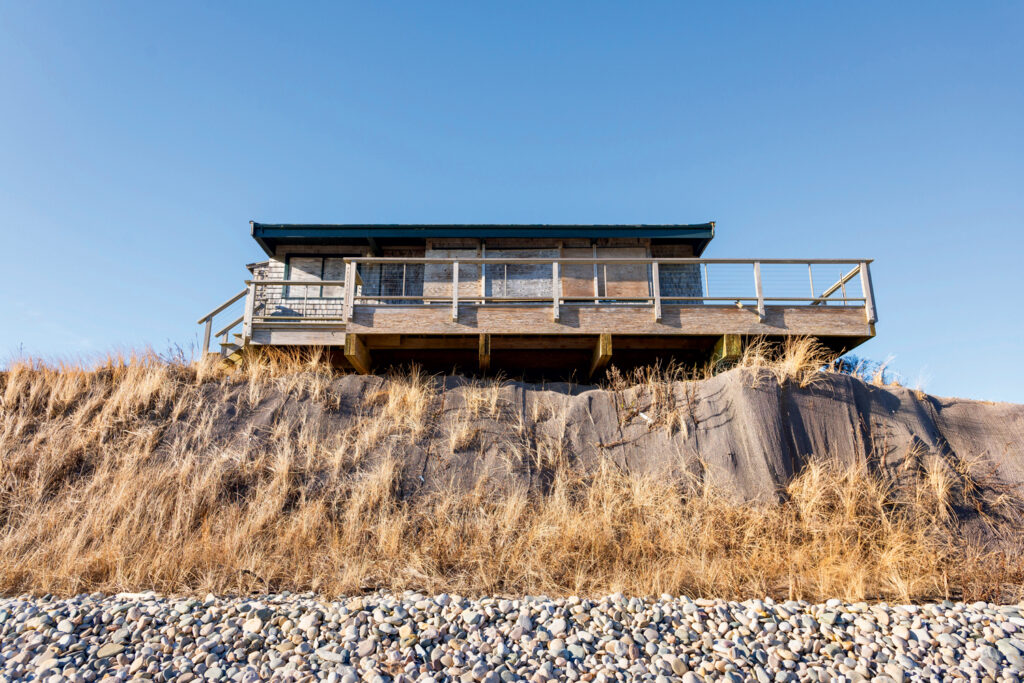
Near midnight on December 27, a breach erupted on Norton Point Beach, sending the open Atlantic rushing toward a portion of the Chappy coastline where the area’s only house sat. Over the next several weeks, the ocean pummeled the defenseless bluff, erasing the last vestiges of the 1,600 feet of land that had once separated the building from the water. By late January, the structure—a single-story building constructed in 1984—sat precariously at what was by then the cliff’s edge.
“If not this storm, then the next storm, or the next one,” Steve Elgar, a senior scientist at the Woods Hole Oceanographic Institution who has studied the area, said at the time. “Eventually it will happen. The [owners] are really nice people, but they built their house on a pile of sand. It’s a good reminder that [Martha’s Vineyard] was formed by glaciers 10,000 years ago…. [It’s] all sand.”
Just a few weeks later, the owners were forced to raze it.
* * * * *
Ten months before the Norton Point breach, I met with Liz Durkee for a tour of the island’s pressure points. As climate change coordinator for the MVC, she focuses on an array of issues—education, infrastructure, energy access, health and safety—that demonstrate how a changing climate affects far more than temperatures and storm activity.
“We’re not like just any coastal community dealing with rising seas. We’re an island—it’s rising all around us,” she said. “But it’s also not just about sea level rise. It’s getting hotter, we’re going to have more issues with supply chains, our health is going to be impacted. It’s all interconnected.”
Credit: Tom Buysee/Shutterstock
Durkee’s path to the Vineyard is a familiar one. A Long Island native, she summered with her family in Oak Bluffs, where her parents, like her grandparents before them, owned a house. After college she worked as a journalist in Washington, D.C., but the pull of the Vineyard and its ends-of-the-earth feel never left her. “I knew from the age of 7 this is where I wanted to be,” she said. In 1991, Durkee returned to the Vineyard to live year-round.
At the time, Martha’s Vineyard was approaching a critical turning point. Gone were the days when Durkee’s father had to explain to his New York friends where the Vineyard even was. Then, in late August 1993, President Clinton and his family visited the island for the first of several summer vacations there, with idyllic photos of their getaway appearing on the front pages of newspapers around the world. Other A-listers and an unending real estate boom soon followed.
Today, the Vineyard’s year-round population of 23,000 residents swells to 10 times that size in summer. Many of those arrivals are by ferry to Vineyard Haven, which is where Durkee met me to begin our tour. It was a mild April day, and the island resonated with the soundtrack of a community readying for another busy season. From the ferry terminal we made the short walk to Five Corners, a tangle of a traffic intersection that’s largely defined by uncertain drivers, the Black Dog Tavern, and an elevation barely above sea level.
“It’s a mess,” Durkee said. “You’ve got stormwater coming down [from areas above the intersection], and you’ve got the harbor on the other side. It’s always flooding when we have storms, but it’s also the only way to get to the ferry terminal.”
It’s also one of the major routes to the Martha’s Vineyard Hospital, a little more than a mile away. If the Vineyard has been lucky when it comes to big storms, that’s due to its position largely outside the paths of hurricanes that roll up the East Coast. Its last bout with a Category 4 storm was Hurricane Carol in 1954. And while Carol took a significant toll on the island, the damage that a similar weather event could inflict today, Durkee said, would dwarf that of 70 years ago.
Credit: Randi Baird
Durkee took us on a slow spin around the hospital. “It’s surrounded by a flood zone on three sides, and the fourth access point would be blocked during a hurricane. It’s a huge public safety issue,” she said, shaking her head. “It was rebuilt only two decades ago and there was talk about moving it, but they decided against it. They rebuilt it a little higher, so maybe the building will be safe—but how are you going to get to it? These are the things that can keep a person up at night.”
We then went to East Chop Drive in Oak Bluffs, a scenic route lined mainly with summer homes where a quarter-mile stretch of road has been closed since 2018 on account of erosion. Even with $13 million in state and federal grants that Durkee had helped secure, the town still needed to come up with nearly $11 million to rebuild the bluff and stabilize the road.
Would this be a permanent fix? Durkee doesn’t think so. “It’s not just for the people who have homes on the road—this is a drive that draws people,” she said. “But it’s buying time. At some point the road will breach, and the town will need to decide what to do. Is this an area it wants to keep up, or that it wants to retreat from? What do you give up to save the rest of it?”
From there, we paid a visit to the fishing pier in Menemsha, one of the country’s few remaining public docks where commercial fishermen have free access to the water. Plans to raise the aging structure—forecasted to be underwater as much as twice a week by 2050 due to rising sea levels—have recently begun. At nearby Squibnocket Beach in Chilmark, we saw where erosion forced the relocation of the public parking lot. In downtown Edgartown, Durkee pointed out the Edgartown Yacht Club, which in 2019 raised its building by two feet, and Memorial Wharf, which has started doing the same.
Credit: Joshua Robinson-White
One of our final stops came on the outskirts of West Tisbury, where we followed a narrow dirt road that abruptly ended with a roped-off section and a “Keep Out” sign that blocked a public parking area—or what was left of it. As we stepped out of the car, a woman emerged from a nearby house and marched toward us.
“You can’t go down there,” Rae Ann Mandell called out. “It’s closed for a reason. It’s very dangerous. The land is unstable. People come out here to rubberneck, and one of these days it’s just going to go.”
After Durkee identified herself, Mandell’s tone softened, and she offered to lead us on a careful tour of the compromised area. It looked like a war zone: cliff faces sheared off, the wreckage of a wooden staircase on the beach, twisted and turned on its side. “We used to spend a couple thousand dollars a year to fix things here and there, but in the 2010s we started getting major damage.” She took a long breath. “And now we’re here.”
Mandell invited us into her home, a rambling shingled house she and her husband, Sam, built two decades before to replace a smaller dwelling that had sat closer to the bluff. She opened photo albums and narrated a brief history of the property. Early pictures of the old house. Her and Sam’s wedding in 1966. Their three kids. A backyard that once extended farther than it does today.
The Mandells’ house seemed safe for now—but were they worried?
Sam waved off the question. “There’s been a lot of erosion, but it comes in fits and starts,” he said. “I’d say there’s another 100 years before there’s a real problem. I have no concerns.”
After all, he added, “We’ll be dead.”
* * * * *
In a curious way, though, the climate crisis has presented Martha’s Vineyard with another inflection point. How the coming years are managed may once again remake the island’s identity.
With a median home price now sitting at $1.45 million, the Vineyard’s soaring real estate values have put a squeeze on housing availability. There’s been no shortage of development, but much of that has centered on second homes and short-term rentals. The building boom has simultaneously raised the stakes for local conservation efforts on the Vineyard, where for every acre of land conserved, another three get developed.
As a consequence, islanders have been spurred to take action. Aquinnah voters last year gave the green light to banning fossil-fuel systems in new construction, and in 2021 voters in West Tisbury overwhelmingly approved restricting of the size of future houses. The MVC is now collaborating with the Army Corps of Engineers on the island’s most comprehensive study to date of its resource and infrastructure demands, the results of which could motivate communities to consider other environmentally driven regulations.
Credit: Sam Moore
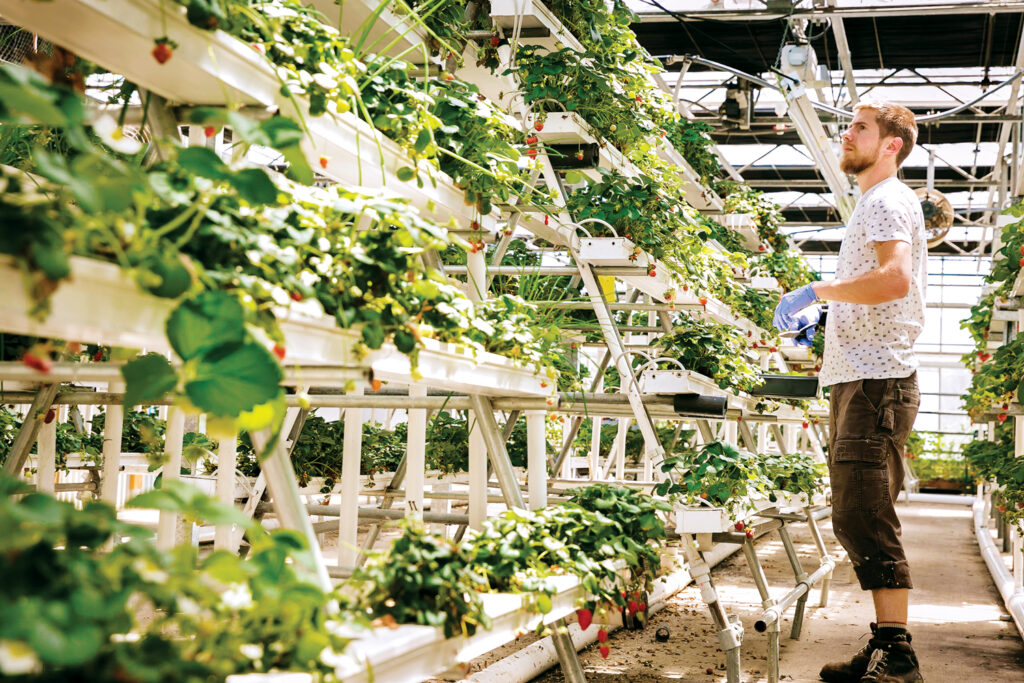
But it’s not just about drawing up new rules. In Vineyard Haven, the nonprofit Island Grown Initiative (IGI) has turned a 42-acre farm into a robust agricultural lab of no-till farming, hydroponics, and futuristic LED pods that can grow greens year-round. IGI reaches into the community, too, helping establish gardens at Vineyard schools and regularly hosting tours and learning sessions at its farm.
As Durkee described it, “This is a chance to see different opportunities—to make things better and create more local jobs as we try to green the economy.”
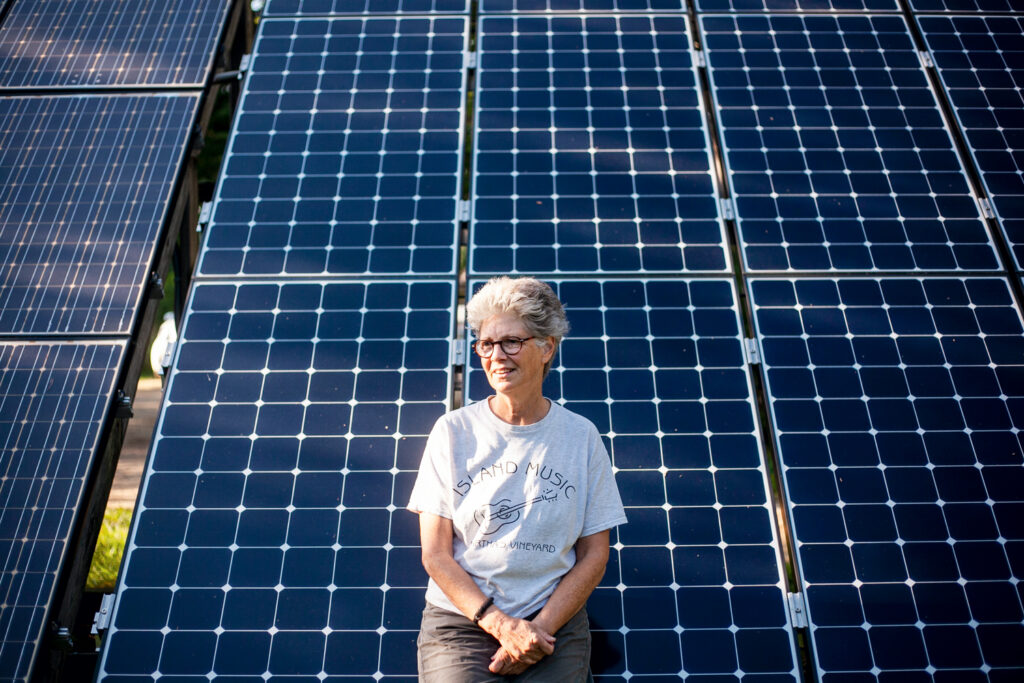
An even bigger example of that was on display at a groundbreaking by the water last May in downtown Vineyard Haven. The push to get the Vineyard completely off fossil fuels in the next 16 years may sound idealistic, but it’s had traction. Solar now accounts for 9 percent of the island’s energy use; in the past three years alone, nearly 1,200 arrays have been installed across the Vineyard. The real difference-maker, however, may be found in the waters of Nantucket Sound.
The dream of tapping into the power of ocean wind is not new. The much-ballyhooed Cape Wind Project—which would have been the nation’s first-ever offshore wind farm—made headlines when it launched in 2001 … and then made many more as it stumbled to its demise more than a decade later under a crush of local opposition. In its wake, wind developers turned their focus to a more remote stretch of federal waters; last fall, Vineyard Wind installed the first of its 62 turbines, each of which will rise more than 800 feet above the water in an area 15 miles south of the island. As the first commercial offshore wind farm in the country, it’s a linchpin in the Biden administration’s pledge to build 30,000 megawatts of offshore wind over the next decade. At full strength, it will produce as much as 800 megawatts of energy on its own, or enough power to light up some 400,000 Massachusetts homes and businesses.
Vineyard Wind’s $4 billion price tag was covered by federal subsidies, tax credits, and international backing (the project is a joint effort between Avangrid Renewables, a U.S. subsidiary of a Spanish utility, and Copenhagen Infrastructure Partners, a Danish investment firm). But the project owes its existence in no small part to Vineyard Power, a local energy cooperative that has spent more than a decade laying the groundwork for the development of large-scale renewable energy projects. And that, according to Vineyard Power president Richard Andre, means wind.
“That’s what we have here,” he told me. “In other parts of the country, like Arizona, it’s solar, but in the Northeast, the way we can get off all fossil fuels and into renewables is through offshore wind.”
The groundbreaking in Vineyard Haven last May was for a new marine terminal. By the end of the year, docks would extend from the lot, anchoring the daily commute of turbine techs and supplies to the wind farm. Against a backdrop of construction pylons, a massive crane, and the harbor gleamed the promise of the future: an artist’s rendering of the new terminal and its transport vessels. Photographers angled for shots, while politicians and Vineyard Wind officials received rounds of applause.
Beyond all the “greening the grid” and “trailblazing” talk, however, was the project’s other point of celebration: its boost to the local economy. It’s expected that Vineyard Wind will create 90 new positions, from turbine techs to administrative staff to ship crews, many with salaries north of $80,000 a year. Stable jobs outside the tourist economy, the argument went, are also important in the Vineyard’s ability to contend with climate change.
“One of the things we need to do is create a 21st-century economy,” Andre said. “Having an economy that is so touristy and so seasonal puts stress on other parts of life here. It stresses housing, it puts a stress on people who need to make most of their money for the year in 10 weeks. Good jobs go away, and locals get pushed out. So this isn’t just about addressing climate change. We’re also addressing economic resiliency so that people can still move here, buy a house, start a family.”
In its deal with Vineyard Wind, Andre’s cooperative also subsidized other tools to contend with climate change on the island—most notably, new battery and solar backups at critical facilities such as schools and municipal buildings.
“We can be a model for other communities,” Andre said. “There can be an ecotourism part of this, where people can come and see how we’re doing things. There’s a real hunger for this. It’s obvious. Loads of communities want to do this kind of thing, but they just don’t know how. Maybe we can show them.”
* * * * *
Every April, the Wampanoag Tribe of Gay Head hosts a planting day at Lobsterville Beach on Aquinnah’s north shore. Stretching some two miles along Vineyard Sound with direct views of Menemsha across the channel, Lobsterville carries an importance for the native community that spans most of the estimated 10,000 years the tribe has called the island home. Its waters have long run with striped bass and bonito, while the lands behind it are home to one of the last remaining stretches of naturally occurring cranberry bog in the state.
In the words of former tribal chairman Tobias Vanderhoop, the concept of land ownership was very different for his Wampanoag ancestors. “We call these the common lands because they were particular areas [that] were held in common and the resources were available to anyone who needed to avail themselves of those resources.”
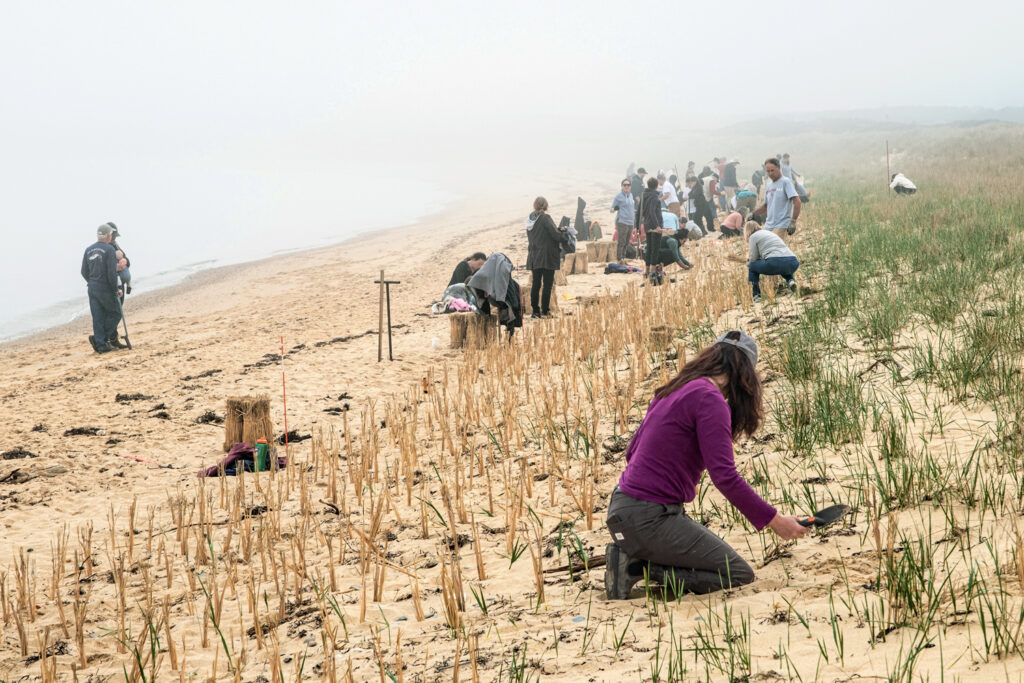
The planting day on Lobsterville Beach is no mere symbolic event. In 2012, Superstorm Sandy ravaged the dunes and parts of the paved road that runs alongside the water, leaving a diminished, rocky beachscape in its wake. For the recovery effort, 65,000 cubic yards of sand dredged from Menemsha Harbor were pumped onto the shoreline. Then the work began to stabilize the new beach. In 2016, Aquinnah hosted its first planting volunteers.
Since then, the vitality of the beach has grown alongside the popularity of the event. Last year 75 volunteers turned out to plant more than 20,000 strands of American beach grass into the sand. The group was a cross-section of the island: parents with young children, a few early summer residents, retirees, and tribal elders and their younger counterparts. There was a social quality to it (the free coffee and doughnuts didn’t hurt), and for some the morning also served as a catching-up time after the long winter.
Before the planting began, the tribe’s historic preservation officer, Bettina Washington, asked the volunteers to form a large group and hold hands with their neighbors. Then she led them in prayer and gave thanks for the day. There was a certain solemnness in the air as Washington spoke. Kids stood still. A nearby woman teared up.
When it was time to work, volunteers paired off and grabbed their bundles of grass. “I’m out here fly fishing a lot,” Dave, an older man from Edgartown, told me. “I had an amazing year last year, and this is my way of giving back.” He walked about 100 feet onto the beach and started planting. Soon, he paused to look around. “Makes you appreciate what we have a little more when you do this.”
The plants themselves didn’t look like much: pale brown and dainty, even fragile. But their slight appearance belied their power, according to Andrew Jacobs, manager of the Wampanoag Environmental Laboratory. “[Beach grass] is doing a couple of different important things,” he said. “The stem comes up and stops the sand from being windswept through. Below, it starts to grow sideways and in every other direction to create this incredible matrix with the neighboring plants.” He pointed to a nearby dune that stood a good six feet high. “That’s a direct result of the fruits of our labor. That dune built up because of the planting we did there a few years ago.”
But there will be more storms—some likely even worse than Sandy—putting at risk not just Aquinnah’s low-lying areas like Lobsterville, but also food crops, important Wampanoag archeological sites, and cultural resources. Continued development, meanwhile, has already fractured the area’s open spaces and leached nitrogen into its freshwater ponds. For the Wampanoag, a community so closely aligned with tradition and a relationship to the land, climate change poses yet another in a long line of existential threats they’ve had to navigate.
“You look around and you see how much has already changed,” tribal elder Kristina Hook told me. “There are areas I can’t go to anymore, like I did when I was growing up. There’s water I can’t drink. I look at some of these houses that go up, and I just don’t get it. If what you want to do is look over Menemsha Pond with a fire going, do you really need six bedrooms?
“It might sound like sour grapes but it isn’t. We know this land has got its limits and we aren’t acknowledging that. And climate change is just making it go faster.”
* * * * *
Writing about her adopted home in her 1973 book No Island Is an Island, the author and environmentalist Ann W. Simon foresaw many of the looming challenges that Martha’s Vineyard now faces. Change was embedded in the island’s earliest sand deposits, she noted, but the pace and turbulence of the next period of change was up to us. And as the Vineyard went, so would the rest of the country.
“An intelligent solution to the Vineyard’s acute problems will hearten the nation, its extinction as an entity will lose us a chance that will not come again,” she wrote. “Martha’s Vineyard is not just another place, ripe for ravaging, but a unique national treasure…. It is, in fact, the only place in all of New England where the ceaseless interaction between the land and sea can be demonstrated for the past one hundred million years. The island has been a lush primeval forest, a submerged ocean floor, rising from the sea in some ancient eras to support the dinosaurs of the time, or to become a great plain where small camels wandered, then covered again by waters. Each period leaves its mark in the material of the Vineyard’s clay beds.”
In the more than half a century since, however, it’s become more complicated than even Simon could have imagined. Maybe the Vineyard does set an example. Maybe solar arrays, offshore wind, and electric cars proliferate. Maybe there is a managed retreat from its most vulnerable coastal areas. But it’s a big world out there. There are other communities that can’t—or just flatly refuse to—recognize the urgency that is being felt by the Vineyard. In the end, the island may do everything it needs to do and it could still suffer great harm.
You’ve seen the headlines: In 2022, an ice shelf the size of Los Angeles disintegrated in East Antarctica. Last year, Canadian wildfires burned more than 25 million acres, turning the sky orange, and in late July, our planet hit its highest average temperatures in recorded history. Even the relatively stable region of New England has shown its fragility, with the Gulf of Maine ranking as the fastest-warming waters in the world and Vermont suffering extreme flooding for the second time in 12 years last summer.
But this race against climate change doesn’t have a finish line—and may not even follow a straight path. Perhaps no Vineyard resident knows this better than Kate Warner. A retired architect who has called the island home for nearly four decades, Warner lives in a tidy house she built in West Tisbury with grounds that are adorned with raised garden beds and an ample solar array. In the early 1990s, her house was the first on the Vineyard to incorporate solar electricity, and in 1995 she brought the first electric car to the island.
“I told my [architecture] clients if they wanted to build a house with me, they needed to put in solar,” she told me. “These weren’t their primary homes, and I felt they needed to give something back to the planet for the gift of having a second or even a third house.”
She laughed. “That didn’t prove to be too popular.”
So Warner left her architecture career to devote herself full-time to renewable energy development. She started her own business, which used U.S. Department of Energy grants to install the first 100 solar setups on the island. In the early 2000s, Warner founded the Vineyard Energy Project, a nonprofit solar education group that offered workshops to builders, school groups, and others; its work eventually led to the development of Vineyard Power. Under her direction, high-profile solar installations went in at sites including the Aquinnah cliffs, the Chilmark Community Center, and the West Tisbury School. For 10 years, Warner poured every part of herself into the work. Until she couldn’t.
“I realized it was the greatest environmental challenge before us,” she said. “And I thought people were going to join me because here we are, this low-lying community, the seas are going to rise around us, people will understand the concern. But I remember this guy came up to me in Vineyard Haven. He said, ‘I was just in Boston and it didn’t look like any seas were rising there.’ What could I say? Eventually I burned out and I had to step away.”
That was in 2008. Then, a decade later, on what she describes as a whim, Warner attended a climate-change meeting in her hometown. That first meeting led to another, and another. She rejoined the West Tisbury Energy Committee, then became its chair. A little became a lot again.
Now a member of the island’s Climate Action Task Force, she was tapped in late 2022 by the MVC to fill a new position: regional energy planner. Today she’s on the front lines of the island’s most ambitious energy-related pursuits, such as advocating that the Steamship Authority ferry operator convert its vessels from diesel to battery power.
What changed? The time off certainly helped, said Warner, but she also sees an island that is committed to fighting climate change in a way it wasn’t ready for two decades ago.
“There’s more of a community that’s involved in this than before, working on all these different fronts, and that’s encouraging,” she said. “Because it’s hard to stay optimistic about this when you look at where things might be headed. I’m frightened—climate change is happening a lot faster than we thought it would. But you have to keep trying. You need a big group, and I feel like we have that right now.”