The Hardest Deadline
When horrific violence came to a small New Hampshire town, the staff of the weekly newspaper had to somehow get the issue out and let the community know what had happened, even though their editor and close friends were dead.
By Richard Adams Carey|Jul 02 2018|

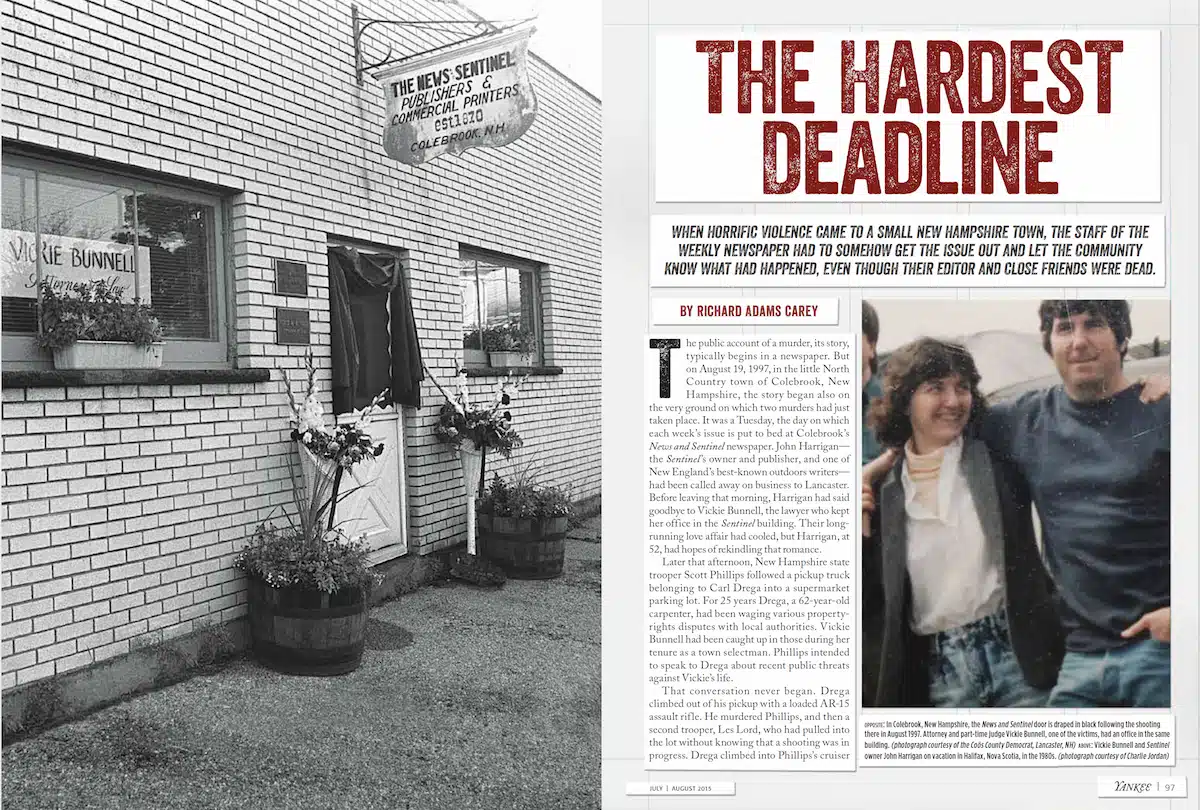
This article originally appeared in the July/August 2015 issue of Yankee.
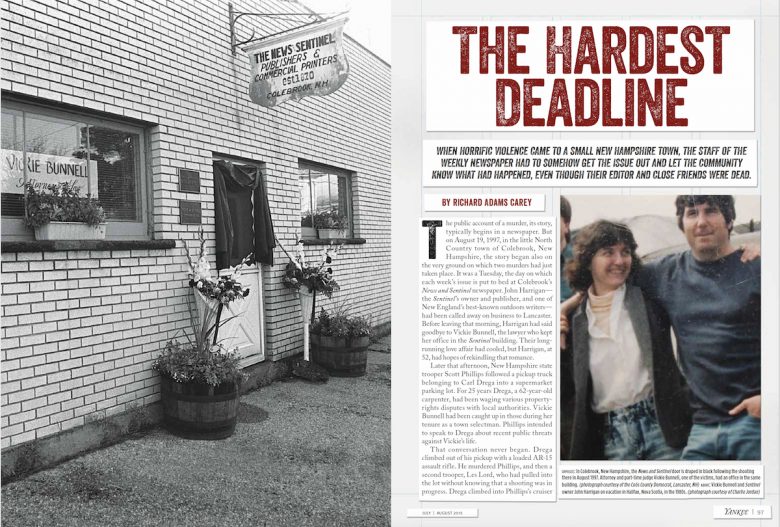
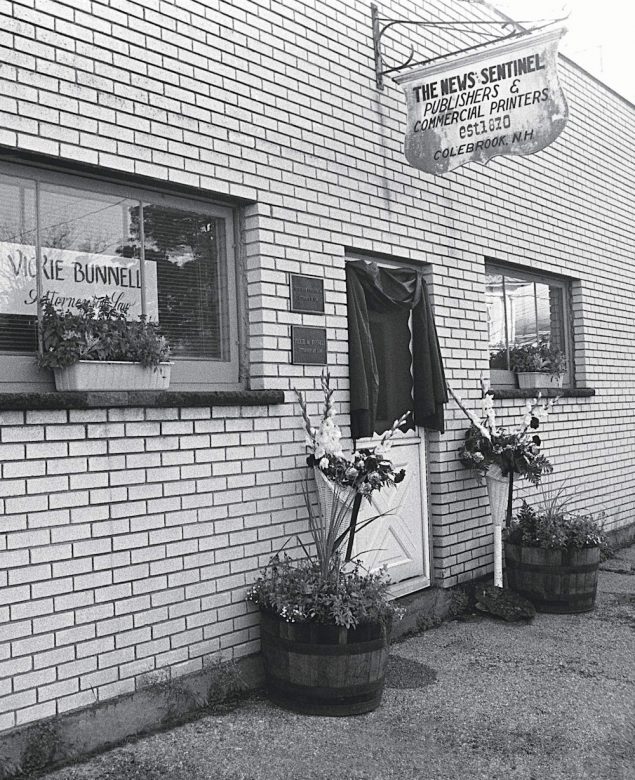
The public account of a murder, its story, typically begins in a newspaper. But on August 19, 1997, in the little North Country town of Colebrook, New Hampshire, the story began also on the very ground on which two murders had just taken place. It was a Tuesday, the day on which each week’s issue is put to bed at Colebrook’s News and Sentinel newspaper. John Harrigan—the Sentinel’s owner and publisher, and one of New England’s best-known outdoors writers—had been called away on business to Lancaster. Before leaving that morning, Harrigan had said goodbye to Vickie Bunnell, the lawyer who kept her office in the Sentinel building. Their long-running love affair had cooled, but Harrigan, at 52, had hopes of rekindling that romance.
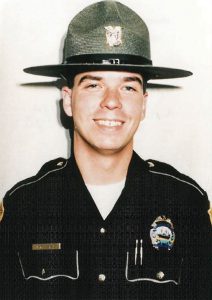
Later that afternoon, New Hampshire state trooper Scott Phillips followed a pickup truck belonging to Carl Drega into a supermarket parking lot. For 25 years Drega, a 62-year-old carpenter, had been waging various property-rights disputes with local authorities. Vickie Bunnell had been caught up in those during her tenure as a town selectman. Phillips intended to speak to Drega about recent public threats against Vickie’s life.
That conversation never began. Drega climbed out of his pickup with a loaded AR-15 assault rifle. He murdered Phillips, and then a second trooper, Les Lord, who had pulled into the lot without knowing that a shooting was in progress. Drega climbed into Phillips’s cruiser and drove to the News and Sentinel. There he shot and killed not only Vickie but also Sentinel editor Dennis Joos. A pacifist and former Franciscan novice, Joos had tackled Drega in a vain attempt to wrest the rifle away from him. Then Drega fled into the Vermont woods. He would die that evening in a shootout with police.
Harrigan arrived half an hour after the murders to find the woman he loved still lying in the parking lot behind the building. Joos had been taken to a hospital, and had died there. Members of the newspaper staff—dazed, incredulous, grieving—had lingered. Charlie Jordan, a fellow journalist and friend to Harrigan, had been at the Colebrook public library when he heard gunfire from across the street. He arrived at the scene just after Drega had fled, and had taken photos of the shooting’s aftermath.
Harrigan didn’t know if it was grief, rage, or the newspaper ink running in his veins that shook him out of his own daze when Jordan said, “I’ve got pictures.” The Sentinel was due out on the street the next morning. The issue they had prepared would have to be blown up and redone. Would that be possible in one night, in the midst of this very crime scene, with a shell-shocked skeleton staff? Harrigan deputized Jordan as editor in Joos’s place and asked him to collect people for a meeting. The story would begin at ground zero.
Credit: Courtesy of the Coos County Democrat, Lancaster, NH
—
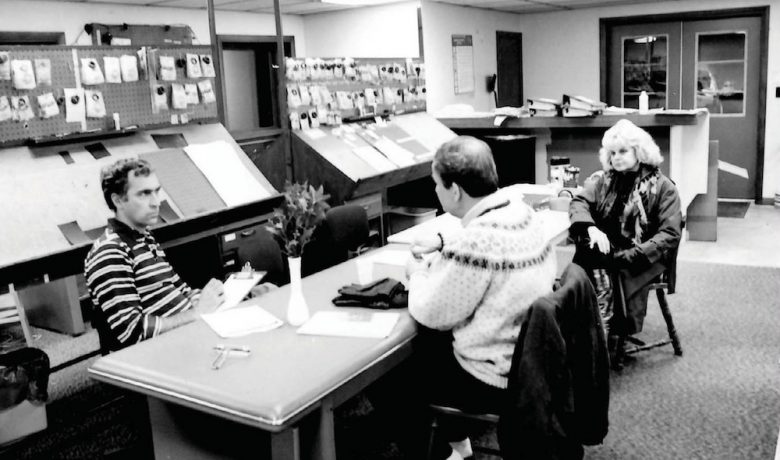
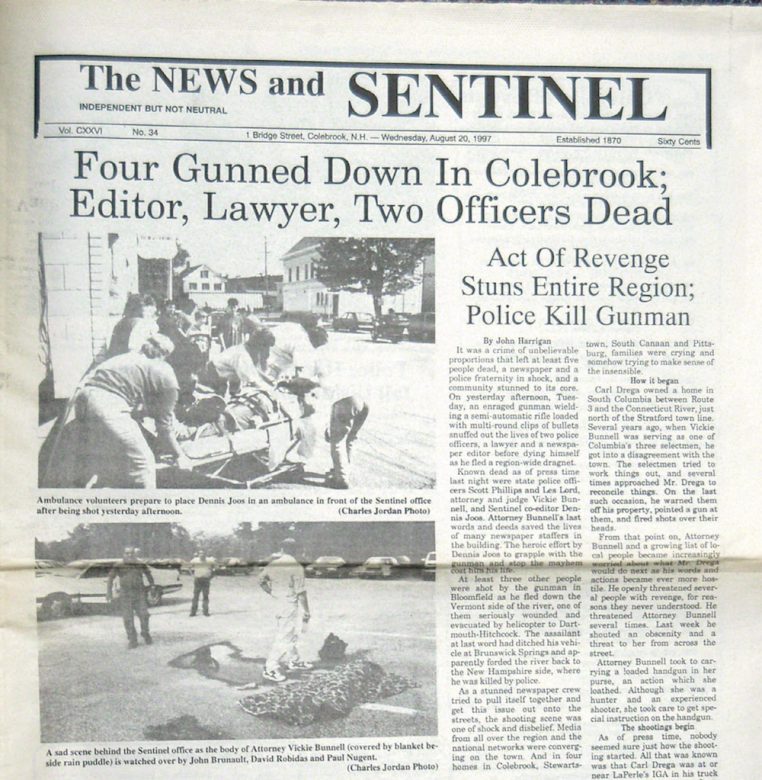
John Harrigan stood in the newsroom of the News and Sentinel with the newspaper’s pasteboards, cross-hatched with the stories originally planned for tomorrow’s edition, reared up behind him. “This is what we do,” he said.
It was somewhere around 4:30 p.m. Charlie Jordan and Sentinel photographer Leith Jones were in the darkroom watching—with the hair prickling on the backs of their necks—the prints of Charlie’s black-and-white photos rise like fever dreams out of their chemical baths.
Kenn Stransky, the Sentinel court reporter in Vermont’s Essex County, had been posted to the front door to answer the phones and keep the out-of-town reporters from bursting in. Ad designer Chandra Coviello had fled straight home after taking shelter next door in Ducret’s Sporting Goods. Reporter Claire Lynch said she had gotten a phone call from Jana Riley, who ran the front desk. Jana was safe with some friends at a hair salon on Main Street, Claire said, but she wasn’t coming back. And co-editor Susan Zizza had gone to Dennis’s home in Stewartstown to tell his wife, Polly, what had happened.
The rest, for whatever reason, had not left, and were still here—now ranged around John in chairs at the press table or in front of the desks that lined the room: Claire, shivering as she recalled the forebodings that had haunted her that morning; compositor Jeannette Ellingwood, an exuberant woman in her seventies who had no truck with forebodings, who had been blindsided today like the rest; the gentle typesetter Vivien Towle, who was being held up, almost literally, by her boyfriend, Monty Montplaiser, an off-duty U.S. Customs officer; and the courtly bookkeeper Gil Short, who had no bookkeeping to do, but who couldn’t find it in himself to walk out the door just then.
No one sat in the empty chair before Dennis’s desk. “We’ve lost him,” John had said a moment before. He had learned as much from a nurse at the Upper Connecticut Valley Hospital. Kenn Stransky, just back from the hospital, also knew that, and by then had whispered the news to Claire and Gil. The announcement struck the rest like one more lash of a whip.
Credit: Courtesy of Charlie Jordan
John sighed and groped for the right words in getting around to what he really wanted to say. Eventually he found phrases to the effect that state troopers and municipal cops, emergency-room doctors and EMTs, all shared something in common with journalists: They had to be there, sometimes, at the worst moments in people’s lives. And sometimes those suffering people—especially in a small town—were colleagues, near neighbors, family members: “People you know, people you love.”
A muttered curse—or was it a moan?—came from the darkroom. Claire couldn’t tell if it was Leith or Charlie. John looked down at the floor, rubbed his eyes. “But, you know, they keep doing their jobs,” he said. “They’re dying inside, but they keep at it. And today it’s been our turn for something like that. And reporting—yeah, this is what we do.”
John knew that every daily in the Northeast had someone out on Bridge Street, or on their way there. He knew that down at the Coös County Democrat, Gene Ehlert, with his bigger staff, was dispatching reporters to the IGA, to Bloomfield, to Drega’s house, to wherever else the story had gone—as John would want him to. In an industry where the reporting done by weekly newspapers was often discounted, even held in contempt, at least one of John’s weeklies would have a good accounting of a story that involved the gunshot murder of a weekly’s editor. This paper, though, the one robbed of that editor, was uniquely positioned, an industry analyst might say, to tell the story. Or was it just the grief that John wanted to scream aloud?
Claire remembered how exasperated John usually got when a big story broke on Tuesday afternoon, on press day. Well, there are big stories, and then there are nuclear bombs. Jeannette was biting her lower lip, trying to keep from breaking into pieces in her seat.
“I don’t know—it’s like a meteor dropped on us from outer space,” John said. “But some of us are still standing, crawling out of the crater—to tell the story, to say what happened and write down who these people, these friends of ours, were. Well, okay—that’s all I’ve got. What do you think?”
—
“You know how to do paste-up?” Jeannette Ellingwood was speaking to Charlie Jordan as if she had just learned he could speak Aramaic.
“I do,” Charlie said. “So where exactly are you in the process here?”
Jeannette and most of the other staffers didn’t know Charlie, had no idea he had once worked for John at the Democrat. Now he’d been deputized as this newspaper’s acting editor while John locked himself away to write the feature story and a new editorial.
“Just give me an hour,” John had told him. “When you tear up the front page, leave a couple of Claire’s stories there, about a third of the page—I don’t want the whole front page to be about this. And you can rip all the sports stories. We’ll need that space for jump pages for the feature.”
Jeannette took Charlie through the finished content in the newsroom, the stories printed in two-inch columns and cut into long strips by Jeannette’s scissors or X-Acto knife, then run through the roller of the hot-wax machine, then pressed with a burnishing roller onto the pasteboards. Now it would be Charlie’s task to cut all this into pieces and puzzle the stories and graphics on to sticky art boards, each of which would be one page of the newspaper. Twenty-four art boards made a complete issue, what was called a mechanical. That, and photo negatives taken by Leith Jones of each board, would go this very night to John’s Coös Junction Press in Lancaster, where the image of each page would be etched into an aluminum roller and printed.
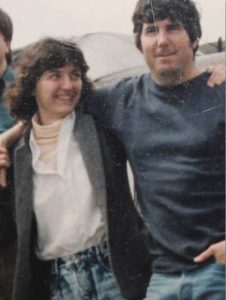
owner John Harrigan on vacation in Halifax, Nova Scotia, in the 1980s.
Credit: Courtesy of Charlie Jordan
Charlie saw that the original content of the issue had been nearing completion: features, the editorial, letters to the editor, the locals, obituaries, sports. He noticed the headline piece among the features, a story by Dennis about the town manager’s resignation. Big news until this afternoon, Charlie thought. He’d keep it, but he’d have to move it back to page three or five. Page four would be staked out as usual for John’s editorial and readers’ letters.
Also among the features was Dennis’s piece about the lost 45th parallel sign that Charlie and his wife had found in an outbuilding at the Lancaster Historical Society. “It’s nice to be in the middle of things, and Clarksville is once again taking note of its place in the center of the Northern Hemisphere,” Dennis had written. “Last week Charlie and Donna Jordan erected an original 45th parallel sign on Route 145 near the old Clarksville School.” Charlie and Donna had lived in that school building for years, had made a good house out of it. Charlie remembered the day Dennis had knocked on its door in 1975. Dennis had just written a profile of J. C. Kenneth Poore, a 90-year-old hill farmer who had also done some newspaper work. Poore was of the opinion that any young writer should go meet Charlie, who was publishing pieces in Yankee Magazine then. Dennis and Charlie became friends. Two decades later, Dennis had loved the feel-good quirkiness of this 45th parallel story. Now Charlie had to finish it for him.
The Colebrook police log, assembled by Claire, had a sweet poignancy to it: a car off the road on Vermont 102 after it swerved for a deer, for example, or the theft of a picnic table from the Route 3 rest area. That was what they’d had to worry about yesterday.
Charlie saw in the obituaries that a joint memorial service for Dr. Herbert Gifford and Dr. Marjorie Parsons—Doc Gifford and Parsie, husband and wife, physicians to the whole town—was planned for Saturday afternoon at the Colebrook Village Cemetery. Most likely the family would want to postpone that; Charlie would have to check. Many of the ads in the newspaper had to do with sales, offers, or events connected to the Moose Festival next week. What the hell was the town going to do about that?
And what about the photos to accompany John’s lead story? Leith was still in the darkroom, hanging wet prints on clothesline strung from the ceiling. Charlie would have to talk to John about which ones to use. That would be a tough call.
Claire had run out the door to learn what else had happened. Jeannette and Vivien—with pitch-in help from Leith, Gil, and Monty—were proofing, printing, and waxing whatever hadn’t made it to the pasteboards yet. Charlie went back to where the features were posted, to what would have been the front page. He stood where people had run for their lives two hours before and went to work, pulling columns of text off the boards.
—
Kenn Stransky never saw the Sentinel’s newsroom that night because the three telephone lines at Jana Riley’s desk were constantly lit up. “When reporters called, I tried to keep my statements down to thirty seconds,” he said later. “I told them as much as I knew was true from what people at the Sentinel had told me, what Claire was finding out on her trips back and forth between us and Town Hall and the police department, and what was coming over the scanner.”
One call came from a TV station in Texas. The voice on the line said, “Hold on just a minute while I get somebody to talk to you.”
“Sorry, I don’t have even a minute,” Kenn said. “If you want any information, it’s now or never.”
Kenn wasn’t surprised that the calls were coming from all over the country, given that in this event “all three points of the triangle,” he said, were represented in terms of people whom civil societies most need to protect: cops, judges, and journalists. Of course a lot of the calls were local. Many thought that the editor killed at the Sentinel had been John Harrigan. Some wanted to talk to John, but that wasn’t possible.
John was in and out of his office, but not taking calls. Twice he went to see Vickie’s parents, who were at their son Earl’s house, just down the street. Both times he paused to talk to the out-of-town reporters outside the building, all of whom were barred from entering while John’s staff was at work. Otherwise the reporters made do with Kenn’s periodic updates. John went back to the newsroom once to see how production was going, and disappeared once into the darkroom with Charlie Jordan. But his instructions to Kenn were explicit: no calls unless it was from his daughter Karen, who was driving up from Newmarket in southern New Hampshire.
Credit: Courtesy of NH Department of Safety
That meant even the Union Leader, the state’s biggest daily. “The publisher down there called,” Kenn said. “He was not polite, and he demanded to speak to John. I said, ‘You’re obviously not his daughter,’ and hung up on him. He called right back, reamed me out, and I hung up again.”
The Union Leader was granted favors, though. There were photos that Charlie Jordan had already agreed to share. Then the Union Leader’s North Country correspondent, and only she, was allowed into the building to take some shots of Charlie doing paste-up, to ask a few questions.
She didn’t see John, though, and neither did New Hampshire Attorney General Philip McLaughlin when he visited at 6:00 with several other state officials and Colebrook police chief Mike Sielicki. They came in through the rear door, lingered for five minutes, and left through the back again. They paused in the parking lot where Vickie still lay where she had fallen, covered by a blanket within the lot’s perimeter of yellow tape.

Credit: Courtesy of NH Department of Safety
For the most part, John’s improvised staff was disturbed only by the lingering presence of Vickie beneath that blanket. “It was sad—and unsettling,” Kenn said. “We’re all saying that they’ve got to do something with that body. Somebody told me that there were a lot of crime scenes, a lot of bodies, and that it was just going to take time before the Crime Lab people could get here from Concord and take care of all the stuff like that. We tried not to think about it, but that was hard, too.”
Calls came from householders around the region, from people who said they were watching this on TV, and Kenn realized that things were different from when he’d moved to the North Country from New York City in 1993, when on a clear day he might pull in one network channel on his aerial antenna, when he’d had to ask his parents in Kansas to tape and mail him episodes of Melrose Place. “Now, via CNN and WMUR and all these satellite dishes,” he said, “this terror was being beamed into every home out there, or a good number of them.”
Kenn would leave journalism in 1998, but that night, while he was still a reporter, he wept with other reporters. “I was outside at one point, talking to the press, and I saw an AP reporter from Concord with tears running down her face, and that’s when I lost it as well,” he said. “It was one of those weird moments, when suddenly it smacks you in the head that we’re all in this together. It happened again the next morning. I was being interviewed by Fredricka Whitfield of CNN—I’d watched her for years on TV in New York—and she was crying, and again I felt this, I don’t know, blood-brother connection to other people in the media, and through Fredricka to people all over the country.”
—
John Harrigan and Charlie Jordan had wrestled with this before when they had worked together at the Democrat: how to choose photographs—of a motor vehicle accident, say—that honestly told a shocking story without being in and of themselves shocking. It was always hard, but never so hard as this.
In the green, ashen light of the darkroom, John—who had already rejected a dozen images—stared at a photo of Dennis, his friend and editor, whose face was obscured, strapped into a gurney and being wheeled by several people to the curb of Bridge Street as a pair of EMTs bent over him. In the background were the hanging sign for the News and Sentinel, a parked car on the street, Collins’s camera shop on the corner of Main, and a motorcyclist heading unperturbed for the intersection. Dennis had only moments to live, and the episode seemed to unfold against a museum diorama. “Well, okay, we’ll use this one,” John said.
“You think it’s okay?” Charlie asked.
“I don’t know. I don’t know—I think so.”
“So just one photo on the front page?”
John shook his head. “I don’t know about that either. That would suggest Dennis was the only victim—or the more important victim.”
But the photos of Vickie were more problematic. Charlie had waited until she was covered, but even so … “Maybe this one?” Charlie said.
In black-and-white, the camo-pattern blanket that Dave Robidas had laid over Vickie looked like leopard skin. Paul Nugent was standing over the body and looking back over his shoulder at Robidas and John Brunault, both of whom stood stunned, fifteen or twenty feet distant. The pool of blood that trailed toward Brunault seemed to reflect his face and shoulders.
John was straining at the seams as he looked at this, and Charlie was suffering as well. “People need to see what happened,” Charlie said eventually. “They need to see what it looked like, at least in some way. It’s part of the story.”
“Yeah—I suppose.”
“And, you know, the story in these photos, either one of them, isn’t people dying—it’s people helping, or trying to help. Doing their best.”
John sucked in a long, empty breath. “Okay—we’ll use this one. Yeah, okay.”
They went on to pick out photos to send to the Union Leader, but they chose to share none of Vickie with the Union Leader or any other press organization. That part of the story was just for Colebrook.
—
Late that afternoon, John Harrigan nearly got arrested—along with everybody else in the Sentinel building.
State police corporal Scott Champagne was in an unmarked car and doing undercover narcotics work in Littleton—specifically, trailing a suspected pot dealer. Then Champagne got a call on his cell phone ordering him to Colebrook to secure crime scenes at both the IGA supermarket and the News and Sentinel.
Champagne arrived on Bridge Street as Norm Brown, director of the Coös County jail, and some civilians were stringing tape around the area. He went on to the IGA, where a state trooper was interviewing witnesses and a Colebrook cop was keeping a log. So that scene was already secure. Champagne returned to the Sentinel.
With his badge and ID on a chain around his neck, and bitter about not being part of the manhunt, Champagne began taking photos of the scene—and stopped short when Brown showed him five bullet casings scattered like cigarette butts near the back door of the building. “So shots were fired right here,” Champagne said.
“That’s right,” Brown replied.
“How many gunmen?”
“I’m pretty sure there was just the one.”
“Were there any shots fired inside the building?”
“I don’t think so.”
“Are you sure?”
“Well …”
At precisely that moment, John burst through the door, skipped over the casings, and rushed to fetch something—he can’t remember what—from a vehicle in the parking lot. He hastened back into the building past an open-mouthed Champagne. “Who was that?”
“That’s John Harrigan. He owns the newspaper—and the building.”
“So there are people in there?”
“Yes, there are.”
“And what the hell are they doing?”
“Putting out a newspaper, it looks like.”
“In the middle of a crime scene? Where this lawyer had her office? No,
I don’t think so.”
“Well, you’d better have a word with Mr. Harrigan.”
“Have you gone through there yet? Checked it out?”
“Talk to John.”
Suddenly Leith Jones was at the back door, and Champagne nearly took a bite out of him. Then Champagne’s conversation with John went off the rails within its first few words. “You’ve got your job, and you’re doing it,” John said. “And we’ve got our job—and we’re doing it, no matter what you say. There is no way in hell we’re
leaving.”
Champagne emphasized the importance of protecting a crime scene, the uselessness in court of mishandled or contaminated evidence. “Crime scene?” John cried. “This is a dead scene—four people are dead. The crime’s been done. Why aren’t you out chasing this guy?”
That touched a nerve. “I can shut you down, Mr. Harrigan.”
“You do that, and you’ll have to live with the consequences—if you can figure out how to stop me, or anybody else who wants to stay. You want to try that?”
That was exactly what Champagne wanted to try. But he took a step back and considered: the whole town in chaos, one or more perpetrators still at large. He conferred out of earshot with Brown, who said he was nearly certain that no shots had been fired in the building. “But I can take a look around,” Brown promised, “talk to people while they work.”
In his report, Champagne would ascribe John’s “poor attitude” to “the shock of the circumstances that were unfolding.” He added that “there was no time or available resources that permitted this writer to argue with or arrest these people.” Instead he went back to John and proposed a deal: Everyone could stay in the building so long as no one went out the back door, where the shell casings lay, or into the parking lot. John agreed—grudgingly, still angry. The problem with the front door was all those other reporters gathered in front of it. Half an hour later—when Monty and Vivien said they needed something from Vivien’s car—John sent them out the back.
That was just as Champagne was explaining his handling of the situation to a skeptical Sergeant Guy Kimball of the state police. Kimball marched into the building and assured John that the newspaper would indeed be shut down, and he arrested, with another instance of traffic through that door.
Credit: Courtesy of the News and Sentinel, Colebrook, NH
—
John can’t remember who called shortly after 7:00 p.m. to tell him that Carl Drega had been shot and killed in the Vermont woods. With that, his headline story had a beginning—albeit a mystifying one; all this from a traffic stop?—a middle, and an end. John was a first-draft writer anyway, and it was one of those leads that nearly writes itself: “It was a crime of unbelievable proportions, that left at least five people dead, a newspaper and a police fraternity in shock, and a community stunned to its core.”
The editorial was tougher. Here John eschewed mentioning the “deranged gunman” by name—indeed John would vow to never utter Carl Drega’s name again—and he punctuated the fate of each victim with question marks: “Dennis Joos, this paper’s co-editor, a newspaperman’s newspaperman who loved rural and small-town life, gunned down as he tried to stop a madman? Vickie Bunnell, a small-town lawyer in the classic sense of the term, who kept her dog in her office and saved the lives of everyone else in the building by shouting out a warning with her last words, lying dead in the parking lot? Scott Phillips, one of our all-time favorite troopers, cowlick and all, taken from his wife and kids and the town that he loved, and loved him? Les Lord, a great guy with a landmark laugh who was about the most likeable guy around, shot down in cold blood?”
Each question mark was a spike of incredulity. “Yes, it happened here. Yes, these wonderful people are gone. It is a nightmare from which there is no waking up. God love these people as their families and their town did—and God help us all deal with what has happened, and remember these fine and cherished faces, and their smiles.”
The column ended with an account of what was happening as John was writing the piece, as his staff—“Some had narrowly escaped the volley that killed Vickie Bunnell,” he wrote, without hyperbole—put it all together. “We left the photos and stories and bylines that Dennis did this week in the paper,” John continued. “It was, after all, his last work, and he put his best into everything that he did. We’ll do a better job with the loss and what this has all meant in next week’s paper. Right now it’s just too much, and getting this paper out is all we can manage.”
In the newsroom, Charlie Jordan pasted in a headline in a font size much larger than the Sentinel’s usual: “Four Gunned Down in Colebrook; Editor, Lawyer, Two Officers Dead.” His photos of Dennis on the gurney and Vickie beneath her blanket rested above brief articles by Claire Lynch about petty vandalism at the post office and two runaway kids from Camp E-Toh-Anee. There was also a Leith Jones photo from the West Stewarts-town Old Home Day parade: two folks on a float with their arms around a docile black calf.
John hadn’t quite finished his editorial when his children Karen and Mike arrived at 8:30. They had to tap on John’s office window, since the front door was locked and the back door taped off. Kenn Stransky let them in, and soon Karen settled into helping Kenn on the phone lines.
She found that some people were still calling to ask if her father was dead. Then Karen—herself a reporter at the Union Leader—couldn’t help getting angry at a reporter calling from the Philadelphia Inquirer. “What are you doing at the newspaper now?” the woman asked. “Are people standing around in groups, hugging and crying?”
“No, we’re not, and you need to think about how you phrase your questions,” Karen snapped. “We’re busy getting the paper out.”
—
By 7:30 the next morning, every copy of the News and Sentinel had been cleaned out of the building and grabbed off the newsstands. John had to call down to the Coös Junction Press to rush a second printing.
At the same time, he conducted what amounted to a running, all-day news conference, from one end of the building to the other, for the out-of-town reporters he had allowed to come in for the day. In his answers to all the questions, he began to find themes that he would return to as the questions were repeated, repeated again. So how is Colebrook different today than it was just yesterday?
“The Shangri-La factor,” he replied. “It’s been lost. It seemed like something like this couldn’t happen here.”
Reporters asked him to explain it all, to offer some rationale for why this happened here. “This guy was just a piece of space junk who happened to get us,” John told the New York Times. “It was our turn.”
Elsewhere in the building, the city reporters moved as though inside a church, speaking in whispers and approaching John’s staffers circumspectly. Nonetheless, people were edgy as they started work on next Wednesday’s issue. Karen Harrigan had been filmed that morning as she helped bundle newspapers. She had felt odd about that, and decided not to take interview requests.
Claire Lynch had dressed up in a sleek dress and high heels for the day, but she ended up fleeing the building, glad of the excuse to pass out sidewalk flyers announcing Scott’s and Les’s calling hours. There, however, a film crew found her and prevailed upon her to walk up the Town Hall steps for them. They held a microphone down low to catch the clicking of her heels as she flushed in embarrassment.
Around midmorning, Karen took a call from a woman down in the Seacoast region, at the other end of the state. “Yes—I ordered a classified ad for this week’s issue,” the woman said with brittle politeness. “And I paid with a credit card, but the ad’s not in there. I can’t find it.”
“Ma’am, did you read any of that issue?” Karen said. “Or have you watched any news on TV?”
“No, I went straight to the classifieds, but …”
“Uh-huh. We’ve had a little incident here.”
“Oh—really? What …” Karen heard a newspaper rustling in the background. “Oh, my.”
“Yeah—we’ll credit your account.”
A few moments later, Jana Riley took a call from someone hoping to be reassured that Fred and Esther Harrigan, John’s parents and the previous owners of the Sentinel, were all right. Jana explained that no, actually they weren’t, and provided the years of their deaths.
In the afternoon, as rain began to fall, Jana admitted to herself that there was another reason she needed to come to work today: her resolve not to let someone like this Carl Drega change her life, or who she was. But as the afternoon wore on, she felt herself getting wound up tight, a little bit anxious. She didn’t like it that she had never seen the killer’s corpse, that she had to take it on faith that Drega had died in the woods last night. She didn’t know any more than the rest of the world why all hell had broken loose yesterday. She wondered if Vickie was just unlucky, if she or Jeannette or anyone else might have just as easily been a target, and if the story about Drega’s death might be one of those facts that newspapers get wrong sometimes, if instead he might still be on the prowl. In the years to come, she would wake at night crazed by the same nightmare: being chased by a man in camouflage pants and wielding a rifle, but with no face, just a yawning fleshy whiteness.
That day she reached a breaking point when another strange reporter asked her—yet again—how she and her colleagues were feeling today. “Well, how do you expect us to feel?” she spat. She stomped into John’s office, ready to quit, until John promised she’d be left alone.
—
Five months later, in February 1998, John was astonished when an Associated Press reporter called, asking for comment about his nomination for a 1998 Pulitzer in journalism, in the category of Breaking News Reporting. His staff at the Sentinel was no less surprised, and pleased—recognition like this, for a small-town weekly—though some couldn’t help wondering why the whole newspaper and its staff had not been nominated, as was the case with all the competition in that category. Why had just the publisher been singled out?
Susan Zizza, in her shame, had a theory. She wondered if it was because the newspaper staff, before they returned to work, had run away, had scattered into the parking lot as Drega was approaching and as Vickie was gunned down; if it was because only Dennis, who had fought and died, and John, who had been absent, were felt to be clean of that stain.
That wouldn’t have been it, certainly. John couldn’t explain it himself, but he understood the nomination’s injustice. “If I won, I was going to make it right at the podium,” he said. “I was going to emphasize that it was a team effort, that everybody pitched in, that I was accepting only on behalf of the whole newspaper.”
But it didn’t make any difference. In April, the Pulitzer was awarded to the Los Angeles Times for its coverage of a botched bank robbery and police shoot-out in North Hollywood.
“Congratulations,” John told his staff the next morning. “You lost to a newspaper with a hundred people in the newsroom.’”
Excerpted from In the Evil Day: Violence Comes to One Small Town, by Richard Adams Carey, from ForeEdge, an imprint of University Press of New England.