



Shades of Greatness | Foster Grant Sunglasses
Ninety years ago on the Atlantic City Boardwalk, someone bought the first pair of a new brand of Massachusetts-made sunglasses. The rest is history.
By Joe Bills|May 31 2019|

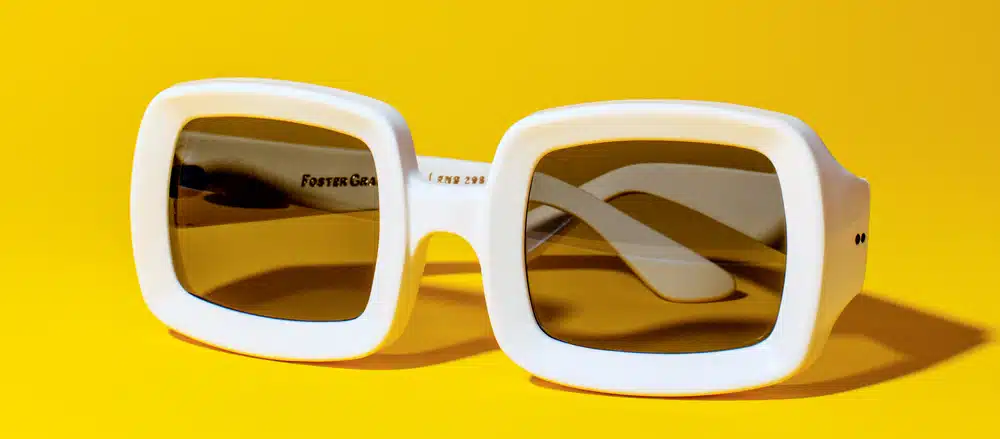
Foster Grant was a titan of the plastics industry by the 1960s, an era during which it rolled out all manner of mod shades, including these vintage square frames from the Leominster Historical Society.
Credit: Lori PedrickCredit: Lori Pedrick
Peter Sellers wore them. So did Louis Jourdan and Anita Ekberg and Anthony Quinn and Mia Farrow. So did the Lone Ranger, Clayton Moore (who knew a little something about mysterious eyewear). Like the famous people hidden behind sunglasses in the indelible “Who’s that behind those Foster Grants?” ad campaign, plastics pioneer Foster Grant has kept a low profile in the pantheon of New England business success stories. But as it turns 100 this year, it has surely earned its place in the sun.
In 1919, a 28-year-old Austrian immigrant named Sam Foster left his job at the Viscoloid comb factory in Leominster, Massachusetts, a city that in the early days of the plastics industry produced two-thirds of all the combs sold in the country. Striking out on his own, he set up shop in an abandoned laundry building in town, and the Foster Manufacturing Company was born.
The addition of “Grant” came from salesman William Grant, with whom Foster partnered up early on. When the two parted ways after just three months, the settlement left Foster too cash-strapped to afford another corporate name change. So Foster Grant it stayed.
The company’s initial products were combs, along with hair accessories and costume jewelry. But when Hollywood popularized shorter hairstyles in the 1920s, the market for combs collapsed, and Foster Grant’s focus turned to sunglasses. At the time, the few American companies that were making sunglasses touted them solely as eye protection. Foster Grant pioneered them as a fashion item, selling its first pair in 1929 at a Woolworth’s on the Atlantic City Boardwalk.
While the initial models were made by hand, with their frames jigsawed from sheets of plastic, everything changed after Foster Grant adopted the European concept of injection molding in the 1930s. Its first-in-the-country machines produced more frames in an hour than a six-man production team could create in a day.
By midcentury, Foster Grant had become the largest sunglasses manufacturer in the world—not to mention the top producer of injection-molded plastic items of all sorts. Soon the company started producing its own plastic, too, which turned up in everything from milk containers and cassette tapes to picnic coolers and stadium seats.
For all that business success, it wasn’t until the aforementioned celebrity-driven ad campaign began in the 1960s that Foster Grant became a household name. Today the Foster Grant brand is owned by Rhode Island–based FGX International, which in turn is owned by the French company Essilor. Yet all these years later, actress Brooke Shields still carries on the legacy of looking into the camera from behind a pair of Foster Grants and asking, “Why would I wear anything else?” —Joe Bills





Met my husband of 33 years while working at Foster Grant in 1982.
I worked in R&D for Foster Grant from 1970 to 1984. They developed and produced all the new plastics for the company. It was a great company to work for.
You’re unfortunately so right about the decline in interest in our collective past. Furniture that we gladly accepted from our parents has no appeal to our kids. While visitors to our home always comment on the warm feeling that it conveys, there are others who refer to our house as a ‘museum.’ Thanks Pottery Barn for helping to keep the feeling alive.
I also worked there in Order entry. I was there till the last day they closed.