



Quonset Huts | Up Close
Born in Rhode Island and built for U.S. troops overseas during World War II, Quonset huts were ideal all-purpose military structures that found their way into American life in the late 1940s. Initially adapted as prefabricated homes, Quonset huts were used as barns, car dealerships, banks, bowling alleys, and service stations. Loved by some, loathed […]
By Joe Bills|Mar 31 2015|

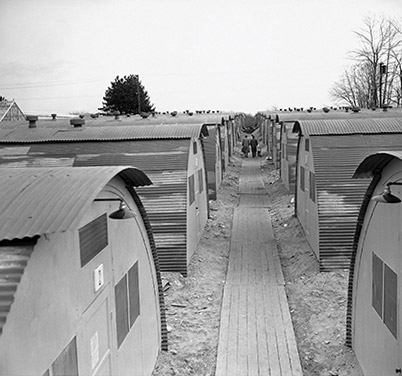
Born in Rhode Island and built for U.S. troops overseas during World War II, Quonset huts were ideal all-purpose military structures that found their way into American life in the late 1940s. Initially adapted as prefabricated homes, Quonset huts were used as barns, car dealerships, banks, bowling alleys, and service stations. Loved by some, loathed by others, these semicylindrical huts became lasting icons of postwar America.
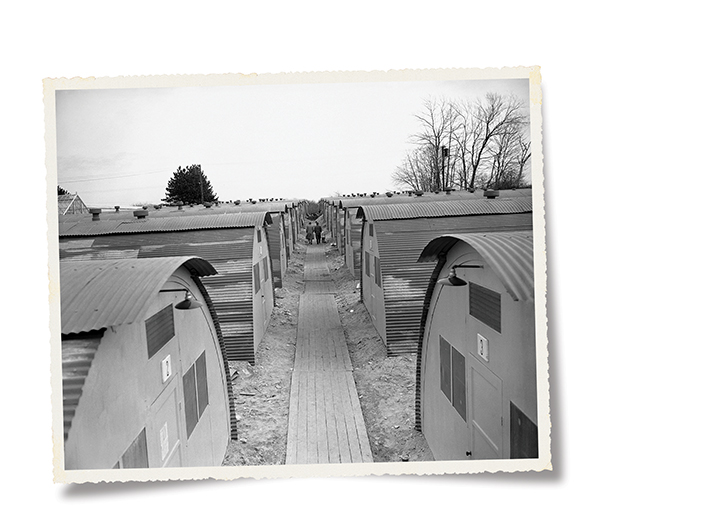
Credit: AP Photo
The huts were named after a newly built Navy base at Quonset Point, Rhode Island. In 1941, the George A. Fuller Company, one of the firms that was building the base, was asked to design and produce a hut for U.S. military use.
The first Quonset huts measured 16 by 36 feet, and the curve of the roof extended all the way to the ground. The odd shape let the entire building be buried in dirt as protection from shelling, without collapsing under the weight.
To meet wartime demand for the huts, which grew to thousands in number, a one-story factory was constructed in West Davisville, Rhode Island, along the New Haven Railroad line.
The George A. Fuller Company produced a total of 32,352 huts in West Davisville before the job was transferred to Stran-Steel, a subsidiary of the Great Lakes Steel Corporation. At its peak, Fuller’s factory employed 3,000 men and produced 150 huts a day.
The Navy’s practice of using civilian contractors to build military installations was problematic during wartime. Most contractors lacked military experience, and as civilians, they were prohibited by international law from direct involvement in military actions.
On December 28, 1941, authorization was requested to form a military construction battalion made up of men recruited from the building trades. “Construction Batallion” was soon shortened to “CB,” and before long this group would come to be known as the Seabees. Today there’s a Seabee Museum & Memorial Park in Davisville.
During the war, the idea of using Quonsets for nonmilitary housing started to gain favor. Between 1943 and 1945, the Navy erected 6,285 Quonset huts as housing for soldiers and their families. A fully furnished two-bedroom hut with kitchen and bathroom cost an average of $3,350, including utilities, infrastructure, and furniture.
Legendary Nashville music producer Owen Bradley built a studio in a surplus Quonset. The acoustic effects of the building’s shape included amplification of sounds in the upper-middle range,
which would become an essential element of the “Nashville sound” of artists such as Patsy Cline, who recorded there. Years later, when Bradley built his new studio, he instructed engineers to design it with the same acoustics as his old Quonset.
A young Gerald Ford set up his first congressional campaign headquarters in a Quonset in Grand Rapids, Michigan, in 1948.
Vermont’s Killington Ski Area opened in 1958, with a converted Quonset hut serving as its first base lodge.
In 1978, 17 Quonset huts at Camp Endicott in Davisville, Rhode Island, dating back to 1942, were added to the National Register of Historic Places.



In 1967 when I first got to my radar base near Dong Ha, Vietnam, our quarters were Quonset huts. There were black tar spots all over them that I soon found out were patches for shrapnel holes from artillery rounds fired at us from the DMZ some 6 miles away.
We had friends in Coventry, Conn. who lived in a Quonset Hut. They bought in the late 40’s or early 50’s for a home as military surplus.
Spent lots of time living in Quonsit Huts.My wife and Ilived in one on the CB base at port Hueneme maybe1951. Then we lived in a double one in Guam about 1952. And again in one in Gitmo Cuba before we got a permanent house. It was a great location on a little inlet on Guantanamo Bay. Our collie dog used to play with the dolphins up and down the inlet.
I renovated a hut in Uxbridge Massachusetts a few years back and am currently living in it with my wife.
I lived in a Quonset hut in the years 1957 to 1960, in New Haven, Connecticut. There were about 60 Quonset huts, and they were located across the street from the football stadium at Yale University. The Quonset huts were used for married student housing. At that time, I was attending Edgewood School (kindergarten to third grade). Edgewood School is located about 2/3rd of a mile to the north from the Quonset huts. The Quonset huts were torn down shortly after we moved out. We moved to Seattle. I have many nice photos outside of our Quonset hut as well as many nice photos inside, for example, me standing in the snow, or posing on the front porch wearing my Halloween costume (cowboy suit), or inside reading a story to my younger sisters, or a photo of one of my wild birthday parties with kids from Edgewood School. In the summer, people threw a multi-punctured garden hose over the roof, so that part of the metal roof would be cooled down by the water in the sweltering summer. Each hut was divided into two units (for two families). In our hut, the other family was the Annamunthodo family. They were from Jamaica. A couple of huts to the west, there lived a doberman dog (I didn’t like it, too scary). My best friend was Billy Glenn. He lived a 20 minute walk through the woods on Forest Road. His dad was prof at the medical school. We had no T.V., so I went to his house to watch Dennis the Menace and Leave it to Beaver. The best time in the Quonset huts was Halloween, because all the huts were close together, and because many, many kids lived in this housing development, and so I’d be able to collect at least two entire shopping bags full of candy. In those days, there were football fields surrounding the network of roads where the huts were located, and it was fun watching the Yale University football players practice. Also, at the east end of the huts was a large barn for horses, where I watched students playing polo. In the summertime, the GOOD HUMOR man drove up and down the network of roads where the huts were located. Our family’s best friends were the Snider family (Ross and Mel). They had a daughter, who must be about 65 years old now. One of the better times during this era, was going with my family to the drive-in theater. My mom would hand sandwiches to the kids seated in the back. Also, I sent quality time climbing a pine tree situated near the front of our hut, and I also made a “fort” located in the forest up the hill located immediately to the east of the huts and, in addition, I made another fort in the sandy area located to the south and slightly just downhill from the road. Also, I collected frogs and made a box for them, and also I enjoyed the lightning bugs in the areas of tall grass located near the Quonset huts. Our telephone number for our hut was Fulton-7-5853. You can see my photos because they are posted on YELP, and you can find them with the google search terms, “quonset huts” and “new haven” and also by inputting the google search terms, “quonset hut” and “new haven.”