Here in New England | A Best Place
Finding a home means so much more than just owning a house.
By Mel Allen|Feb 23 2026|


Mel Allen
Credit: Jarrod McCabeFrom the day I arrived in New England during a January 1970 snowstorm to now, I have lived in 18 different houses in 11 towns—seven in Maine and four in New Hampshire, the state I’ve called home since the autumn of 1979.
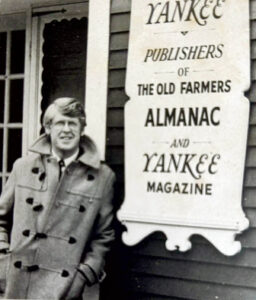
I have been part of many stories telling of deep roots and love of land, the words always belonging to others. Most of those pieces have appeared in this magazine, which for 90 years has been devoted to a singular sense of place.
This feeling of belonging is elusive and cannot simply be wished for; it cannot suddenly be grafted on. For the nearly half century I worked at Yankee, my deepest roots were planted in an office with a view of the town fire station and a grassy meadow that climbs slightly to a knoll beside a country road. Most of the time when I left, it was on the edge of night.
When the pandemic hit, for many months there was no separation between work and home. Town became a family we all shared. And then it ended.
I have a friend who has lived most of his life within a few miles of where he was born and raised. Even when he explored living elsewhere, he knew he would return. His house nestles against a forest; summer days pass in a family boathouse, handed down through generations, on one of the prettiest lakes in New England. If my friend were a tree, his branches would spread high and wide; people would rest beneath its shade and look up in wonder.
My wife, Annie, grew up in the same small town where we are now settled in an old house by the river. She has lived in Rome, San Francisco, and Washington, DC, but years ago she, too, came back to her birthplace. And since I moved here, I have realized that where I see buildings and shops and streets, she sees history, traditions, stories. And mostly, she remembers. When we are walking in town and people pass by in cars or on foot, she knows many by name, and what they do, and often what their parents did, too, a small-town genealogy that only those with long ties to a town will know.
There is time now to be attentive to the comings and goings of the people who share this place with me. To listen to the rhythm of a town. I had never thought of it this way, but it is not unlike nurturing any relationship.
A five-minute stroll from our house there is a local grocery store with a few tight aisles. When I enter, as I do almost every day, one staff member or another greets me by name. Not long ago, a young woman who works there had made cookies and offered them hot from the oven to me and other customers.
Recently, I stopped in to find the store celebrating the birthday of a man who had grown up in town and who had worked there for years. Decorated cupcakes and cookies lined a counter, and we were coaxed to help ourselves. You could hear the shouts of “Happy birthday, Dwight!” carry all through the store.
When I walk through town now, people call out and nearly always ask how I am liking retirement; many of them know this stage of life. When we have walked a bit of distance, I ask Annie their name and she knows. Next time, I will know it, too.
I have lived in our town for 17 years and only now, because I am here, daybreak to dark, I greet the people tending the flowers on Main Street; I am learning the names of the dogs we pass by each morning. Maybe, just maybe, I can have more than a house by a river. If I try, if I am patient, I can also find my own best place: a hometown.