Down East Rising: bluShift Aerospace
How bluShift Aerospace, an audacious little rocket company, could make coastal Maine an unexpected front-runner in the commercial space race.
By Brian Kevin|Feb 23 2026|

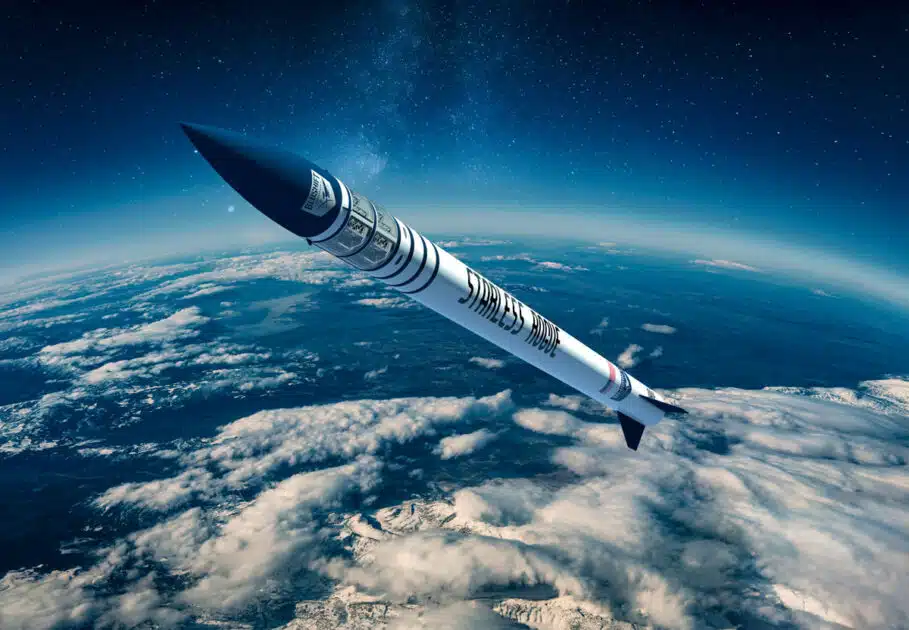
bluShift Aerospace’s "Starless Rogue" (shown in an artist’s rendering) could one day help pave the way for a fleet of eco-friendly rockets carrying satellites and research payloads from launchpads on the Maine coast.
Credit: Courtesy of bluShift AerospaceOn a quiet summer morning on the Down East coast in the year 2040, a distant rumble causes a pair of lobstermen to look up from the traps they’re repairing. It’s a Sunday, when hauling is prohibited in Maine waters and the local rocket company tends to schedule its launches. Ambling to the edge of the dock, the two gaze offshore, squinting at a distant platform silhouetted against the horizon. As they watch, swigging their coffee, a slim rocket begins to ascend, trailing a light-gray plume, a silver needle stitching a pale thread into the sky.
The rumble lasts less than 30 seconds, and once the rocket is out of sight, the lobstermen turn back to their traps. They’ve seen this before—a couple of launches a month these days, up from two or three a year, back when the rocket company first opened its mission control near the harbormaster’s office. They know the rocket will ascend some 250 miles, to about the same altitude as the old International Space Station, but that it won’t reach the velocity needed to stay in orbit, falling instead back to Earth after seven or eight minutes in space. And they know that companies and research entities pay a pretty penny to access those minutes in microgravity, that the rocket is ferrying sophisticated experiments that MIT or Intel or Pfizer delivered to their little corner of New England, ready to be installed in a payload bay and remotely initiated when the craft reaches zero G.
And that exhaust trail dissipating over the ocean? They don’t worry anymore about its effects on marine life—or on their livelihoods. They watched the rocket company’s founder nibble on a chunk of its proprietary biofuel a few years back, during a presentation at the new fabrication shop. They’ve both done some off-season work there, welding rocket parts, not to mention hiring on occasionally to help retrieve rockets after a splashdown. In fact, in just a few short years, the town’s whole little aerospace sector has come to feel pretty humdrum—just another scrappy enterprise in a fishing town used to scrappy enterprises.
*****

Credit: Lindsay Becker
That’s Sascha Deri’s vision for the future of bluShift Aerospace, the rocket company he founded in 2014 and currently operates out of a former naval air base in Brunswick, Maine. And at times during the past couple of years, that vision has felt tantalizingly close—for example, early one evening in October 2024, when bluShift gathered a few dozen investors, reporters, and space industry muckety-mucks on a stretch of the base’s tarmac to witness a crucial rocket test.
During the hours before ignition, Deri had mostly sat inside the 2006 Timberlodge travel trailer his team had retrofitted into mission control, running diagnostics and narrating excitedly on a livestream. But now and again he stepped outside to mingle and chat with the small crowd, an affably earnest 50-something in khakis and a Patagonia vest. With his salt-and-pepper hair and black-rimmed glasses, he looked like a slightly crunchy Ira Glass—a far cry from space-entrepreneur stereotypes of strutting start-up bros and bombastic showmen. As dusk settled in, Deri grinned and joked about needing to get the test off before his daughters’ bedtime, though his commute wasn’t far, his home just down the road in the little coastal college town.
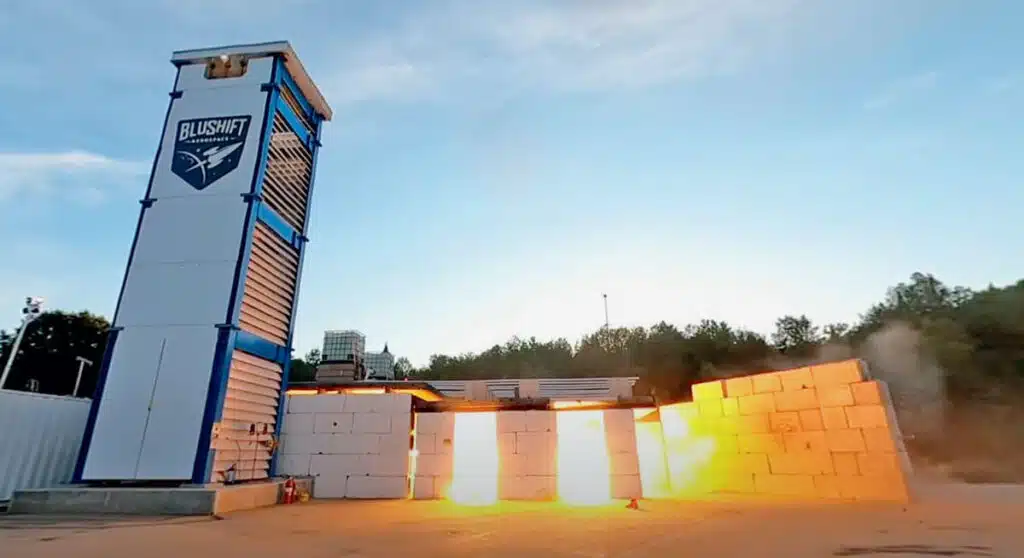
But back inside the trailer, at the moment of ignition? Deri felt tense, his eyes glued to a cinder-block bunker a quarter mile away as a spear of white flame erupted from one end of it. Inside was a makeshift combustion chamber, a huge cylinder of inch-thick steel more commonly used as sewer-line pipe. Alongside the bunker was a vertical tank, 30 feet tall and gleaming, from which oxidizer flowed into the combustion chamber at a hopefully steady pace.
Deri took his eyes off the fiery plume only long enough to glance at a screen full of data, monitoring, among other things, pressure, thrust, and all-important duration. The test of the engine he’d named MAREVL—the Modular Adaptable Rocket Engine for Vehicle Launch—was what was known as a full-duration hot-fire test. It was bluShift’s second and would determine how well MAREVL could handle a full 60-second burn of the company’s top-secret biofuel. That’s how long a rocket would need to reach the Kármán line, the boundary between Earth’s atmosphere and space, some 62 miles above the Maine coast.
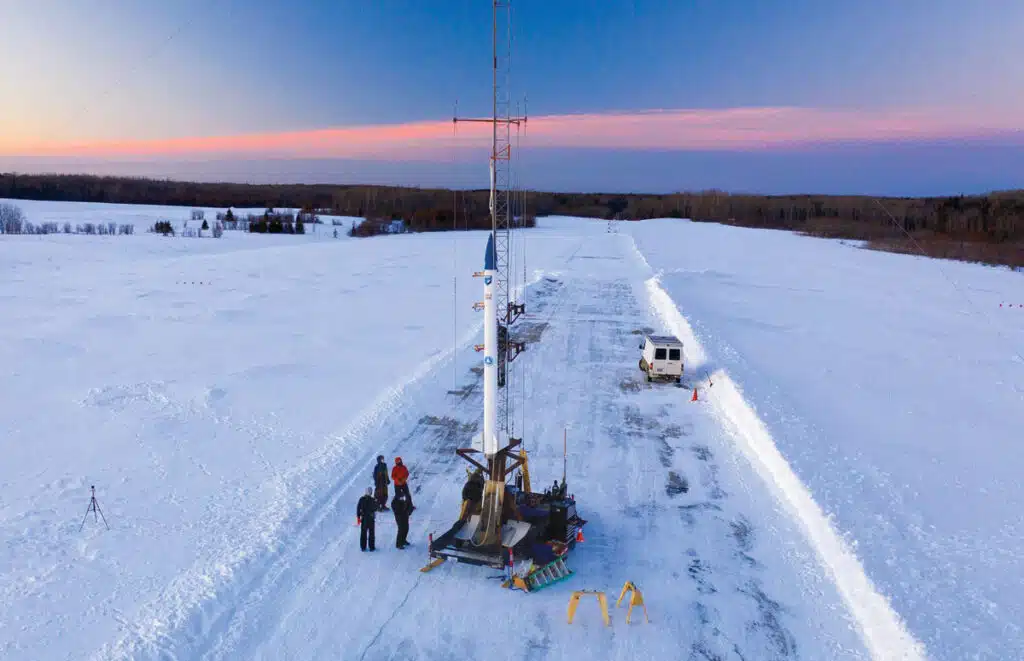
Thirty seconds in, the screen told Deri that the engine was delivering more than 16,000 pounds of thrust, a bit less than was needed to get bluShift’s envisioned 50-foot rocket, dubbed Starless Rogue, into suborbital space. It’s eight times more than what propelled a 20-foot prototype, called Stardust, some 4,000 feet into the air in January 2021. That low-altitude launch, from the frozen runway of the former Loring Air Force Base in far northern Aroostook County, was Maine’s first-ever commercial rocket flight—and the world’s first powered by nontoxic, nearly carbon-neutral biofuel. That, too, had been a moment when the vision of an eventual Maine spaceport had felt very close.
Credit: Knack Factory
But suddenly, 55 seconds into the burn, the smooth white-orange plume was interrupted by a shower of fiery debris, accompanied by a sound like a burst of radio static. To the spectators outside, it looked like sparks pinging around the tarmac. Inside the trailer, a chorus of voices called out, “E-stop! E-stop!” Emergency stop. Deri leaped from his seat and charged into the control room, his far-future vision abruptly replaced by a more immediate one: of catastrophic combustion-chamber failure, an explosion that could set the project back months—and put those cinder-block walls to the test.
*****
The first spacecraft Sascha Deri ever sketched was a Viper attack ship from Battlestar Galactica, which enthralled him as a ’70s kid with precious little access to TV. He was 6 years old when his parents took the family back to the land, moving to a cabin in East Orland, Maine, near where homesteading gurus Helen and Scott Nearing had famously farmed since the ’50s. At first, Deri’s family lived off the grid, but the simple life proved grueling. When they succumbed to electricity, Deri spent his much-rationed TV time escaping to the worlds of Battlestar, Buck Rogers, and Doctor Who on a black-and-white set.
The outdoors was his chief entertainment: the woods, where he wandered unsupervised; Toddy Pond, where he and his brother paddled and sailed (his dad forbade motorized boats). On winter nights, he nestled into snowbanks at the water’s edge to look up at the Milky Way.
“That’s where I remember asking my dad what was up there, how many people, how many stars,” Deri says. “All those normal kid questions—or what used to be normal kid questions.”
His family moved 12 more times before he turned 18, all within Maine (“like we were running from the law,” he jokes). And all throughout, Deri kept asking questions about the stars. He was still in East Orland when he made his first rocket, an aluminum tube stuffed with match heads. He was in Brunswick, on his way to a high school biology class, when the Challenger exploded in 1986. He left Maine to major in physics at Indiana’s Earlham College—a small school founded by Quakers, his mom’s faith tradition—where he studied, among other things, quantum mechanics and the expansion of the universe.
Then, after graduation, Deri’s interests swerved. He picked up a second bachelor’s degree, in electrical engineering, at the University of Southern Maine. In 1999, he cofounded a solar-power start-up in Boxborough, Massachusetts, and the company was a success, helping DIY customers install at-home solar as that market was heating up. But Deri still felt the pull of the stars. And in 2011, turning 40, he also started feeling something like a midlife crisis.
“I decided, embarrassingly, that I was going to give up playing video games at night and dedicate my spare time to something I really wanted to do before I die,” he says. The goal he settled on: launching a space probe to Proxima Centauri, Earth’s next-closest star system, some 4.25 light-years away.
It’s an ambition so improbable that when NASA briefly considered it in the 1980s, the agency dubbed the concept Project Longshot. An object traveling at one percent the speed of light—which no human-made spacecraft has yet achieved—would reach Proxima Centauri in roughly 425 years. But Deri nonetheless began pouring his spare time into reading textbooks and papers on aerospace tech: propulsion physics, materials science, fuel chemistry. He turned his office into a make-do lab and machine shop, complete with a CNC mill for crafting engine parts. Using an online meetup platform, he assembled a ragtag crew of big-dreaming collaborators with whom he brainstormed and tinkered. On his brother’s farm in North Yarmouth, Maine, he started testing amateur-sized rockets.
That’s where he was in 2013 when he had an epiphany. Deri had already narrowed his interest to what are known as hybrid-propellant rockets, in which a solid fuel source is injected with a liquid oxidizer to help it burn. Hybrid rockets are simpler, cheaper to build, and safer to transport than engines relying solely on solid fuel (like NASA’s space shuttle boosters) or liquid (like Elon Musk’s SpaceX uses). But the particulars of the fuel and oxidizer mix can vary. One day, in his brother’s farmhouse kitchen, Deri’s eye landed on “a certain substance” in a container on the windowsill, and he found himself wondering how it might behave as fuel.
To hear him tell it today, the mystery substance outperformed petroleum.
He won’t say what his proprietary, plant-based fuel source is, but it is avowedly nontoxic and nearly carbon-neutral. Deri has declared that it “can be cheaply sourced from farms across America.” A University of Maine researcher once placed it in a tank full of seawater alongside a live lobster, harmlessly, for two weeks. In 2022, during a CNN interview, Deri held up a crumbly black bar of it and took a good-size bite.
He incorporated bluShift in 2014, and as he launched into three years of fuel testing—along with fundraising, team building, and early development of what would become the MAREVL engine—Deri’s lofty focus on Proxima Centauri faded. In its place, a new vision: a fleet of eco-friendly rockets carrying satellites and research payloads, launching from the Down East coast and bringing the booming commercial space industry to Maine.
*****
If the prospect of rural, far-flung Maine as a conduit to the stars strikes you as unlikely, don’t tell Emily Dwinnells. As one of the chief architects of the Maine Space Corporation, a public-private entity established by the state in 2022, she, too, envisions the day when the Pine Tree State is a launchpad—and not only for bluShift, but also for a host of rocketeers.
A Kittery-based consultant in the tech and data sectors, Dwinnells prepared a report for the state legislature that laid out the surprising number of assets Maine has going for it as a would-be space hub. One of the biggies: all that little-developed coastline. Like Cape Canaveral in Florida or the Gulf Coast peninsula that hosts SpaceX’s Starbase, Maine’s sparsely populated Down East coast allows for launch trajectories over the Atlantic, minimizing risk to populated areas and permitting recovery at sea.
What’s more, a rocket launched from the Down East coast can head south over open ocean, which provides a clear pathway for a spacecraft to establish a polar orbit. That’s a perk that few other U.S. launch sites offer and a huge plus for many commercial-satellite applications—imaging, communications, climate monitoring—since satellites traveling pole-to-pole can pass over any swath of the globe as it rotates west-to-east below. An added bonus: Maine’s rural character makes it an ideal place to download satellite data with minimal electromagnetic interference.
No surprise, then, that launch sites are one of three “core business units” the state legislature tasked the Maine Space Corporation with developing. Speaking to a room full of aerospace professionals at the most recent Maine Space Conference, in Portland, executive director Terry Shehata said he envisioned the corporation “at some point” buying or leasing coastal property for construction of a spaceport—though the legislature dictated these be only for small rockets, not NASA-scale launches causing noise, traffic, shockwaves, and debris. (“We’re not interested in becoming the Cape Canaveral of the north,” Shehata said, speaking on a panel alongside an exec from Florida’s aerospace development agency).
The other two pillars of the nascent Maine Space Complex include an analytics center, offering specialized tools for processing satellite data, along with a campus where space start-ups and established operators can share industry-specific tech and other resources.
So far, only that last component has a head of steam. In 2016, Deri moved bluShift from his office in Massachusetts to Brunswick’s former naval air station, decommissioned in 2011 and since reborn as Brunswick Landing, a sprawling mixed-use development. It’s now also home to the Maine Space Corporation, which last year opened an “innovation hub” full of shared tech and is actively wooing more space-related ventures. In the past three years, bluShift has been joined there by another small-rocket start-up—Promin Aerospace, a Ukraine-based company that has yet to launch—and an office of Teledyne Technologies, a $5.5 billion tech giant that built components for NASA’s James Webb Space Telescope.
In 2023, after touring bluShift and Brunswick Landing with a delegation of Maine politicos, NASA’s highest-ranking official touted Maine’s “brilliant future in space.”
“You bring up space, and everyone thinks of it as something Florida does,” Dwinnells says. “So part of the communications piece of this is just making it believable for Maine.”
And that means emphasizing the extent of the opportunity. The nonprofit Space Foundation valued the 2024 global commercial-space industry at $480 billion and predicted rapid growth within a decade. Much of that value is tied to products and services that rely on orbiting satellites—often quite little ones, known as nanosatellites—that do things like track your Uber Eats delivery, feed data to your weather app, and put images into your Google Maps search, along with plenty of more esoteric applications.
Some of it is tied to the sector that bluShift is targeting: companies, universities, and government entities that need short stints in microgravity for research and development. Want to learn how to make computer chips without gravity-induced defects? Or culture cells more effectively for drug development? Suborbital rockets, while not powerful enough to deploy satellites, can facilitate these and other remotely conducted experiments in “micro-g.”
But in recent years, folks looking to get to space for any of these purposes have encountered a problem: not enough rockets. There are wait lists to send a payload up on a big launch from, say, NASA or SpaceX—and paying passengers on those rockets can’t be choosy about the specifics of their trajectories or schedules.
So bluShift is far from alone in trying to bring alternatives to market. In fact, Deri has built the company during what Douglas Gorman, a reporter for the space trade publication Payload, characterizes as a global “start-up boom” within the small-rocket sector. And likewise, Maine isn’t the only state hoping to build infrastructure to woo those start-ups and the space-bound clients they serve.
“But I think Maine is approaching it in a unique way that has some staying power,” says Gorman—a native Mainer, as it happens, now based in New York. “It’s because of the geographical aspect, the ability to have a spaceport, but also because it’s doing things like converting old military facilities to support the space industry in other ways.”
For all the talk about the future, however, Dwinnells cautions that would-be commercial-space clients won’t stay underserved forever. “We have a time-bound opportunity here,” she says. “You look in the paper, and every day there’s a new piece of news about space.” Maine’s launch window, in other words, is now.
*****
Credit: Courtesy of bluShift Aerospace
bluShift’s first stab at a 60-second engine test hit a snag at T-minus two whole days. A full-duration hot-fire test is a milestone in a rocket’s development. The first, cautious test of the MAREVL engine had lasted just five seconds. The next ran for 20. Tripling that—burning through the fuel load required to reach space—subjects an engine to far more stress.
The hiccup was a lack of nitrous oxide, the liquid that’s injected, during a burn, into a hollow cylinder of the trade-secret biofuel. For weeks, the bluShift crew, these days about a dozen strong, had been readying a shiny new oxidizer tank the size of a small silo. Custom-built by a Rockland manufacturer—there’s that space economy trickling down—the tank is flight-ready, meant to ascend as part of a finished rocket.
But there was a learning curve to filling it for the first time, transferring N₂O from an array of small pressurized cylinders, and days before the scheduled test, the team realized they were short of the 400 gallons needed. Their usual supplier said getting more would take weeks—weeks of payroll and busywork, with the site already prepped and the test already trumpeted to investors and the press.
“We were ready to drive around New England and literally load whatever we could find in the back of my F-250,” Deri says.
This is not how SpaceX rolls. But to hear Deri and his team tell it, “Yankee ingenuity”—a willingness to improvise and work on the cheap—sets bluShift apart nearly as much as its biofuel. That F-250? During engine tests (that is, when it’s not towing the mission-control RV), it’s parked near the bunker with a pallet tank full of water and a pump, an old-school backup for the test site’s firefighting carbon-dioxide quench system. Inside the bunker, meanwhile, a huge length of commercial steel pipe served as a cheap testing alternative to a fully engineered combustion chamber.
“Something I enjoy about watching our engineers work is an emphasis on producibility and testing that’s so real-world,” says David Hayrikyan, bluShift’s chief technology officer. “If you sent our designs to engineers at other companies I’ve worked for, you’d get a big piece of metal and a 5-axis milling machine, and you’d machine all this complicated geometry, and it’d cost $150,000. Our crew starts with, ‘Let’s buy a sewer pipe.’”
Hayrikyan, a Boston University mechanical engineering grad, has been with Deri since the beginning, having answered his online call for would-be rocket scientists back in Boxborough. “I walked into that room looking for people who wanted to build something,” he remembers. “Sascha mentioned the Proxima Centauri idea, and I was like, ‘This is batshit! This dude is lighting rockets on a farm!’
“But the thing about Sascha,” Hayrikyan goes on, “is that he thinks it’s possible. He’s able to imagine these abstract ideas, and he sometimes sounds wild when he talks about them—but then he is also super down to execute.”
After a few desperate calls to Maine gas suppliers, bluShift executed its first full-duration test after only a week’s delay. It was largely a success, the MAREVL engine delivering high thrust for over a minute, along with some evidence of instabilities midway through, a slight sputtering to the plume as it blasted out the back of the sewer pipe. Having an issue to address seemed almost to bolster Deri all the more. “This was incredible!” he told 1,000 or so viewers of his livestream. “I can’t wait to hear the results of the data and make the next test even better.”
*****
The next test, the one in October 2024, was indeed better—the flurry of shouts for an emergency stop notwithstanding.
The engine, it turned out, burned through the last of its fuel right at the minute mark—T-plus 60 seconds, as designed—stopping itself by the time anyone got a hand on the big red button. The sparks that Deri and others saw were the result of burning through a cardboard liner surrounding the fuel, and although a simple graphite piece was expelled from the chamber, it caused no damage. “Nothing’s supposed to fly out of our motor,” Hayrikyan says, “but this was great because it was an informative and benign failure, and preventing it [gave] us a metric for our next test.”
And while the e-stop episode briefly terrified Deri, you’d never have known it from the smile he wore as he bounced out of the RV to join press and investors on the tarmac. Deri is a winning communicator, and as the last moments of twilight gave way to darkness, he stood in front of the testing site and relayed bluShift’s whole genesis story—the farm, the windowsill—with an eager, almost theatrical flair you might expect from a fanboy’s Battlestar Galactica episode recap.
When he finished, one of the TV newspeople muttered about the darkness, switched on an LED, and asked Deri to repeat his whole spiel. “Oh, sure,” Deri said, unfazed. And then he did, without any noticeable lapse in enthusiasm, as if the words were leaving his mouth for the very first time.
That knack for storytelling may serve Deri the next time he sets out to garner support for launching bluShift rockets from Maine. He has twice tried and failed to win backing for such a plan in Washington County, at Maine’s salty eastern edge—a region not known for its embrace of the new. In 2021, Deri approached the town council in Jonesport, population 1,300ish, some 50 miles east of the pond where he once stargazed. A landowner there was willing to lease a small, uninhabited island as a launch site. Deri vowed no more than 32 launches a year, all on Sundays, when lobstermen can’t haul, or in the evenings, when the fishing fleet is in. He pitched STEM projects with local schools. He stressed how dramatically smaller the rockets and launches would be compared to the SpaceX ones on TV. He said he aimed to build a manufacturing facility, hiring welders and machinists, drawing on the town’s boatbuilding workforce.
But locals worried about effects on fishing, and when the town responded with a temporary moratorium on aerospace operations, bluShift instead set its sights on nearby Steuben, reenvisioning launches not from land but from a self-elevating barge called a liftboat. Initially, Steuben’s council was supportive. But local opposition stressed the threat of pollution and made comparisons to SpaceX’s impacts on the Texas Gulf Coast. Elon Musk’s gargantuan company has been fined there for discharging industrial wastewater into sensitive wetlands. Its exploding spacecraft have rained debris. And last year saw more than 150 launches of its Falcon 9 rockets, each of which, experts say, releases some 336 metric tons of CO₂ into the atmosphere, roughly equal to the carbon output of 78 cars driven in a single year.
Credit: Courtesy of bluShift Aerospace
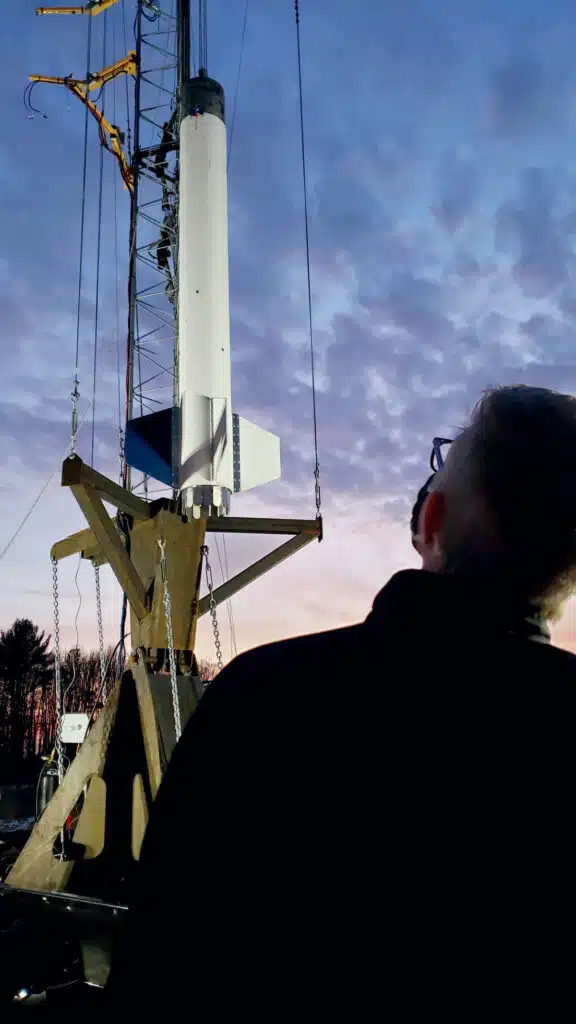
In March 2025, Steubenites approved a referendum prohibiting both commercial rocket launches and space-industry manufacturing. Deri was disappointed by the setback, but at the moment, he and bluShift have more pressing tasks. Among them: an investment round, obtaining an FAA commercial launch license, further perfecting the oxidizer-injection system, and building a flight-ready combustion chamber and fuselage for the rocket they’re calling Starless Rogue. The goal, if these and other pieces line up, is a launch of Starless Rogue, with paying-customer payloads, from New Mexico’s Spaceport America before the end of this year.
Lately, Deri has also been focused on fielding other interest in bluShift’s engine tech, including for use in boosters on hypersonic jets. A bit ironically, he says, it isn’t the carbon-neutral nature of his fuel that’s attracting the interest, but instead that it’s simply easier to source, store, and transport than the toxic chemicals found in conventional solid rocket boosters. (It also doesn’t hurt that it’s less expensive, too.)
But while he doesn’t yet know where, the dream of building a coastal Maine launch facility is still at the core of Deri’s long-term vision—and he repeated as much for the local news folks out on the tarmac in Brunswick.
“What ultimately motivates me,” he said confidently, “is that Maine can have a real foothold in exploring space and the universe.” Then he seemed to go off-script for a moment.
“And I’m hoping that…,” he said, then paused. “This is not…,” he tried again, before faltering.
“The beginning for me was 11 years ago,” Deri said, finally. Then he gestured behind him, at the darkened test site beneath the first faint stars. “But this feels like just the beginning.”
This feature was originally published as “Down East Rising” in the March/April 2026 issue of Yankee.