Here in New England | A New Year
Moving on doesn’t always mean saying goodbye.
By Mel Allen|Dec 30 2025|


Mel Allen
Credit: Jarrod McCabeMy father spent much of his working life in an office beside a combination pharmacy and soda fountain. I worked in the soda fountain through high school, and since our workdays both ended at 6 o’clock, we’d meet up to walk home together. Each evening, my father would put his key into his office door and turn it to lock. On the day he turned the key for the final time, it broke off in his hand. He did not know it then, but he had only two years left to live, and I always wondered whether that moment at the door was coincidence or omen.
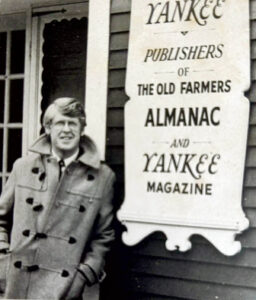
I thought of my dad when, on last January 17, a Friday, I said goodbye to my colleagues and the rambling red building that had seen me through more than 45 years at Yankee. I peeked into my office, now empty of decades of stuffthat I once thought too important to discard. Weeks later, I dropped by to say hello and found the office trim, orderly, efficient. I felt as if I had sold the house I’d known for decades, and another family had moved in; the house the better for its new lives to shelter.
It is a strange concept, “retirement.” As if we can simply walk away from what we have thought about for years, and leave it behind, simply one more big carton of stuff to take to the storage unit. But I had a transition strategy: Find a workspace, a routine, a semblance of “going to work.” I discovered mine only a five-minute walk down my street. When the town library opens at 10, I set up my laptop in the sunlit “quiet” area.
Throughout last winter I read my Yankee stories from 1977 to today, choosing more than 40 of them to compile into a book. When I walk through my small New Hampshire town, people call out, “How’s retirement?” I smile and say I’m working harder than when I was editor. Now my library time is spent writing the talks that I give as I travel New England with my book. That’s where I find the feeling people hold for Yankee.
After one recent talk, a man stood up and said that he, too, had just retired and his wife urged him to cancel their Yankee subscription and just read it at the library. “My wife is from Georgia,” he said, as the audience laughed. “She doesn’t understand. I need Yankee to come into my home. I need to hold it in my hands.”
Another day I was in a village where I was told to expect a “sparse” turnout. The talk was to begin at 3. Rather than a light crowd, a stream of people began filling the rows. At the scheduled start time, the doors stayed open—we were waiting for someone, I was told. Five minutes passed. Ten. Then I heard a murmuring. Looking toward the door, I saw an elderly woman walking in, with people holding her arms for support. The publisher of the local weekly paper leaned forward and said to me, “I can’t believe it. She hasn’t been out of her house for months. She is wheelchair-bound.” But she was determined to come and hear stories from a Yankee editor.
Writing this column is like moving back home, for just a while, stopping by to chat every now and then. Meeting readers again, wherever they live. Keeping the key in the door, but not turning it so hard that it will break.