Ben Cosgrove Gets Lost
In wandering landscapes old and new, the restlessly creative Massachusetts composer Ben Cosgrove puts a sense of place to music.
By Joe Keohane|Dec 30 2025|

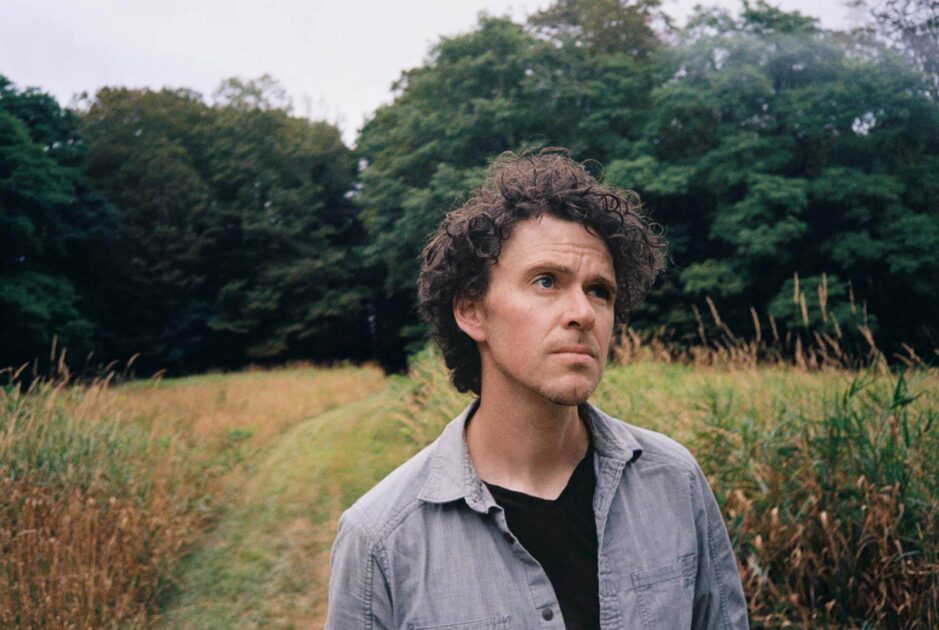
The restlessly creative Massachusetts composer Ben Cosgrove.
Credit: Corey HendricksonWhy, I sometimes wonder, don’t we think of ourselves more like birds in a murmuration, or like electrons in an atom, instead preferring to project a degree of stillness and order onto the world that may exist only in our minds? It seems strange that we live on an irregular, imperfect hunk of rock that shifts, morphs, belches, and floods, incessantly and shudderingly rearranging itself as it spins wildly through space, and yet we feel it’s more appropriate to sit still and hunker down on some piece of it instead of sprinting deliriously around on its surface.
We live in a world of constant growth, collapse, confusion, asymmetry, and chaos: In the scheme of things, nothing lasts, no story is completed, and no narrative is perfectly satisfying. People and things drift, gracefully or suddenly, in and out of our lives; we move between places that will have changed, subtly or dramatically, every new time we see them; and every person, thing, and idea in the world moves forever along irregular, incongruous, unrelated, and uncontrollable trajectories. It falls to us to try to find meaning and stability in a world like that, and maybe the best way to do that is to constantly examine and embrace all that change and all that movement itself.
* * * * *
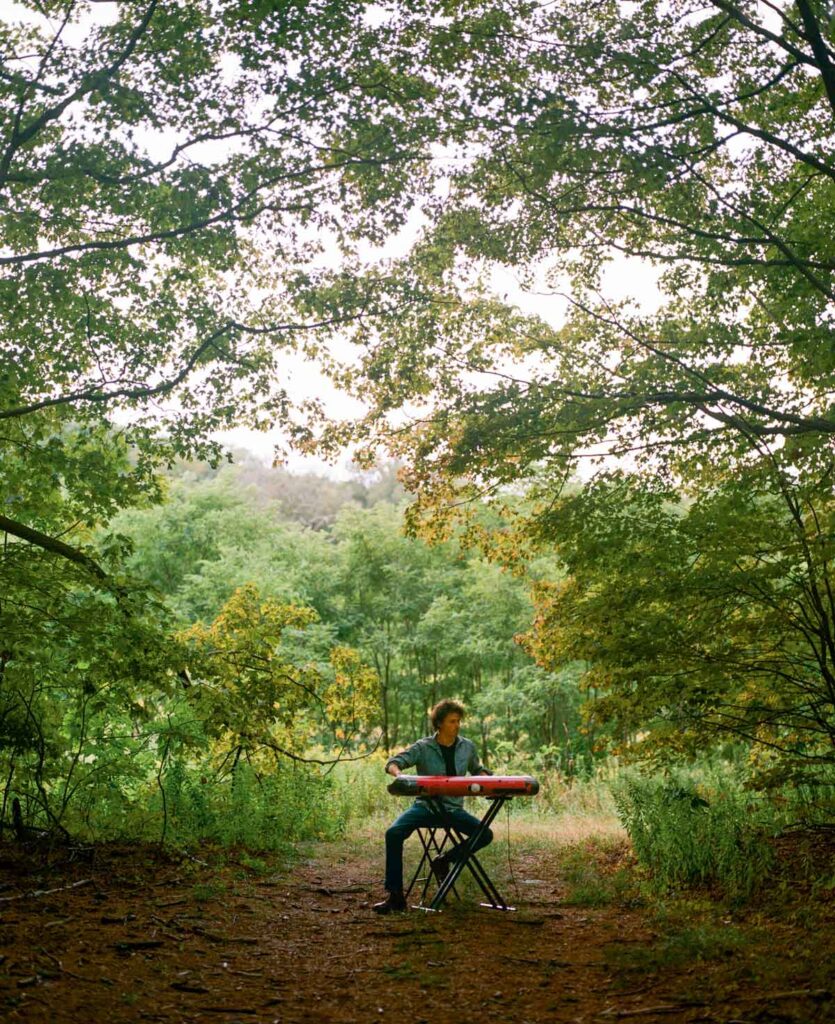
On a morning in August, the author of those words, composer Ben Cosgrove, stands in a dirt parking lot at the foot of Mount Monadnock in Marlborough, New Hampshire. His car, which is as integral to his music as the red Korg keyboard he performs it on, is a 2012 black Ford Focus. It just hit 200,000 miles. The transmission has never been great, he says, but lately it’s been developing “additional idiosyncrasies,” and may not be long for this world. At some point, he’ll get a new car, as he does every two or three years. Then he will drive it into the ground like the others, all in the service of art.
Cosgrove, 38, writes music about landscapes. This makes him sound bland, like some kind of musical watercolorist, but he’s not. His process is intense and all-consuming. He travels to a place—here, abroad, familiar, alien, on land, on sea, on a lava field, whatever—takes it in, feels it, and then attempts to convey all that musically to others. So far, he has done this across seven albums—including his latest, Topograph, out this January—and an endless tour of cafés, bars, clubs, galleries, and any other venue that will have him.
His music is quintessentially American, omnivorous, and democratic. It incorporates elements of classical, folk, country, blues, pop, et cetera, and can be by turns meditative and chaotic, somber and exuberant, lovely and frightening, still and dynamic. There are times it feels like his pieces are blowing in off the water, or rising from the earth in a swell, a surge, spinning eddies off the edges. There are times when they feel like they’re coming from the sky. When I was driving here through Connecticut, listening to his albums, his music seemed to interact with the surroundings. The sound of my tires hitting strips of tar on a road, creating a rhythmic thump, synched up with his composition “Anorak,” which is about the disorientation one feels during a major storm. The sound of a garbage truck next to me on Interstate 84 created a drone that harmonized with a piece inspired by wind in Oklahoma. At one point while listening to his album Salt, I honestly thought there was a bird in my car. I still don’t know why.
There is nothing else like it.
* * * * *
Cosgrove has climbed this mountain hundreds of times, but he doesn’t remember his first ascent. It would have been back when he was a toddler. His extended family used to come here in the summers and stay at a camp in nearby Rindge, New Hampshire, purchased long ago by his great-grandfather. Cosgrove could ride out to Mount Monadnock on his bike. His adventures thereabout provided a road map for the wanderer’s life that followed.
Credit: Corey Hendrickson
“I love the thrill of finding unexpected pathways between places, and this mountain is like that,” he says, as we start our climb. Each of the trails feels distinct, so when one trail unexpectedly intersects with another, the totality of the mountain snaps into clearer view. You suddenly know where you are. “Nothing overjoys me more than feeling your mental map sort of shudderingly rearrange itself,” he says.
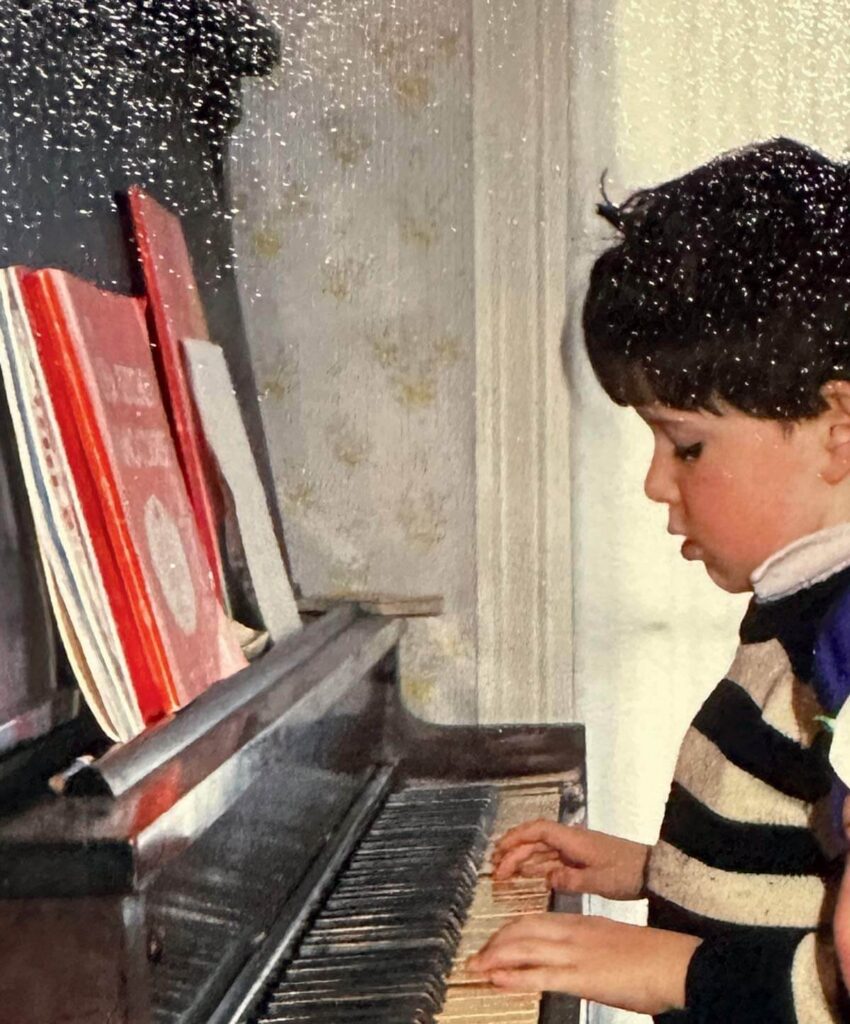
His life in music started early. He’s of Central Massachusetts stock, and when he was about 2, his family moved to a 1950s ranch house in a hilly, suburban neighborhood in Methuen. The house proved fateful. There was an old upright piano there, left by a previous occupant who didn’t feel like moving it. A very young Cosgrove started picking at the keys, and before long he was playing tunes like “Twinkle Twinkle Little Star” by ear. “I just remember this insane magic of like, ‘Oh my God, if you play this note and this note at the same time, it sounds this way, but if it’s this note instead, it’s a different thing,’” he says.
“It was his favorite thing in the house, clearly,” his mother, Kim Cochrane, recalls. “He was always there. It was a calling.”
Cosgrove’s parents weren’t musical. His mother is a retired educator and his father worked for the town. But they saw something in his early musical experiments, and when he was 5, they got him a piano teacher. The teacher was a woman named Judy Schmidt, who lived in Andover. That, too, proved fateful. Schmidt wasn’t the sort of teacher who endlessly drilled students on rudiments. “She gave me a very long leash,” Cosgrove says. “I would come in and want to talk about a song I heard on the radio, and we’d work on that. Or she’d send me home and say, ‘For next week, write a song about this snowstorm.’ It couldn’t have been a more ideal setup for whatever weird thing I’m doing now.”
He wrote his first proper song when he was 6. Fittingly, it was called “Waves.” “It sounded like waves—it really did,” his mother says. Before long, he was walking around, proclaiming, “When I grow up, I will be a composer!” An early inspiration was Beethoven. “I was obsessed with Beethoven,” he says. “I carried around a plastic bust of Beethoven, in a Calvin and Hobbes kind of way.” His mother chuckles at the memory. “Beethoven would go in the car with us,” she says. “He slept with Beethoven. He carried it around with him everywhere he went. He was very attached to Beethoven.”
Credit: Courtesy of Ben Cosgrove
Cosgrove’s parents were very supportive—despite being nonmusicians, and possibly because of it. “I think it was to my benefit that no one else in my family was a musician,” he says. “If there was a professional sax player or something around, they would have been like, ‘This is a terrible idea! He’ll never make any money!’” He had great teachers in Methuen who were constantly pushing him and introducing him to new material. He got into pop music, rock music, “Weird Al” Yankovic. (“He’s one of our best,” Cosgrove says. “His arrangements are so precise and clever.”) In high school, upperclassmen started feeding him jazz records, which opened him up even more. He became an omnivorous listener, and it all found its way into his music.
* * * * *
We make our way through a shaded section of Monadnock, through a tunnel of trees. “The best thing about this trail,” Cosgrove says, “is that you pop in and out of the woods a lot. You’re in this tunnel, but then you get a big, bald outcropping. And I like the effect of not knowing where you are, and then boom, you have an opportunity to orient yourself. And then you’re back in the woods again.”
We come to such an outcropping about a third of the way up, and stop and gaze out over the rumpled mossy-green bedsheet that is this part of New Hampshire. It’s a perfect day, clear and cool for August, and the view is interrupted only by a single slate-gray column of rain hanging in the middle distance.
“You couldn’t have asked for a better day,” I say.
“As long as the storm stays over there,” he says.
We gaze out for a few moments. What’s this view do for him? I ask.
“Oh, my God,” he says. “It’s so orienting. It’s a still point in the turning world. It’s always here. It’s looked pretty much the same for my entire life.”
The mountain played an influential part in his artistic development. Cosgrove remembers the summer before he went to college. He was about to move to Boston, and, as a kid with little experience with cities, he was nervous about it. “So I came up here,” he says. He climbed to the summit, looked to the southeast, and there he saw Boston, about 75 miles away. “I was like, ‘Oh, it’s right there!’” As it was when he was a little kid plying these trails, the unexpected pathways between different places snapped together in his mental map and told him where he was in the world.
In the years to come, he would live by those moments. “I get really squirrelly when I don’t have a sense of where I am relative to other things,” he says.
* * * * *
When the time came to apply for college, Cosgrove found himself at a crossroads. Should he go to a music school, or to a liberal arts school with a music program? He opted for the latter, and enrolled at Harvard University in 2006. He majored in music, but he went deep into the material that would provide the bedrock for his future work: geography, history of the North American landscape, environmental studies, literature of the environment. It was at Harvard that his unique artistic vision began to cohere. “My college thesis was a piece of electroacoustic music that was based on maps of Massachusetts,” he says. “It was terrible, but that’s pretty much when I started doing what I do now.”
His life on the road began at Harvard. In 2008, he got a summer job updating a Let’s Go travel guide, driving across the country from Maine to British Columbia, gathering and checking facts about restaurants, hotels, attractions. “It was unbelievably lonely,” he says. “I would get someplace, frantically sprint around the city doing all this work, and then it would be like six o’clock and I would be done. And I just remember feeling so empty, and out of place, and alone.”
What changed since then? He started paying closer attention. He trained himself to see, to feel, and to mine everywhere he went for flashes of insight and inspiration. “It’s hard to feel lonely in places if you’re really paying attention to them,” he says. “And what more do you need in life than to not feel lonely?” Now, he says, “I never feel that way. Driving around to weird new places is my favorite thing to do.”
After college, Cosgrove remained in Cambridge for a year, grabbing whatever “desperate musical odd job” he could get, and finished his first album, Yankee Division—a reference to the Yankee Division Highway, also known as Route 128. Inspired by the contrasts between rural New England and urban New England, the album came out to limited fanfare and scant sales, but it happened to coincide with a watershed moment for Cosgrove: He won a journalism fellowship from Vermont’s Middlebury College to pursue a project about acoustic ecology and noise pollution in national parks.
Over the next year he hit the road, visiting research sites, talking to scientists, noticing, composing, playing. “I began doing what I do now,” he says, “which is drive around, get confused by places, and write music about them.” In between these stops, he played every venue that would let him: bookstores, gas stations, cafés, bars—performing his music and telling stories about the landscapes that inspired it. He became a dynamic performer. “It wasn’t what you’d expect to hear at a bar gig,” he says, “but it was a fabulous training ground for learning how to get people to pay attention to me for an hour.”
These days, Cosgrove spends most of his time on the road, with his keyboard in the back seat, going from place to place, gig to gig, experience to experience. This, of course, is more like the life of an old-time folk singer than a typical classical composer. “I’m like a minstrel going from town to town with my little suitcase of songs,” he says. “I love it.”
* * * * *
We continue along the trail, scrambling up staircases of shattered rock, over tangles of gnarly black roots vainly seeking purchase in the thin soil. As we reach another outcropping, the column of rain from earlier has grown larger and is edging closer. And a new storm system has formed to the west of it. “We may regret this later,” Cosgrove says, “but that does look so cool.” We commit to reaching the summit, even though every hiker we encounter is beating a hasty retreat back to the base.
A little higher up, Cosgrove looks out again. He points to a long straight light-green line cutting through the lush green landscape below.
“It’s amazing how striking those power line corridors are,” he says.
“Like Parisian boulevards,” I quip.
“And just as romantic,” he quips back.
* * * * *
Ben Cosgrove is, suffice to say, exceedingly well-traveled. He spends most of his time on the road, crashing with friends and supporters, or traveling on the dime of organizations that fund his work. He’s written music about Kansas, New Mexico, Oklahoma, Texas, Ohio, California, Mississippi, and many other places. He has performed in every state but Delaware. He has played for cowboys at a ranch in Montana. He’s written music about Hawaiian volcanoes as part of a fellowship with NASA. He’s gone on a research vessel from Vietnam to Australia and written about the sea. When he drives, which is most of the time, he generally foreswears GPS because it eliminates the possibility of getting lost. Getting lost, he says, “opens you up to discovery. If you don’t disorient yourself a little bit, you’ll never find anything new,” he says. “Some of my best ideas started out as mistakes.”
Some of his best stories, likewise, started out as disasters. Once his car broke down in the middle of nowhere in Idaho, en route to a gig in Wyoming. He managed to get a tow, and was taken 60 miles to a town with a mechanic. But it was a Sunday, so the garage was closed. “It was a thousand degrees in July,” he says, “and I was just standing there in a cornfield with no plan.” So he called a friend in Wyoming who was going to host him after the show, and told him where he was. “He was like, ‘Oh, wild. My cousin lives there.’ So he called his cousin, and she and her husband came by and picked me up. Her husband’s family ran a cheese plant in town, and I got to go help out at the cheese plant for a week while we waited for my car to get fixed.
“I feel like that is illustrative of how lucky I tend to have been,” he says. “I think an earlier version of myself would’ve been much more panicky and horrified by having to reschedule these shows. But a steady diet of small disasters kind of prepares you for anything.”
For all his wandering, however, he remains “one thousand percent” a New England artist. “It’s maybe the most important part of my life.” He loves the geographical diversity—the way New England isn’t one place, but a place composed of many places. “It’s really 700 different landscapes, if you know how to tell them apart from each other,” he says. “You can travel for an hour in any direction from wherever you are and be someplace completely different.”
New England has been a consistent muse for Cosgrove. He’s recorded songs about the tidal rhythms of salt marshes on the Maine coast. He spent a month living in Acadia National Park, as part of one residency, and a year traveling around the White Mountain National Forest for another, while playing schools, prisons, and the Omni Mount Washington Resort. He’s composed music inspired by stretches of the New England Trail that run through Connecticut and Western Massachusetts, and by Northampton, Massachusetts, where he lived during the pandemic. He has gigged at L.L. Bean. As of this writing, he has performed in 60 of New England’s 67 counties. (“Feel free to put that in your piece,” he tells me. “Maybe it’ll help me to finally bag those last seven.”)

Credit: Corey Hendrickson
As much as the region furnishes him with inspiration, it functions perhaps more importantly as a lens through which to view other places. “This is kind of how I feel the world should look,” he says, indicating Mount Monadnock. “So the places that really strike me, or make me feel confused, or vexed, or uneasy, are that way because they aren’t forested and hilly. So much of my music is some version of How this place is not like New England.”
Like this mountain, New England is a fixed point in an ever-spinning, changing world. “I do feel really rooted here, and I wonder if I didn’t love New England so much, and feel so at home here, if I would have the confidence to explore as broadly as I do,” he says. “I can kind of glide around more freely, and with a more open heart, knowing that there’s a Mount Monadnock here, whether or not I crash and burn in New Mexico.”
* * * * *
Further up the mountain, we hit another outcropping. Cosgrove looks at the storm again. “I suspect we’re not getting out of this without getting wet,” he says. Another hiker passes, heading down, and mentions the storm. “We’re prepared to be wet,” Cosgrove tells him.
We keep going, and finally come within 100 yards of the summit. The greenery begins to yield to a field of bald rock. “This is a pretty cool moment, actually,” Cosgrove says. “We’re near the top, so it’s like the last gasp of forest.”
Four more retreating hikers pass.
“You’ll have the whole place to yourself because everyone’s fleeing the rain,” one says.
“We’re the dumb ones,” Cosgrove says.
A few more yards, and we make it to the summit. Cosgrove turns, and points to the southeast. “And there,” he says, “in perfect view, is Boston.”
On the side of us that is still clear, you can see the city skyline, some 75 miles away. It’s the view Cosgrove saw as a teenager, the one that oriented him and gave him the confidence and perspective to venture into a life of the unknown. He stares out at Boston, and points to the Pru building. “I’ll be playing there tomorrow night,” he says.
“Just don’t turn around,” I say.
He turns around. The storm is right on us. “For a second,” he says, “I hoped naively it would veer off. But we’re in the Zamboni’s path now.”
The wind kicks up, the temperature drops, a few pelts of rain fall. I pause to take some quick notes before my notebook is reduced to pulp. Cosgrove snaps a picture with his phone. I look up, and he’s smiling.
“I got a photo of your last moments being dry,” he says.
* * * * *
On our way back down, drenched, sliding over slick lichen-covered rocks and pestered by flies, Cosgrove talks about his mission. He’s played for every kind of person, he says, and he’s found that even in a time of division they all share a common love, regardless of political orientation. “Everybody loves the land,” he says. “I’ve done a lot of work in the last couple of years where I’m [politically] outnumbered a hundred to one everywhere I go, but they love hearing me talk about fields and rivers.”
He has a friend whose husband worked on a ranch in Montana. “They brought me in to do a private show for everybody who worked at the ranch,” he says. “It was all these wealthy cowboys, and they were the most rapt and engaged audience. They all had questions, because ranchers think about the nuances of landscape more than almost anybody else. I went back for five years running. I returned to the exact same place.”
That sort of engagement lies at the core of his art. “I think a lot of good can come from encouraging people to think more critically about how they are affected by the land around them,” he says. “Especially because if you see the same places most of the time, they gradually become invisible to you. I frequently run into people who are like, ‘I never thought to look at this rock like that, but after you played your song about that other thing, I have a new appreciation for this thing I see everywhere.’ Helping people be more mindful of familiar places feels like a good use of me.”
We eventually reach the base of Mount Monadnock, wetter, and dirtier, and somewhat fly-bitten, but happy. We shake hands to say goodbye. I ask what he’s doing now, and he says, excitedly, “I’m going to work.” And he gets back in his car, turns the key, and disappears down the road.
Ear to the Ground | The Recordings of Ben Cosgrove
Yankee Division (2011): Cosgrove’s first album, which he started when he was a student at Harvard. It explores the landscape of north-central New England and takes its name from Route 128, aka the Yankee Division Highway, which divides urban and rural Massachusetts.
Field Studies (2014): The product of his early life on the road, Cosgrove’s lush, sprawling second album ventures far beyond the comfortable familiarity of New England, taking its inspiration from places as diverse as Lafayette, Louisiana; Palo Alto, California; Abilene, Kansas; Bath, Maine; and Montreal.
Salt (2017): Cosgrove’s “breakup album” was inspired by salt marshes, fault lines, tidal rivers, and estuaries—restless landscapes where the only constant is change, and where you’re forced to make peace with the fact that the ground beneath your feet might not be there for long.
The Trouble with Wilderness (2021): Written and recorded during the pandemic, which Cosgrove spent in Northampton, Massachusetts, Trouble studies the intersections of city and wilderness, and makes the case for how “the built environment can be as insane, impressive, humbling, affecting, and worthy of attention as any … wilderness.”
Bearings (2023): An album about movement, Bearings was written on the spot in the studio to capture the feeling of orienting yourself in an unfamiliar landscape. “There was something about having to find a song in the moment by moving around the piano,” he writes, “that felt … true to the way I engage with the world.”
Topograph (2026): Cosgrove’s latest recording is a collection of songs about places where water and air move land. Much of it was written while Cosgrove was on a residency north of the mouth of the Columbia River, “an insane landscape” where islands move and swaths of land are made and unmade. “A really, really wild place,” he says.