



A Fatal Mistake | The Sinking of the El Faro
On October 1, 2015, the container ship El Faro sailed directly into the path of Hurricane Joaquin. When it sank it took the lives of all 33 aboard, including eight New Englanders. Rachel Slade wanted to know what happened and why. You will not soon forget what she found.
By Rachel Slade|Sep 29 2016|

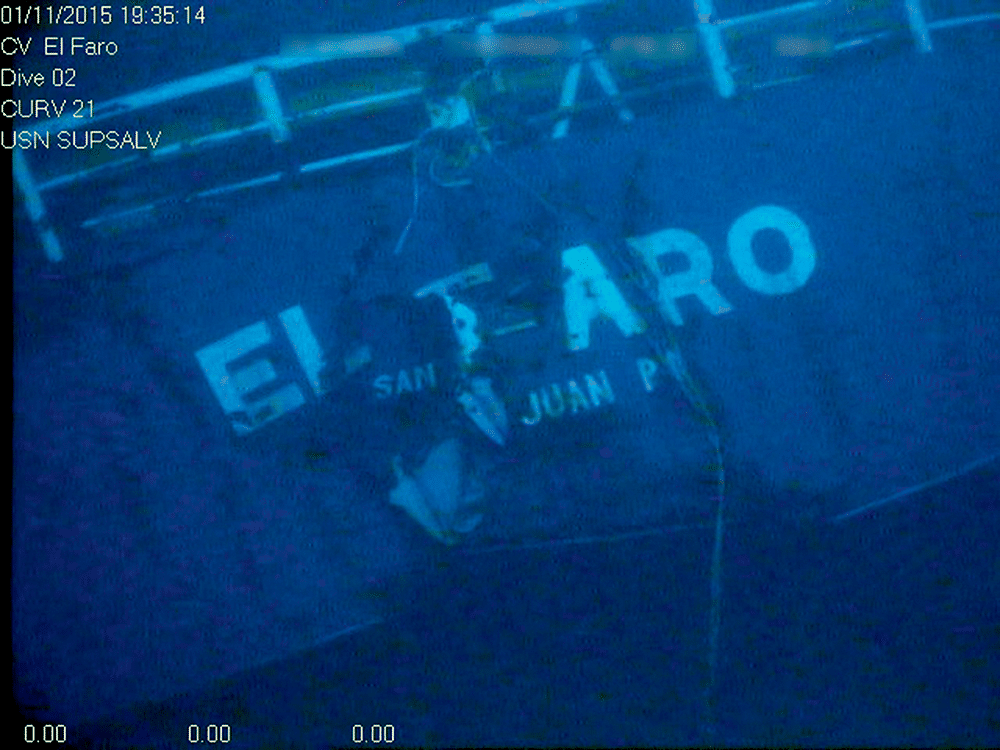
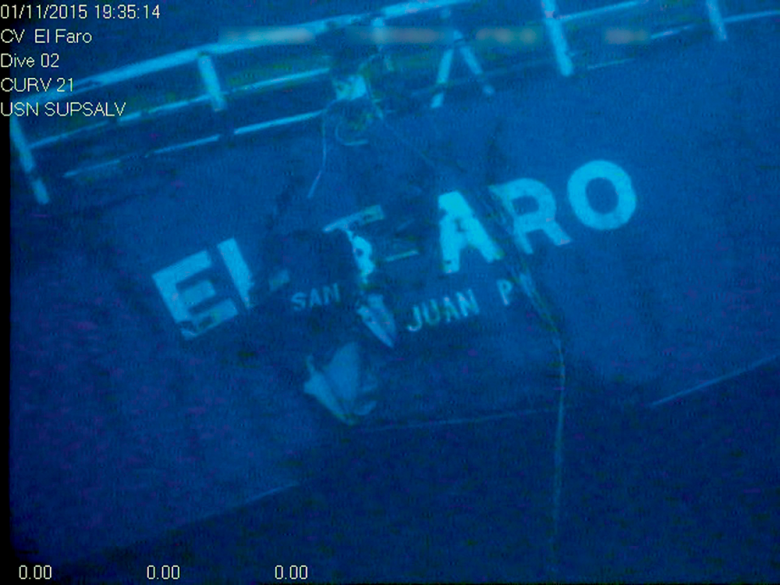
Videos taken 15,000 feet below the ocean surface showed the ghostly sight of El Faro’s stern, which became the epitaph of a maritime tragedy whose final hours will likely forever be shrouded in mystery.
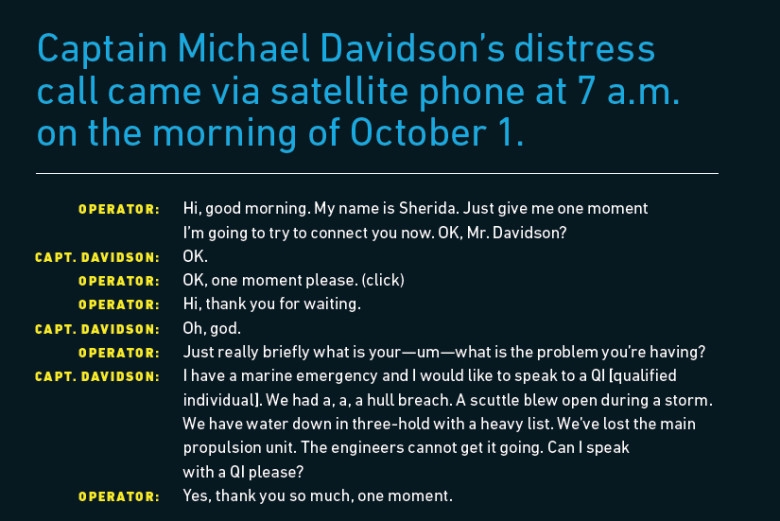
Credit: National Transportation Safety Board via Associated PressThe operator put Davidson on hold and then the line went dead. Captain John Lawrence, the shipping company’s designated person on call, had received a similar voicemail from Davidson just minutes before and was trying in vain to reconnect with his colleague at sea. Seventeen minutes later, three automated distress signals from the El Faro triggered a massive Coast Guard search. After flying and sailing for eight days over 183,000 square miles around the ship’s last known position, the effort turned up an oil slick, a debris field, and a person so battered as to be unrecognizable floating in a survival suit.
When news broke of the vessel’s disappearance, people wanted to know how a modern American ship as big as Boston’s Hancock Building could sink without a single survivor. Why did the captain steer directly into the path of a hurricane? Why did the engines fail? Who’s responsible? Marine experts pointed to El Faro’s advanced age, or the company’s alleged greed, or the captain’s supposed arrogance in single-mindedly pursuing what became his deadly route.
In November 2015, a remote-controlled deep sea explorer launched from Woods Hole, Massachusetts, plunged 15,000 feet below the Caribbean Sea to photograph El Faro’s bruised, twisted hull. The ship’s bridge had been violently torn from the boat, and lay half a mile away on the ocean floor.
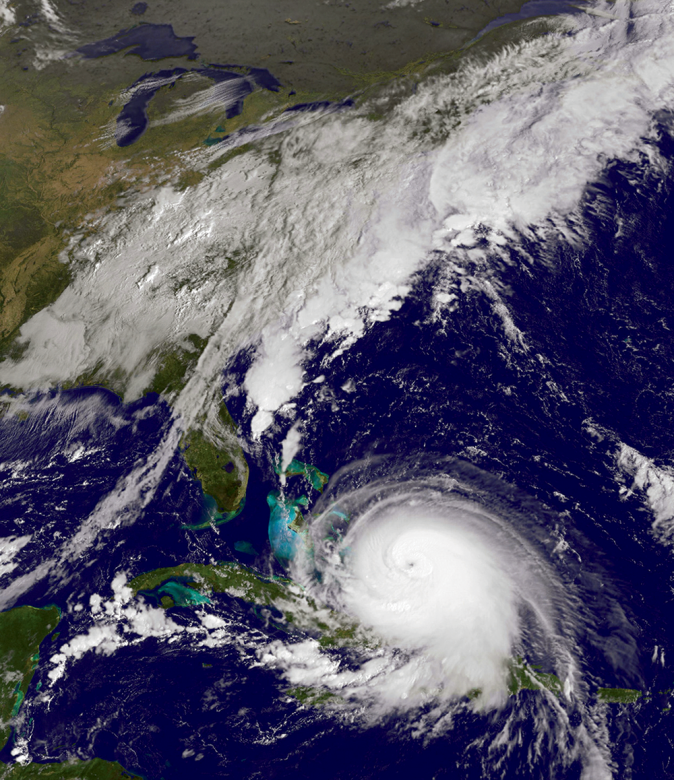
Credit: NOAA via Associated Press (Satellite Photo)
A federal investigation—four weeks of hearings held three months apart in Jacksonville, Florida—was jointly conducted by the U.S. Coast Guard and the National Transportation Safety Board. The proceedings produced copious testimony from former crew members, weather experts, shipping professionals, and shipping company executives. But no clear answers. In August 2016, another deep sea explorer retrieved the ship’s voice data recorder, which provided audio from the bridge, recorded in the hours leading up to the sinking. On it, you can hear the captain order the crew to abandon ship. It will likely take months before an official report is issued, and even then, we may never know exactly what happened on board El Faro that day.
In the spring of 2016, I became obsessed with shipping and the mystery of the El Faro. As I dove deeper into the tragedy, I began to ask a different question: What forces had brought that ship, and those sailors, including eight New Englanders—Michael Davidson, Danielle Randolph, Michael Holland, and Dylan Meklin from Maine; Jeffrey Mathias, Mariette Wright, and Keith Griffin from Massachusetts; Mitchell Kuflik from Connecticut—to that particular place at the particular moment, when a normally calm sea surged dozens of stories high, rolled the enormous vessel, unseated its cargo, and sent it to the deep?
Few Americans spend much time thinking about the industry, but cheap global shipping is the backbone of 21st-century life—it’s how we get $300 Chinese-made laptops and $12 Indian-made cotton T-shirts. About 90 percent of worldwide trade travels by sea. Sift through stacks of H&M jeans or walk the shoe aisles at T.J. Maxx and inhale the shipping container’s stale perfume; that’s the scent of commerce.
From an airplane, cargo ships look like steel alligators creeping up brown rivers, or barely visible specks cutting a perfect wake in the open sea. Dockside, they’re awesome and remote—with steel prows rising 30 feet up above the waterline, blue and red containers stacked eight stories high, and enormous propellers below.
The huge boats have their fans, too: With vessel-tracking websites like marinetraffic.com, you can follow ships as they travel around the globe. Each fuel-guzzling leviathan transporting millions of dollars of cargo, crewed by a handful of sailors watching the horizon for pirates or weather, appears on the screen as a small, colored blip. Hobbyist ship-spotters regularly upload time-stamped photos of the boats they’ve seen.
Throughout the spring, I streamed the hearings while driving or doing the dishes. I eavesdropped on chat rooms where professional seamen debated every revelation or news report. I researched the history of international shipping and the U.S. Merchant Marine, and visited the Maine Maritime Academy in Castine where young men and women were preparing to sail to Europe aboard the school’s training ship, the State of Maine. Their excitement was so contagious that I felt the pull to steam across the Atlantic with them. I wanted to experience the vastness of the ocean among confident young sailors and knowledgeable mariners. What was it like to be cut off from the world, focused only on the rigors of seafaring?
Instead, I sat for seven hours a day in the overly air-conditioned Jacksonville convention center-turned-courtroom listening to testimony. Relatives of those lost occupied the front rows facing the investigative panel, while TV crews and journalists watched from the back. Under oath, experts and mariners answered the panel’s questions with their backs to us; unable to see their faces, I could hear the concern or fear in their voices.
During breaks, many of us escaped the room’s chill to thaw in the Florida sun. That’s where I met Jill Jackson-d’Entremont, who’d recently moved from Philadelphia to Florida to be closer to her brother, Jack Jackson, an able seaman. When he was lost on the El Faro, Jill went to clean out his house and found his laundry still in the dryer.
Each lost sailor had stories he or she could not tell. To learn them, I needed to get closer to those they left behind. One chilly Sunday morning, I headed north to meet Deb Roberts.
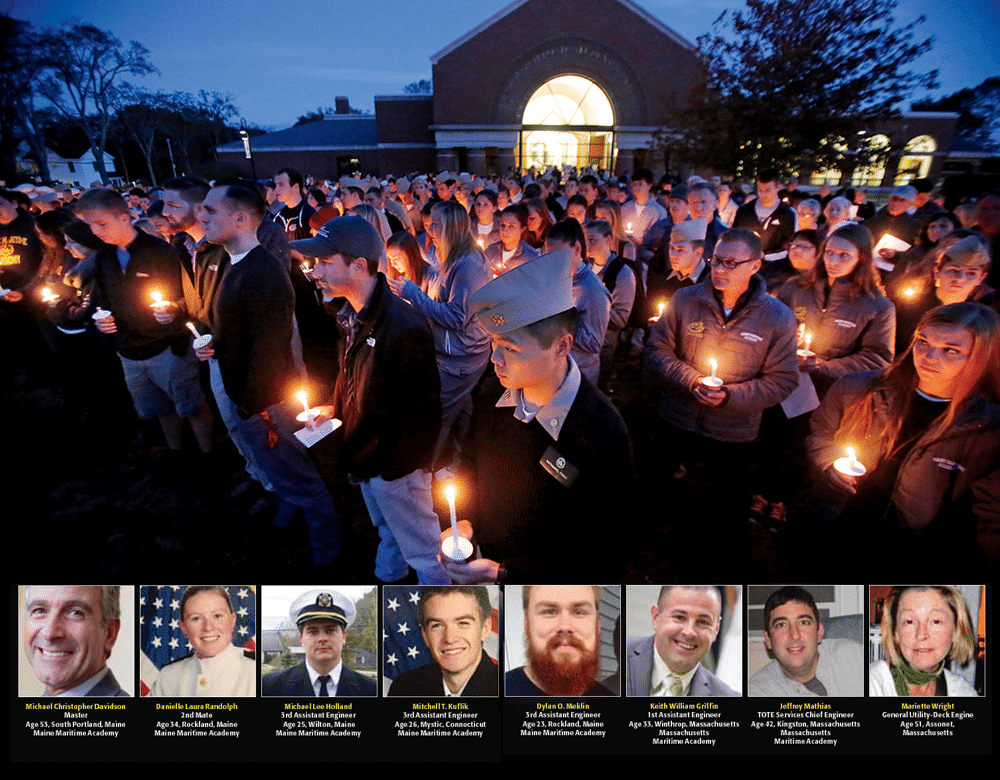
Credit: Photograph by Gregory Rec/Portland Press Herald via Getty Images | El Faro crew courtesy of their families.
Wilton, Maine, is landlocked and rural. To get there, take Route 4 out of Lewiston and follow the trail of used car dealerships, gun stores, and gas stations, over the Androscoggin River (just around the bend from the ailing Verso Paper Mill) to the foot of Wilson Lake, where a hard right gets you to the town of 2,000. Main Street’s offerings: a public library, bank, and post office. This is where Michael Holland lived—raised in nearby Jay, where he played high school football and got his first shotgun at age 16. This is lake and mountain country; the ocean seems worlds away.
Deb Roberts sent two sons to the Maine Maritime Academy. Michael was her oldest. After graduating in the spring of 2012, he went to work in the hot, humid, earplug-and-earmuffs-loud El Faro engine room to finance his life on land.
Southerners send their children to the military. New Englanders send their children to sea. Even before the American Revolution, a 12-year-old Maine boy could work in a ship’s galley and emerge a decade later as captain of his own vessel. After the revolution, the country depended on New England’s maritime prowess to feed its people and drive its economy. By the late 1700s, 90 percent of federal revenues came from the region’s merchants, so much so that when drafting the country’s first laws, Alexander Hamilton continually consulted with his Essex Junto—merchants who had opened up trade in places as far-flung as Guangzhou, the Pacific Northwest, and Fiji, and were now running large fleets from Salem, Newburyport, and Boston.
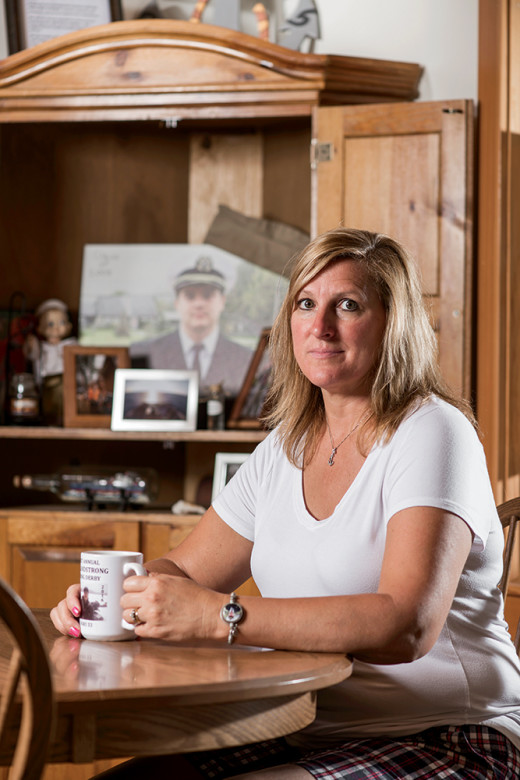
Like countless Maine boys before him, Michael had a plan: He’d bought a house in Wilton where he hoped to start a family, and once he owned the house outright, he would give up his life at sea for a job running a local power plant, just as his football coach had done. To Michael, friends came first, and he had plenty of them. “Michael would just be the first to volunteer, to try something crazy, to live life to the fullest,” Deb says, sitting across from me at her dining room table. “He had no idea that he just had 25 years to do it, but he lived as though he did.”
Credit: Mark Fleming
Behind her, a corner cupboard had been given over to “El Faro 33” gifts and mementos, which spilled onto the adjacent sideboard. On a shelf, a photo of Michael next to his first deer kill shows him long and lean—a boy who had suddenly found himself in a man’s body. In his Maine Maritime Academy graduation picture, you can see the wispy hint of a nascent mustache; his white officer’s uniform is snug in the middle where four years in a classroom softened the former athlete.
While Michael was at sea, Deb kept busy. She lobbied Maine legislators for a tax exemption for young mariners, worked as an administrator in the Jay school system, raised her other two children, and went at the weeds in her garden with a vengeance.
Michael preferred doing rather than pondering, just like his mother. “I never really got into a lot of conversations with Mike about the nitty-gritty details of shipping,” Deb says. “When he was home, it was about, What you making for dinner, mom? You got any leftovers? Did you go hunting? Did you go fishing? Did you catch any fish? Did you go to camp? You know, those types of things. We never talked shop, just the big things.”
But Deb noticed a change in Michael over his final summer. “We saw him more than we had seen him at all before,” she said. “You know, he lived 10 minutes away and we’d hardly ever see him. He was a single guy and when he was off on his Saturdays, he was off having fun.” Now that Michael had starting dating a nurse from Jay named Kelsea who worked in Farmington, Deb says, “I saw him settling down. I really did—I saw him becoming a grown-up.”
On Tuesday morning, September 15, Michael flew down to Jacksonville to join the crew of the El Faro for its final Puerto Rican run. Kelsea drove him to the Portland airport. The evening before he left, Deb brought him his favorite Greek pizza and reminded him to work on his Christmas list and text it to her so that she could start shopping for him. “Then I gave him a hug and a kiss, told him I loved him, and to have a great trip and I’d see him in November.”
Hurricane Joaquin began as a tropical depression in the Atlantic Ocean on September 28, the day before the El Faro left Jacksonville. The National Hurricane Center (NHC) predicted that as it intensified, the storm would get pulled north toward Atlantic City by a low-pressure system. This forecast proved dead wrong.
Even with all our technology, predicting the weather is still very much an art form. It begins with plugging raw data—temperature, barometric pressure, and regional systems—into dozens of computer models, which then generate various storm trajectories and strengths. The models rarely show identical storm paths and intensities, but often, a pattern emerges. Specialists analyze these patterns using their knowledge of past storms to guide them. By the time an NHC forecast is published, the data on which it’s based is at least six hours old.
More information increases accuracy. On land, data is in abundance. Every city, town, and airport across the country constantly records and reports minute changes. At sea, information is spottier; raw data comes from aircraft, ship-to-shore reporting, and weather balloons.
Storm intensity and trajectory are notoriously difficult to predict in the tropics. Due to winds, ocean temperatures, and changing currents, systems bounce around in confounding ways. Tom Downs—a professional meteorologist for Weather Bell, a private service that independently analyzes raw data and comments on the official forecasts—compares predicting tropical storms to trying to follow the end of an uncontrollable fire hose.
Credit: Reuters/NOAA
But on Tuesday, September 29, at 6 a.m., 15 hours before the El Faro left Jacksonville, Downs and his fellow Weather Bell analysts saw enough in their models to challenge the NHC forecast. They sent their clients a warning that the nation’s weather prediction was wrong: “While acknowledging this is tricky and not as obvious to me as Sandy,” the report said, “I am not just winging it … to be blunt it really has an ugly idea and is farther to the west than NHC. Given what is setting up in front of this (with the rain and easterly flow), this would be a disaster.”
That evening, Captain Eric Bryson, a ship’s pilot for Jacksonville Port, was waiting at home when the call came: The container ship El Faro was ready to leave port for its usual run south to Puerto Rico. At 7:30 p.m., he walked up the gangway of the ship to the top deck, then up several flights more to the bridge, where he met with the ship’s master, Michael Davidson. After a cup of coffee, Bryson stepped out into the night air on the port-side balcony. It was a balmy 80 degrees and calm under mostly cloudy skies. Looking up St. Johns River, Bryson prepared to guide the huge ship from the busy port east to the sea.
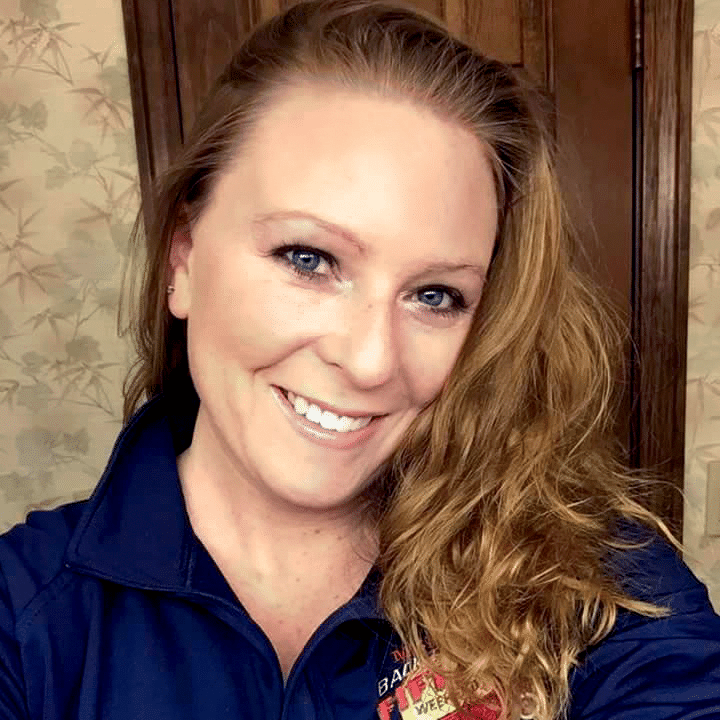
As a pilot, he was familiar with many of the El Faro’s crew, and had a special fondness for second mate Danielle Randolph, whom he’d known since she was a cadet working on the sister ship, El Morro, 12 years before. “On the bridge, she was always happy and friendly, and certainly all business,” he told me over the phone. That evening, he had heard Danielle on the walkie-talkie reviewing the cargo—294 cars, trucks, and trailers below deck, as well as 391 containers on its top deck. Remembering her, Bryson said, “She was uncommonly nice.”
* * * * *
Danielle spent her childhood in Rockland on the Penobscot Bay, determined to work on the ocean. Her passion started early: “I remember taking Danielle to kindergarten,” her mother Laurie Bobillot tells me, “and, you know, being my oldest, when I took her to school I was bawling my eyes out. I said to her, ‘Oh, I don’t want you to go to school.’ And Danielle goes, ‘Mama! I want go! I want to learn about the water!’ And I’m thinking, ‘Wow, this is just kind of weird.’”
In the summers, Danielle worked on the docks of Port Clyde for her aunt’s lobster business, and at the O’Hara Corporation—a fishing consortium and marina in Rockland. In the fall of her senior year at Rockland High School, Danielle only applied to the Maine Maritime Academy. That’s not how it works, her mother counseled her. You apply to a lot of schools and hold your breath. Danielle replied, “Mother, I’m going to MMA and that’s that.”
During her freshman year at the academy, Danielle phoned home to ask Laurie, a hairdresser, about hair loss. Was it normal to clog up the shower drain? Sure, she answered. Everyone sheds. When Laurie saw her daughter that spring, she was alarmed to discover that the stress of college had created bald patches in Danielle’s thick blonde locks. Her daughter shrugged it off. That was her way: She soldiered through.
Later, as a deck officer aboard container ships for TOTE Maritime, Danielle earned a reputation for holding her own as a cheerful, wisecracking, hard-working woman in the largely male industry. Still, she painted her stateroom pink and decorated the drab ships’ interiors for Easter and Christmas. As soon as she returned to Maine from each tour of duty, she’d shop for shoes and vintage ’50s dresses and snuggle with her calico cat, Spot.
For 10 years, she worked several stories above where engineers like Michael Holland labored in the engine room. She calculated loads, watched the weather, carried out orders. She was busy, and liked it that way.
But months-long stints away, hampered by limited cell and Internet service, made it difficult to maintain friendships. Danielle tried dating another sailor, but ended the relationship when she feared that settling down would ruin her career. When Danielle did reach out to her family while she was at sea, her messages were brief, impersonal, signed with a simple, brisk “-D.”
As a deck officer in a quasi-military industry, Danielle was trained to follow commands and avoid questioning her superiors. If she had concerns, her style was to walk away and think over the situation in private rather than confront it directly. Her stoic nature dovetailed well with the merchant marine, where life is about order, checklists, protocols. It’s an industry that attracts people who prefer solving problems with a wrench. Many mariners speak wistfully of the peace they find on board, where they are temporarily cut off from the noise of the world.
Though Danielle and her mother were close, she rarely talked about her life at sea. But lately, Danielle found herself serving under a steady churn of new masters. Some were hands-on—walking the decks and running daily drills to keep the crew up-to-date, alert, and engaged. Others disappeared into their staterooms and let the ship run itself, trusting their mates to be their eyes and ears.
Credit: Courtesy of the Randolph Family
Technology may have transformed the industry, but the captain still sets the culture aboard ship, just as he did in the 19th century. When Captain Ahab appears three days into the Pequod’s voyage, Melville writes: “Not a word he spoke; nor did his officers say aught to him; though by all their minutest gestures and expressions, they plainly showed the uneasy, if not painful, consciousness of being under a troubled master-eye.”
In May, TOTE had forced the resignation of Captain Jack Hearn, who’d served the company on and off for 28 years, 25 as master. Same with Captain Peter Villacampa, who had originally hired Danielle. Steven Shultz, the first mate on the El Faro’s final voyage, had been in that position only since August. There was barely time for each new captain to establish a rhythm, and there was even less job security. Nearly everyone was considered temporary.
In shipping, where you learn on the job, turnover can lead to a critical loss of knowledge. Some former El Faro crew members testified that they gleaned more about the aging boat they served by stumbling onto manuals on board. At the hearing, former Captain Hearn testified, “When I first transferred [to TOTE], there was tremendous experience on the specific run. After 10 years in the company moving up through the ranks, they knew their job, and they had a good mentoring program. By the time I was leaving [in 2014], that was changing. There was less experience both on the deck and in the engine room.”
Thousands of containers are lost at sea every year because they weren’t securely fastened. When a storm batters a boat, improperly tied cargo can crash onto the decks or slide around in the hold, compounding a ship’s roll. Hearn described using a tool for testing the “button”—the latch on the deck floor to which lashings were fixed. Later, a TOTE chief mate claimed that he’d never heard of the tool. Marine architects specified that El Faro’s cargo lashings should come from the button at a 45-degree angle, but some crew members said they didn’t know why that angle was important, or even how to test the lashings. Lashing tension—critical to its performance—was tested on board by feel. At sea, knowledge can be the difference between life and death.
Privately, Danielle hinted to her mother that she might be over it. The culture at TOTE had changed. She considered going back to school to study maritime law, or working on an oil rig.
On September 28, as she was preparing to fly down to Jacksonville for yet another tour on the El Faro, Danielle hemmed and hawed. It wasn’t like her. “She just felt that something wasn’t right,” Laurie says. “She didn’t want to go out shipping this past September, which was really weird. That was the first time ever, ever, that we heard the kid say, ‘I really don’t feel like going.’”
By 8:25 on the evening of September 29, the El Faro’s crew dropped the last of its lines and Captain Bryson guided the boat down the river. While he worked, he chatted with the ship’s master, Michael Davidson, and Jack Jackson. The men discussed the usual things, Bryson testified, including water traffic. They also touched on the tropical weather system building in the Atlantic. “I don’t recall what I saw or said,” Bryson told the investigative panel, “but Davidson said, ‘We’re just gonna go out and shoot under it.’ It was audible to everybody. No one reacted.”
An hour later, Bryson had navigated the El Faro to open water off the coast of Florida and prepared to disembark. He climbed down the side of the cargo ship by rope ladder and onto the pilot boat. At 9:30 p.m., the tug turned and headed back to land. Bryson would soon be the last person alive to have stood on the El Faro’s decks.
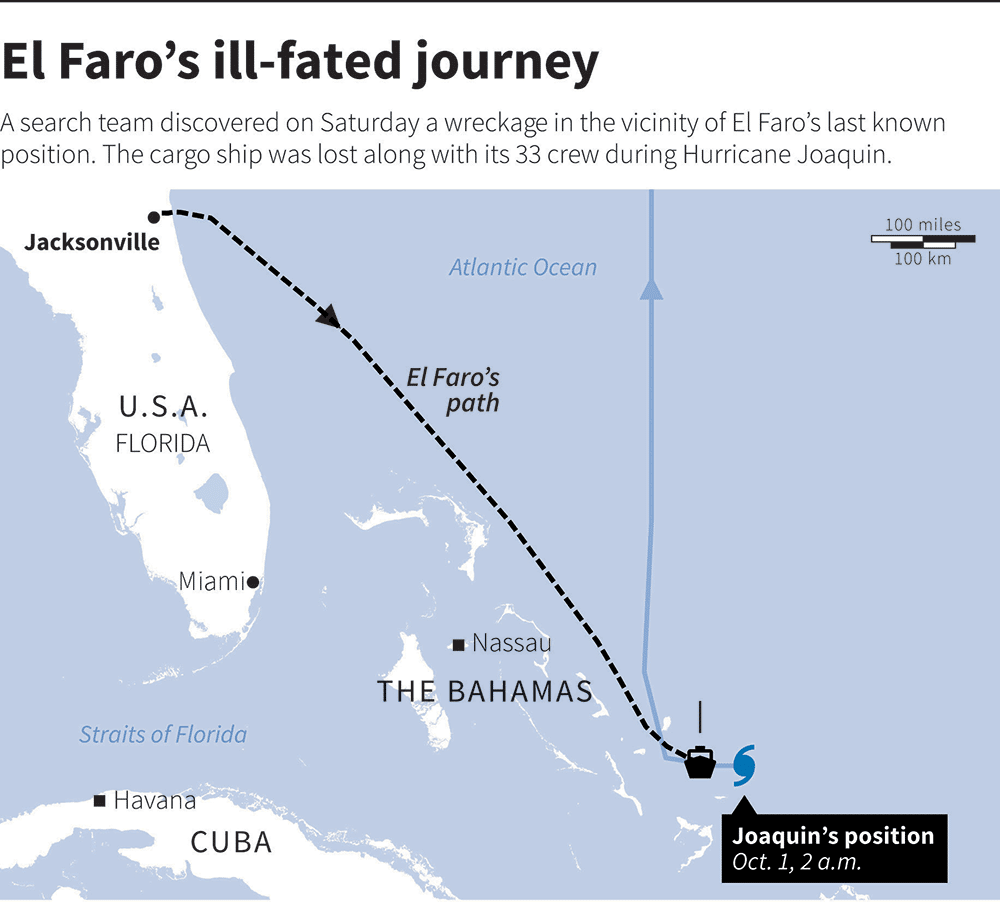
Through the night and into Wednesday, the tropical storm lumbered stubbornly along its southwestern path, just as Weather Bell predicted, slowing down and gaining intensity. By daybreak on September 30, the NHC declared the system a Category 1 hurricane named Joaquin, with a center located approximately 125 miles north of the Turks and Caicos Islands, but the forecast didn’t alter its predicted path. The El Faro sped down the Florida coast along its usual southeasterly route.
Captain Davidson had graduated from Maine Maritime Academy more than a decade before Danielle and Michael. Slim with salt-and-pepper hair, 53 years old, he had grown up on the Maine coast, where reminders of a glorious maritime past haunt every corner; where majestic inns are named for sea captains, like Camden’s Captain Swift Inn, Searsport’s Captain A.V. Nickels Inn, and the Captain Jefferds Inn in Kennebunkport; where official town welcome signs often depict schooners at full sail. Even the names—Searsport, Bucksport, Kennebunkport—speak to their nautical importance. This is where, for generations, boys went to sea to support their families through shipping, whaling, or fishing. Some never came back.
Davidson had spent his youth on the water. He’d mastered boats for Casco Bay Lines along the Maine coast and tankers in the Gulf of Mexico for ConocoPhillips before joining TOTE Maritime in 2013 to tag-team the Puerto Rican run. He made a good living, enough to maintain a 4,100-square-foot home on a cul-de-sac outside of Portland for his wife, Theresa, and his two athletic daughters. Now that the girls were in college, expenses were high. Fortunately, mastering container ships paid well, if you could get the work.
The day before, TOTE had offered Davidson time off. He declined, saying that he didn’t want to lose vacation days because he wanted to complete his shift in time for his 25th wedding anniversary.
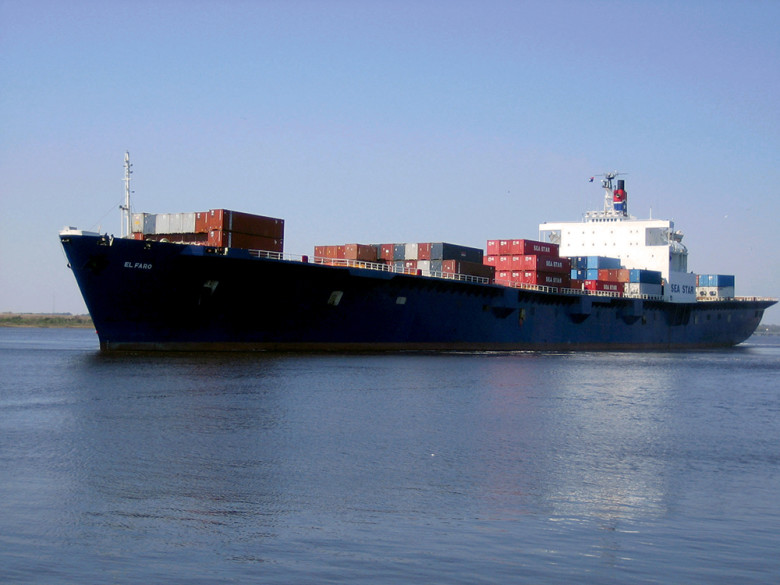
The El Faro was 28 years older than the average cargo ship docking in American ports, ancient by international shipping standards. It had already lived several lives since it had been built in Pennsylvania during the Nixon administration. Originally christened the Puerto Rico, it was one of the last vessels produced by Sun Shipbuilding & Drydock Co. before the yard shut down. For nearly two decades, the ship carried cargo between San Juan and the East Coast of the U.S. for a Puerto Rican outfit. In 1991, Saltchuk, the Seattle-based parent company of TOTE, assumed ownership. The boat was conscripted to transport military cargo for two wars, and after being lengthened 90 feet in 1993, served in the rough Alaskan waters as the Northern Lights before traveling through the Panama Canal one last time to do the San Juan run again as the El Faro.
When news of the El Faro’s disappearance hit, a handful of Sun retirees reminisced on online message boards about building it. After the accident, Deb Roberts received a ship in a bottle handmade by a former Sun shipbuilder named John Glanfield, who said he had worked on the El Faro; he still felt a connection to the boat he’d help construct so many years ago.
The El Faro flew the American flag, and this is significant. One of the earliest acts of the U.S. government was to protect its maritime interests by forbidding foreign ships from participating in the country’s coastal trade. Some 200 years later, vessels hauling cargo between American cities must be domestically registered, built stateside, and crewed by citizens—members of the unions—following American labor laws. This legislation, known as the Jones Act, is designed to ensure that the U.S. isn’t forced to depend on a foreign entity for transporting goods, cargo, or troops during wartime. It also guarantees that America retains a certain level of nautical knowledge, should it ever find itself globally isolated.
And yet, the laws plague American shipping. Because U.S.-built vessels cost at least twice as much as those made in Asia, shipping companies often keep their woefully outdated boats longer than they should. It’s simply too expensive to upgrade their fleets. Many of the El Faro’s components, including its open lifeboats—just like those you’d find on the Titanic—were grandfathered in. Its power plant was also ailing. A compliance agent testified during the hearings that she wouldn’t bring its boiler up to full pressure because, well, it was old. In fact, one of two boilers on the El Faro’s steam plant had been shut down for inspection just before its fateful run, and was found to have significant problems. For this reason and others, the Coast Guard put the boat on a watch list; the El Faro was scheduled to be dry docked and overhauled in November before going back to Alaska.
Credit: Courtesy of TOTE Maritime
At its peak, the American merchant marine moved 40 percent of the world’s trade. Then shippers began registering their boats in foreign countries to get around Jones Act requirements. Now the American merchant marine carries just one-half of one percent of global trade.
An ever-diminishing fleet means fewer job opportunities. Often, captains will take a first- or second-mate position on a boat to earn a paycheck. When oil prices dropped last year, petroleum companies reduced output, requiring fewer tankers and barges, and fewer crews to helm them. Mariners took another hit; good-paying jobs in the merchant marine protected by American labor laws are scarce indeed.
In this climate, Davidson was angling for a promotion. To comply with new emissions regulations in the Caribbean, TOTE had ordered a pair of liquid natural gas ships to replace its three aging vessels—El Morro, El Yunque, and El Faro—and Davidson hoped to captain one of these. He interviewed for the position in May, and was awaiting an answer when he arrived in Jacksonville in September. If Davidson didn’t get the promotion, he would probably follow the old boat through the Panama Canal back to Alaska, where it was slated to do the Northwest route once again. Michael Holland had already been told that he’d join the El Faro on its West Coast run in the spring of 2017. That was a long way from Maine.
In fact, TOTE wanted younger captains to helm its gleaming LNG Caribbean fleet. That makes sense, a veteran mariner tells me. “I’ve seen it’s much harder to train experienced captains for these vessels. What you need is video game experience. With non-feedback of a vessel, it’s more intuitive.” Besides, he adds, “knowing how to run an antique steam plant, not many captains can handle that kind of vessel. TOTE probably decided Davidson was more valuable in Alaska.” TOTE had identified its LNG captains, but probably hadn’t yet notified Davidson that he was not one of them.
On Wednesday afternoon, a day after the El Faro left port, former second mate Charles Baird was at home in South Portland watching the Weather Channel, and what he saw of the developing storm worried him. He texted his concerns to Davidson, who at that point was still close enough to the coast to get cell service. Like all deck officers, Baird knew that captains ultimately decide the route, but there’s often room for debate. Charlie Baird was navigating when Davidson took the same inland route during tropical storm Erika. A former first mate of the El Faro told me, “He was the one who’d convinced him to go inland.” He adds, “I challenged the masters all the time. I said, ‘Captain, you need to take the old Bahama channel.’ I said, ‘I’m putting it on you.’ You gotta threaten them.”
This time, on land and off-duty, Baird’s powers of influence were limited.
Davidson assured Baird that he was aware of the storm. Hurricanes were almost always pulled north at some point before hitting the Caribbean island chain, and a Category 4 hurricane hadn’t tracked through the Bahamas since 1866. But Joaquin was taking its time; its path defied the odds.
Later that day, an increasingly concerned Baird texted Davidson again: What was the captain’s plan for avoiding the storm? Davidson replied that he was heading along the normal route at full steam (20 knots), and would sail under the system. Baird followed up, reminding Davidson of the escape routes available to him—the channels cut between the islands that would get him to the lee side if he found himself in trouble.
Twelve hours later, Joaquin had inched southwest while escalating to category 3—a major hurricane with winds up to 129 miles per hour—while the El Faro continued on its collision course with the storm. Now the ship was east of the Bahamas as Joaquin closed in.
Captain Kevin Stith was steering El Faro’s sister ship back up to Jacksonville and didn’t like what he saw. He was on the other side of Joaquin, closer to Puerto Rico, when he sent an email via satellite to Davidson to report that he’d just recorded 100-mile-per-hour winds. He warned him about the errant NHC forecast, and asked about his plans.
In his testimony, Stith said that Davidson replied that he had been watching the storm, had altered his route southerly; he expected to be on the back side of the hurricane in a few hours. But GPS tracking later revealed that Davidson hadn’t changed course. In fact, Davidson continued full steam ahead on a straight southeastern course up to the end.
During the hearings, Davidson was described by those who worked with him as conscientious, if not hands-on. He wasn’t deeply involved with the minutiae of ship operations; like many captains, he relied on the other deck officers—like Danielle—to be his eyes and ears. Stith, who frequently served as Davidson’s first mate before becoming master of the El Yunque, testified,“I did not see him on deck often. Maybe twice during my time with him.”
But Davidson’s cautiousness may have gotten him into trouble with employers in the past. Some news services reported that he had lost his previous petroleum company job because he’d elected to have his ship towed to port when it developed steering problems. Just a month before his final voyage, he’d rerouted the El Faro to avoid Tropical Storm Erika. After the El Faro sunk, experienced mariners online often theorized that TOTE had chewed out Davidson for this longer voyage, which would have cost the company time and fuel.
Like any company, privately owned TOTE needed to be profitable. In the early 2000s, it played a cutthroat game of chicken with two other U.S.-flagged transportation companies to monopolize the Puerto Rican route, a major run protected by the Jones Act. In an attempt to bankrupt each other, the three carriers deliberately cut their shipping prices to unsustainable levels, and TOTE, along with Horizon, emerged victorious.
Eliminating the competition wasn’t enough to satisfy TOTE’s executives. In 2008, a federal antitrust investigation uncovered a years-long price-fixing scheme that the two surviving companies had worked out to ensure that each made money from the Puerto Rican route. Both companies pled guilty and paid millions of dollars in fines. High-level executives from TOTE and Horizon went to jail. TOTE restructured and cut management.
It’s possible that this history, combined with his need to impress TOTE, colored Davidson’s judgment when confronted with a storm as he steamed south in the Atlantic Ocean.
Then again, it’s possible that Davidson didn’t understand what he was up against. Stith says that when he served as Davidson’s first mate, he observed that the captain relied heavily on the Bon Voyage weather reporting system, a proprietary service paid for by TOTE. “I think that was probably his primary resource; it had been proven over the years reliable,” he said during his testimony. “I think in our conversations he had full faith in that Bon Voyage System.”
At the hearings, Bon Voyage representatives revealed that they generally repackaged National Weather Service forecasts, a data-inputting process that took several hours after the original report had been issued. Their predicted trajectory for Hurricane Joaquin, sent out on September 30, was as much as 21 hours old and 500 nautical miles off.
Slow-moving hurricanes are hell for mariners. With hours and hours of high winds and high seas, even the saltiest sailors get seasick as the enormous boat rolls, dips, rises, and slams down into the troughs of the waves. “It’s a big danger,” testified Hearn, who’d been at sea during Hurricane Sandy. “When you’re in the grip of heavy seas for a longer period of time than a front, my experience is, once you start fighting weather, cargo lashings come loose, and there’s the fatigue of crew. More than 24 hours of that, the cargo is in danger. It’s a hazard to go out because the cargo is heavy and could crush a person.”
One former El Faro first mate told me, “In rough conditions, the first thing you do is throw up. All get seasick, plus you’re scared, as the seas are breaking over, with the ship rolling, making its own wave.” He’d worked with Danielle—he was very fond of her, called her Dani—since she was a cadet. He was furious that the El Faro had taken her into the storm.
Joaquin was the slow and powerful storm all mariners dread. As the El Faro approached the Category 3 hurricane, Danielle and the crew tried to hang on as the vessel rose and fell, struggling to power through the high seas, straining cargo lashings to the point where some may have given way.
In huge swells, its massive propeller would have come in and out of the waves, putting excessive strain on the 40-year-old steam engine trying to keep pace. Hearn said, “If you’re slamming your stern out of the water, then the boat settles in the next trough of a wave. With the force of tonnage, it slams. It’s a pounding that could be catastrophic to the machinery.” Hearn describes a dire scene: “If your stern is slamming, you need to get into a head sea and reduce the speed. You risk [propeller] cavitation [a violent reduction in pressure that sends shock waves through the shaft] if the prop comes out of the water. You can feel the vibration when it does.”
Credit: National Transportation Safety Board via Associated Press
Down in the engine room, Michael doubtless labored with his fellow engineers to keep the old plant running, trying not to get knocked into the hot steam pipes all around him as the ship’s prow rose and then plummeted. One problem they faced was clogging of the fuel lines. During voyages, chunks of the asphalt-like fuel, called bunk, settle to the bottom of the fuel tanks, and that sediment can get shaken free by the sea’s churn. It’s likely that someone in the engine room spent a sleepless night clearing the fuel-line filters dozens of times an hour. It might have been impossible to keep up. At some point near dawn, the engine went out.
Without propulsion, the enormous El Faro was at the mercy of an angry ocean, slammed by waves, thrashed by winds. It was particularly vulnerable because it had been designed with a broad lower deck that served as a parking lot for the cars and trucks it carried. If water got down there through an open hatch, or worse, through the enormous door cut in the hull for roll-on/roll-off loading, she could quickly destabilize and sink.
At 7 a.m. on October 1, Davidson made the emergency call to shore. His voice on the recording is eerily calm. They’d lost propulsion. They were at a 15-degree list. They were taking on water. There was a breach in the hull. About half an hour later, the black box recorded Davidson calling for his crew to abandon ship. But they had little chance for survival in open lifeboats and rafts.
On land, the Coast Guard and TOTE’s designated contact discussed the severity of the El Faro’s situation. No one at TOTE had been following the El Faro; Davidson’s emergency call came out of the blue. Plotting his position, the U.S. Coast Guard was alarmed to discover that the ship was just 20 miles from Joaquin’s eye. The storm would soon escalate to Category 4.
But that, and the automated distress calls, were the final messages from the El Faro.
In the wee hours of October 1, Danielle sent her mother an email. She’d told Laurie about harrowing hurricanes before, but always after the fact. This time, she wrote, “Don’t know if you’ve been hearing, we’re in really bad seas and really bad wind and heading straight for the hurricane.”
Then she wrote, “Give my love to everyone.”
“As soon as I read that, I knew we were done for,” Laurie tells me. “She never, ever, ever, ever would write Love, Danielle or anything like that. She wasn’t cold-hearted, she just had a really hard time saying—like I always had to finish the phone call, ‘Love you,’ and she’d say, ‘Love you, too.’ She would never be the one to generate the Love you, Mom type thing, you know what I mean? And for her to write on the email, ‘Give my love to everyone,’ I knew we were, we were, we were screwed.
“So when I got the phone call saying that they’d lost communication with the ship, ‘We’re sending people to look,’ I knew then and there that the ship went down. There was no doubt in my mind. I didn’t have to wait the seven damn days of them searching. I knew damn well that the ship went down.”
Strong and resilient, like so many parents of New England mariners before them, Michael Holland’s mom, Deb, and Laurie were among the first relatives of the lost crew to accept that the El Faro had been lost. During the agonizing week in Jacksonville while the Coast Guard combed the ocean for the survivors—and then any evidence of the enormous ship—they became the public face of maritime grief.
They worked with the Red Cross to set up a Facebook page with regular updates for anyone connected to the El Faro. They gave TV interviews to ensure that the human side of the tragedy wasn’t lost in its telling. Pictures of Michael, and Danielle—smiling in her crisp white uniform, her hair tucked beneath her hat—appeared everywhere.
After the final meeting in Florida, when relatives were told that the search was finished, Deb, her husband, and Kelsea navigated rush-hour traffic to get to the beach. Eight years before, Deb had driven to Castine to see Michael off before he sailed to Europe aboard the Maine Maritime Academy’s training ship. Now she was saying a different goodbye.
Holding her shoes, she walked to the water to be closer to her son. She said, “We had this beautiful moment on the beach where Kelsea and I just felt Michael.
“We went in the water, and obviously just lost it, and cried and hugged. I was crying, really crying hard,” she says. “And I was leaning down and then this huge wave came and got us soaking wet. And I was like, All right, Michael, I get it, I get it. OK, I’ll stop.”
Editor’s Note: On December 13, 2016, the National Transportation Safety Board released a 510-page transcript of conversations recorded on the El Faro’s bridge during the cargo ship’s final hours. The transcript, taken from audio recovered from the ship’s data recorder, is the longest ever produced by the NTSB.
See More: El Faro Update
Correction: Charlie Baird’s texts were sent to Captain Davidson on September 29 while the El Faro was still docked at Jacksonville.




A very well written article filled with much information and a lot of heart. So sorry for this tragedy.
This is a story readers will not soon forget. It is the result of a reporter’s quest to know what could possibly have caused a seasoned ship captain to steer into a hurricane, and who were the people on that ship? In the news reports after the sinking, they were names. To Rachel Slade they became the reason to find out what forces put them on the ship and who did they leave behind. One of the most powerful stories of the year.
This is a well researched and hauntingly beautiful story of the last days of El Faro’s final journey; the men and women that manned her; and the families left behind. As Paul Harvey would say, “And now you know the rest of the story.”
As noted in this tragic story,it was the loss of time and the cost of extra fuel that caused the captain to take the chosen route . Profit and greed!!!!
Beautifully written and thoughtfully composed. Such a heart breaking tragedy.
Truly a true story that puts you in an area of what the many components that the shipping companies that use the oceans of emense size, dangers and challenges the safety and lives of those working for a living to succeed each time the enter the depths and deep secrets only the waters can tell keeping the why’s and how of ships swollowed by these tragic loss of so many lives who work and live to survive amongst the waters that determine those who can survive through scenario of human life and the life and furies of a storm at open seas.
Takes courageous people to have to work with and with such a thing as the gorgeous seas when calm, that can rage up and take your life for having chosen a profession that can end with the powers of natural surroundings that literally ends ones life while traveling across its miles of open seas. What an emotionally powerful article.
Thank you truly for your time, effort, heart and soul invested in this story. We appreciate it more than you will ever know.
Signed friends and family members of the “Backbone” mariners
Eight Bells for shipmates of the Elfaro, love to the family and friends! To the sea we go and to the sea we know my fine brothers and sisters of the sea!
Sealift command, merchant marine has extremely changed, MANY have left their professions to start over and not by choice.
A “gripping ‘” story ! More so because it was reality. Many thanks to the author and my heart is heavy for families and friends of those lost. Thank’s Yankee !
Fascinating accuracy. I sailed as an Engineer for over 35 years and retired. Many times I discussed with family and friends that people were advancing too fast on Merchant Ships. In the 60’s and 70’s it took between 10 and 20 years to sail as Captain or Chief Engineer. The old timers would never get between a Hurricane and the US Coast. They would slow down and a few times lay in port for a day or two. The Shore Side Marine Departments had experienced sailors working in the offices and they listened to the Captains.
If the author thinks that we can hear more….. I, personally, would like to read the next edition. Rachel Slade-well done, dam well done.
This story is incredibly difficult to read. The story was sad when it was just names and faces on the tv but Now we know the humans behind those names and it’s very difficult to know they lost their lives for the reasons stated.
The term for a propeller coming out off the water is cavitation; not decapitation.
Thank you Doug for that correction. The word “decapitation” was taken from the testimony but we have researched further and your word choice is correct. We will correct it on Monday.
Cavitation is not the term for a prop coming out of the water. It is the term for bubble formation due to pressure change. Propeller decapitation is the term used for the prop coming off the shaft. I think the term you are looking for is “breeching”.
“Broaching.”
My great-great-grandfather was a sea captain out of Wiscasset,ME & I can’t
find what happened to him, so was very touched by this story.
As a parent of a maritime academy graduate, this story really hit home for me. Every time my son sails out, I say a prayer for his safe return home, never taking anything for granted. Prayers to all those Men & women currently at sea , may God guide you safely home .
journalism at its finest-this tragedy should serve as a warning to shipping companies that prioritize profits before the lives of the crew.
One year ago today I gasped in horror and burst into tears at the news that an American ship was missing in a hurricane. Because it was personal – my son is a Midshipman at the U.S. Merchant Marine Academy, and for one thing, I feared that some of his classmates might be aboard. As it turned out there were no cadets from any school on the El Faro… but the loss of the 33 mariners who were was devastating to me nonetheless. All I could think about was the anguish of their families because if my boy chooses to sail post-graduation, I will be the one on land, worrying about him and constantly thinking of him being at sea.
I am new to the maritime community (my son is now 2/C, a junior, and we have no other family in the industry) but this loss was felt very keenly. I understand that it’s a highly dangerous profession – there’s a reason mariners are paid well – but this loss just seemed so shocking and unnecessary. There have been so many theories tossed around that it’s hard to know what to think. I, too, have read the opinion of professional mariners and even they don’t always agree about what happened and why the El Faro’s course was not altered.
This is a beautifully-written, well-researched story and Rachel Slade clearly poured her heart into it. I applaud and appreciate her efforts. I especially like that she pointed out the importance of the shipping industry, which is indeed completely overlooked by the majority of Americans. I hope to read the rest of her story in the future!
Gut-wrenching article. Crew and families are in my heart and prayers.
I’ve watched and read as much as I could about this tragedy. Living in New Zealand I haven’t been able to follow this story as much as I wanted to. As like a majority of people, it blew me away that a ship of this size, in this day and age could sink. But storms and the sea have no mercy. This article has been amazing to read, it’s sad and shows the human loss in this tragedy. Thank you so much, I will continue to follow up on this huge loss from the other side of the world and look forward to any more articles on this incident. God bless.
Just about everything has been written about this terrible incident. I can only add that in my 43 years as master I have faced the need to make the hard decisions that are associated with the job; every time the first and foremost consideration in my mind has been the safety of the crew. Fortunately, I am currently working for a company whose brass supports that kind of thinking, but it has not been always that way in the past; that is when the job turns ugly and one has to do some deep soul-searching and consult with the Higher Power.
Having sailed a long time ago, appreciate the author’s efforts and accuracy depicting life aboard ship and the different characters encountered. Un fortunately, her comments about the age of the vessel and the state of the US flag merchant marine are too, too true. As it stands now, not much can be done to turn it around. Kudos to the author for a good job, well done. May the crew and officers rest in peace.
As a Mother of a Captain this was heartbreaking to read. My heart goes out to the Families and God bless all the Captains and Crew out there doing a very hard job. This was very well written and one that will stay with me.
I’m in Malaysia and had never ever gone to sea. The farthest was on board a ferry to an island which is all of two miles from the mainland. There is therefore a severe limit as to what I could possibly visualise of what a ship like this and its crew go through. But the writer has done an excellent job with this article in helping me to better understand. Without this article, many of us wouldn’t have known the human side of things. It would merely have remained “a container ship in the US that sank during a hurricane”.
Well done Rachel and Yankee. Please keep covering the story. There is plenty more to come as our maritime industry decides how to respond to this. The 1983 Marine Electric sinking resulted in significant reforms and improvements (including the USCG rescue swimmer program) and we can hope that there will be improvements made to the industry as a result of this tragedy. For example, once the ship was breached, how were they supposed to survive in open lifeboats? This is an important story for Yankee Magazine.
Thank you Rachel for that beautifully sensitive and moving account of this very avoidable tragedy. I have experienced similar storm conditions at sea, although on a smaller ship, and your insightful words capture very well the terrifying conditions, in particular the effect of the propellers coming out of the water, and the inevitable sense of helplessness felt by the courageous and dedicated crew of El Faro in those final hours. We can only hope that this heartbreaking loss of life is translated into a learning experience on how to avoid such tragedies in the future.
Bill, thanks for responding to this article. CE Richard Pusatere
Dad
A great piece of reporting and an even better piece of writing. I spent 33 years at sea on a variety of ships: tramp freighters, container ships, tugs and tankers. My last 20 years were as Master. I often sailed the same route as the El Faro, at the same time of year. Your bail-out points are to either go south to Miami, turn west through Northeast Providence Channel, or duck south through Crooked Island Pass or Mayaguana Pass – a few of which I have done. The El Faro sank on the doorstep of the Crooked Island Pass, taking an old shipmate of mine with her. There is no way that I can add anything to this finely presented article, but I will say this: freighters are schedule driven, tankers are safety driven. Now that the freighter industry has had their Exxon Valdez moment, maybe that will change. I sometimes hold little hope for that, what with the removal of sailors (licensed engineers, mates and Masters) from the higher management positions.
Let us pray.
Richard, thank you for reading and responding to this article. You and I may have spoke on the phone. Although, it will not change my response. Thanks again, the future of mariners are in your hands at Ft. Schuyler. “First and Foremost”
This was a very will written article. Thank you for explaining the very details of everything that happened those who won’t understand marine life. It gave me a greater appreciation for those leading the huge cargo ships out to sea. I look forward to reading any more articles from you.
Experienced with repair of old boats and the tole that times takes on them. Enjoyed the article, god bless to those who sail and to those who have never returned.
I am a midwest flatlander to the bone who had never even heard of this incident until I read this story. (I was referred here by Politico’s Playbook daily email, of all things). Even in preview form, this is a powerful article that–I hope–may have the ability to change the way that US shipping is regulated. It is a travesty that antiquated safety measures (e.g. open life boats, out-dated weather forecasts) are able to be used anymore. The peak into TOTE’s anti-competitive behavior is also a major cause for concern. In my own limited experience with anti-trust law, where there is at least one *blatant* example of cartel behavior in an industry, you can be sure it runs rampant throughout. Kudos to the author. I hope the extended article drills down into some of these policy points.
This accident was due to human error. It was completely avoidable and 33 mariners would be alive today if the company that operated the vessel would have had an effective Safety Management System (SMS) mandated by the USCG under the International Code for Safety Management (ISMC). Instead the company, TOTE, blamed the ship’s Master for the entire incident. The ISMC was set up to ensure a strong relationship between the vessel and the shoreside management of the vessel. The company should have never allowed that ship to depart port until at the very least there was a clear plan and protocol for addressing all possible developments of this storm which was developing PRIOR to the ship leaving port. To add insult to injury the company has hidden behind old laws to limit their liability to almost nothing. To add even further insult to injury the President of TOTE accepted an award shortly after the incident, which was in the worst possible taste possible.
Great Article, I worked aboard the sister ship, the Greatland from 2000 – 2009 and Steven Schultz the 1/M onboard the ElFaro was in the same position onboard the Greatland. He began about 2004. That was under the Tote family of ships, which at the time was only three strong. The El Faro, renamed, became a member of the Sea Star fleet, which is, i believe a subsidiary of either Tote or Saltchuck. He may have been new to Sea Star but was experienced with that class of vessel.
Thanks,
Antoinette Amato
Mike Davidson was one of the few people I considered a friend in my life. I wish I had known the other 32 people on board. Only so that I could celebrate them as well. Mike was as ambitious as he was cautious. He was as personal as he was professional. I mourn all those who went beneath the sea that day.
Thank you for this comprehensive piece of journalism. I experienced this tragedy as an export agent who spoke with Tote marine CS agents ( formerly Sea Star line) on behalf of my customer who exports they’re heavy machinery from Jacksonville to Puerto Rico bi-weekly to at the least. My job was to insure that this steamship line had all the proper documentation needed to get my clients’ freight loaded on the vessel in Jacksonville and unloaded in Puerto Rico. In freight forwarding, you think of your carriers as a member of your team. You depend on them doing their jobs so you can keep yours by keeping my customer happy. My freight was always loaded on the El Faro. Those heroes (I’m not using that term lightly) made that 3 day JAX -PRI run for me and others in the international trade community week in and week out without fail until that fateful day. I did not personally know not even one crew member who faithfully made that run. But I know what they did for me and others! And I will be forever grateful. I will never forget them! I call them courageous because as mariners they put their lives on the line every time they set sail. They made it look easy! So easy, they make the rest of us sitting at our desks take the seafarer life for granted. It’s the life they love! And they get it done. Safe on land, we forget that what they do is dangerous-until… Until they perished doing their job- for me! I’ll never forget, one of colleagues first broke the news the El Faro was lost. I searched online for every news tidbit I could find. I held out hope. Insurance would compensate my customer for losses. But where was the crew? Then my people at Tote issued the final statement. The vessel and the crew was lost. By the way, the CS agents at Tote are some of the nicest people in the business! Trust me. That’s saying something! I informed my customer. I sat stunned. I looked around my office at my colleagues. There was just short of 33 of us. I think of how, when they perished, my people (El Faro crew) only had each other. I went home and told my husband the story of how “my people” were lost. It hurt. A year later, it still does. For the next 2 weeks, I wore black to show my respect for those irreplaceable heroes. I suggested to my Branch Manager that our company should make a contribution to their families. I asked my people at Tote if they could get me a small replica of the El Faro for my desk. I never received it. But regardless, I’ll never forget “my people”! To this day, I struggle with the question, “Why”? Especially in this day and age. Another vessel ( with another line) was reportedly lost and every single crew member was saved. That left me asking, “Why couldn’t my people be saved?””Why did they have to sail in that weather?” I struggled with that too. So I say to you, “Thank you” for attempting to get answers. Thanks also for providing the forum for people like me to express their sorrow.
I sailed 40 years from start to finish, many times on the same route. I appreciate the research it took to write this article and the many people in the field you must’ve spoken too. That said, it’s grating when a ship is referred to as a boat. We may jokingly say it among ourselves, but to outsiders (landlubbers) we would never insult our ships and professions by calling them boats. The exception would be on the Great Lakes where the ore boats are commonly referred to as boats. Enjoyed your article, looking forward to more.
this piece tells a heartrending story about a vessel & pays tribute to its lost crew, while u quibble over frivolous terms like boat vs ship. shallow.
Feeling a little self-righteous, are we? Cultural things matter to communities.
It’s not a self riteous thing. It’s proper terminology to be used when discussing a ship. It’s using proper terminology when discussing subject at hand. A doctor doesn’t say “belly” he will say abdomen or whatever he is referring to. And there is a difference. You can put a boat on a ship but can’t put a ship on a boat.
Thank you for this excellent piece of journalism. I worked on this vessel as a third mate in the 90s when it was named the Northern Lights. This article
was therapeutic for me and I want to thank you for putting the families and crew in the spotlight. This was the last vessel I worked on and I left the industry in large part due to an agressive Tote captain so I know how the crew must have felt. God Bless their souls.
Congratulations on a well researched and written article. I have read the El Faro hearing transcripts, and I think you did a great job in distilling the important points from over a week of testimony. What you missed was that most of the testimony was intended to blame the captain for the tragedy, because the limitation of liability act of 1851 limits the shipowners liability to the value of the ship AFTER the accident if they had no knowledge of what was going on. This law is archaic in the days of satellite communication, just like the Jones act which kept a 40 year old ship with open lifeboats in service.
Don this is a very good comment, very true but largely not known or if so, not talked about.
A devastating story about how an important industry, the merchant marine, has been eviscerated. And a story of tragic loss because profit is such an important motive. This article was beautifully written and informed the public about the state of American shipping. What will it take to put lives before profit?
Accurate storm forecasts are already tough on the east coast. But now days it is common to hear terms like unprecedented, record breaking, etc…
After researching the unusual weather and causes I have come to the sickening conclusion that we and our planet are mere commodities in the eyes of those who control the money. The northwest has massive geo-engineered assignments that displace water meant for us to go somewhere else, going on 1-3 times a day and at night, making several passes in the dark (not sure who would fly like that!) if rain clouds are overhead. If it wasn’t happening directly over my head I wouldn’t believe it. Insurance on disastrous storms, lost vessels, and lives is being leveraged and making huge profits for those in the know. Why don’t we get ANY information on the companies flying and dumping tons of water altering chemicals on towns like Eugene Oregon and making upcoming rainstorms virtually disappear into a light shower. We need to dig deeper connect the dots and follow the money or this will be only one of many
tragedies to come.
And no one compared this disaster to the loss of the Edmund Fitzgerald some 40 years earlier. The Fitz had no access to the kind of information available to mariners today, and still the El Faro was lost. My heart and prayers go out to the families of those lost. There is no reason on Earth this should have happened.
This article was excellently written. My cousin Dylan was aboard El Faro, and a day hasn’t gone by where I haven’t thought of him at some point. Beyond the grief I find myself reflecting on the bright future he had ahead of him as he was an exceptional individual. This was his first trip for TOTE as he had just graduated MMA the previous spring. He was a bright and caring young man, and we all miss him terribly. I’d like to think if it wasn’t just a corporation’s greed, and arrogance of the Captain that he… they’d all be with us today. I don’t like talking bad about Captain as I know he has friends and family grieving as well, and largely I blame it on the pressure he was under by the company.
I realize global commerce never sleeps and its the name of the game, but it’s kind of a slap in the face to see that TOTE maritime is still sending ships out in these dangerous weather patterns.
Incredible story.
When I first heard of this tragedy I asked how and why? Now that you have answered these questions so heartbreakingly well, I just hope the powers that be will take this lesson to heart. To all that go to sea, and all those lost at sea, you have my highest respect. May God bless you all!
Extremely well written . Having spent over 40 years in the maritime industry ( at sea and ashore), I can appreciate the keen eye and research that is apparent in this
article
God Bless the Master, Officers , and Crew of the El Faro
Rachel did an excellent job reporting within the parameters of a monthly periodical. Good research, with the officers families. Although, VERY brief.
There are now 33 extended family members of the SS El Faro’s crew. We can only remember, commiserate, laugh, and cry when we think of the period of time, starting 10/01/2016 at 07:00 hours until 07:40 hours.
PLEASE let’s not forget the crew of the SS El Faro.
C/E Richard Pusatere.
“So proud of the man he became ”
Thank you,
Frank Pusatere
Frank, I am in agreement with you. I do believe it was well written, but it ended so abrubtly. The article was very brief. I am left wanting to know more about the crew aboard. Why only focus on 2-3 of them. I want to know the stories behind the others, who they left behind, what brought them there, etc. Rachael Slade, please help us to find out the info!
I’ve lived in a coastal community in Mass. for all of my 52 years. I’ve seen hundreds of container ships and never stopped to realize that people with families were operating them. God bless those families and also Rachel Slade for a very important article.
Really is a tragic event, I hope everyone will always put safety first in mind. I also wonder if there would be any survivor who made it to the nearby islands if the remains have not been found.
Very moved by this amazingly well written article. Thank you for writing this and trying to get some info and enlightenment about how these people sacrificed their lives for a greedy, heedless company. It’s clear most of us don’t understand the whole story of how everything gets shipped to our communities/stores/warehouses or the hazards faced along the way. The global supply chain over the last 40 years has flooded our lives with an astounding variety of cheap goods, yet also unleashed many demons of it’s own.
I served on the NAVY air craft carrier INTREPID during KOREAN WAR we hit hurricane CAROL when returning to the states in the east coast. oar bow below the flight deck was smashed. I love the sea, but must respect it& its power. WELL done article!
I spent 30 years on the high sea in the merchant marine. This book was so well written, especially considering the author, Ms. Slade, is not a maritime veteran. These men and women went through a living hell, their experience was so well depicted in the pages of this account. Thank you Ms. Slade for the compassion and understanding you afforded the ill fated crew. May this account help prevent a similar event.
Now need ton learn you the criminal side of the rest of the story, why DOJ -FBI did not pursue Title 18 US Code 1115. Seamens Manslaughter. I know the untold fact. I was not call by USCG as a former ABS Surveyor of the ship before the unsafe conversion.
Your article was very good to me a novice of the maritime life. I live in Jacksonville Florida and visit the Memorial to the crew of the El Faro when I can like yesterday Jan 4th 2021. https://flic.kr/s/aHsmTrjWdU
Tote is and has always been a shady shipping company. This was a preventable tragedy in most US Shipping companies, but for TOTE it was inevitable.