The Man Who Watches Bears | Here in New England
Bear biologist Ben Kilham lives in two worlds: human and ursine. Learn more about “the man who watches bears” in New England.
By Ian Aldrich|Jun 13 2012|

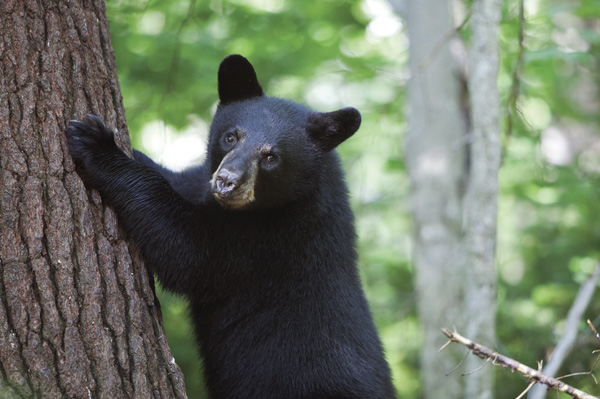
Small Male Cub SQ2MCS.
Credit: Jarrod McCabeThe bears will soon be here. Ben Kilham is confident of that.
It’s a mild evening in early August, just pushing past 6:00, and Kilham, a bear biologist in Lyme, New Hampshire, is ready to work. In a clearing deep in the woods that’s flush with clover and a few old apple trees, he sits patiently in his truck, scanning the woods for his visitors. He flicks on his satellite receiver, listening for any signal that might indicate a nearby bear. He hears only static. Kilham is unfazed. “They know the time,” he says. “And they know what time I’m here.”

Credit: Jarrod McCabe
Credit: Jarrod McCabe
That they do. Co-owner of New Hampshire’s only licensed bear-rehabilitation facility, Kilham is the state’s go-to guy whenever game wardens are alerted to an injured or orphaned bear who’s too young or unhealthy to survive on its own. On an enclosed eight-acre chunk of forestland near his house, Kilham, with the help of his sister, Phoebe, has rehabbed some 90 to 100 cubs over the course of his career, caring for them and feeding them until they’re 18 months old. Then he introduces them back into the wild.
But Kilham’s work extends far beyond parental duties. He’s eschewed traditional limits on human contact with his bears and in the process has forged a relationship with these animals that’s almost unique among wildlife biologists. His discoveries have yielded new insight into bears’ social lives and intelligence. His findings have become the subject of several National Geographic documentaries, put him on network morning shows, and made him the co-author of the 2002 book Among the Bears, which tells the story of his early work raising orphaned cubs.
Much of what he’s learned has taken place in this clearing, which Kilham visits almost every evening for a few hours between May and November. “Most nights nothing happens; then some nights the most amazing things happen,” he says. “And you don’t get to see the most amazing things happen unless you put your time in.”
But Kilham’s work is notable, too, for what he’s not. He works for no university, possesses no advanced degree. For all of his 59 years, Kilham, who is severely dyslexic, has had to circumvent convention and create his own methods for understanding the world around him–which is why his wildlife work isn’t just about bears. Kilham’s findings and the roadblocks he’s encountered and overcome along the way say something about his own species as well.

Credit: McCabe, Jarrod
Kilham has packed his usual tools of the trade: camera with a long telephoto lens, iPad, notebook, several small bags of Oreos, and two big white buckets filled with corn. He’s tapping notes on the iPad when an adolescent male bear, around 20 months old, and one Kilham is only slightly familiar with, emerges from the woods.
“How are you?” he says, leaning out of the truck, in a gentle voice. “You don’t have Mama around, do you? If she was, you’d be up a tree, wouldn’t you?”
Kilham climbs out of his truck, grabs a bucket of corn with both hands, and pours out the kernels near a hawthorn bush, maybe 20 feet from where the bear is standing. He takes a few steps back and points to the food. The bear locks his eyes on Kilham, and then in an effort to show a little intimidation, hops forward with force, an act bear biologists call a “false charge.” Kilham doesn’t flinch.
“You’re a silly goose,” he says.
It’s only after Kilham is back in the truck that the bear makes his way to the corn. For the next several minutes he settles into the snack, relaxed. He’s got food, and the clearing to himself. Then, suddenly, he stands on his hind legs, sniffing the air. He beats it toward a nearby cherry tree and climbs up a safe distance. More bears are on their way.
Nobody knows the woods around Lyme better than Ben Kilham.

Credit: McCabe, Jarrod
“Ben’s perception of dark and my perception of dark are really very different,” says Kilham’s wife, Debbie. “My perception might be that at 4:00 it’s already dusk. His dark is pitch-black. He’s just so comfortable in the woods that he can come out in the dark.”
Built like a bear himself, with wide shoulders and a powerful frame, Kilham has called this small New Hampshire town near the Vermont border home for most of his life. He learned to love the forest with his dad, Lawrence, a virologist and accomplished ornithologist who taught at Dartmouth Medical School and shared with his son a passionate interest in wildlife.
Lawrence Kilham, and his wife, Jane, a physician, fostered a spirit of independent thinking among their five children. Books and animals ruled the family home, a rambling Federal in downtown Lyme that served as a den for injured and orphaned foxes, owls, skunks, and woodchucks. Once, during a year’s sabbatical in Uganda, Lawrence introduced the family to the newest member of the clan: a half-grown leopard. “We considered them pets,” Kilham remembers. “We’d talk natural history the way most families talk sports. It was just an everyday event for us.”
Following his dad into the woods became a central part of Kilham’s relationship with his quiet father, and the natural world opened to him like a book. He could read what the deer had been feeding on, or when a pack of coyotes had passed through. With its clear natural laws, the outdoors resonated with Kilham in a way other settings couldn’t.
Unlike his siblings, Kilham was a terrible student. Nobody understood his dyslexia then; teachers called him lazy and pushed him to try harder. Still, staying awake before exams by blasting the sound on his television, he scratched out a wildlife degree in 1974 from the University of New Hampshire. His poor academic record killed his dream of graduate school.
So Kilham found what he could do: gunsmithing. The work catered to his strengths in mechanics and design. He eventually landed at Colt Firearms in West Hartford, Connecticut, but despite his skill–at one time he held two U.S. patents–his inability to secure a master’s degree undermined his chance of promotion.

Credit: McCabe, Jarrod
“I was always wondering why I couldn’t be a professional engineer when I was perfectly capable of doing the work,” he says. When the economy soured in 1982, Kilham lost his job, and he and Debbie restarted their lives in New Hampshire.
Back in his hometown, Kilham built and repaired firearms for customers out of his shop on a lot where eventually he built his house. And that’s how it might have continued for him, were it not for two Dartmouth professors for whom he’d done some work. They’d noticed the ease with which building things came to Kilham and told him about Dartmouth’s Thayer School program for students with learning disabilities. He could earn a master’s in engineering. “Take the entrance exam,” they said. “See what happens.”
In 1992, Kilham saw what happened. After a six-hour test, he emerged with a score that placed him in the top 1 percent of candidates. “It gave me the confidence to just say, Jeez, if I’m that smart, why don’t I just use my intelligence and forget everything else?” Kilham recalls. “I made a pact with myself to do things my way and damn the torpedoes. It wasn’t important to me to conform and do a poor job of conforming when I could do a good job doing things my way.”
By the time of the exam, Kilham had already become interested in bear biology and behavior. Now, though, after long harboring the dream of focusing on a single animal, he left Thayer and gave himself permission to make wildlife study his real vocation. But even Kilham wasn’t convinced he’d learn a whole lot. Much of the big work, he reasoned, had already been done. Then, two years later, he cared for a pair of bear cubs that had been abandoned in Vermont. And two years after that, “Squirty” came into his life and changed everything for him once again.
Back at the clearing, it’s nearing 7:00, and the bears are out in full force. In addition to the young male, his sister, Josie, and their mother, SQ2, have shown up. But it’s the arrival of a large female, who bounds out from the eastern flank of the woods, that causes a commotion. The cubs scamper up separate trees, while SQ2 seeks distance as well. The newcomer plops down on the ground, 20 feet from the truck. “That’s Squirty,” Kilham says, stepping back outside with a packet of Oreos in his hand.
Of all the bears that have come into Kilham’s life, Squirty has been the most important. In February 1996, she came into his care a runt of a thing, seven weeks old, weighing just three pounds. Her mother had abandoned her three cubs after their den up north had been disturbed by a logging operation.
Kilham became their surrogate parent. Near his bed he created a makeshift den from a large basket. He bottle-fed the cubs and then slowly introduced them to the world outside his home. On their walks into the woods, he got down on his hands and knees, showing them what foods to eat.
As the cubs grew, Kilham watched. He saw that they relied on fresh deer scat to aid their digestion, used the tips of their tongues to identify new items, and went into a stiff-legged walk to leave marking points in the land for other bears to pick up.
After Kilham released the threesome into the woods, Squirty stayed close by. Today, she’s the matriarch of a clan of female bears that comprises daughters, granddaughters, and great-granddaughters. But it’s a social hierarchy that also includes Kilham, whom Squirty largely treats as a bear. When Kilham put a GPS collar on Squirty, he did so without sedating her. She exacts punishment, including “message bites,” when he’s overdone his stay, but she also allows him access to her cubs. “It’s the price for things like this,” he says later, holding up a packet of Oreos.
Outside in the clearing, Kilham approaches his old friend, who stands on her hind legs and plants her front paws on his shoulders. Kilham holds steady, opens the packet of cookies, and feeds her by hand. “That’s all,” Kilham tells her when she’s finished her treat, as he raises both hands to indicate that he’s out of cookies. Squirty gets down on all fours and rumbles over to a pile of corn Kilham has poured out in advance of her visit. Back in the truck, he says, “I’ve learned stuff from her that I couldn’t have gotten anywhere else.”

Credit: McCabe, Jarrod
Kilham’s observations have revealed a level of collaboration among bears, females mostly, that had largely been missed. When Squirty’s daughter, SQ2, for example, was unable to raise one of her own daughters a few years back, Squirty adopted her granddaughter. And Kilham also discovered that Squirty was sharing her prized beechnuts with bears from outside her territory. He has even shed light on bear anatomy: He discovered a receptor–now called the Kilham organ–on the roof of black bears’ mouths that enables a mother to teach her young which plants are suitable for eating. She chews on edible vegetation, and her cub smells her breath to identify which plants are good to eat.
Kilham has filled notebooks and hard drives with his research, shot some 70,000 images, and recorded hundreds of hours of video. All of it he’s done on a shoestring. Outside of speaking engagements about his work, he earns nothing from his research; Debbie, a benefits consultant, is the breadwinner. Because Kilham isn’t credentialed with degrees, he isn’t eligible for the kinds of university grants to which many wildlife biologists have access.
Because Kilham’s work is outside the purview of modern academia, he’s free from the pressure to publish, but because he can’t, on his own, write a scientific paper about his research, there’s been a slow embrace of his findings. At his first International Association for Bear Research and Managment (IBA) conference in 2001, fellow wildlife biologists criticized his work.
“Several scientists told me, ‘We like what you’re finding, but we don’t like your methods,'” Kilham says. “But I can’t get a Ph.D. I’m not suddenly going to be good at calculus. My access to science is through my methods, which is closely observing animals.”
Recently, there’s been more acceptance of his work. At last summer’s IBA conference in Ottawa, Kilham was one of the featured speakers. He’s made two of a projected several trips to China to guide wildlife experts who are reintroducing pandas to the wild. He lectures regularly at Dartmouth and at the University of Massachusetts. Later this year he’ll publish his second book, Out on a Limb, which dissects his recent research and his experiences in overcoming dyslexia: That is to say, although Kilham has learned a lot about bears during these past two decades, he’s also learned quite a bit about himself, too.
“You’re born the way you’re born, with certain abilities and disabilities,” he says. “Some just carry bigger labels than others. It’s hard to explain what I do if I don’t explain my difficulties in school and why I don’t have a Ph.D., why I’m not following the leader, and why I’m a bit of a rebel or a maverick.”
Daylight is fading fast. It’s now past 8:00, and Squirty has left the clearing. Two young males, brothers, have taken control of the area, playfully chasing each other around. “And it keeps going like this all night long,” Kilham says, putting a pair of binoculars up to his face. “Sure beats watching TV.”
He watches for a few more minutes. There’s a certain slow, peaceful rhythm to the scene. He stays at the clearing until the last ray of sunlight has blinked away. “At some point you’ve got to head for home,” Kilham says, setting down his binoculars. “It gets too dark to see.” With that, Kilham fires up his truck and leaves the clearing, heading for the world to which he must return.
More information at: benkilham.com. Note that it can be dangerous to approach a bear or feed it. A bear’s behavior may be unpredictable; it may become suddenly angry or aggressive. Kilham stresses that bears should never be fed near homes.