Road Show: Chasing New England Foliage with Tauck Tours
A decade before Yankee’s launch in 1935, Tauck Tours was already getting folks revved up about visiting New England.
By Ian Aldrich|Aug 26 2025|

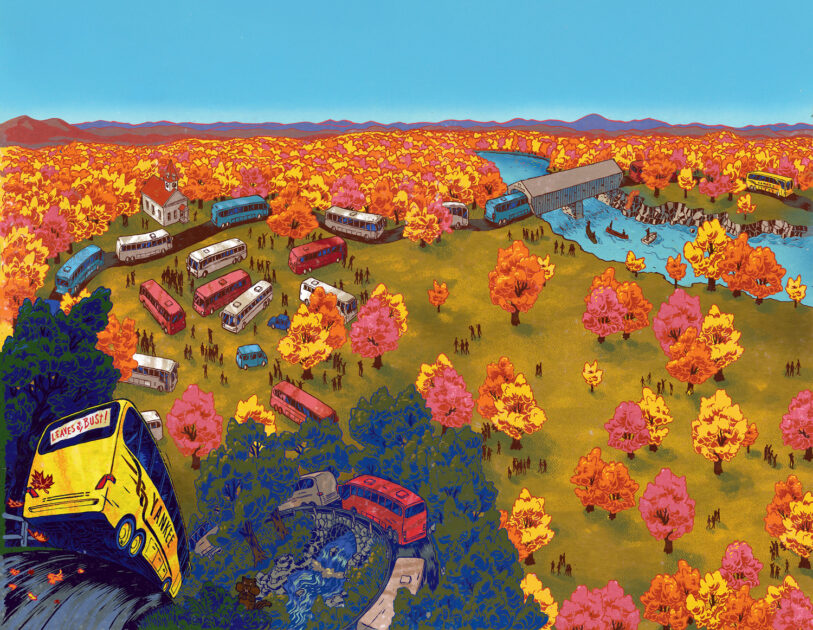
At lower left, a Tauck foliage-tour bus in its familiar yellow “Yankee” livery (no relation to this magazine, incidentally, but we approve) plunges into the heart of New England leaf peeping in this 2017 Yankee illustration.
Credit: Illustration/art by Andrew DegraffWe were on the hunt for foliage. It was early October, and for several days our group of 40 or so had motored through New England on a bus tour with Connecticut-based travel company Tauck. There had been bucket-list stops along the way—Fenway Park, the Mark Twain House, a Vermont sugarhouse—but the autumn color we were seeking had proved elusive. And depending on who we talked to, local chatter made us feel as if we were either a million miles from our destination or oh so close.
“I live 45 minutes north,” one Vermont store clerk told us. “And up there the leaves are amazing.”
Tamping down the foliage anxiety was the Tauck team itself, a guide-and-driver duo who never doubted we’d finally catch the color. Experience helped: Not only had they presided over decades of autumn trips, but they also worked for a company that had been leading these kinds of trips since 1925. Roads changed, sights came and went, but October, we were promised, always delivered the color.
In Vermont’s Northeast Kingdom, we got the first whiff that maybe we were on the verge of something special. It wasn’t just the big maples or hashtaggable town centers. There was a nip in the air. Wood smoke curled from chimneys. It felt like fall. Even better: We were headed to New Hampshire and higher elevations.
At the sugarhouse stop in Vermont, one of my fellow travelers emerged from the evaporator room, practically breathless. “I was speaking with a fella who was just up north, and he said the White Mountains are on fire,” he said, opening his hands wide.
Tauck’s origin story is an unusual one. The company’s founder, Arthur Tauck, was an idea man with an entrepreneurial bent. Trained in the banking business, he was in his mid-20s when he struck out on his own with a patented design for a coin tray, crisscrossing New England to sell his invention to banks.
But it was at a scenic lunch stop on the Mohawk Trail in North Adams, Massachusetts, in the fall of 1924, where Tauck observed an absence—and maybe a new opportunity. A glaring uniformity defined the restaurant’s patrons: They were all traveling salesmen like himself. Even with the fall colors out in full effect, there was not a single tourist in sight. Tauck wondered, Would that change if they had an expert guiding their way?
The next summer, the 27-year-old rented a Studebaker wagon and launched his first trip: an ambitious six-day, 1,000-mile itinerary on largely dirt roads that cut through three New England states and included side routes into New York and Canada. Six customers paid $69 each to join in the sprawling trek. At a time when most Americans didn’t even own a car, Tauck’s tour was a revelation. Upon returning home, his guests spoke glowingly about the trip, and inquiries about future itineraries soon poured in.
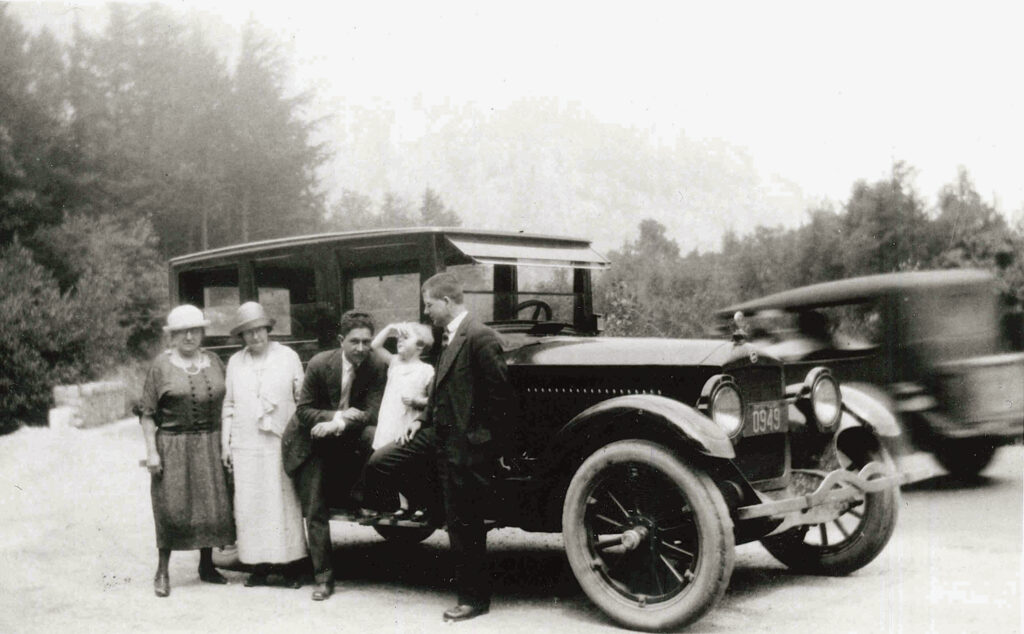
Credit: Courtesy of Tauck Tours
By 1929, Tauck had a new business. He bought a fleet of buses, hired staff, and developed several different New England itineraries that showcased the region’s premier hotels, cultural destinations, and local history. One century after its founding, Tauck now boasts a global footprint. Still family-owned, the company operates out of a gleaming glass-and-steel building in Wilton, Connecticut, where it oversees more than 170 different trips across all seven continents and in 70-plus countries. There are African safaris, land journeys through Israel and Jordan, and an 18-day excursion through Nepal and northern India. Over the past decade and a half, Tauck has partnered with filmmaker Ken Burns to produce a series of guided itineraries through the American West and elsewhere that explore the themes of Burns’s films.
“We truly believe that travel is a force for good in the world,” says Jennifer Tombaugh, Tauck CEO and the first non-family member to head the company. “I remember hearing from one of our guests who had traveled with us to Egypt for the first time about how moved they were at what they saw. Yes, we come from different religions, different cultures, and different backgrounds, but ultimately we have this shared humanity. Travel reminds us of that.”
That holds true for the New England trips, too. Even as Tauck has greatly expanded its lineup over the decades, this region is still at the center of what it does. Every year the company offers four distinct tours—54 trips altogether—including a 12-day “grand” excursion that would have made Arthur Tauck proud. There are covered-bridge photo ops and general-store stops, of course, but also visits to museums and historical properties. On my tour we visited Ken Burns’s Florentine Films studio in Walpole, New Hampshire. In Vermont, we sat for a lecture on the history of the New England landscape. In Boston, we spent part of an afternoon on a foodie tour of the city.
Then there’s the unexpected pleasure of traveling with a group of strangers. On many vacations, we are often solo actors. We eat at the same restaurants as other travelers, swim in the same pools, go back to the same kinds of hotel rooms. Typically, there’s little engagement with strangers—there’s no incentive to engage. When you’re thrown together with a bunch of unfamiliar faces on a bus, however, there’s no choice but to socialize. You’re exploring together. You’re seeing places and meeting people for the first time together. There’s a shared experience to draw from, and that can also deepen the meaning of what you’re seeing.
It’s at the Sugar Hill Meetinghouse, on the western edge of New Hampshire’s White Mountains, that we finally find autumn. All the boxes are checked: The white clapboard meetinghouse decked out with pumpkins and cornstalks. The near-peaking maples on the front lawn. The blue-sky day. The tidy farmhouse across the street. Nothing—not even the private tour of Fenway Park—elicits the same excitement in my fellow travelers as this tiny town green.
I remain in my bus seat and watch the others take in the moment. One couple does a quick dance, several people pose for photos with the trees, one woman actually hugs a maple. On the steps of the meetinghouse, a round of selfies is produced. There is euphoria in the air.
Following a solid 10 minutes of picture taking, the crew then files back onto the bus. “That’s the best selfie I’ve ever taken,” says a woman from Florida, pausing in the aisle to look at her phone.
She laughs with approval. “That’s so good.”
This feature was originally published as “Road Show” in the September/October 2025 issue of Yankee.