



New England’s Small Museums | The Memory Keepers
Can New England’s small museums survive a nation’s short attention span? Can they still bear witness to lives that mattered, to the stories they tell?
By Howard Mansfield|Apr 23 2015|

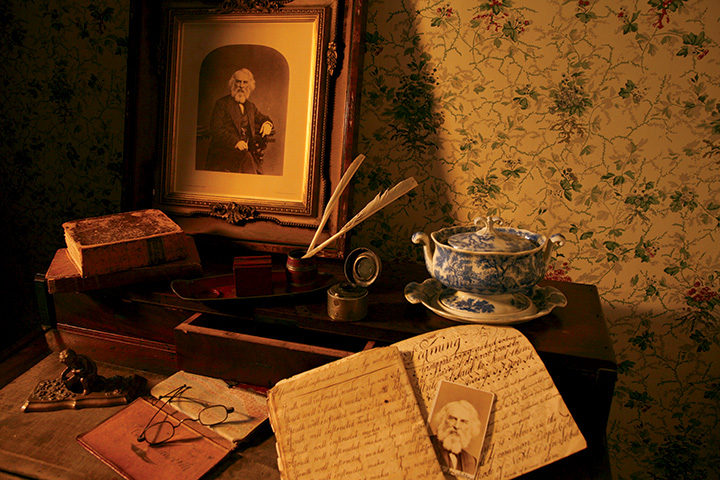
In the Wadsworth–Longfellow House in Portland, Maine, we meet a family with a deep sense of history.
Credit: Doug Mindell
Credit: Charles Krupa/AP Photo
Moonrise
The big yellow Wolf Moon rose large and close as we drove through Waltham, Massachusetts, headed to the “Full Moon Tour: Living in the Dark” at Gore Place, an early-19th-century Federal-style mansion. I had imagined a sweep of moonlight falling through tall windows, a shadowy darkness that would slow us down, recalibrating our senses. We parked in a small lot and walked up the drive, which was lit by candles. From the front steps of the mansion we could see the Wolf Moon off to the right behind a gauze of clouds, and directly ahead, through the trees, the big red letters of a Walgreens.
There were seven of us for the tour: my wife and myself, a newspaper photographer, a young couple in their twenties who had heard about the tour on Twitter, and two senior citizens who had found a discount coupon for the tour online (paying less than the $16.37 per ticket that we paid).
Our volunteer host, Stu, was in period dress, wearing a brown cutaway coat with broad lapels and tails, and narrow wire-rim glasses. Stu knew his facts about life in the dark, about the Gores, and about the house’s hard life. You couldn’t ask for a better tour guide.
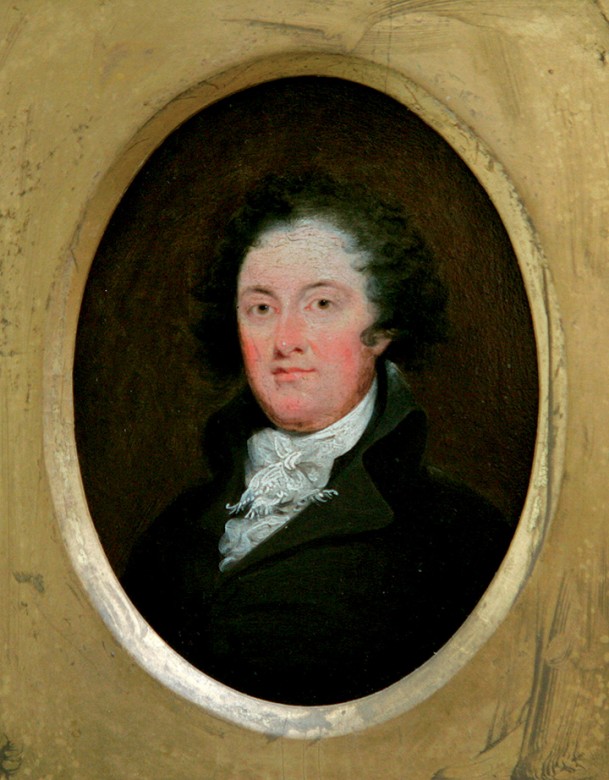
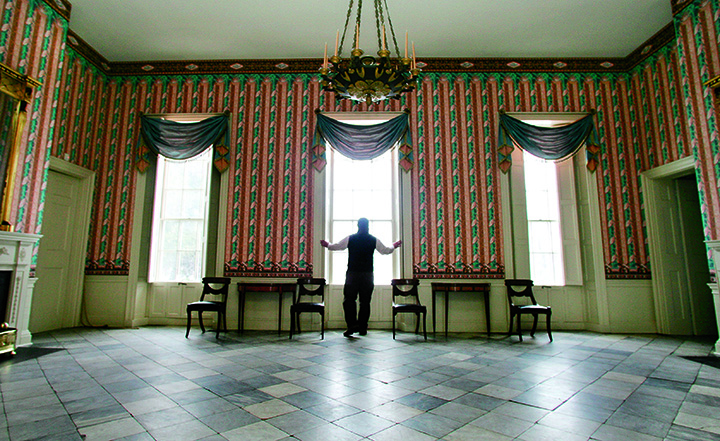
Christopher Gore was a Massachusetts governor and U.S. senator. His house, built in 1806 to the design of a French architect, is stately and impressive. The two-story spiral staircase, an innovation in New England at the time, is a great piece of theatre. The oval drawing room with tall windows and the marble-floored Great Hall have the lavish scale of an embassy.
Credit: Charles Krupa/AP Photo
The Gores have been gone a long time. When Christopher’s wife, Rebecca, died in 1834, the house and its contents were auctioned off. The house passed through eight owners before being rescued from demolition in 1935 by a group of Beacon Hill women who formed the Gore Place Society and bought it.
The estate sits on 50 acres, and that land is the museum’s livelihood. The staff operates a 10-acre farm and sells produce at a farm stand. They also rent out snowshoes to tour the grounds; there were four tubs of them in the old drying room where the tour began. Stu gave us a pitch for the museum’s other events: Jane Austen tours, a Poe impersonator, concerts, Christmas teas and Santa teas for children, and his favorite, held on the last Saturday in April, the sheep-shearing festival. “It’s just a total hoot,” he said. In 2013, 17,000 people showed up. That was an exceptional year; it was two weeks after the Boston Marathon bombing and people wanted to get outside. On that day with 17,000 people on the grounds, just 400 toured the house, first floor only, a 10-minute sample, “a taste portion.”
In addition to the sheep festival, each year 6,000 total tour the house, another 6,000 attend programs, and 34,000 visit the Web site. Those are robust numbers that many small house museums would welcome.
Credit: Charles Krupa/AP Photo
As for our Full Moon Tour, it was more implied than lived, more explained than experienced. We were in only one room that was candlelit. Another room had a combination of a candle and some LED lights in Argand lamps. Most rooms were dimly lit, or our guide might turn down the light as a sepulchral, gray-haired woman in a long black dress swept in behind us to close the doors.
Was the tour over-promised? It wasn’t a tour by moonlight, but it was a good tour led by an energetic guide. In an earlier, pre-Internet era, most visitors would have been satisfied. It’s homemade and, like old radio, asks that you use your imagination. But today, how can a house tour compete? It can’t be as tightly paced as a 12-part cable-TV drama queued up for binge watching. It can’t dash click-by-click to match your whim. Not long ago, historical memory was New England’s great story to tell a nation hungry for history. New England has the greatest concentration of museums in the country, of which half are history museums. Back in that pre-digital era you didn’t have to promise visitors the sun, moon, and stars to get them in the door. But now, what’s a small museum to do?
—
On Gore Place’s Web site, the page referring to renting out the house and grounds for weddings and events says, “Gore Place is your historic country manor for the day.” Gore Place is like a historic tuxedo or a period ball gown that you might rent. It’s history—not any specific historical story. It’s just a spritz of history. It’s a setting, a backdrop.
Is the house a little lost?
“Not a chance,” says Susan Robertson, who has been the museum’s director for more than 20 years. About a dozen years ago the museum staff began to use the house as a “stage” to tell stories like “Living in the Dark.” Before that they did the expected museum thing: They explained their collections. But “no one was coming to visit us,” she says. “And nobody had heard about us. My staff would go to cocktail parties and say they worked at Gore Place, and the guests would say: ‘Where? What? Who?’”
All the theme tours, teas, and impersonators are to draw the public in and give the museum a chance to tell the Gores’ story, Robertson says: “You also have to be very clever in this business if you’re going to engage the public and get them in. We have a pretty sophisticated public in Boston, don’t we? Lots to see and do. Not necessarily going to come to a house museum.”
Credit: Courtesy of Gore Place
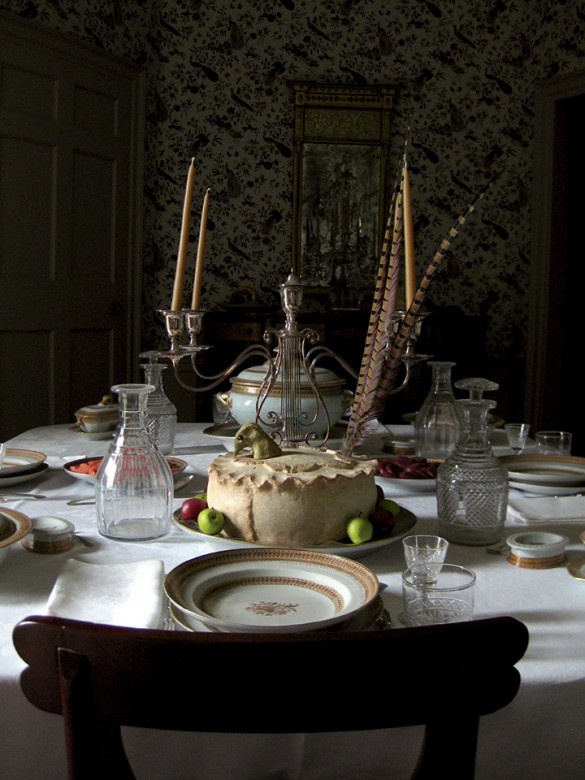
Gore Place is a model of the museum-as-festival: Weddings! Moonlight tours! Snowshoe trails! Fancy teas! (“Mother’s Day Tea,” said one reviewer on Yelp, “though it was nice … they could step it up with more goodies, better tea selection, and lemonade for kids.”) The museum may be following what I’m coming to think of as the “Cat in the Hat” model: If you want to attract the public, you have to keep pulling cats without end out of your hat. Many other museums are handing out snowshoes (Fruitlands and the deCordova Sculpture Park and Museum), offering do-it-yourself “letterboxing”-style scavenger hunts (Charles River Museum) and hosting teddy-bear teas (Concord Museum and many others).
This application of theme-park show biz is sometimes called “edutainment,” a word that is proudly used by some museums as they try to lindy-hop with Disney. “We can’t compete with a roller coaster,” says the vice president of Colonial Williamsburg, “but we can provide what one guest called ‘a Disney World for the mind.’ We take that as a compliment.”
Disney is in the happiness business. (“Happiness,” says an employee manual, “is our principal product.”) That seems straightforward. But today many museums are following Disney’s lead. Should a museum be in the happiness business? A great deal of history is not happy.
The Age of Peak Distraction
“People want their buttons pushed all the time. There’s no room for stepping back and contemplating. Or being quiet,” says Michelle Stahl, director of the Monadnock Center for History and Culture in Peterborough, New Hampshire. “When you think about the great museums—the Metropolitan, the Museum of Fine Arts, Boston—they’re all built on that ‘cathedral of culture’ model. These huge, grand spaces with the rotunda. It’s all inviting you on the subliminal level. You’re entering a sacred place. And there’s not a lot of room for that now. The younger generation expects not to just be a passive recipient. We’re in this really participatory culture now. Everybody’s an author; everybody’s a curator; everybody’s got a blog.”
And the younger generation is leery of historical societies. The Monadnock Center for History and Culture has recently shed its old name, the Peterborough Historical Society. The word “Society” made it seem like an exclusive club that you had to be invited to join, Stahl says. Though that was true years ago, the impression lingered. It was necessary to “break down the barriers so people can see: ‘Oh yeah, that’s for me, that’s something I can go to.’
“There’s also kind of a derogatory thing around historical societies. If I had a dollar for every time somebody says, ‘Oh, you work at the “hysterical” society.’ People say that to me all the time. It’s an old-lady thing. It’s not seen as valuable or important.”
The renaming of the Peterborough Historical Society and the storytelling at Gore Place are typical of what I hear when I meet with curators, or meet with the exhibition committee I serve on at a state historical society, or read about how museum attendance is falling. The question always is: How do we get people to pay attention? Everyone is chasing the audience, and the audience is off, head bowed over a smartphone.
“We live in an age of peak distraction,” says Malcolm McCullough, author of Ambient Commons: Attention in the Age of Embodied Information. “Never has distraction had such capacity to become total.” When everyone is busily slinging electrons at each other—information—why go stand in a museum and look at an old shoe in a glass case? Why, in fact, go anywhere? Just Google it.
Credit: Doug Mindell
Our Broken Timeline
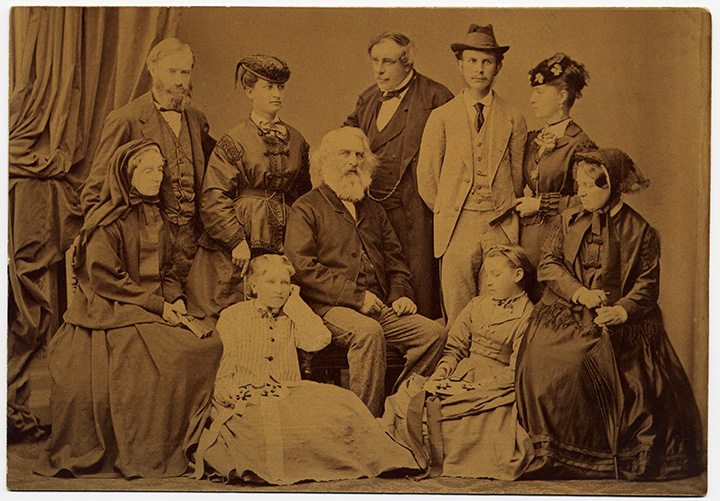
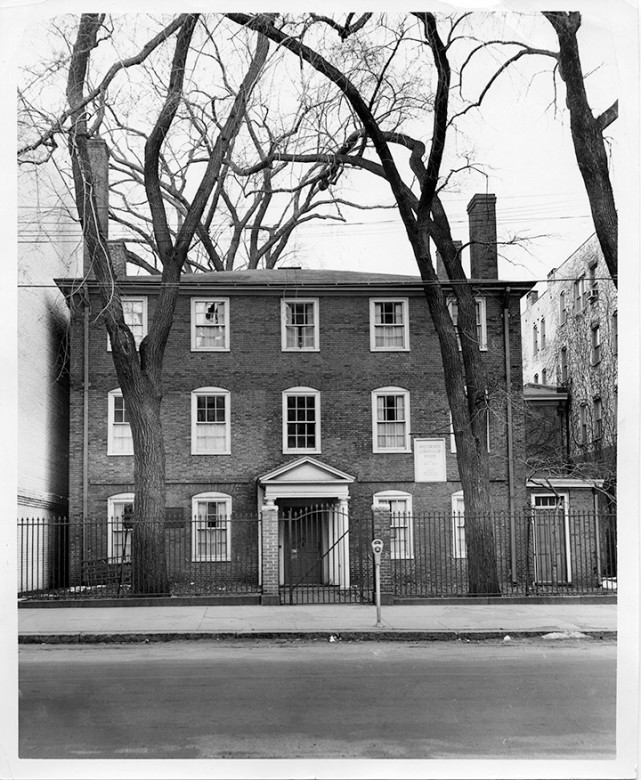
The Wadsworth–Longfellow House sits back just a few steps on busy Congress Street in Portland, Maine. The red-brick Federal-style mansion is formal, reserved. Inside, the house has a quietude that is like entering another atmosphere. What’s striking is how thick history seems to be here. For three generations, the life of the Wadsworths and the Longfellows revolved around this house. They were record keepers. Stephen Longfellow, father of the poet Henry Wadsworth Longfellow, was a founder of the Maine Historical Society, and Henry served as the society’s librarian. The family knew that their story was important.
I’ve come to Portland to talk to John Mayer, museum curator of the Maine Historical Society. I haven’t come to look at the house, but it wins me over, slowly. Museums are in a hurry these days to set everything in motion. It’s a hard sell to tell people to come visit and be quiet, to listen and wait. That’s what the Longfellow House asks of us.
In the first two generations, the house was thick with life. Henry’s maternal grandfather and grandmother, Peleg and Elizabeth Wadsworth, had 10 children. Family letters recount happy scenes of Elizabeth’s children gathered around her, singing, playing games, or working on school lessons. Henry’s father and mother, Stephen and Zilpah Longfellow, had eight children.
Credit: Maine Historical Society
On the second floor, you can see where little Eliza Wadsworth signed her name in the plaster of her family’s new home back in 1785 or 1786. By the back door on the first floor there are several handwritten “medallions” from different days in the 1830s to the 1850s. They mark important family events, but which ones are unknown, Mayer tells me as he shows me around. “We’ll keep looking at these to try and make more sense of them,” he says in the hushed tone the house calls forth from us.
And there are penciled notes on a third-floor window frame: “Friday eve’g July 14th 1837—a magnificent sunset of golden clouds.” And “how dear is the home of my childhood.” The family regarded the house with great affection from early on, calling it “the old original” in Henry’s time. It was a revered family touchstone.
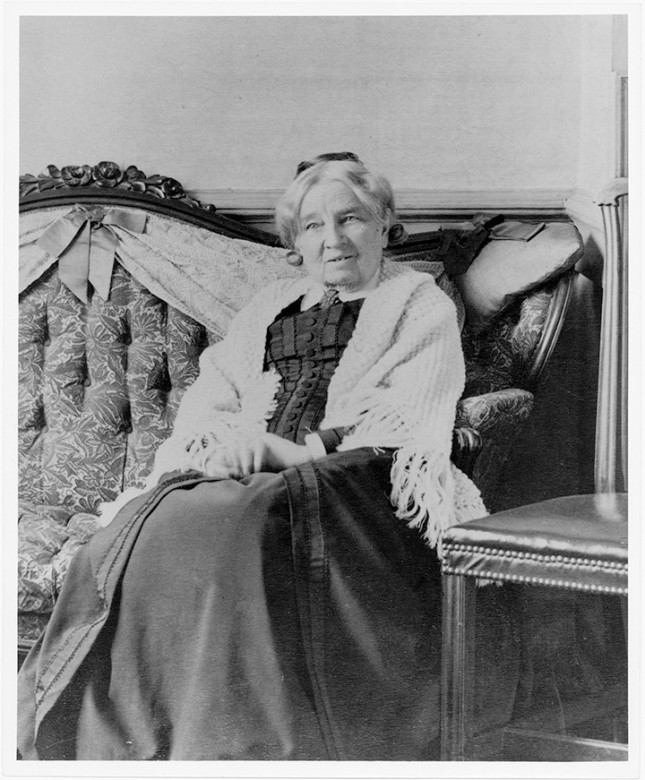
Henry’s sister Anne lived here for 87 of her 90 years. She knew what the house meant to the family and to the nation. As tall buildings pressed in, she refused an offer to sell “the old original”—even with one building just inches away, so that the family had to block up the windows on that side. Most families would have sold, but Anne resolved to give their home to the historical society.
Credit: Maine Historical Society
She left the society notes about the furnishings of the rooms. Any changes she made to “the old original” were done carefully, as if she had taken an oath of “first do no harm” to the family home. Unlike her neighbors, she did not add natural gas for lighting. She used an outdoor privy—the last permitted privy in Portland.
What is unusual about this house is that it was passed down intact. It didn’t have the rough ride of many historic houses—a series of owners, hard use by churches and colleges, division into a rooming house, near-death demolition experiences and last-minute rescues (a standard preservation biography).
The family had an unusual sense of living in history, says Earle Shettleworth Jr., Maine’s state historian. Grandfather Peleg knew George Washington. Henry was close to his grandfather, “so he becomes imbued as a boy with the early stories of the Revolution,” Shettleworth says. “And that’s a very important influence.” In three generations the family spanned the history of the nation. The Wadsworths and the Longfellows were timeline bearers.
Credit: Maine Historical Society
Anne’s will specified that the house be preserved as a “Longfellow Memorial.” It opened as a shrine in 1901. The Longfellow House is the oldest house museum in Maine and one of the oldest in the country. (At the time there were only about two dozen house museums in America. Today there are 6,000.) It’s also the oldest surviving house on the peninsula in Portland. The Longfellows had a strong sense of history. We don’t. We live in a society with a broken timeline. Without a sense of living in history, historical museums and societies are set adrift.
To step back out on Congress Street is to have the house’s lingering sense of history torn from you. Out on the street you rejoin the contemporary feeling of event following event 24/7: One thing happens, then another and another. News personal and political, local and international. A baby is born; a bomb explodes someplace far away. If we lose small history museums, we’ll lose continuity; we’ll lose the witness of the generations. “The old original” is a witness to a surer sense of history. Witness is what breaks through the digital haze.
Witness
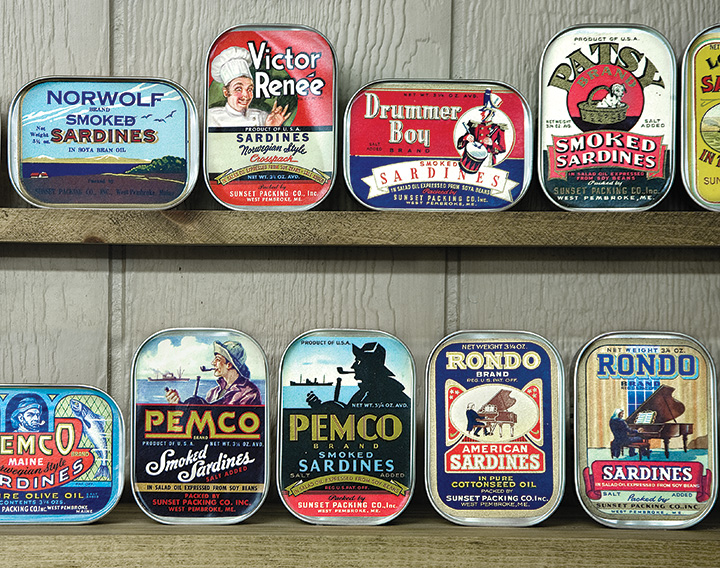
The Maine Coast Sardine History Museum in Jonesport is a sincere testament. To build it, Ronnie Peabody and his wife, Mary, put in their $15,000 savings and took out a $15,000 loan. Friends and neighbors donated money, building materials, and the loan of heavy equipment to build the gray-clapboard building. Inside, the Peabodys have corralled the remnants of a once-mighty industry. There are photos of the carriers that brought in the herring, parts of the boats, heavy canning equipment, and all along one wall, town by town, from Eastport to South Portland, each factory is represented by rows of colorful sardine tins. It’s like an art gallery with paintings that are, on average, about four inches tall.
Credit: Markham Starr
On a hot day the museum smells like sardines. “I like the aroma,” Ronnie says. “I take a nice big breath …”
—he inhales—“Ahhh! It brings back memories, boy.” Some of the cans still have sardines in them—70-year-old sardines. He takes those into his house in the winter and returns them in the summer.
Ronnie worked in a sardine factory for six years. His family was employed in the industry. His father was gone for weeks seining; his brother ran a flaking machine; and an uncle ran a wrapping machine. He’s 59, with white hair and beard, dressed in a gray sweatsuit and wearing rose-colored glasses, with a patch over his left eye. With Ronnie walking me through, I feel as though I’m being trained on my first day on the job. One of the first things he tells me is: “Remember they’re not sardines until they’re cut and put in a can. They’re herring up until then.”
He shows me each machine in detail: how it works, where it used to jam, where it had to be lubricated. The Universal No. 12 Closing Machine sits on the floor, nearly three tons of gray-painted metal and its original grease. It was loaded in here in pieces on a forklift. “I put it together myself with a
pallet jack and a box of wood and took a chance on my life,” Ronnie says.
Introduced in 1937, this machine was revolutionary, promising to seal 150 cans a minute. The industry was wary. It was never run at top speed; usually at 100 cans a minute. “They had what they always called too many ‘smashups,’ and believe you me, I’ve seen ’em,” Ronnie recalls. “And what a mess. Things start going that fast and all of a sudden you get a jam and it keeps going until you get over here and catch a button. There’s cans, there’s fish, and they’re all ground up; there’s oil.”
Ronnie goes over each part: the filler feed, the star wheel, the oil or mustard tube (depending on what the sardines were packed in), the can plate, the rocker that opened the tube’s nozzle—zzzt, zzzt, zzzt; the chuck plate, the lifter, the knockout rod, the coder to mark the production run, the operation that curled the cover over the flange, and the one that flattened it, making the can airtight. All of this, not surprisingly, was “very noisy: pchoong, pchoong, pchoong … You had to step away to talk.”
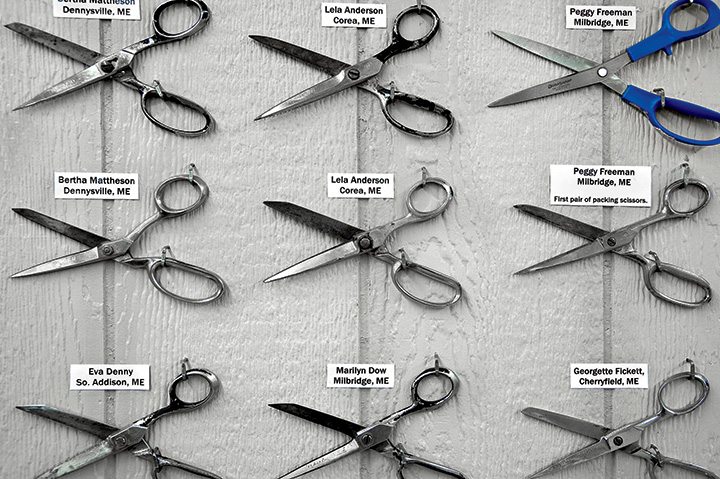
The machinery, though quieted, has a brute presence. But the next exhibit is startlingly intimate—a wall of scissors —80 in all on one wall and a new row starting on the back. They seem too simple for the task. Each pair of scissors, with a woman’s name and hometown, represents a life’s work cutting sardines, up to 12 hours a day, standing in one place on a cold, damp floor doing the same thing over and over. “And you wouldn’t believe the speed. They get in the motion; they’re just rocking,” he says, showing me. “I couldn’t believe it the first time I saw it. They had the hardest job in the factory. And that’s why we did this tribute wall to all packers.”
Ronnie shows me how the oldest scissors got shorter from being sharpened: “You can see how much some of them have been ground down over the years.” He shows me the scissors of The Late Eliza “Lizzie” Beal, Beals, ME. “See how short these blades are? It’d take the length right off of them.”
Credit: Markham Starr
I look at the scissors, each so individual and expressive: Muriel Beal, Milbridge, ME. Her first pair was provided by the Stinson Canning Co. in 1943. Aloma Alley, Jonesport, ME. Rusty and dark. Bertha Mattheson, Dennysville, ME. Worn smooth with a dull sheen like an old nickel. Velma Trundy, Stonington, ME. Dirty white cloth or tape wrapped around the top handle. The Late Agnes Crowley, Beals, ME. Agnes’s scissors look well-tended and ready for the day’s cutting.
This entire museum could be filled with scissors, floor to ceiling; they probably could be lined up by the mile, each a witness to thousands of factory days. What’s left unsaid is all the work and childrearing waiting at home.
Without the sardines, Ronnie doesn’t know how everyone on the coast would have survived. He wants visitors to know “how big the industry really was. It was the financial backbone of the coast.” Over time there were more than 400 factories along the coast. When he grew up in Jonesport, “all you heard day and night were carriers running up and down the reach, going out and getting a load of herring, bringing in a load, going out. And whistles blowing. You could hear them for miles. If you knew the tone of the whistle, you knew what factory had herring coming.”
Ronnie Peabody is a witness to a bygone industry and life. With this museum he is an ancient storyteller, a memory keeper for his coastal tribe. The museum’s exhibits are the real thing, but it’s Ronnie’s witness that makes it live.
Jonesport is probably far away from where you live, but go. Allow time for Ronnie to show you around. In his enthusiasm you’ll find what’s lacking in too many museum visits. You’ll leave thinking about the hard work of the past and about what we do and don’t do for work today. And, if you’re so inclined, pause in front of the wall of scissors and offer a silent blessing for all those women who stood for 12 hours a day cutting the sardines, and for the men out catching the herring, and for the whole lost past and the blind present.
The Past Will Not Sleep
Many small history museums are starved for visitors. Some house museums will have to close, insist some of the leaders in preservation. They may be too hasty. Yes, some museums offer only dead-end tours of some old fossil’s highboy, and some are stuck giving teddy-bear teas to survive, but they have a story to tell if they can be revived. We’re never free of the past. Or as Ralph Waldo Emerson wrote, “The Past will not sleep, it works still. With every new fact a ray of light shoots up from the long buried years.”
I thought about this when I picked up a brochure for the Royall House and Slave Quarters. We know that Northerners had slaves, but we’ve forgotten the real story for a more convenient tale about the righteous North. The Royall House is a prime example of what a revival looks like.
—
Peter Gittleman first heard about the Royall House back in the 1980s. He was 24 and working as a guide at a historic house when he met Julia Royall at a party. “Oh you should visit my family home,” she said. Her family home was now a museum and she was on the board. Her family had been gone a long time from that house. The Royalls were Loyalists who fled the country at the start of the Revolution, leaving behind their 500-acre farm and three-story mansion in Medford, Massachusetts. During the war the house became headquarters for Generals John Sullivan and Charles Lee and Colonel John Stark. The Royalls sold the house in 1806. It passed through several owners and was in rough shape, before the Daughters of the American Revolution rescued it and established a museum in 1908.
Gittleman was upset by his first visit: The house tour “was largely about brown furniture.” The tour guide talked about Isaac Royall and the furniture makers. And there was little mention of slavery—even though the Royalls were the largest slaveholding family in Massachusetts. Isaac Royall Sr.’s fortune was built on slavery. In two decades in Antigua he had sold at least 274 slaves. Gittleman was told that Royall “was a kind master and his slaves undoubtedly liked him, which is a fantasy story that was, frankly, sort of appalling to me.”
Credit: Doug Mindell
In the forthright manner of a young man, he wrote a critical letter to the president of the board. The president wrote back and invited him to join. It would take Gittleman more than 20 years to turn things around. With Julia Royall, he worked to get the board to see that slavery is the story they must tell. Otherwise, he says, “we could just limp along as a completely marginal house museum. I went to the board and I said, ‘Just because you’ve been around for 100 years, that doesn’t mean you’re guaranteed to be around for the next 100 years. So we have to figure out what it is we want to be that’s going to be useful in the 21st century.’ And ultimately the board came around to believing that telling the story of Northern slavery was in fact something that we could do that nobody else could do in New England, because we have the only surviving slave quarters in New England.”
Now known as the Royall House and Slave Quarters, the revived museum has conducted extensive archaeology at its site and created a new school field-trip program. The Massachusetts Foundation for the Humanities honored the museum with its Massachusetts History Commendation, citing it as “emerging as a leader in its field … and an example to other organizations with small purses and large plans.”
Gittleman remains on the museum’s board as its co-president and treasurer. “It could have gone either way,” he says. “We could be like any other sleepy house museum and just tell the story of the lovely Royalls and their lovely furnishings and their lovely silk bed hangings. But we didn’t. We took the riskier path.”
—
On a morning in early May, Kathleen Cutting has brought 22 fifth-graders from her social-studies class at Linden STEAM Academy in Malden, Massachusetts. They assemble in the slave quarters to listen to the museum’s education coordinator, Olivia Searcy, introduce the Royalls and the people they enslaved; at one point 34 Africans working to keep four whites comfortable. She explains what we know about them today from digging up artifacts and studying the inventory made of Isaac Royall Sr.’s estate at his death in 1739.
The class is with Searcy all the way. They ask good questions: “Why did they pick Africans to enslave?” and “Did any ever escape from the Royalls?” The fifth-graders have been studying slavery and have worked with some prep materials sent by the museum. When Searcy shows a picture of Isaac Royall Sr.’s probate inventory and asks what it is, many hands go up. “Look at this—amazing!” Searcy says. They identify his inventory, and Searcy elaborates: It’s “a list of all his property—every single thing, every horse, every cup, every bowl, every blanket, every enslaved person.” That inventory, she says, “is how we know a little bit about the lives of the enslaved people. If there were no inventory, we’d have only a few things to piece together to figure that out.”
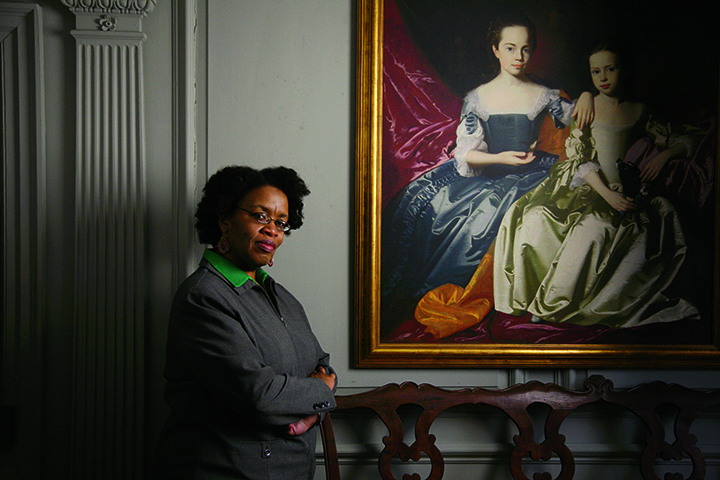
setts, stands next to a reproduction of John Singleton Copley’s portrait of Mary and Elizabeth Royall.
Credit: Doug Mindell
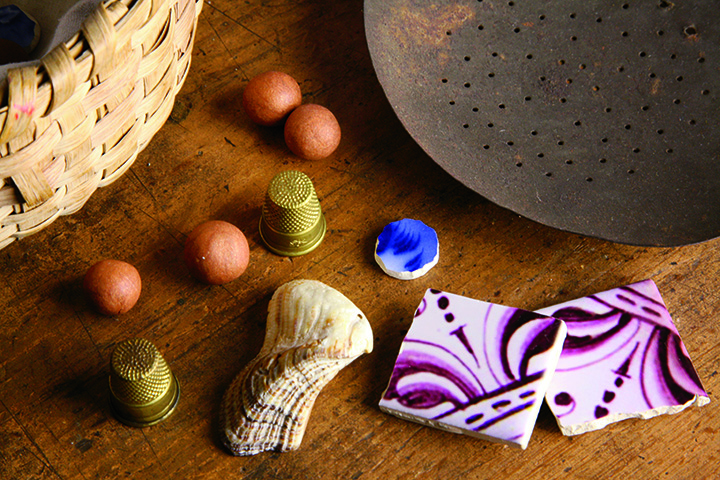
Searcy’s presentation puts the daily objects of use back into the slaves’ hands: a chipped milk pan, a dinner plate, a sewing kit. This is no longer an empty house. Searcy refers to “enslaved people” as a way of keeping the slaveholders in the picture. You weren’t a slave “because you were born a certain way,” she says. “Somebody chose to do this to you.”
She introduces two of the Royalls’ slaves: a boy, Joseph, age 13, and a girl, Prine, age 7. The ages are estimates and they’re portrayed as full-size silhouettes in the kitchen because there are no descriptions of them (in contrast to the two Royall children, Mary and Elizabeth, whose full-length portrait by John Singleton Copley hangs in Boston’s Museum of Fine Arts).
Joseph and Prine were Belinda’s children. When Belinda was 12, she was taken from her family in Ghana and enslaved, first in Antigua. At age 70, in 1783, Belinda petitioned the Massachussetts legislature for an annual pension to be paid by the Royalls’ estate to support herself and her sick daughter. She won. Her petition, along with the 1739 inventory, are the two key historical documents that tell us about the Royall House and Slave Quarters.
The class tours the Royalls’ house, where the division between free and enslaved is stark. The rooms for the Royalls have elaborate woodwork, fireplace tiles, and, in one room, faux-marble pilasters. The rooms where the slaves worked are spare, their bedding modest, in one case perhaps nothing more than some old grain bags stuffed with straw or corn husks. The canopied bed in the Royalls’ “Marble Room” was worth 200 pounds, according to the inventory—as much as the entire slave quarters. “You have a bed and a building that are worth the same amount of money,” Searcy says. “That says something about what’s important to you.”
Back in the slave quarters, near the end of their visit, one of the students, Tzuriel Ligunya-Muisyo, has a question: Why did the day go by so fast? “I felt like this was only even 10 minutes.” This is what every museum curator and docent would like to hear from their visitors.
The Royall House could have limped along telling a story of furniture. It could have closed. But here it is with an important story to tell. If being the story bearer to the nation is still New England’s role—or, to put it in modern terms, if historical memory is New England’s brand, then it should be true to the brand. Be honest about it: Northerners kept slaves. Tell the truth, tell it well, have a tireless education program and curators with the stamina of athletes, and just maybe the public will visit. History isn’t a Happy Meal; it’s not a teddy-bear tea.





Thank you for this thoughtful piece, an easy read about important conservation. This is especially true in our New England area, settled early & full of quite surprising information. I love The Loring-Greenough House in the Jamaica Plain section of Boston. My mother was on the board, as was her mother. Preservation of the past is a task some of us consider necessary to be fully alive in the present. It would be so great to see an article about the House in Yankee some time; when reading about Belinda’s petition to the Massachusetts legislature, I was reminded of Mrs Loring’s petition to the English crown, asking that she be compensated for losses sustained during The Revolutionary War. It is quite a list!