



Adrift in Time | Why Peddocks Island Is an Island Community Like No Other
Just eight miles from Boston, Peddocks Island is a seasonal community of historic cottages, where residents share resources and maintain a way of life that’s increasingly rare.
By Erick Trickey|Apr 06 2020|

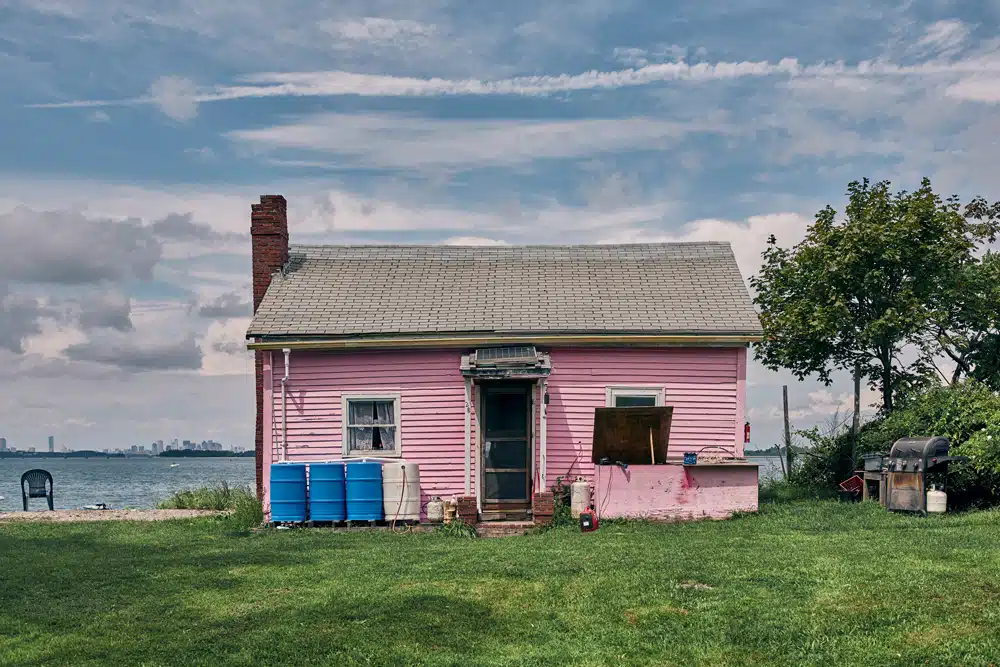
Part of a Portuguese fishing village turned summer colony, a weatherworn cottage on Peddocks Island looks out toward downtown Boston, less than eight miles away.
Credit: Tony LuongFrom the sky over Boston Harbor, Peddocks Island looks like a baby bird, its body and tufted tail pointed southwest toward Quincy while its rounded head reaches, as if eager for food, toward the town of Hull. After arriving at the ferry dock on East Head, most visitors to Peddocks walk straight ahead to the brick barracks of Fort Andrews, where U.S. soldiers trained for three wars, watched over the harbor, and guarded more than 1,000 Italian detainees in the 1940s. Only a few visitors turn left, pass the white clapboard chapel, and hike to the most vibrant spot on any Boston Harbor island, a century-old Portuguese fishing village.
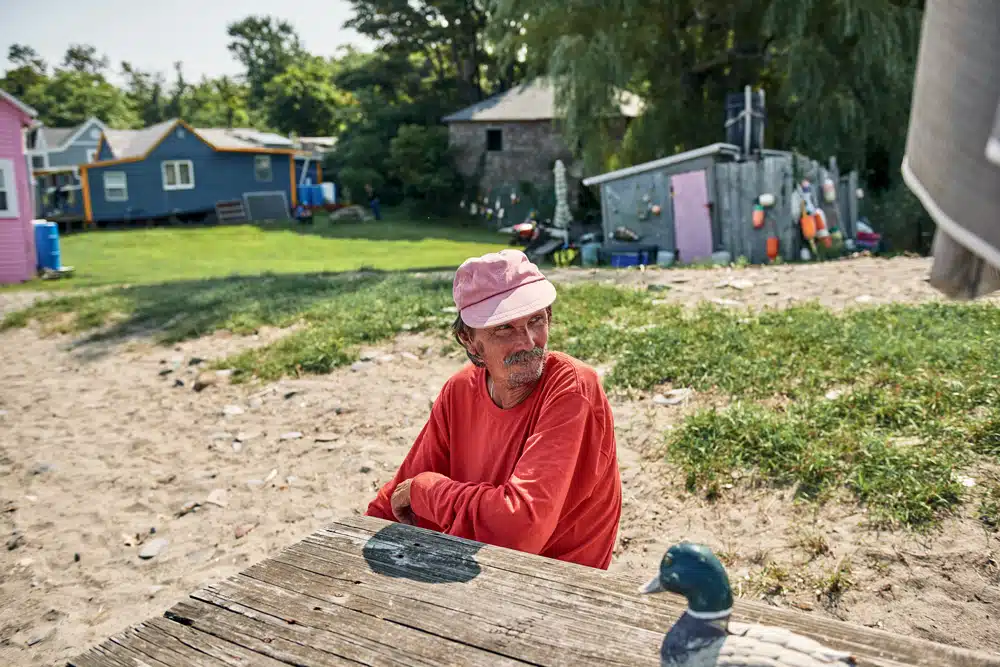
The footpath down Peddocks’s neck builds anticipation. The narrow dirt track threads through a stand of trees, which opens to reveal a white cottage set on a hill. An island caretaker built the home decades ago, and her family still lives in it. Here, quiet descends, except for waves lapping on the beach and the occasional airplane roaring toward Logan Airport. The path continues on, past scraggly brush and marsh and through the woods. Then more cottages emerge from the trees: rows of them, each one story tall, made of wood and standing amid well-mowed grass. Each has its own color scheme—white with red trim, yellow, sky blue, pink.
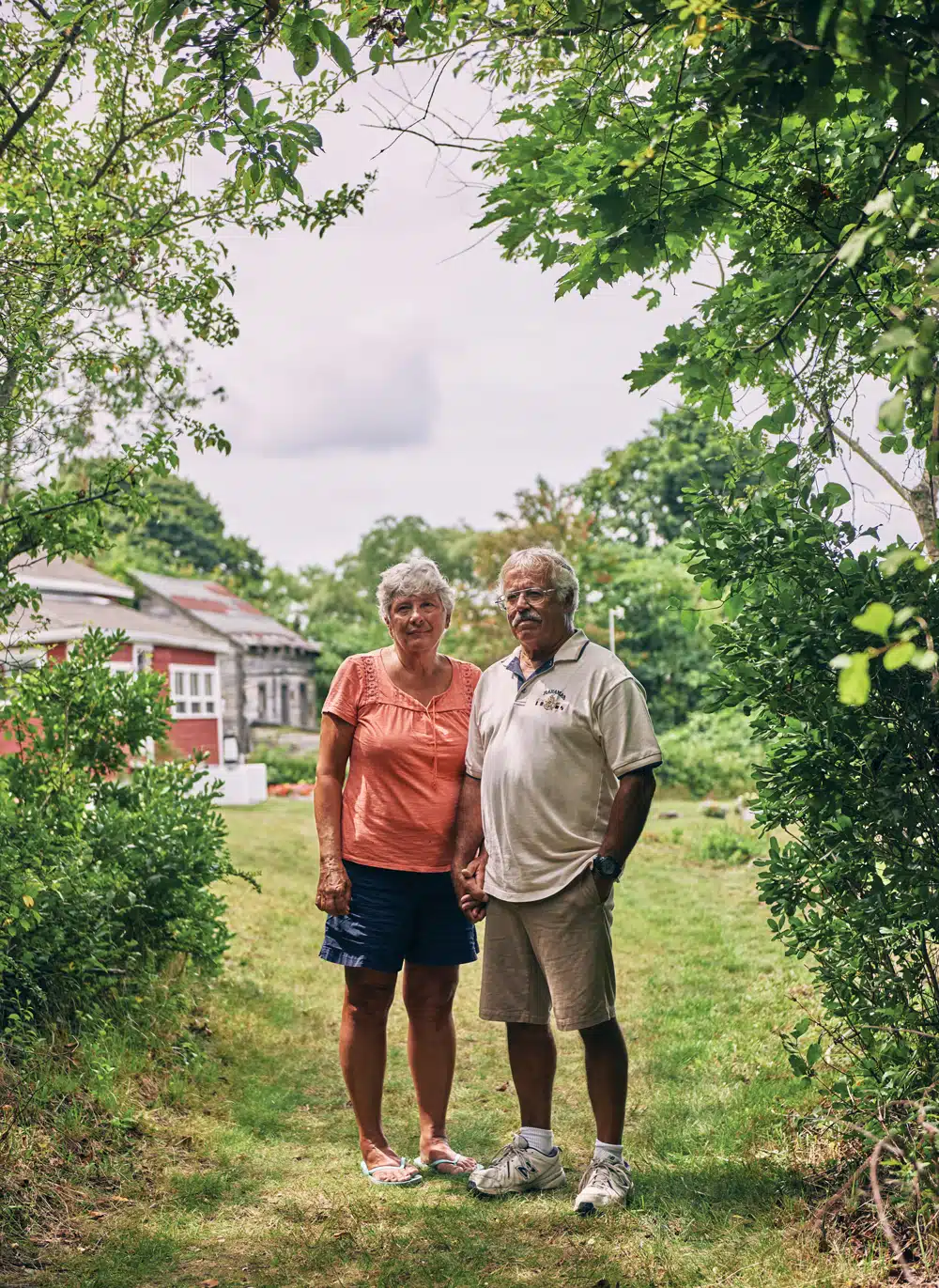
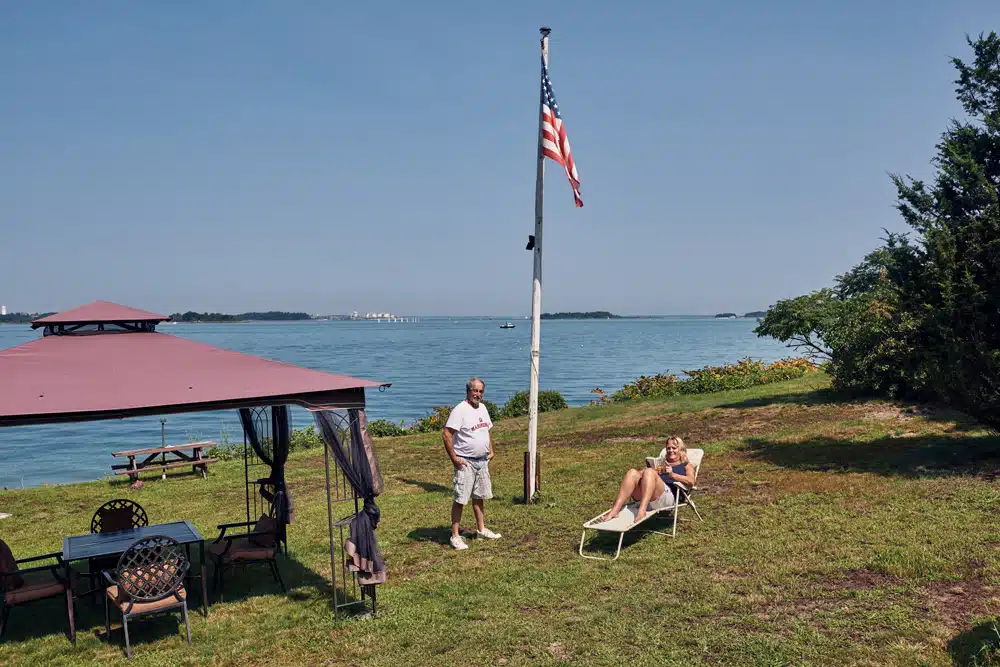
Relaxing in a lawn chair near his cottage, Jim Saudade gazes at Boston’s skyline on the western horizon. He’s wearing retired-guy summer casual: red polo shirt, white shorts, black sandals. “Peddocks Pirate,” reads his white baseball cap.
“I’ve loved it since the first day I came,” Saudade says of Peddocks. He grew up on Hough’s Neck in Quincy, and he’s been coming here since the 1950s, when his father bought the brick-red cottage he owns now. “I’ve always wanted to spend the summer here, but I wasn’t able to until [retiring] 10 years ago.” Now he spends eight months in Florida and four months on the island.
Credit: Tony Luong
Saudade and his summer neighbors are the only people who live on a Boston Harbor island. Their community of about 24 cottages traces its roots back to 1887—the year that Portuguese immigrant fishermen migrated to Peddocks after the city of Boston forced them off nearby Long Island. The village survives as a remote summer getaway, a frontier outpost within sight of the Boston skyline. Families have passed the cottages down for decades, and many still return each summer with supplies of water and food.
Peddocks cottagers live off the grid, with outhouses instead of bathrooms, showers fed by rain barrels, and solar panels and batteries for electricity. While they aren’t full-time back-to-the-landers, they’ve come to see their island community as a test of character and commitment, built on hard work, careful planning, and mutual aid.
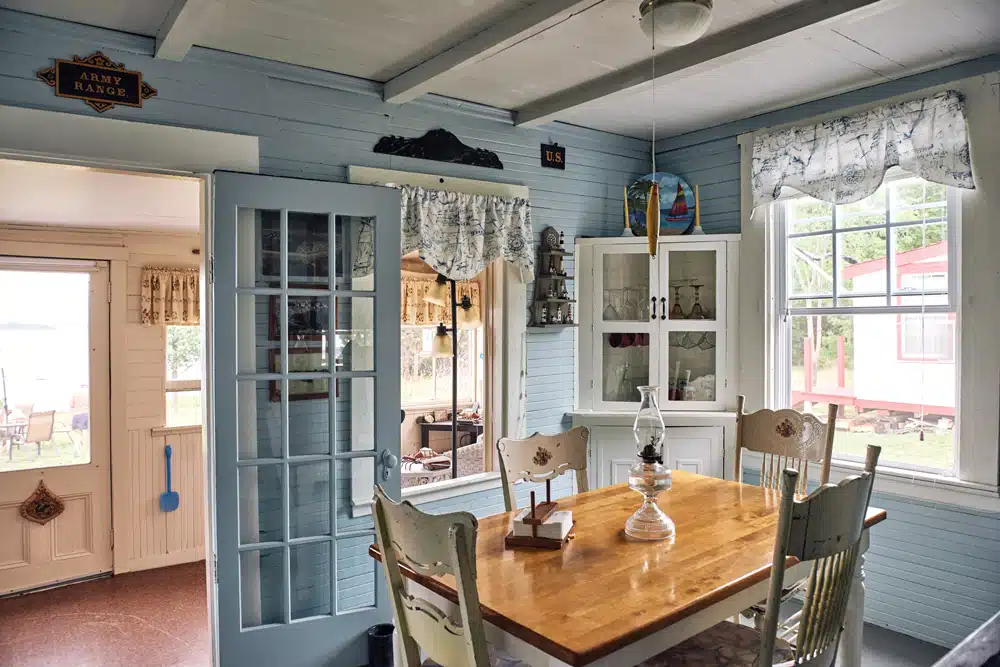
Saudade may have a kerosene lamp on his dining room table, but he’s jury-rigged modern conveniences for his home. He’s like an island-retiree version of MacGyver, the TV tinkerer who escaped weekly crises with a Swiss Army knife and duct tape. Twelve barrels catch water from the roof’s gutters. Solar-powered pumps send the water to an indoor toilet, shower, and sink. Two rooftop solar panels and a battery feed electrical outlets for lights and phone chargers. Saudade plans to keep coming back to Peddocks “as long as I’m alive, if I can,” he says. “It is a challenge as you get older. So I’m trying to meet those challenges with some ingenuity.”
Credit: Tony Luong
The Peddocks Island community has an expiration date no one knows. The houses were built before Massachusetts seized the island by eminent domain in 1970 for a park. But the cottagers never owned the land under their summer homes; they only leased it. In 1993, after the cottagers protested an attempted eviction, a state commission settled on a compromise: life tenancy. The cottagers pay $400 for annual permits to return to the island from May through October, but they can’t sell the permits or pass them on to family. So Saudade’s generation of cottagers will be among the last on Peddocks Island. When they pass away, so will their community, and its way of life.
– – –
For the cottagers, Peddocks Island has long been a refuge where time, conflict, and even everyday identity wash away. “If I had a lot of problems here on the mainland, when I got on that island, that was the other guy,” says Jack Downey, a retired salesman from Norwell, Massachusetts. “It was like living two separate lives. I was John Downey here on the mainland, but I was Captain Jack out there.”
Downey was 32 and his wife, Mary, was 25 in the summer of 1968, when they bought a cottage on Peddocks Island’s Crab Alley, a cozy row of cottages that was named after the seafood the village’s founders caught and sold. In August 2017, at 81 and 74, just before they relinquished their cottage to the state due to health problems, the couple sailed to Peddocks Island to visit their summer home one last time.
The Downeys’ cottage had oil lamps, an outhouse, and a well in back for water and for keeping food cold. They’d been away for two years, recovering from surgeries—his neck, her back—but everything was just as they’d left it.
“It was like the clock had just stopped,” Mary says. “You open the door, and the clock starts up again. Time stands still on the island.”
But stopping time takes a considerable amount of work. “Lug and Tug Island,” some cottagers call Peddocks, because of the physical effort that’s required to get things like food, drinking water, laundry, and propane to their summer homes. And the cottages themselves, decades old, are prone to decay (the state demolished several after their owners gave them up or passed away), so with the closest hardware store miles away by boat, the cottagers have to get inventive.
Jack Enos, a Brookline civil engineer, has come to his cottage every year since 1957; his memories of the summer of 1969, when he was 12, include watching the moon landing on a battery-powered black-and-white TV on the porch. His family would pick up driftwood and take hinges off shipwrecks on the beach. “You could look under this house, and it’s like a lumber yard,” he says. “There’s jars full of hinges my father probably put there when he was a kid.” Other favorite Peddocks memories include “figuring stuff out,” he says. “I think as an island person, you have to have this self-reliance.”
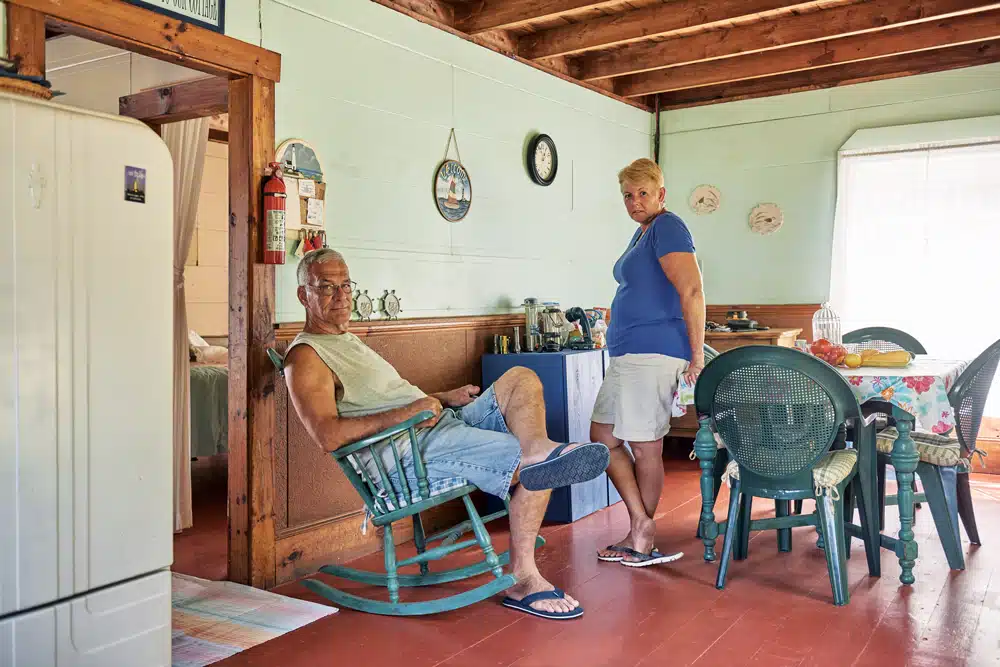
Ken and Annie Clark have a rooftop solar panel to power their laptops, tablet, printer, and scanner. The two financial advisors who live near Bradenton, Florida, spend July and August working from the mustard-yellow cottage that Ken’s mother bought in 1967. Their desks stand next to panoramic kitchen windows that look out on Hull and sailboats heading out of the Hingham Yacht Club.
Credit: Tony Luong
Island living gives the Clarks a break from their daily routine of ringing phones and computer screens. Their propane-powered refrigerator dates to 1932. A gas light illuminates the kitchen. For many years they showered in an outdoor stall with well water heated in the sun. “It goes when I go,” Ken says of the cottage. “Till death do us part.”
Every week or so in summer, Jim Saudade visits the mainland to do laundry and buy propane and groceries. “You have to live by the tides and weather,” he says. Low tide means a longer haul from shore. If winds are gusting more than 30 miles an hour, he says, most cottagers won’t leave the island.
But it’s worth it, Saudade says, for the chance to spend a relaxed summer grilling and baking pizzas, reading, and listening to the island’s coyotes (“I’ve heard them singing, and there’s at least four or five voices sometimes,” he says). In the evenings, he visits his neighbors; like him, many grew up in Boston’s South Shore suburbs. “I’ve known most of these people since I was a little kid,” he says. Cottagers gather at a pink house at the end of Crab Alley to watch the sun set. “Some people call it the island family,” he says.
That family is also a mutual-aid society. “The island way is, we all have to help each other and watch out for each other,” Saudade says. Peddocks has no emergency services other than the police and fire boats that patrol Boston Harbor. So Saudade refreshes his CPR and first aid training every year, in case of an island crisis.
“The scariest thing out here,” Saudade says, “is fire.” About 50 years ago, a blaze broke out in a cottage next door to his, and he tells the story as if it were yesterday: how two dozen neighbors formed a bucket brigade to douse the flames with rain-barrel water. “People took the water one bucket at a time, and hand to hand, into the house,” he says. “We got it out.”
– – –
Happening upon the Peddocks Island cottages can be a surreal surprise for a park visitor. Suddenly you’re walking right past people’s front doors, with their belongings visible in the windows. This community is a peculiar no-man’s land between public and private, between a preserved past and a lingering present.
“People walk through yards,” says Bill Hale, whose wife’s family has summered here since 1918. “But the [cottagers have] gotten around to accept it. Those that were very belligerent about it in the beginning and nasty to visitors have mellowed out with old age.”
Most cottagers, in fact, say they enjoy interacting with park visitors. “When they hear you’re a cottage owner here,” says Annie Clark, “and you share some of the history, they’re very excited.”
As a state-owned park interpreted by the National Park Service, Peddocks Island is filled with both natural beauty and human history. The island wouldn’t be as interesting without Fort Andrews’s barracks, which reflect a soldier’s-eye view of the world wars, or without the historic cottages—and the cottage families themselves.
Credit: Tony Luong
Credit: Tony Luong
“One of the reasons that Peddocks is interesting to me is [the cottagers are] going, but they’re not gone,” says Cathy Stanton, a Tufts University anthropologist and author of a recent ethnographic study of the Peddocks Island cottagers. Her study, which was commissioned by the National Park Service, concludes that nearly all the residents have “ties of kinship, occupation, or friendship” to either the Azorean fishing families who came to the island after 1887 or the next generation of Portuguese-Americans, who built the cottages. “This really is a traditional community,” she says.
Stanton, who grew up visiting her family’s cottage in Ontario, Canada, says the Peddocks cottagers share a feeling she remembers: how time spent in seasonal communities often seems “more intense than real life.” The challenges of remote island living magnify that feeling. Stanton says cottagers often share stories about water, wells, and fire. “They show you how very close to the edge this environment is,” she says. A Peddocks ghost story tells of a cottager drowning in a cursed well. There’s no evidence it really happened, says Stanton, but the story has a moral: “If you wanted to be on the island, to survive you had to pay attention to water.”
The cottagers are among the few people who are still living in Massachusetts parks. On the Cape Cod National Seashore, people continue to summer in some of the 19 historic dune shacks, which were added to the National Register of Historic Places in 2012. In Myles Standish State Forest in Plymouth, 143 private cabins are gathered around five ponds, thanks to a state rental program that began in 1919. Ashmere Lake State Park in Hinsdale has 15 private cottages. The state Department of Conservation and Recreation (DCR) asserts its rights as a landlord at Peddocks, Myles Standish, and Ashmere Lake by issuing annual permits to cottagers under a “seasonal cottage campsite program.”

Credit: Tony Luong
What will happen to the Peddocks community as more residents pass away or surrender their cottages isn’t yet decided. For decades, the DCR has tried to phase out the cottagers’ private use of parkland. Neglect and demolition have become its unspoken policies: It tore down several vacant, decaying cottages in 2001 and razed a dozen more in 2018. Before their demise, two sagging, empty cottages on Crab Alley were decorated with blue, red, purple, and green lobster-trap buoys—neighbors’ efforts to keep entropy at bay.
In 2001, the Massachusetts Historical Commission declared the Peddocks Island cottages eligible for the National Register of Historic Places, saying they were worthy of preservation as “highly significant” parts of the Boston Harbor Islands’ history. The commission has pressured the DCR to find new uses for the cottages—and to allow owners to once again hand down their cottages to heirs. But according to spokesman Troy Wall, the DCR has no plans to change the life tenancy policy. “As cottages become state property,” he says, “they will be assessed to determine whether the cottages can be salvaged for possible use.”
Draft options for a Peddocks Island redevelopment plan released in 2019 by the DCR, the National Park Service, and the nonprofit Boston Harbor Now include razing the cottages to replace them with glamping tents or making them into a “cottage community cultural center” that would share stories of the cottagers and their lives on Peddocks.
So the government may someday commemorate the cottage community—after forcing its demise. “Ten years from now,” jokes Jack Downey, “they’ll be hiring us to go out there and role-play as the people who lived in the village.”




I live on Great Hill, Houghs Neck, Quincy and look directly at the pink cottage on Peddock’s Island, watch the skiffs with Island residents heading for the island all summer. Many of my neighbors own the cottages. It is sad that they can’t pass them on to the next generation. They are hearty folks who are willing to endure because of the love of nature, independence and honor their relatives who first were there.
Yes / Yes. Because of free just America. Personal interests seem to come before general ones.
Enjoyed the history
I am a second generation proud member of Peddocks Island island family.
Well this is a new one on me — Never heard of Peddocks Island before now — I am so impresses — Love what the people of the Island have today — Wish I know about it when I was growing up — Born & raised in Framingham , MA. I would love to be on the Peddock’s Island –SOOO quiet — etc. etc. Hope you all get to keep the HUB -BUB out of your Island. sincerely, Peggy from MD.
I spent many days each summer anchored off the island and snorkeling around with my family as a young boy. Picknicing and walking and exploring the island and others nearby. Such experiences instilled a love of history and Maritime culture that ultimately resulted in my becoming a cruise ship Captain and sharing this appreciation with others.
My grandmother was postmistress of Peddocks when it was Fort Andrews. My family had several cottages for a few generations. Then the MDC kicked us out of our home, killed the island way of life, made me cry for years as a child because I didn’t understand why the government was always trying to kick us off.
Have many memories of growing up on Peddocks island sad seeing the cottages rotting away when I was a boy was a vibrant community of people some who are still there it’s been along time since I’ve been over there family cottage is still in use that what my father& mother would of wanted planning a trip over there soon with my sisters Cathy& Lorraine to see the cottage we grew up in .
Hi Ray, my cousin and I visited Peddocks yesterday. As we walked by your former cottage, I thought of Cathy. I lived in cottage 31 with my parents. If you read this, it would be great for you to contact me at milfordelms@gmail.com
Omg my Grandparents Agnes and Al Marchand owned a cottage on the fort side of the island spent many happy summers there , no one in the family wanted the cottage so it was sold , I believe the cottage is still there someday would love to visit again , WHAT WONDERFUL CHILD HOOD MEMORIES
We had a boat at Hingham Yatch Club and as a young person was always fascinated by Peddocks Island
I’m so happy that I came across this article because I don’t ever remember hearing about Peddocks Island. I just emailed the story to my sister who is now settled in Arizona, and I’m curious as to whether she had ever heard about the Island.
Such a great story, thanks for reporting it. My father grew up in East Boston and knew every Harbor Island like the back of his hand. The islands were their back yard back in the day. It was always fun to visit and and all of them.
My grandmother Helen McManus Keyes living in Hull for the summers would be rowed over to Peddocks every Sunday to play the piano at the church for the Italian prisoners during WWII.
My grandparents had cottage there when they lived in South Boston. They continued to summer there after moving to Arlington. As a child I remember having to take two separate boats to get to the island, we spent many summers there. My parents never told us what happened to the cottage after my grandparents died. It was a yellow cottage with a front screened porch, with the outhouse along the right side of the cottage. The cottage was right on the ocean’s edge and you had to go down the stairs to the ocean. There were so many small rocks on the ocean bottom that you needed to wear your sneakers to go into the water. If anyone reads this and remembers the Dwyer’s cottage, please reach out to me.
My parents went to a picnic on prince’s head way back in 1916 or there abouts and fell in love with Peddocks Island. They rented the purchased a cottage and summered on the Island since 1917. Our cottage was once owned by a baseball player who played for the Boston Braves way back in the early 1900’s. There used to be a private Bar in the rear end of the cottage. An old island lady named Mable, used to tell me how much fun she had in that bar. With a beautiful smile she said, “Oh I had many a good time. we just danced and sang all night long until the sun came up the next day.” We since had to tear the bar down and it is now a covered patio. There is so much history on Peddocks. It is too bad that the families that have lived and summered there cannot pass it on to their children. We are the Island’s wonderful history. My children, grandchildren and I feel blessed that we were able to enjoy such a unique place. It is not for everyone, though. If you are afraid of hard work. The island is not for you. The hard work and the satisfaction of enjoying the fruits of your labors when done is what made it fun.
I grew up in Hull . We used to find it amazing that people walked around on the island. I never in all those years did I visit the island. I would go out fishing with my dad . we would go out through the gut and never stopped on the island. I am so glad I found this article. Please stay safe.
My grandfather,father ,aunt and friend’s dad built a cottage(mostly from driftwood) on the hill above CrabAlley. Amazing memories.
While reading my Yankee magazine I got so excited to see this article. For many years my Mothers cousin, Doris Chalmers Clark would go out to the island to the family home. it was a quiet resort for so many. Eating fresh lobster & seafood at night. So peaceful. Both my brother, Charlie Brown (for real) & my mother Gert would go out & join Dotty. When I think back those days were a refuge for my mother . Thank you to all the Chalmers for their love. I sent copies of this magazine to my brother & Kenny
so grateful for this article. In 2008 I gathered 27 family members in Hull, and invited any who wanted to take the hike to Prince”s Head. About a dozen joined this Houston Texas descendant of Elder John Prince to make the Pilgrimage. Elder John was the town Elder of Hull for some 30 years, and it was on Pedocks Island that he kept his sheep in the 1640’s. He had come to America in 1633, and spent time in Hingham before settling in Hull. His kids and thoze of Samuel Lincoln, the ancestor of Abraham Lincoln lived across from each other on the Green in Hingham. And on a side note, one of Elder John’s descendants was at Fords Theatre the night Lincoln wS assissanated.
Our group made it to the sandy beach that Saturday, and it was a magical moment for this Texas boy to be where my 10th great grandfather had once walked almost 400 years before. I must make it back and meet some of rhese cottagers. What a story.
it was the enthuisasm of my new found cousin, Howard Pflaumer and his daughter, Patricia of North Weymouth that set the wbeels in motion that summer of 2008.
Anything less than a preservation effort to maintain these cottages and the inhabitants way of life would be a complete travesty of local history. I am trying to pretend I did not hear the suggestion of “Glamping” tents as a replacement. This would only add insult to injury to the homesteaders whose tenacity, endurance and good old Yankee ingenuity deserve our respect. This is an important life lesson to all those who follow.
My husband of 51 years grew up in Squantum and his family remained there until 1994.
I thought they knew everything about Quincy and the islands. Until this marvelous article, we had no idea about the plight of the Portuguese fishermen and their families and the shameful forced relocation to Peddocks island, at the hands of government of Boston and allowed, probably encouraged by the state.
To continue to rob their descendants of what is rightfully theirs is a travesty, a blatant and systematic form of racism. I hope the better angels visit the powers that be and make sure that the families rights are reinstated. Including preserving the community and the cottages that are not passed along within families.
There are many parts of this history that remind me of the Gullah folks on the islands off the coast of Georgia and South Carolina.
As a former resident of Houghs Neck I’ve been on the island many times and could actually see it from Riverview St such a shame Islanders can’t pass their cottages on to loved ones Seems like the Government wants this beautiful island ????
Great article. I would love to Peddock’s Island. There is no ferry service this year. Does anyone have any ideas how to get over to Peddock’s? Thanks
I loved reading this article. I have fabulous memories and some not so fabulous memories from spending one month every summer on Peddocks island. My dad (Robert Alexander Chalmers) would take us to the island. We loved it but I learned that those who didn’t grow up going were not as crazy about Peddocks island as we were. I brought my husband (boyfriend then) in 1974. We were 17 and 18 years old. He questioned why I wasn’t concerned with mosquitoes , an outhouse, no running water and no electricity. I had to patiently explain that no electricity is part of the charm. With no electricity families spent their evenings sitting out on the porch conversing while watching ships pass by. Or we passed the time by playing card games or board games via a kerosene lantern’s light. Some of the older kids would take a boat to the mainland to go roller skating. I remember being envious and longing to join the big kids. But thanks to my Aunt Dottie (Doris Chalmers Clark) we would have fun little kid activities like gumdrop harvesting from the gumdrop trees ( Chinese Hollie’s). My mom would distract us while Aunt Dottie would stick gumdrops on the leaf stickers. Then we would pull the gumdrops off the leafs. I remember as a young child asking when the sticker bushes would bloom gumdrops.
The not so fun memories involved bathroom needs. I remember using the bed pan under the bed for nighttime potty needs. I also remember wanting to ALWAYS use the bedpan instead of trips to the smelly fly dwelling outhouse which always seemed to have a horrible smell. I don’t remember minding using water pans for sponge baths and hair washing. We collected the rain water in a large barrel and used that water sparingly. The same went for well water being sparingly used only for drinking and dishes. My mom urged us to only use the well water for dishes. She brought water with us from the mainland for drinking water.
While I didn’t like arriving at low tide and walking and sinking in the muck I enjoyed digging for clams in that same muck. I also remember spending FABULOUS afternoons swimming out to a swim platform in freezing cold water. Another common afternoon activity was walking to Princess Head.
Thank you for triggering my memories of 30 days every summer on Peddocks island. These childhood memories both good and not so good are part of my treasured childhood memories. I hope to visit Peddocks island and take a walk down memory lane this summer. I haven’t been to Peddocks island in several decades. My visit this summer with my youngest sister Robin is one I look forward to!