Christmas Revels | The Sounding Joy
May our Christmas Revels not be ended–for their music is indeed ‘such stuff as dreams are made on.’
By Jim Collins|Dec 01 2013|

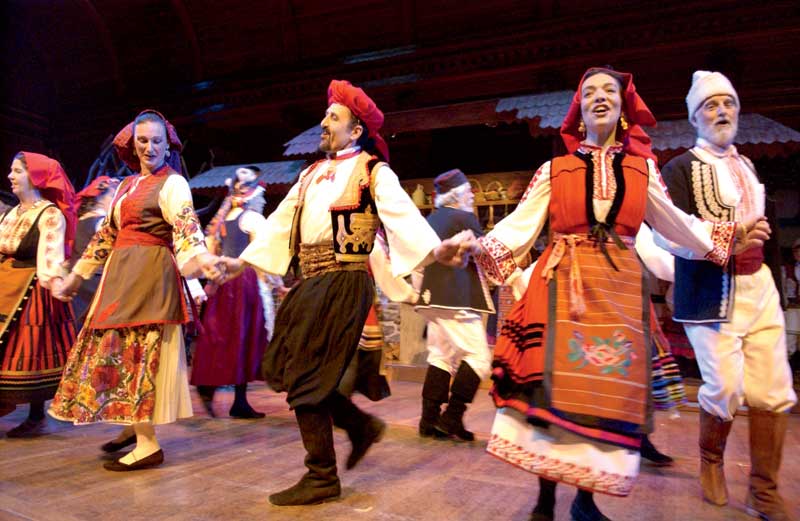
One highlight of the 2002 Christmas Revels, which featured an Armenian and Georgian theme, was the "Sebastia par," an Armenian folkdance that originated in the ancient Anatolian province of the same name.
Credit: Ide, Roger
David Coffin leads the audience and ensemble in the “Sussex Mummers’ Carol” at the close of the 2007 Christmas Revels, which featured a Balkan theme.
Credit: Ide, RogerCredit: Ide, Roger
The Christmas Revels, a winter-solstice celebration of folksong and dance, began 39 years ago this season–long enough in the past that some kids who sang in the first Revels productions have appeared later on stage as adults, while others have seen kids of their own join the chorus. For years, extended families have made the show an annual pilgrimage; friends in the audience return each December to the same rows and seats, organize reunions beforehand at the same restaurants, or go out afterward to the same coffee shops. Originally designed to celebrate authentic, communal traditions, the Revels by now has itself become an authentic, communal tradition in Cambridge, Massachusetts.
The Revels was the brainchild of the late John Langstaff (“Jack” to his friends and colleagues), a Juilliard-trained concert baritone who had a deep interest in folk culture and storytelling. Langstaff first staged a “Christmas Masque” at New York’s Town Hall in 1957. Despite an enthusiastic response, though, the celebration lost money, and after a staging in Washington, D.C., and a made-for-television encore, Langstaff brought the curtain down on the idea, seemingly for good.

One highlight of the 2002 Christmas Revels, which featured an Armenian and Georgian theme, was the “Sebastia par,” an Armenian folkdance that originated in the ancient Anatolian province of the same name.
Credit: Ide, RogerCredit: Ide, Roger

In the 2006 German-and Swiss- themed Christmas Revels, cast member Giles Holt walks the “slack rope,” representing the balancing act between the old and the new year.
Credit: Ide, RogerCredit: Ide, Roger
But in 1971 Langstaff’s daughter Carol persuaded him to try it again in Cambridge, her hometown. Langstaff brought together professionals and amateurs under a new name, “The Christmas Revels,” and the chemistry worked: The pros felt energized by the enthusiasm of the community singers and bent their voices to sound less trained and more natural; the amateurs learned from and felt inspired by the pros and sang better. The blending was just right for the material and created the feeling of a family, or a village, celebrating.
David Coffin, who has performed in 30 Revels productions, believes that Langstaff’s inclusive vision was key. “He was like a neighbor among us–though, to be sure, a neighbor with a very fine voice,” he says. Something between the audiences and the performers clicked.
Langstaff’s choice of venue added a note of perfection. Sanders Theatre–an elegant space within Harvard’s Gothic, mansard-towered Memorial Hall–lent something magical to the gatherings. This magnificent yet intimate lecture hall–with its warm, polished woodwork and three soaring levels of seating–worked on the audience even as they were arriving. As the Revels’ current artistic director, Patrick Swanson, puts it, “We have the extraordinary presence of Sanders Theatre itself. People who come for the first time feel as though they’ve come into a great, big, familial place. Of course, many, many people come back every year …”
Within a few seasons after the 1971 début, a nonprofit group formed to promote and stage ever-more-ambitious productions. Audiences learned to appreciate new traditions each year, from Scandinavia, Scotland, Mexico, Russia, Eastern Europe, or, as they did last year, Appalachia, the African American South, Native American gatherings, and New England’s Shaker communities.

The Christmas Revels’ 2007 shows included the men’s chorus performing the song “Domakine, sipi vino da piene” from the Pirin Mountains of Bulgaria: “Master of the house, pour wine for us to drink because a baby boy is born!”
Credit: Ide, Roger