The Heirloom Apple Hunters
New England once grew thousands of apple varieties. A band of devoted detectives is racing against time to find the survivors.
By Sara Anne Donnelly|Aug 24 2026|

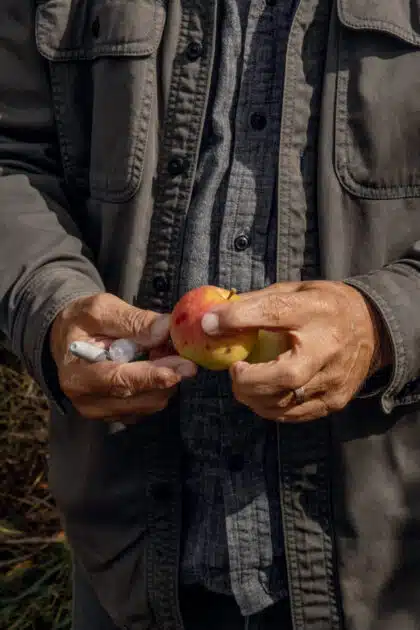
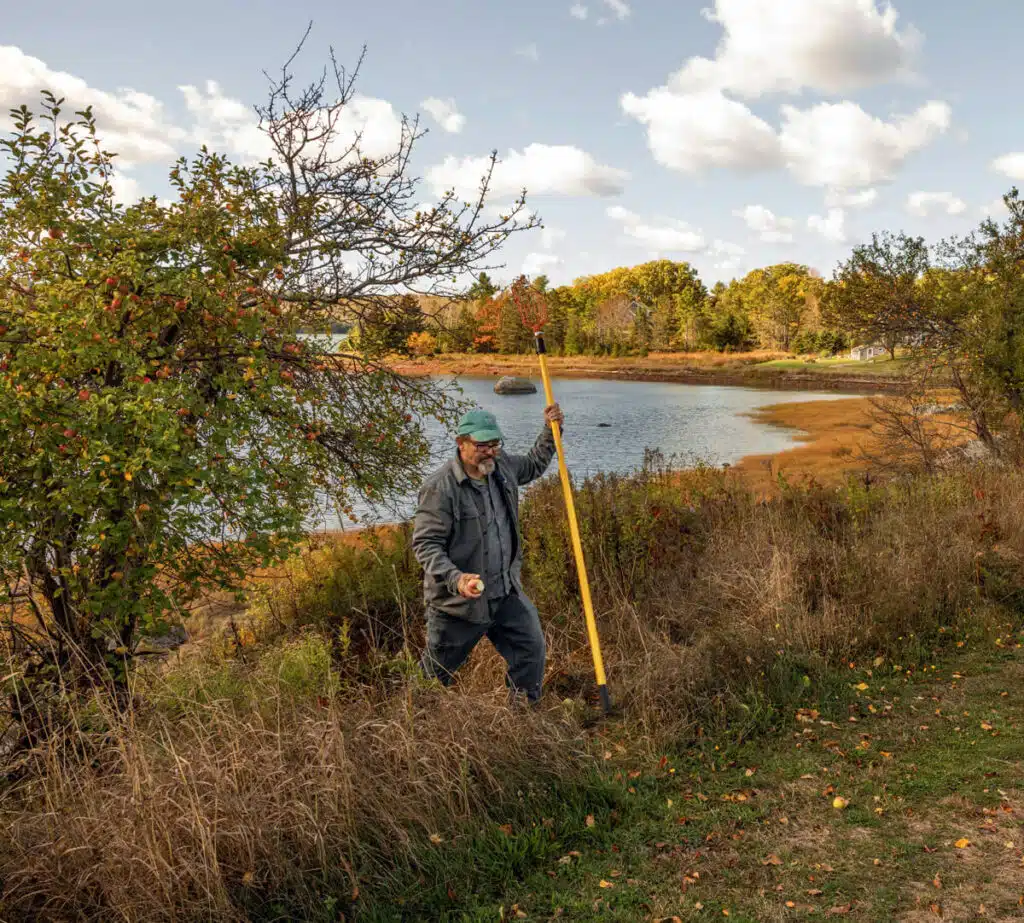
Todd Little-Siebold gathers DNA from an apple on the coast of Maine while searching out potential heirloom varietals. A history professor at the College of the Atlantic in Bar Harbor, he has spent more than a decade tracking down, researching, and helping to preserve heirloom apples in Down East Maine.
Credit: Greta RybusTodd Little-Siebold spends his days off investigating strange apple trees. One October morning, the tree that piqued his interest belonged to a young couple in Penobscot, an 18th-century village along a rocky shoreline of Maine’s Blue Hill Peninsula. The couple had connected with Little-Siebold after hearing about the Drap d’Or de Bretagne, a rare French apple thought lost to history that Little-Siebold and fellow apple hunters found four years ago in a neighboring town. This couple wondered whether their own tree might be another Drap d’Or, or some other missing and special Malus domestica.
Little-Siebold was all for it. “My problem is I have AADHD—Apple Attention Deficit Hyperactivity Disorder. I’m like, ‘Apple! There’s an apple! Let’s go get the apple!’” he says. “It’s addictive. It’s like a treasure hunt every day.”
The Penobscot apple tree grew halfway down an embankment along a windy corner of Northern Bay. To get to it, Little-Siebold was led across the couple’s backyard, past a vegetable garden, a swing set, and a dozen or so loudly alarmed chickens and ducks. Along the way, the pair told him how, in the late 19th century, this had been the site of a busy brickyard and port, but by 1920 those industries had died out and a family farm had taken over. “We’ve been calling it the Bayview apple,” the husband said, pointing to the tree in question, growing so crookedly its mop of tangled branches skimmed the muddy beach, which was covered with tide-flattened sea grass and bruised yellow-and-pink apples. “We think they’re really good for sauce and pies, but they’re pretty good for eating, too.”
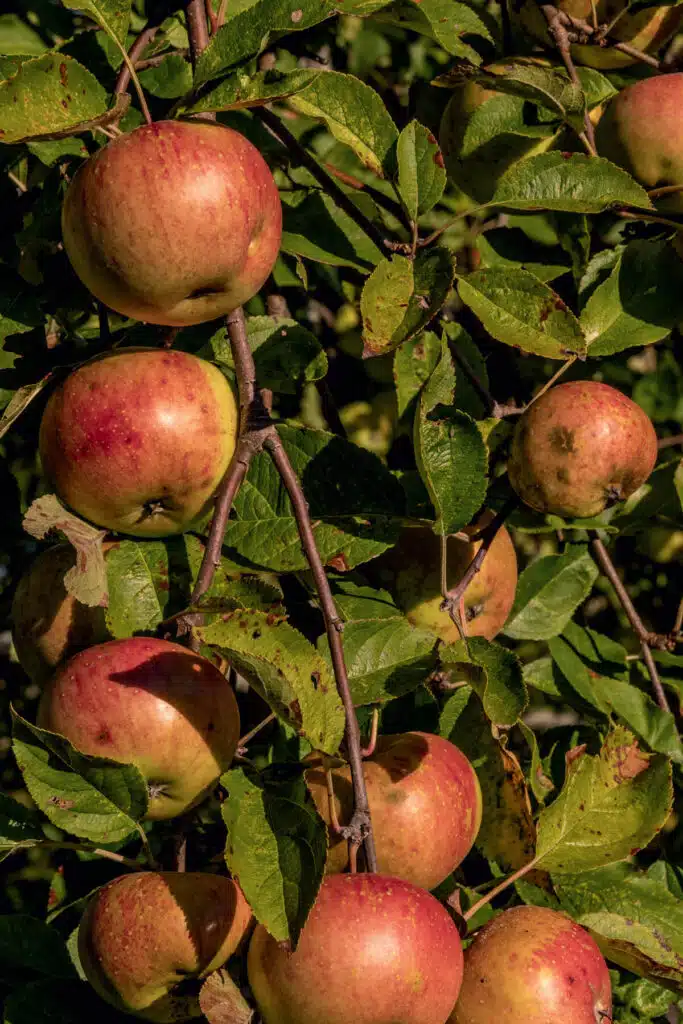
Little-Siebold scrambled beneath the lowest branch and climbed, grunting up the slippery embankment to the trunk, searching for the telltale graft scar that would prove someone long ago had intentionally grown this crooked tree. “I’m noticing broken plates, broken glass,” he called down. “This was the farmer’s dump. A lot of times they’d dump apples and the tree would come up in the dumps.” That would mean this tree is from seed, and not a cultivar at all. Little-Siebold trailed off. A short while later, he reemerged from the canopy, wiping his muddy hands on his cargo pants and tugging thoughtfully at his gray goatee. He plucked an apple from the tree and bit into it. “The first thing I would say is, wow, what a great apple,” he said. He studied the tree again, chewing thoughtfully. This tree could have sprouted from trashed cores, he mused, but then again, farmers often intentionally planted apple trees on the edge of their land, and erosion and storms could just have pushed this one sideways toward the shore over time. He scrutinized the firm white inside of the apple in his hand, the seeds forming a symmetrical oval. And then there was the fruit itself: complex, sweet, finely textured.
“I think you almost certainly have a cultivated fruit,” he announced. The homeowners grinned. “And it’s an amazing fruit.” He clipped three leaf buds each from the north and south sides of the tree and put them into test tubes to ship later to apple geneticists at Washington State University. After carefully packing those into his tote bag and filling a paper bag with sample fruit, he pointed to a row of large apple trees on the adjacent property. “Would it be OK for us to look at these, too?”
Welcome to the Maine apple hunt: an ad hoc effort to save heritage apples, the rare survivors of a vast and nearly vanished orchard landscape once filled with thousands of varieties. According to a 1905 catalog by the U.S. Department of Agriculture, some 14,000 kinds of apples were grown between 1804 and 1904, mostly in small orchards on land too marginal for other crops. There were apples as small and red as cherries, fruits that were ghostly white and others so dark they looked black, and monstrously pimpled russets. There were others so tart and juicy they tasted effervescent, or left the flavor of banana, coconut, or clove lingering on the tongue. New England in particular had the most diverse and longest history of apple propagation in the country, because colonists here were first to bring trees from abroad, and Maine alone grew more than 600 varieties during this time. Growers named the apples, often after themselves (Gloria Mundi, Carll Apple), their location (Cherryfield, Bethel Belle), or their appearance (Hidden Rose, Blood Apple, Broke Down).
“These apples weren’t being trademarked; they weren’t even being written about,” says John Bunker, a Maine apple historian who mentors Little-Siebold. “Names were just points of reference. Most of these varieties were hyperlocal, and many of them were never really sold, except maybe on a very limited local basis.”
For many of these apples, the only surviving record is in local grange hall registries. And by the early 20th century, as the agricultural market globalized, apples were being bred more for shelf appeal, durability, and transport than for flavor. Federal agricultural agents encouraged farmers to rip out their unique varieties for lucrative mass-market alternatives like Red Delicious, Granny Smith, and McIntosh. This development, combined with the Great Depression and a pair of catastrophic winters, decimated hundreds of thousands of Maine’s apple trees. The few that survived are now reaching the end of their natural lifespan, just as old farms and undeveloped land are disappearing from Maine’s landscape. “If we’re going to save them,” says Bunker, “we have to do it now.”
*****
Every apple seed produces a genetically unique tree. Plant a Honeycrisp seed, and what grows will probably look and taste nothing like a Honeycrisp. Even seeds from the same apple can produce wildly different fruit. This genetic diversity from seed makes apples remarkably adaptable: Seeds that take root and survive usually acclimate to their environment.
To replicate a specific beloved apple, however, growers need to take the seeds out of the equation and clone the tree instead, using the ancient practice of grafting: inserting a shoot, or scion, from the original tree into hardy rootstock. In this way, heritage apples survive by generations of deliberate human selection.
Little-Siebold grew up in Atlanta, Georgia, “at a time when supermarket apples were pretty uniformly terrible.” His mother used to buy apples by the three-pound bag and they’d sit in the fridge uneaten because the fruit was so bland. But in 1997, he accepted a history professorship at the College of the Atlantic in Bar Harbor. He and his family moved into a farmhouse in Ellsworth with a 150-year-old Yellow Bellflower tree across the street, a New Jersey–born cultivar first documented in 1817 with lemon-yellow skin and a pink blush.
“I’m looking out my window and I’m thinking, What is this thing?” recalls Little-Siebold. “So I picked some apples, and it turns out they make unbelievable pie.” He started collecting other local apples for cider and went to so many of Bunker’s talks on heritage apples that Bunker “joked that I was stalking him.” Heritage apples opened up what Little-Siebold describes as an entirely new way of seeing the outdoors—not as woods and fields but as a kind of historical record of a more diverse food landscape. He designed a field-based course on apple hunting (he prefers the term “fruit exploration”) using apples as an entry point for learning about changes in farming and loss of biodiversity. In the first class, Little-Siebold holds up an heirloom apple that’s in season and asks, “Why can’t I buy this apple in the supermarket?” His students spend three months trying to answer that question.
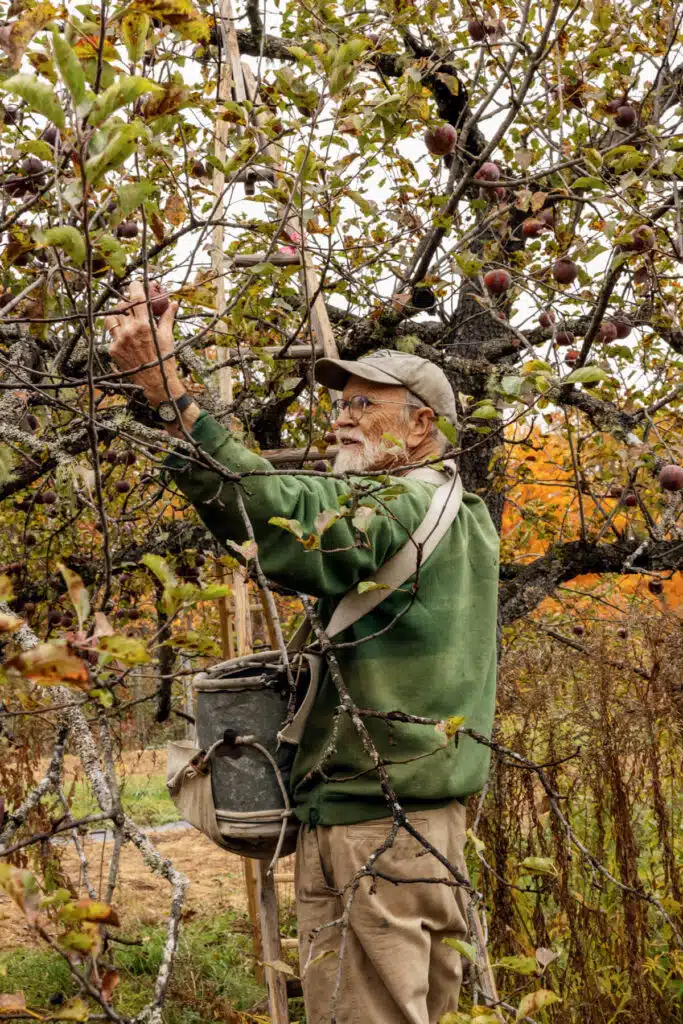
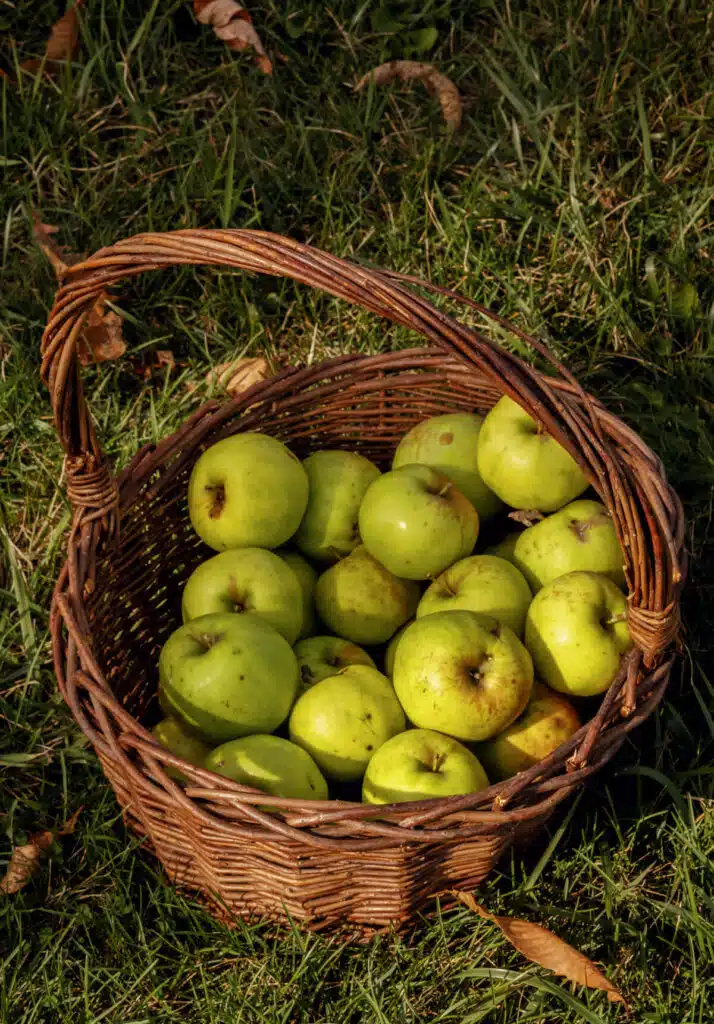
In 2022, Little-Siebold, Bunker, and their fellow apple hunters registered a monumental find: a Drap d’Or de Bretagne, or “Golden Cloth of Brittany,” one of the rarest apple varieties in the world. This particular Drap d’Or is “the scrawniest little tree,” Little-Siebold says, a hollow, blackened contortion growing on Verona Island, at the mouth of the Penobscot River. But the yellow fruit it bears every couple of years is complex and sweet, still worthy of being “esteemed by the curious,” as prominent English pomologist Richard Weston wrote in 1772. Little-Siebold thinks this Drap d’Or de Bretagne was planted around 1837, when the previous owners, a family of subsistence farmers, bought the property from Revolutionary War general Henry Knox. The heritage apple genome project at Washington State University confirmed the apple’s unique provenance by matching it genetically with a cultivar in a French public research institution. At the time, the Verona Island tree was North America’s only known living example of Drap d’Or de Bretagne—a dessert apple first recorded in France in 1628 and since lost even in Europe, save a single tree in a Denmark heritage orchard. (Two more Drap d’Or trees have since been found in Waldo County.) It is believed to be one of the oldest continuously grown apples in North America, and is one of three known ancestors from which many of the continent’s varieties descended.
After the discovery, Little-Siebold launched the Penobscot Valley Apple Project, which intends to sample the DNA of about 100 trees from Bucksport to Deer Isle over the next two years to determine whether French settlers there introduced some of New England’s earliest cultivated apples. It’s possible the Verona Island tree arrived through the 19th-century nursery trade, but it’s also possible it was propagated by farmers from a tree planted in or around Castine in the 17th or 18th century. If this second hypothesis is correct, it may point to a deeper and largely overlooked French influence on North American apple history. While researching a book he’s writing on the subject, Little-Siebold found that the earliest documented orchard in North America was planted by French settlers in Port Royal, Nova Scotia, in 1608. French settlements in Down East Maine around the same time are also documented, and in 1613, a settlement on Mount Desert Island recorded planting “fruit trees.” “One of the things that’s fascinating is the genetics is telling us that the French signal is really important in early American apples, but people have no idea,” he says. “So part of it is looking for things that people don’t even know we should be looking for, which is these French apples.”
*****
The man generally credited with launching Maine’s heritage apple renaissance is Little-Siebold’s mentor and friend John Bunker. Half a century ago, right before Bunker graduated from Colby College, he and a couple of friends bought a large parcel in Palermo and set about learning to live off the land. He realized quickly that farming in the village of Palermo was a dying art. “When I got here, there were like half a dozen farms left in town,” Bunker says. “And they all shuttered maybe five or 10 years after I arrived. But the apple trees just kept on growing.”
Bunker would ask neighbors for their dropped apples, which he’d take home to preserve, bake, and cook with while he learned how to grow crops on his own land. The old-timers taught him where their apple trees came from, how to graft them, how best to eat their fruit. “I was realizing, these old trees, no one seems to care about them, but these apples are super cool,” Bunker says. “These old trees, they’ve been through everything—waves of browntail moths, 30 degrees below zero, everything. These trees are survivors.”
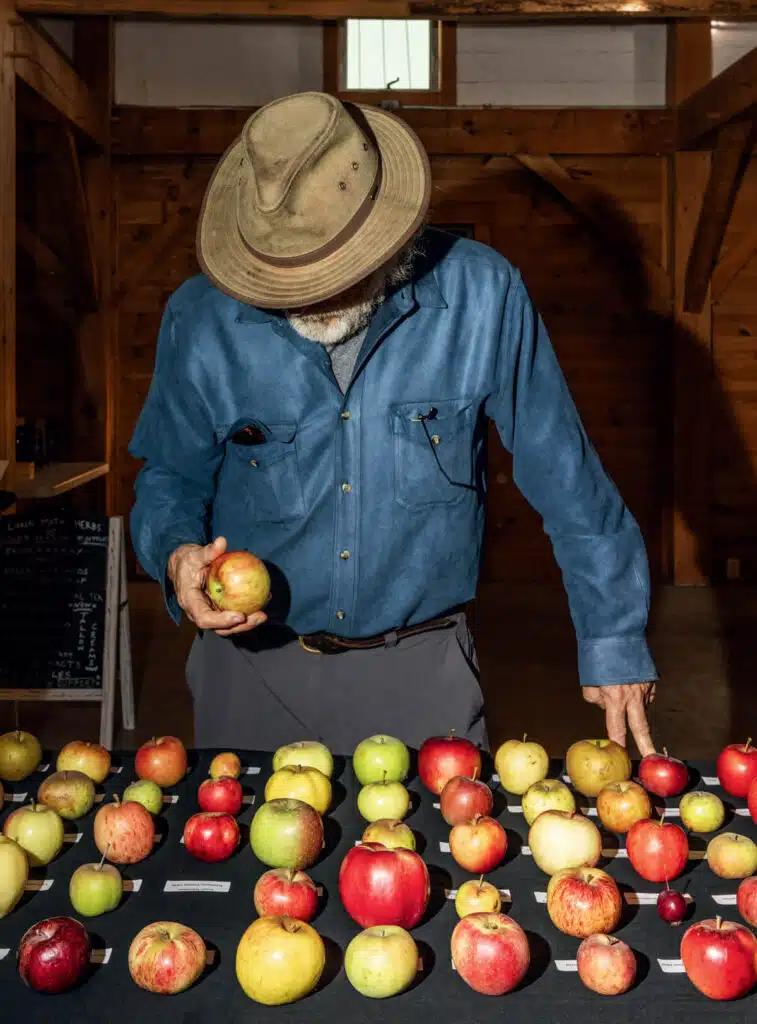
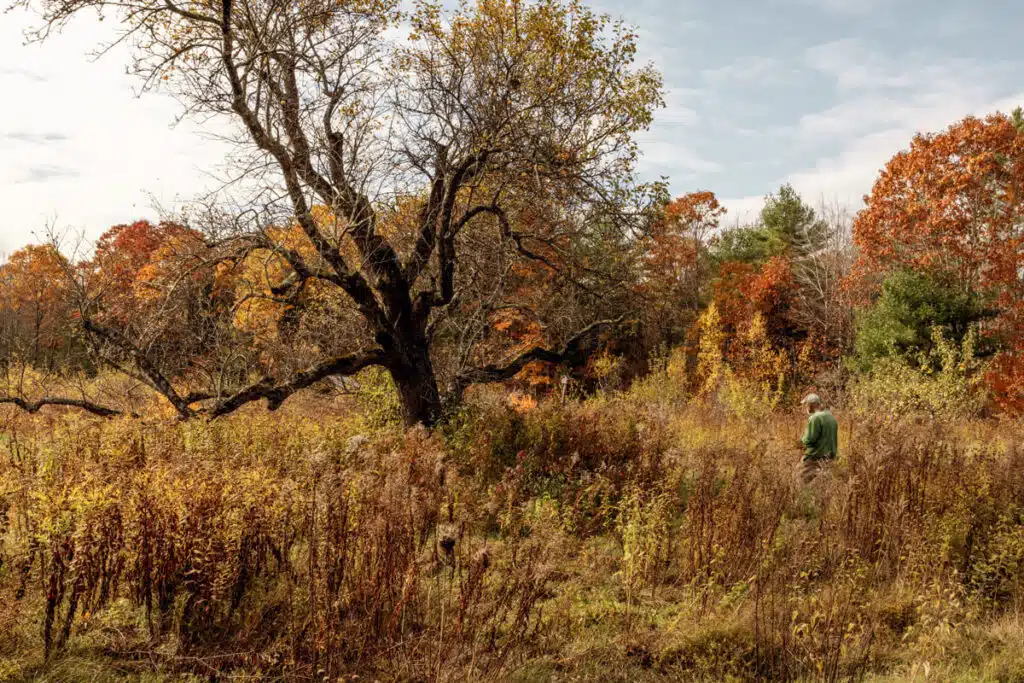
Eventually, an encounter with Ira Proctor, a local farmer known for growing a dark purple apple called Black Oxford, inspired Bunker to begin identifying hundreds of Maine varieties using a method called phenotyping: comparing a fruit’s physical traits—shape, color, texture, flavor, seed pattern, and stem cavity—against historical descriptions and knowledge passed down by growers like Proctor. It’s a heady challenge, and even Bunker, who today is considered one of the top apple historians in the world, is proven wrong by DNA about 40 percent of the time.
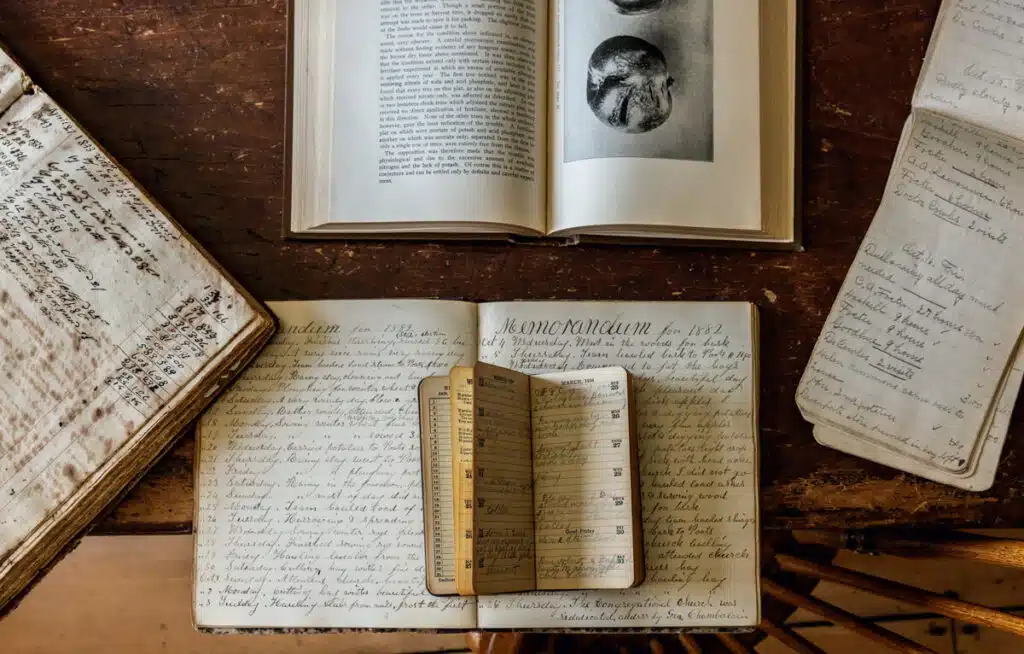
During the winter, Little-Siebold meets every few weeks with Bunker at his Palermo farm, a sprawling idyll of orchards, vegetable gardens, and weathered outbuildings. The two sit at the dining room table overlooking a backyard duck pond, hunched over farmers’ diaries, grange records, annual reports from the Maine State Pomological Society, 19th-century maps, and tomes with names like The Apples of New York (published 1905), Systematic Pomology (1925), and the seven-volume Illustrated History of Apples in the United States and Canada (2016). They haggle over the features of the mystery apples they’ve collected: the slope of the stem cavity, the shape of the calyx, the color and arrangement of seeds at the core. Occasionally, Bunker’s wife wanders in to cook on the antique wood-fired stove in the adjacent kitchen, wafting sweet and salty aromas into the room.
Bunker is turning 76 this fall, with white hair tucked under a ball cap, holes in his boots, and a thin and scratchy voice. Over his 50-year career as an apple hunter he’s compiled a database of his observations of roughly 2,500 varieties of apples. He consults this database to come up with a tentative variety of a mystery apple, comparing his and Little-Siebold’s observations against those logged years earlier by what Bunker jokingly calls “John of the past.”
In his 2019 book, Apples and the Art of Detection, Bunker compares hunting heritage apples to the work of Sherlock Holmes, who famously called solving mysteries “the art of detection.” At Maine’s Common Ground Country Fair and the Great Maine Apple Day, Bunker lectures on historic fruit and hands out “WANTED ALIVE!” fliers with drawings and descriptions of a few dozen northern New England varieties he and his colleagues most hope to find:
Wanted: Golden Pippin (possible known alias, Allen). Last known sighting: Washington County, c. 1886. Any information that leads to the rescue and revival of this apple—or any other really old tree—will be greatly appreciated.
Strangers line up with bags of apples for him to examine. If they can’t find him in person, they mail him boxes of fruit or leave apples on his car or doorstep in Palermo. “People care about the old apple trees, but they don’t know that anybody else cares,” Bunker says. “I’ve felt like it’s my responsibility, my opportunity, to put myself out there at fairs, at lectures, at book signings, anywhere someone can see that someone cares.”
*****
Little-Siebold can pack as many as half a dozen apple hunts into one day, leaving just after dawn with a tote bag filled with sample tubes, a French pocket knife, and an 1885 Maine atlas. Most of the trees he looks at turn out to be seedlings or common varieties like McIntosh, but every now and then he finds what he calls the “really obscure, rare” ones. “What I’m focused on is preserving old cultivars,” says Little-Siebold. “Part of this is about memory and lived experience. But it’s also about many people in Maine, I think, getting back to the land. They have these apple trees, and they feel sort of compelled to be stewards.”
Each year, Little-Siebold, Bunker, and the dozen or so other volunteer apple hunters in Maine send samples from up to 40 promising trees to the Washington State DNA lab. The ones confirmed as rare are then grafted onto rootstock at the Maine Heritage Orchard in Unity, which Bunker founded as a living archive in 2012. So far, there are about 300 local heritage varieties in the orchard, and over the past six years DNA testing has helped correct about a dozen misidentified varieties.
Back in Penobscot, Little-Siebold will spend four hours looking at apple trees. He traverses backyards, bushwhacks through woods, slides down into gullies, eating the apples he finds along the way. Since identifying the Drap d’Or on Verona Island—a tree he and other apple hunters had known of for nearly 20 years before examining it—Little-Siebold worries he might overlook another important apple. “What keeps me up at night is, I’m running through my head, Could I have passed by one of the apple trees I’m looking for?”
By lunchtime, the sea breeze is rippling the bay and a deeper chill has settled in, but Little-Siebold is still going. Along the way, he finds lots of McIntosh, one dark red apple that could be a rare heritage variety called Blue Pearmain or just an unusual McIntosh, and a heritage apple with a vertical suture line called Tolman Sweet. He tastes a cherry red apple so sugary it seems candied, seedlings so bitter growers call them “spitters,” and a pale yellow apple with flavors of sage and onion. Little-Siebold has been grinning all the while, sometimes giggling, and his cheeks are red from the cold. “Once you begin, you’ll see them—apple tree, apple tree—you’ll see them everywhere,” he says.
At the end of the visit, his hatchback is packed with paper bags of fruit, with placeholder labels like “Candy Apple” and “Turkey Soup.” In the coming weeks, he’ll bring all of these bags to Bunker at his farm to try to identify before sending samples to the Washington State lab to see if a variety in their genealogy matches. “The likelihood that we have found a lost cultivar today is pretty high,” he says, slamming the trunk shut. “Some of this fruit is amazing.”
This feature was originally published as “The Apple Hunters” in the September/October 2026 issue of Yankee.