The Call of the Fireflies
An enduring sense of wonder at one of summer’s most ephemeral delights.
By Yankee Magazine|Jun 12 2025|

The Call of the Fireflies
Credit: Jamie MedeirosBy Susie Spikol
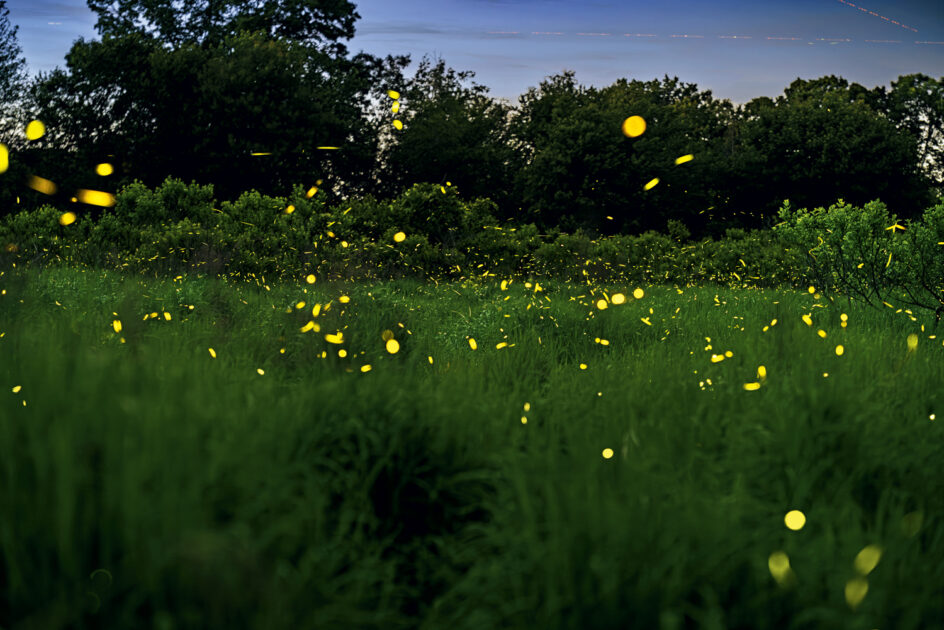
I’ve been away with the fairies this soft June night. I went willingly. I followed their glimmering lights past the spicy bee balm blooms and through a damp, tangled patch of wild mint. Across the road, in just my bare feet, I chased them into my neighbor’s field. In the dark meadow, the fairies twinkled like stars that had loosened themselves from the sky to dance upon the earth.
In my head, I knew it was only the flickering lights of fireflies, but my heart knew them as the will-o’-the-wisps, mischievous fairies who lead seekers like me astray. A story set deep in my memory, shared by my mother one June night long ago. She knew all the stories and spun them like straw into gold. There were my favorites, like the one about the winged horse, Pegasus, who sprang to life from three drops of Medusa’s blood, or her repeated warning of how I should never accept drink or food at a fairy ball unless I planned to stay for the rest of my life.
Fifty years later, in my neighbor’s field, I stand with bare feet pressed into the cooling grass, like the young girl I once was. My mother’s stories pulse in my heart like flashes of fireflies; I let the glowing lights take me away.
There are ways of knowing something, like lightning bugs. Maybe it is the stories a mother tells her daughter on a blanket under the stars of a Vermont sky. Maybe it is the time spent chasing them through tall meadow grasses to finally hold one little glowing beetle in the palm of a tiny hand. Maybe it is now how time falls away when I stand in this New Hampshire field and hold my breath as the dark meadow lights up with the sparks of these soft-bodied flying beetles. It is better than any Fourth of July. The only sounds I hear are the wild trill of gray tree frogs and my own heartbeat.
Lightning bugs, fireflies, lamplighters, fire-tails … no matter what the name is, these beetles have a magical hold on me no less strong than any will-o’-the-wisps might. Imagine making light without heat—a bioluminescent chemical reaction like a fairy tale’s magical spell to our eyes. Or how these insects, members of the Lampyridae family, entice their lovers with glimmering winks of light and rhythm, a silent searchlight for well-matched sex. Or how firefly young start their life as glowworms, larvae that make the leafy soil twinkle like earthbound Christmas lights. In the winter, little glowworms sleep tucked away in the ground, under rocks and fallen trees. Their light flickering green, yellow, or even blue, the only light in utter darkness. In the cold of winter, when I stand on the frozen ground, I am filled with a pulse of hope and the knowledge that there is always a bit of light, even in midnight darkness.
The everyday stories of these beetles are enough to make a naturalist like me want to wander off and follow fireflies wherever they will take me.
I remember once swimming in the early summer waters of a northern Maine lake. The dark water had all the stars resting on the surface, while on the hillside down to the very shoreline, the air was filled with fireflies, flashing. My friends and I still talk about this night, as though the starlight and fireflies bewitched us to never forget what it feels like to be young, free, and so alive.
Once, even long before that, I chased fireflies down the sidewalk and back through the streets in my old Brooklyn neighborhood. The air was hot, and I can still remember the smell of the heat rising from the dark concrete. The streetlights were on, and across the tiny patches of front yards, my brother and I ran, catching enough to tangle them in my hair like I was Mab, Queen of the Fairies.
I never thought the world would run out of this magic. But I’m aware now, too aware, and with each passing summer, I notice the light is fading. The fireflies are disappearing. I worry that one summer not far from now, when I can’t sleep and step outside to wander away with the will-o’-the-wisp lightning bugs, there will be none left. It is true. One in three fireflies in North America are imperiled due to the regular roll call of problems. From habitat loss and pesticides to climate change and light pollution, these bugs, like so many other creatures of our world, are silently disappearing.
I cannot bear the thought of a world without fireflies, these bugs of brilliant light, these beings who have lived on earth longer than the first human. Then all that will be left behind are the stories of how, once upon a time, there lived a small, quiet beetle that lit our summer nights like wild fireworks and invited our imagination to dream with its silent sparks.