



50 Must-See American Revolution Historic Sites in New England
From battlefield parks to preserved homes and forts, these American Revolution historic sites in New England bring the nation’s founding struggle to life.
By Yankee Magazine|May 07 2025|

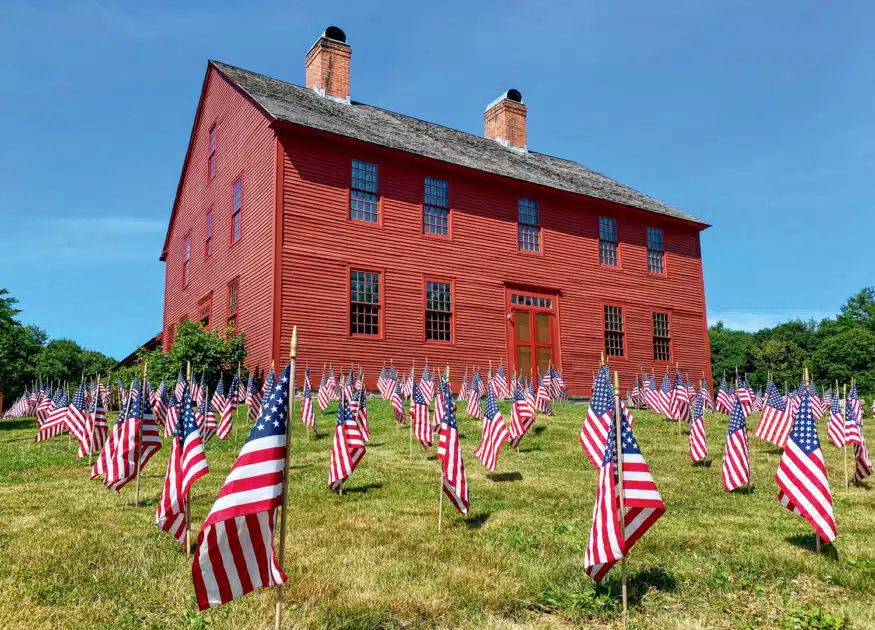
At Connecticut’s Nathan Hale Homestead, the annual Flag Field for Heroes celebration lends extra patriotic flair to the home of a family who sent six sons to fight in the Revolutionary War.
Credit: Courtesy of Connecticut LandmarksThe nation is gearing up to mark its largest celebration in half a century, as America’s 250th birthday arrives next year. Get in on the party early with a visit to one of the many historic sites and museums in New England that bring to life the story of the American Revolution and fight for independence.
American Revolution Historic Sites in New England: Where the Fight for Independence Lives On
Revolutionary War Sites in Connecticut
Fort Griswold Battlefield State Park, Groton
The largest Revolutionary War engagement in Connecticut lasted only 40 minutes. Dubbed the Battle of Groton Heights, it was sparked by an attack on Fort Griswold led by the infamous American traitor Benedict Arnold, by then a British general. On September 6, 1781, some 1,600 of Arnold’s troops landed near the mouth of the Thames River, half at Groton and half at New London. At the time, Fort Griswold was manned by 165 militia and local volunteers, who put up a valiant defense before being overwhelmed. But the British victory was a hollow one, occurring just six weeks before their final defeat at Yorktown. This Connecticut state park incorporates the battlefield today. fortgriswold.org
Nathan Hale Homestead, Coventry
America’s first famous spy—his statue stands at CIA headquarters—faced the gallows in 1776 with the words “I only regret that I have but one life to lose for my country.” A member of a prominent farm family, Hale grew up in a home on the site of the present Georgian house, built by his father the same year that the 21-year-old Yale graduate was hung by the British for espionage. Among the period furnishings and artifacts preserved at the site is a trunk containing Hale’s belongings, returned to the family after his execution. ctlandmarks.org/nathan-hale-homestead
Old New-Gate Prison, East Granby
Medieval rulers built their own dungeons; magistrates in 18th-century Connecticut found one ready-made, in the shape of an abandoned copper mine. In 1773, the colony’s General Assembly authorized the use of the mine as a prison—and a few years later, the crimes that could send an offender into the bowels of New-Gate included loyalty to the British crown, whether active or merely suspected. Up to 40 Loyalists at a time were incarcerated, in what inmates described as “hell.” Today, guided tours take the non-claustrophobic through the site’s dank recesses. portal.ct.gov/ecd-oldnewgate
Putnam Memorial State Park, Redding
Connecticut’s oldest state park commemorates an encampment by a Continental Army division commanded by General Israel Putnam in the winter of 1778–1779. Assigned the task of defending the reestablished supply depot at nearby Danbury, along with approaches to West Point and the shores of Long Island Sound, Putnam’s division occupied a string of camps on terrain scouted by a little-known colonel named Aaron Burr. As at Valley Forge, soldiers bivouacked in miserable conditions, prompting a petition to Connecticut Governor Jonathan Trumbull for promised blankets, clothing, and food allowances, along with warnings of increasing desertions. putnampark.org
The Turtle at the Connecticut River Museum, Essex
Long before nuclear submarines and even U-boats, there was an operating submersible—used, albeit unsuccessfully, during the American Revolution. A Connecticut patriot named David Bushnell had the idea of furtively approaching a British warship to mount an explosive charge on its hull, and he had local mechanics build a one-man spherical sub, the American Turtle, to do the job. The first foray reached the warship, but pilot Ezra Lee couldn’t attach the bomb. Two more attempts also failed before the Turtle was eventually found and scuttled by the British. An exact model, with working parts, is displayed at the Connecticut River Museum. ctrivermuseum.org/turtle-submarine
Revolutionary War Sites in Maine
Burnham Tavern Museum, Machias
The first naval battle of the American Revolution was fought in early June of 1775 in the Machias harbor. The engagement wasn’t a fight between opposing naval forces: It was a confrontation between the townspeople of Machias and the British schooner Margaretta, anchored at the port. Opposed to the shipment of Maine lumber to build barracks in British-held Boston, locals boarded and seized the Margaretta, mortally wounding its commander and taking surviving crew members prisoner. The story is told today at Machias’s Burnham Tavern, built a mere five years before the battle known as the “Lexington of the Sea.” burnhamtavern.com
Fort George, Castine
Constructed of palisade-topped earthworks surrounded by a moat, Fort George recalls a British attempt to establish a loyal colony in Revolutionary-era Maine, and a failed American attempt at recapturing it. In 1779, General Francis McLean seized Castine and built the fort to defend a planned colony called New Ireland. The “Penobscot Expedition” of Continental troops from Massachusetts, of which Maine was then a part, was repelled by the British that summer, and Castine remained in enemy hands until 1784—a year after the Treaty of Paris secured American independence. Today, only partial earthworks remain. mainetourism.com/listing/fort-george/3250
Fort Halifax State Historic Site, Winslow
Built by the colony of Massachusetts at the outset of the French and Indian War, Fort Halifax was abandoned in 1766. But the fort’s wooden blockhouses and palisaded enclosure later served as the staging ground for an attack on what had become British Canada. In September 1775, Colonel Benedict Arnold—not yet a general, or a traitor—assembled 1,100 troops here for an assault on Quebec City. Just over half that number made it to the Saint Lawrence River, where the siege of Quebec failed. One blockhouse, the oldest in the United States, survives at the state historic site. maine.gov/forthalifax
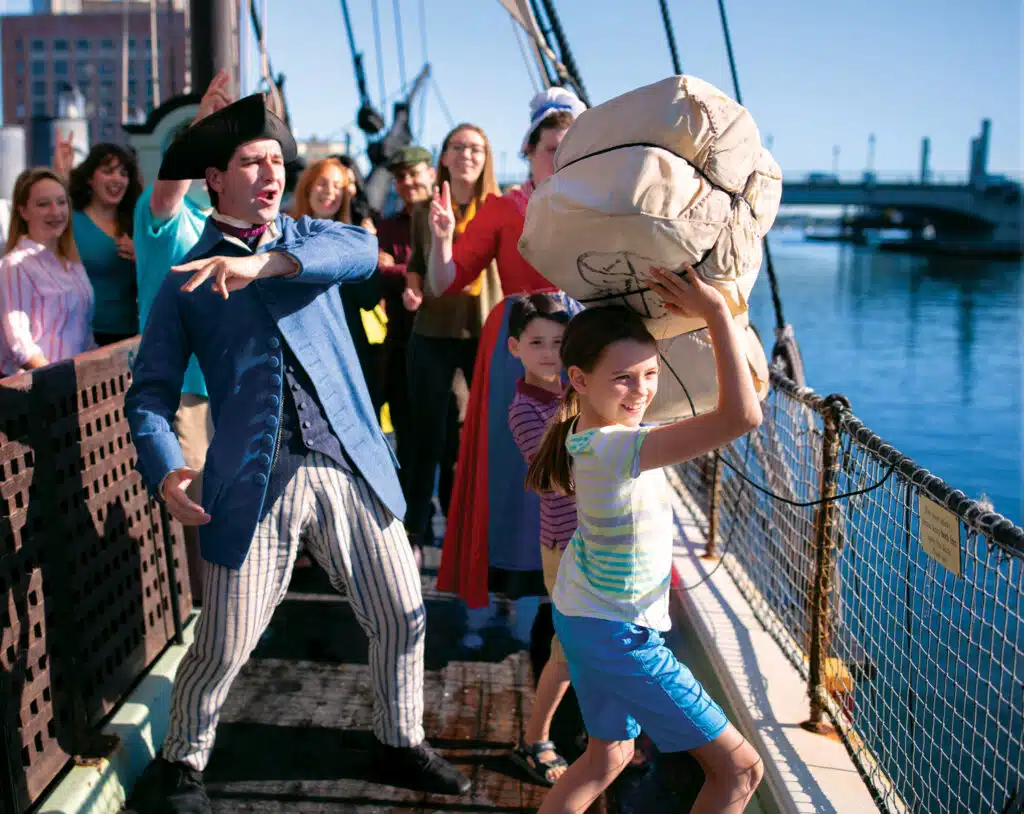
Credit: Photo by Boston Tea Party Ships & Museum
Revolutionary War Sites in Massachusetts
Boston Tea Party Ships & Museum, Boston
It wasn’t just the three-pence-per-pound tax on tea—it was the idea of taxation by a British parliament in which Americans had no representation, and the East India Company’s monopoly on tea imports. Whatever the underlying issues, the tipping point came on the night of December 16, 1773, when irate Bostonians dumped more than 90,000 pounds of tea into Boston Harbor. Replicas of two of the tea-carrying ships, the Eleanor and the Beaver, are docked at Congress Street Bridge, and an adjacent museum holds one of the chests from which tea was heaved during the “Party.” bostonteapartyship.com
Bunker Hill Monument, Boston
Begun in 1825 to mark the 50th anniversary of the Revolution’s first major engagement, this 221-foot granite obelisk doesn’t stand on Bunker Hill—nor was the battle fought there. It was on Breed’s Hill, also on the Charlestown peninsula, that Colonial and British forces met on June 17, 1775. Anticipating a British plan to fortify Charlestown, the Americans secretly erected a redoubt atop the hill. General William Howe’s successful attack on the fortification resulted in roughly 450 American and 1,000 British casualties. The summit of the monument is accessible by stairway, and a related museum stands across the street. nps.gov/bost/learn/historyculture/bhm.htm
Concord Battle Site, Minute Man National Historical Park, Concord
Emerson’s “rude bridge that arched the flood,” where the “shot heard round the world” was fired, still stands today (in accurately reconstructed form), spanning the Concord River at Minute Man National Historical Park. Having continued their march toward Concord after the Battle of Lexington, British regulars were met at the bridge by 400 “minute men” militia from surrounding towns. That sharp engagement reversed the outcome at Lexington, as the British began a retreat toward Boston marked by continual American ambush fire along the battle road, much of which is preserved within the park. nps.gov/mima
Lexington Battle Green, Lexington
The opening volleys of the Revolutionary War were fired shortly after dawn on April 19, 1775. Seven hundred British regulars had been sent to seize a cache of Colonial arms believed to be stored at Concord. Town militias along their route had been warned about the British advance by Paul Revere and others, and it was at Lexington’s town green that militiamen faced the regulars. Militia Captain John Parker ordered his men to hold fire, but a shot rang out—from which side is uncertain—and the skirmish began. Eight colonials were killed, and one British soldier wounded. An anniversary reenactment takes place on the green each year. tourlexington.us
Old South Meeting House, Boston
Built in 1729 as a Puritan house of worship, the Old South Meeting House entered patriotic lore as the gathering place for 5,000 Bostonians protesting Britain’s Tea Act. The date was December 16, 1773, and among the speakers was Samuel Adams. Accounts differ as to whether Adams directly appealed to the throng to head for the harbor and stage the event remembered as the Boston Tea Party, but there is no doubt that this is where it began. Restored after occupying British troops converted it into a riding stable, Old South is now a stop along the Freedom Trail. nps.gov/bost/learn/historyculture/osmh.htm
Paul Revere House, Boston
Paul Revere’s house on North Square is downtown Boston’s oldest. Built about 1680 and purchased by Revere in 1770, it remained his property until 1800, serving through most of that time as a family residence. This was the home Revere left on the evening of April 18, 1775, to begin the “midnight ride” celebrated in Longfellow’s poem, and to which he returned after the British evacuated Boston. Having served at various times as a tenement and a cigar factory, it was eventually restored to its 18th-century appearance. Remarkably, its construction is 90 percent original. paulreverehouse.org
Revolutionary War Sites in New Hampshire
The Fort at No. 4, Charlestown
The stockade known as the Fort at No. 4 served a crucial role throughout New Hampshire’s Colonial history. It was constructed in 1744 to guard against French and Abenaki attacks on Plantation No. 4, the northernmost settlement along the Connecticut River. Serving as a garrison for British regulars and local militias during the French and Indian War, it figured in the exploits of Major Robert Rogers and his Rangers. General John Stark mustered some 1,500 troops here on his way to victory at the Battle of Bennington in 1777. Today’s fort is a 1960 replica. fortat4.org
Fort Constitution, New Castle
Dating to the early 17th century and named Fort William and Mary in 1692 in honor of those British monarchs, Portsmouth’s Colonial-era harbor defense stands at the mouth of the Piscataqua River. At the outbreak of the Revolution, it was Britain’s only fortification in New Hampshire, and its cannons and powder were a tempting prize for local patriots. On December 14 and 15, 1774—four months before the battles at Lexington and Concord—rebels seized the fort and its supplies. Later renamed Fort Constitution, it served through World War II, and portions of its ramparts remain. Note: Although the fort is closed to visitors, you can see it from the water on a number of narrated cruises out of Portsmouth. nhstateparks.org/find-parks-trails/fort-constitution-historic-site
John Paul Jones House Museum, Portsmouth
The naval commander whose elaborate sarcophagus rests at the U.S. Naval Academy occupied far simpler quarters during his stay in Portsmouth. In 1777, John Paul Jones rented a room in a home run as a boardinghouse by a local widow. He returned to Portsmouth in 1781–1782 to supervise the construction of the America, the first U.S. ship of the line built for the Continental Navy. Launched in 1782, the America was never commanded by Jones; it was given by Congress to the new nation’s French allies. Later named for its onetime occupant, the Georgian home—built by African American housewright Hopestill Cheswell—is a museum commemorating Jones and his era. portsmouthhistory.org/jpj
Stark Park, Manchester
Hero of the Battle of Bennington and the man who coined New Hampshire’s state motto, “Live Free or Die,” General John Stark is commemorated at several Granite State locations. His birthplace is marked in present-day Derry, his childhood home stands in Manchester, and his statue graces the grounds of the capitol in Concord. Before Bennington, he told his men, “There they are, boys! We beat them today or Molly Stark sleeps a widow tonight!” The New Hampshire men and Vermonters won, Molly escaped widowhood, and today she and the general slumber together at Stark Park in Manchester. starkpark.com
Revolutionary War Sites in Rhode Island
Battle of Rhode Island Site/Heritage Park, Portsmouth
Although inconclusive in its outcome, Rhode Island’s only major Revolutionary War battle remains memorable as the war’s first in which a mixed-race brigade of white, Black, and Native American soldiers took part. The Americans hoped to seize Newport, at the southern tip of Aquidneck Island, with help from a French amphibious landing. But British discovery of the Americans’ plans, along with French Admiral Comte d’Estaing’s abandonment of the action due to damages to his ships in a storm, doomed the joint assault. The Americans, though, managed to hold their positions here, at Portsmouth. battleofrhodeisland.org/heritage-park
Butts Hill Fort, Portsmouth
Originally created in 1776 as an American battery, southeastern New England’s largest earthworks fortress was occupied by the British late that year. Its substantial 1777 enlargement was accomplished with forced labor, as General Robert Pigot pressed Portsmouth residents into service. The fort briefly changed hands again in 1778, when the British moved their troops toward Newport, and stood at the center of the American line during the Battle of Rhode Island. The fort’s seesaw history ended in December 1779, when the British left Rhode Island. Ongoing restoration projects aim to make the surviving ramparts more visible. battleofrhodeisland.org/butts-hill-fort
Conanicut Battery, Jamestown
Over a five-year period during the Revolutionary War, the battery at Conanicut changed hands twice. An earthwork and cannon emplacement was ordered by the Rhode Island General Assembly in 1776, but was captured by the British that December. They held the position until October 1779, expanding the redoubt to its present shape overlooking West Passage. Abandoned by the British in July 1780, the battery was strengthened by the Marquis de Lafayette and manned by America’s French allies through 1781. Now preserved within parkland, the battery is the site of occasional ceremonies and cannon firings. jamestownhistoricalsociety.org/conanicut-battery
Fort Barton, Tiverton
In the days when holding the high ground was the only way to observe enemy activity—and keep attackers at bay—Tiverton Heights was a crucial part of American defenses in Rhode Island. Across the narrow strait from Tiverton, British troops held Aquidneck Island, and artillery mounted here behind massive earthworks prevented them from crossing to the mainland. The fort was named after Lieutenant Colonel William Barton, who raided the British camp and kidnapped its commanding general. Portions of the earthworks remain, and an observation tower looks out over the Sakonnet River basin and Aquidneck Island. battleofrhodeisland.org/fort-barton-site
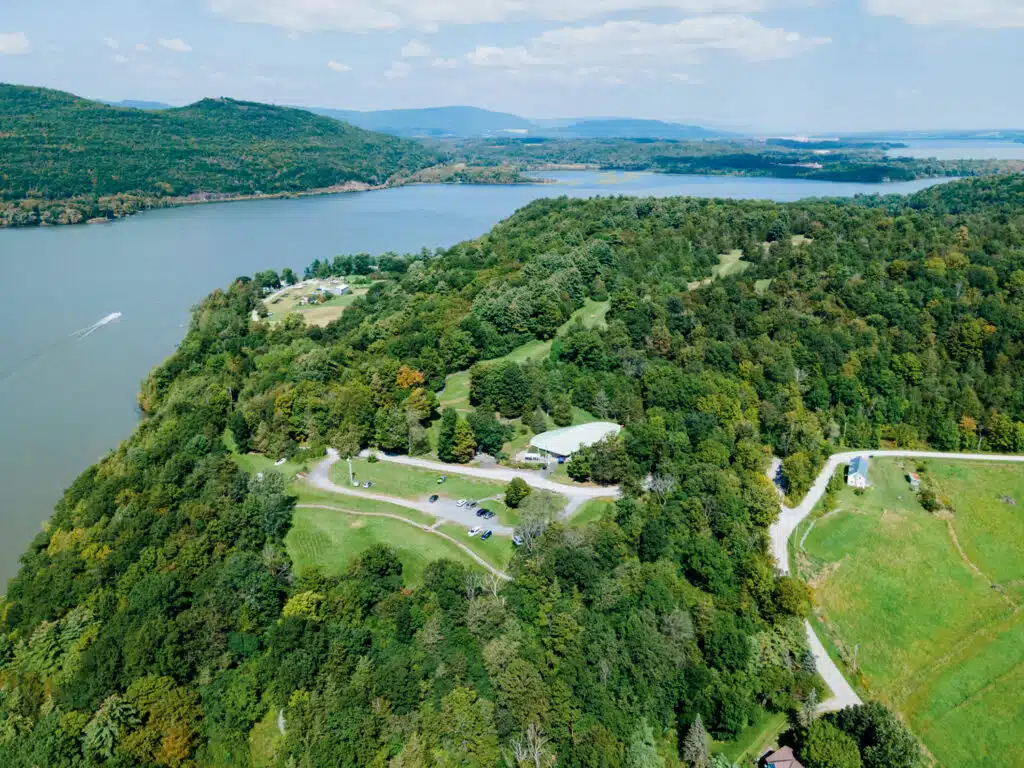
Credit: Andy Duback
Revolutionary War Sites in Vermont
Bennington Battle Monument, Bennington
In the town of Bennington, a 306-foot limestone shaft—the tallest structure in Vermont—commemorates an American victory in a battle actually fought across the border in Walloomsac, New York. British General John Burgoyne, heading south in order to cut off New England from its neighbor colonies, learned of critical supplies stored at Bennington. But his troops never reached their objective. They were cut off and defeated on August 16, 1777, weakening the British drive south and leading to Burgoyne’s surrender two months later after the Battle of Saratoga. benningtonbattlemonument.com
Catamount Tavern Site, Bennington
The copper statue of a catamount that stands in a quiet corner of Bennington isn’t there just to represent the big feline—also known as a mountain lion—that once roamed Vermont forests. It also marks the location of the Catamount Tavern, a public house built in 1769 and frequented by Ethan Allen and the Green Mountain Boys. It was here that Allen and company are said to have plotted the capture of Fort Ticonderoga. The tavern burned in 1871, and the statue was erected 25 years later. benningtonmuseum.org/visit/outdoor-walks/driving-tour-of-historic-sites
Chimney Point State Historic Site, Addison
Home to Native American and French colonial settlements, this promontory at the eastern approach to the Lake Champlain Bridge shared with New York’s Crown Point a crucial defensive role early in the Revolution. For more than a year following the 1775 American capture of Crown Point, Chimney Point was also occupied by Continental forces, and this narrow waist of Lake Champlain served as a base for American land and naval forces. An 18th-century tavern, visited in 1791 by Thomas Jefferson and James Madison, has been restored as part of a state historic site. historicsites.vermont.gov/chimney-point
Hubbardton Battlefield State Historic Site, Hubbardton
The only battle of the Revolution fought in Vermont was a victory for the British, but one that cost them dearly. As American troops retreated from Fort Ticonderoga and Mount Independence, their rear guard was pursued by British troops under General Simon Fraser, along with German mercenaries. Fraser engaged the Americans, and might have been defeated if not for the arrival of the Germans. The Hubbardton battle, fought on grassy terrain preserved today as a state historic site, crucially delayed the British advance in the lead-up to the battles of Bennington and Saratoga. historicsites.vermont.gov/hubbardton-battlefield
Mount Independence State Historic Site, Orwell
Visitors to this scenic peninsula overlooking Lake Champlain find it difficult to imagine it as home to 12,000 American soldiers, encamped here as a bulwark, along with New York’s Fort Ticonderoga, against a British advance south along the lake from Canada. With three-tier fortifications designed in part by Thaddaeus Kosciusko, the rocky redoubt served its defensive purpose from July 1776 to July 1777, when the Americans abandoned Ticonderoga and began a strategic retreat marked by the Battle of Hubbardton. Mount Independence is preserved as a state historic site, laced with six miles of trails, some of which have interpretive signage. historicsites.vermont.gov/mount-independence
Are there any American Revolution historic sites in New England that we’ve missed? Let us know in the comments below!
This feature was originally published as “A Salute to History” in the May/June 2025 issue of Yankee.



Have been yo fort ticondaroga and its a fascinating place, rich in history, with some of the most. Beautiful flower gardens around whcih are kept up by a dedicated group of historians. Also in todondaroga, or close by, is the famous “Roger’s Raiders”, a place with a significant history. Roger and crew were responsible for a number of important victories in the war and founding of America. They endured some brutal marches in winter, helping secure the area against the british. In Maine, check out “Snowshoe Rock” i think the name is. Another fascinating historical site.