



The Mayflower | Everyone’s Ship
For better and worse, the Mayflower carried the seeds of the nation we know today in its cramped and swaying hold. What does that mean to you?
By Justin Shatwell|May 21 2015|

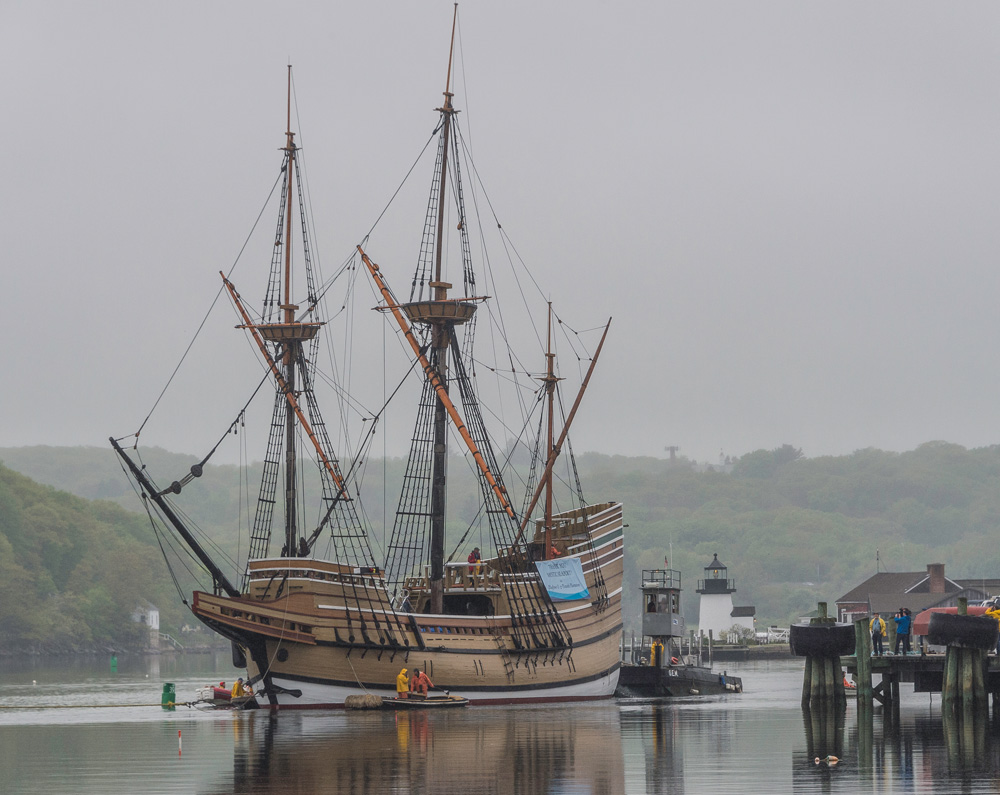
The Mayflower II is towed away from Mystic Seaport, where it underwent repairs this winter.
Credit: Denis A. Murphy, Mystic Seaport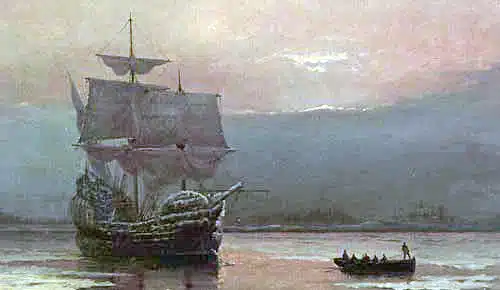
Credit: Public Domain
The Mayflower II is currently out on the ocean. You’re forgiven if you didn’t notice. The event is more an errand than a voyage and has been accompanied with minimal fanfare. Throughout the winter, the ship had been laid up at Mystic Seaport for repairs, but now with the snow gone it was decided to tow her back to Plymouth so she can resume her traditional post in time for the summer tourist season (see Note below for the latest news on where to find Mayflower II).
The fact that it has attracted any news coverage at all should give us pause. What is it about this ship that so captures our imagination? How can the mere glimpse of her ancient silhouette rocking on the waves carry so much weight?
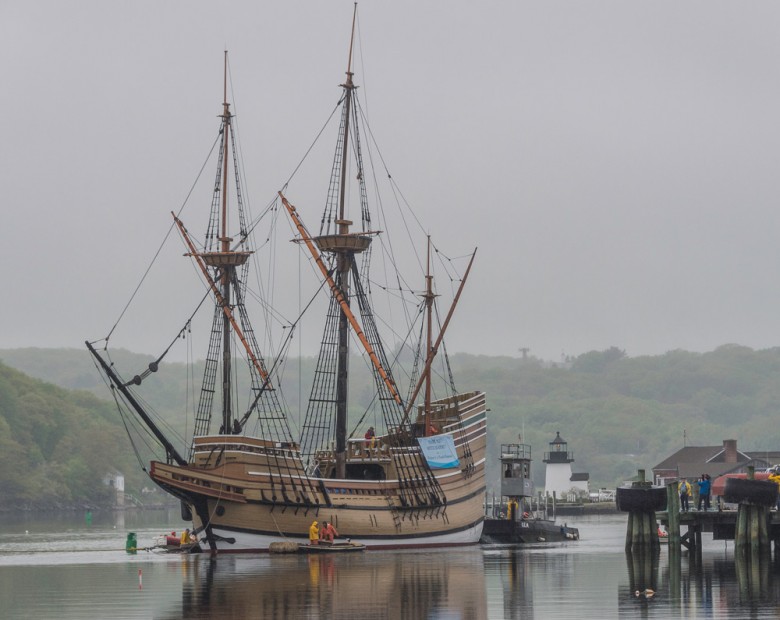
Credit: Denis A. Murphy, Mystic Seaport
The irony is that a Pilgrim likely wouldn’t get all misty and nostalgic if confronted with the same sight. The historical record suggests they weren’t overly sentimental about the vessel that carried them here. William Bradford, the Pilgrim leader whose book, Of Plymouth Plantation, provides us with much of our knowledge about the colony’s early days, does not even refer to the Mayflower by name. He simply calls her “the ship.”
As the Pilgrims sailed toward the New World they had bigger things to worry about than the ship beneath them. Could they truly achieve religious freedom? What reception would they receive from the natives? Would they have enough food to survive the winter? Their thoughts would have been dominated by questions of what would happen to them after they made landfall. The voyage was merely prelude to the main event. Under those circumstances, falling in love with the Mayflower would have made as much sense as a bride becoming enamored by the limo that drove her to the wedding.
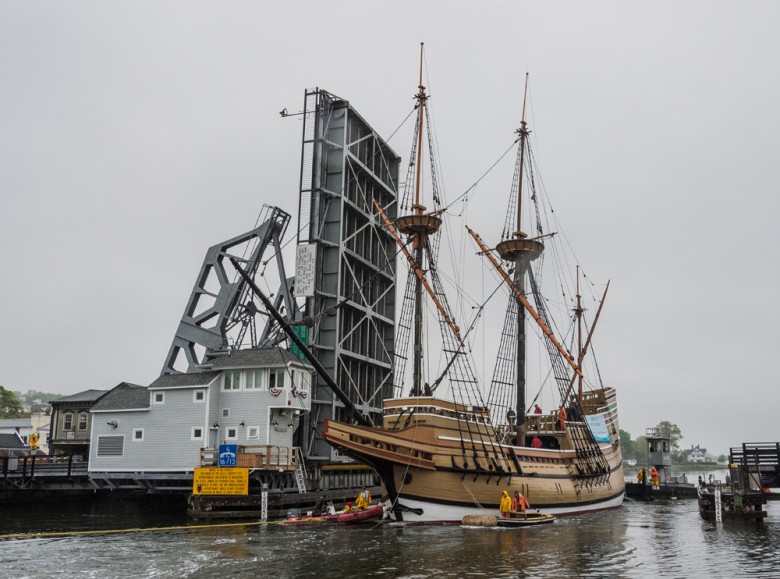
Credit: Denis A. Murphy, Mystic Seaport
And yet I can’t deny that when I see the Mayflower II I feel a little tug on my historical heartstrings. The name of the ship may have been an afterthought to Bradford, but it’s seared into the minds of modern Americans. Almost 400 years later, we can see the long, winding chain of dominoes that began to fall the moment the Mayflower discharged its passengers. We know what the Pilgrims did not—that their colony would survive and flourish.
As we look back, the personal struggles they faced are blurred and lost amid the broader narrative. They may have seen themselves as an isolated group, separated from society by religion and geography, but we know them differently. Their identity has blended with our own. They were the first of us.
Through that lens, the Mayflower takes on a different light. It’s more than just a hired ship with a hired crew that would return to England after finishing its job. It’s no longer just the Pilgrim’s ship. It’s our ship. It’s come to symbolize the story of every dreamer who searched for a new life on a distant shore. In a way, it carried us all here.
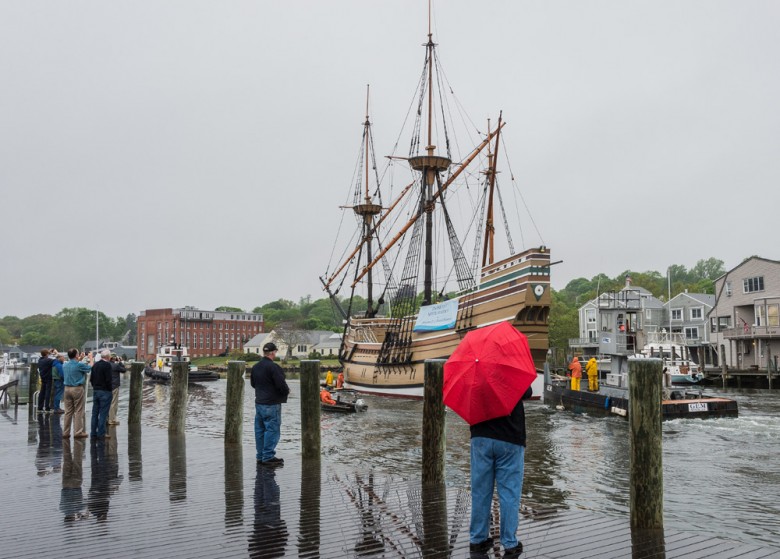
Credit: Denis A. Murphy, Mystic Seaport
How many people remember the Arbella, the flagship of the fleet that brought the Boston colonists in 1628? How many people can name the vessel their ancestors came over on? Where is the monument to the vast, anonymous fleet that ferried souls to Ellis Island? The Mayflower stands in for all those ships. In one story, it tells all of our stories. It’s the perfect symbol for a nation of immigrants.
It hardly matters that the Mayflower II is a reconstruction—that it’s a symbol of a symbol. In history, the artifact is never as important as the story it lets us tell. As we come up on the 400th anniversary of the Pilgrims’ voyage in 2020, I’m sure we’ll all be hearing that story more and more frequently. Take it as an opportunity to think about your own history. For better and worse, the Mayflower carried the seeds of the nation we know today in its cramped and swaying hold. What does that mean to you?
IMPORTANT NOTE ABOUT MAYFLOWER II
Mayflower II, Plimoth Plantation‘s full-scale reproduction of the tall ship that brought the Pilgrims to Plymouth in 1620, is currently away from her berth at State Pier on the Plymouth Waterfront. Until 2019, the ship will be at Mystic Seaport receiving a full restoration ahead of Plymouth’s 400th commemoration of the Pilgrims’ arrival on New England’s shores. Follow the ship’s progress here.




Great story. I was born and raised in Maine and Thanksgiving always was special at Grammy’s house. She passed in 1978 and my Mother discovered why it was so special. Grammy Dyer was a descendant of Stephen Hopkins. My Mother found the connection and never applied for membership in the General Society of Mayflower Descendants. Born during the depression she was frugal. Mom passed in 2003 and I used her research to develop and file for membership. It took six years to verify Mom’s work but even without a computer Mom had it right. I have since found 4 other Mayflower passengers that Grammy was descended from: William Brewster, Richard Warren, Isaac Allerton and Stephen Hopkins. The Mayflower II and Thanksgiving brings back memories of Grammy. Thanks again.
I have six sets of nine times Mayflower grandparents … Soule, Warren, Allerton, Standish, Hopkins and Cooke, also Robert Cushman and others who arrived with the Winthrop Fleet to Massachusetts Bay Colony. I feel they “live on in me!”
How do you go about looking for this information?
Ancestry is one place to start. Get full names and dates of birth of your parents and grandparents and keep searching and verifying on up.
My husbands 11 Great-grandfather is Thomas Rogers.
I’m not sure what it means to me. My people came over in the 1680’s. Some families who have the same name as their Mayflowered ancestors are proud of that. It makes me think how unless we happen to be Native American, we’re ALL immigrants and so we should be okay with people who are also immigrants from more modern times.
I am a direct descendant of the London merchant Thomas Weston who provided the Mayflower to the Pilgrims and helped finance their journey.
I am a direct descendent of John Joseph Billington who has been portrayed as a villain by many since he was the first Pilgrim to receive the death sentence at Plymouth and thus set the precedent for capital punishment in the New World. However the truth is far more complicated. Billington and half of the original Mayflower Pilgrims were poor people from London. The other half, the Separatists, were a religious sect that had been banished to Holland by the English King. They were given free passage by King James if they sailed to the New World. There was a conflict between these two groups the moment the ship set sail from England. Renaissance men and women and religious fanatics who had the guns to force the other half to do their bidding. A mutiny took place onboard the ship led by John Joseph Billington when the poor Londoners rebelled against the rule of the Separatists led by Governor Bradford. From that moment on there was hatred between John Joseph Billington and William Bradford. A conflict between a worldly Elisabethan mentality and a Separatist religious mentality. The conflict is still embedded in the US today. There were several rebellions against the Separatist rule in Plymouth Colony. Nathaniel Hawthorne´s short story The Maypole Of Merrymount is a fictional account of the conflict between a more worldly and liberal lifestyle and the harsh religious outlook of Governor Bradford and Myles Standish, Separatist law enforcement officer. The Mayflower and Plymouth were the first places that the conflict between a liberal and sectarian worldview and a conservative and religious outlook took place in what now is America!