



The Legend of the Sacred Cod (Or Is It Scrod?)
While “scrod” may be delicious, have you ever heard of anyone actually fishing for “scrod”? Of course not! Find out how this term came to be.
By Yankee Magazine|Oct 08 2021|

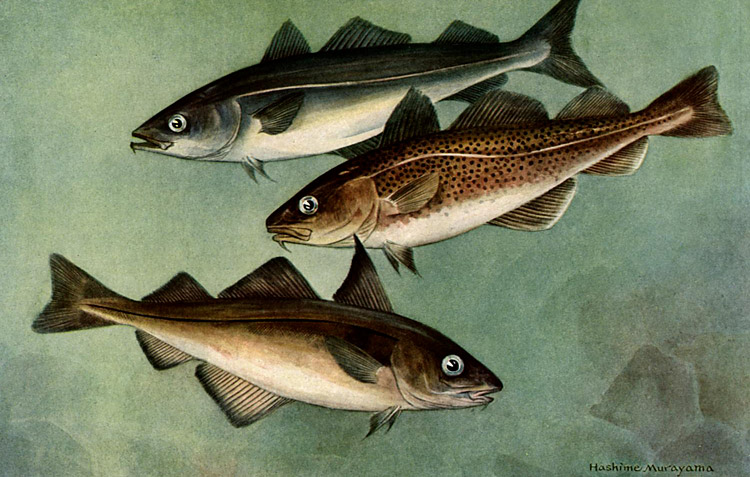
What is scrod? Is scrod the same as cod? And why is there a wooded “Sacred Cod” suspended over the public gallery in the Massachusetts House of Representatives? Read on to learn more about the curious history of scrod fish in New England.
The Legend of the Sacred Cod (Or Is It Scrod?)
There is, of course, no such fish as “scrod” in New England waters or anywhere else. The term began years ago when fishing schooners would return from the Grand Banks to the Boston fish pier, loaded with fish ready to be auctioned off. Now, fancy hotels like, for instance, the Parker House (still going strong) didn’t want to serve fish that came out of the bottom of any ship’s hold. It would be old, flabby, and maybe soft from the weight of each succeeding day’s catch on top of it. To go along with its famous rolls, the Parker House wanted only the small, choice, firm fresh fish from the top layers.
Of course, the Parker House maître d’ couldn’t predict what sort of fish would be on the top layer. If he printed the menu featuring haddock and the top layer turned out to be pollack — well, he might get away with it in Kansas City, but not in Boston. So what to do? The answer was simple. He coined a name for a new seafood. He called it “scrod.” (Possibly he was making a contraction of “sacred cod”?)
What is scrod?
Haddock, cod, pollack, and hake are all related and all caught off the New England coast but, for the most part, “scrod” is either haddock or cod. If both are fresh, properly prepared, and cooked without skin, it’s pretty difficult to tell the difference.
Incidentally, it’s easy to tell cod from haddock if their skins are on. It’s part of the cod’s New England mystique, you see, that it became the “sacred cod” because it was the fish Christ used when he fed the multitudes, and even today the marks of his thumbs and forefingers are plainly visible on the codfish. As to the haddock, well, the devil thought he could multiply fish and feed multitudes too. So he grabbed a cod, but it wriggled and slid through his red-hot fingers, burning two black stripes down its sides. And so it became a haddock. Fishermen still use these markings to differentiate between the cod and the haddock.
Today, a large codfish (or is it a haddock?), carved from a single block of white pine, hangs between two central columns in the Massachusetts House of Representatives—a symbol of all the codfish has meant to the New England economy in years past. This “Sacred Cod” faces north when the Democrats hold the majority, south when the Republicans do. The symbolism of that has always escaped me.
This post was first published in 2014 and has been updated.
SEE MORE:
Scrod | Lexicon
How to Pronounce “Scallop” | New England Dialect
Why People Say “Rabbit Rabbit” on the First Day of the Month




Selected catch right off the dock
That’s what my grandpa called it!
Back in the day, there were three seafood restaurants in Connecticut called The Clam Box. I worked at the one in Cos Cob, and our ‘fish of the day’ was mostly always scrod and bluefish. We didn’t have an answer for when we were asked what it was, so we used to make stuff up.
Oh wow, the Clam Box! What an amazing institution especially the one in Cos Cob. Grew up in Riverside so that was an early 70’s spot. It’s now been replaced for many years with an overpriced townhome development. But just hearing “Clam Box, Cos Cob” made me smile.
Always heard it means ” seamen catch right off dock”.
Actually, it came for two “older” women on a train to Boston on a Friday. One asked the other, “Why are you traveling to Boston”. The first woman responded, “well, I go to buy needles and pins and fabric for sewing”. So, she said, “OH, and why are you going to Boston?” To which the second woman said, “I’m going to Boston to get Scrod.” The first one exclaimed “Oh MY, Dear, So am I, but I didn’t know it had a past tense!”
Past, plu-perfect subjunctive.
That’s hilarious! It sounds like something Dorothy Parker would have said.
My grandmother, a former waitress at the Parker House many years ago, told me a scrod was a baby cod, and a schrod was a baby haddock!
That is the exact meaning that I was taught. If it has an ‘h’, it’s haddock. If it doesn’t, it’s cod. And, it is always young and firm fish. 🙂
This was my impression too. I used to work on the outer Cape in restaurants and was told by the cooks scrod was young cod and schrod was young haddock. The c or h was the signifier.
special consignment reserved on deck
This was such delightful read! Excellent, engaging writing. What a pleasure.
Then what is sole? I always buy the filets and top with my crab cake mixture and bake, laying on a layer of thin sliced lemon.
Flounder Family
To the best of my knowledge, “or a touch of New England malarkey” I was told it meant “Seaman’s Catch Remaining on Deck” In other words they gave the leftover unwanted catch to the crew.
David L. Gold’s book Studies in Etymology and Etiology (With Emphasis on Germanic, Jewish, Romance, and Slavic Languages), published in 2009, notes that an American newspaper dated 16 October 1841 mentions the noun scrod in connection with fish.
The Parker House Hotel opened on 8 October 1855.
Consequently, the legend related above about the maitre d’ of Parker House and his alleged coinage scrod is indeed that — a legend.
The attempts to interpret the word scrod as an acronym (seamen’s catch remaining on deck, special consignment remaining on deck, seamen catch right off dock, selected catch right off the dock, and others) are all attempts a posteriori to make sense of the word, which is not an acronym.
ok, well if it’s not an acronym, then where does it come from, linguistically speaking?
Scrod is acronym for “serving catch received on the day”
When I worked at a few Massachusetts seafood restaurants in the early 1960’s, the chefs said the last thinner (aft) half of the haddock was called scrod. So the front part was haddock and back part scrod at those restaurants.
Well, according to Wikipedia, scrod is a term used in the wholesale fish business for the smallest weight category of cod, haddock, and other whitefish. Fish too young to take a baited hook. For what it’s worth.
Wikipedia can be edited by anyone which makes it an unreliable source.
Can’t remember the restaurant I ate at in boston when I was told it was an acronym for “Sea Captain’s Recommendation Of the Day”
I was raised on the Stanley Fish Wharf in Manset, Maine and was always told Sctod was a cod fish that weighed 2 pounds or less.
Fifty years ago, at a restaurant at Hampton Beach, my Mother told our server that she’d never heard of a Scrod fish. The server laughed, and said that it stands for SCRap Of the Day. SCROD. Makes more sense than, Sacred Cod, IMHO. 🙂
Special Catch Right Off the Dock
I am not familiar with the term scod used in the New England states to represent the cod fish, however before Christopher Columbus sailed to Americas the Portuguese fisherman were catching the migrating cod fish for the European market. In 1472 three ships (2 from Denmark and 1 from Portugal) sailed to America to claim land they called Vinland. This land was marked by building a tower on the east coast and placing a marker stone on the Vinland west coast 370 leagues on a pole line. The group was led by Joao Corte Real. The Newport Tower still stands today as a reminder of pre-columbian enterprise in America. In addition to a land mark (ref; Chapter 3 of the treaty between Spain and Portugal in 1494) it was used as living quarters for the fisherman. The town tower at one time had an atrium with central heating and a second floor with a shallow double flu for making smoke to process the cod fish that were caught in the stone V traps on the Atlantic shore just south of the tower. The process was very unique in that the cod fish was butterflyed without the skin, it then was placed on a rod along with about 5 other cleaned cod. Before placing the cod in the tower it was dipped into a solution of boiling water and cod liver oil. The cod liver oil covered the exterior of the meat, the rods with cod were then placed in the second floor smoking room of the tower for about an 8 hour process smoking which hardened the oil on the surface of the fish. The finished product was then stripped from the rods and placed in wooden barrels, the barrels of smoked cod was transported from the second floor to the ground with the aid of a yard arm that extended above the south west window to the ground about 4 EL’s (12 feet) from the tower. At this location the wooden barrels containing the coated cod was filled with fresh water from the Mill street spring about 100 yards west of the tower. The process of sealing the barrels allowed the residue of cod liver oil to flow over the barrel and onto the ground. (Soil tested for cod liver oil by Mich. State University). After the barrels sealed they’re loaded for shipment and preserved like canned fish, however when the fish got to market the customer would place the cod in boiling water which liquefied the oil and allowed it to float to the top leaving fresh cod for eating in the same manner as fresh fish. The key to this process was no salt taste in the final product.
Did you know Cod fish mate for life and their are three schools in the Atlantic? They are bottom feeders and migrate north and south which may be related to the wooden cod that points north when Dem,s in office and South when Rep,s in office.
I am just an old Indiana farm boy and we do not have Cod in Indiana. The closest we can come to it is watching the cows chew it.
That’s a mighty long reply containing an awful lot of errors. Please learn the difference between apostrophes and commas. Anyone from Indiana to Cowhampshire knows that cows don’t (and wouldn’t) chew cod, but cud.
Gary B: I feel certain the writer was tongue-in-cheek in his “cod” versus “cud” remark—I thought it humerous. Errors in punctuation do not diminish the value of a good-told story. This was a good-told story.
I concur
Steven, I thoroughly enjoyed your story, factual or not. It was interesting and humorous, a nice little read.
I am from Boston (originally), and was told as a child that SCROD meant, Small Catch Of the Day!! 🙂
The Newport Tower (also known as: Round Tower, Touro Tower, Newport Stone Tower, and Old Stone Mill) is a round stone tower located in Touro Park in Newport, Rhode Island, the remains of a windmill built in the mid-17th century. It has received attention due to speculation that it is actually several centuries older and would thus represent evidence of pre-Columbian trans-oceanic contact. Carbon dating shows this belief to be incorrect.
I answered this back in April 2017. This was the best catch of the trip held topside not in the hold with the rest of the fish. S. special C. consignment R. reserved O. on D. deck.
Growing up in New Hampshire and a commercial fisherman for most of my life . I was told as a young boy that SCHROD was small Haddock and SCROD was small cod
That’s what I was told when I worked in Boston restaurants in the 1980’s!
Scrod is a small Cod. If you eat very fresh Cod or Haddock there is a noticeable difference in taste. Haddock has a little sweeter flavor, somewhat similar to that of a fresh lobster tail, and it’s a much prettier fish. We used to catch a lot of both when we went fishing out of Rockport over 50 years ago. At that time we could easily come home with a couple dozen of each, enough to fill the freezer for the winter.
Having worked at several New England fish markets and working on boats it was always Special Captains Run Of the Day or Special Captains Remainder On Deck. Usually small, undersized bycatchof varied speciew that would be best suitable for frying or stews/chowders etc. (Not usually meant as a stand-alone dish)