



Have You Ever Cut the Devil’s Throat? An Examination of New England Phrases
New Englanders don’t necessarily need adjectives and adverbs to describe something. Here, we examine a few unusual New England phrases.
By Judson D. Hale|Dec 01 2016|

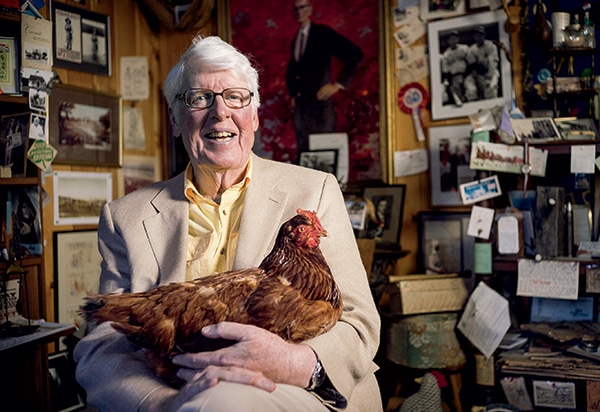
Jud's Journal author, Jud Hale.
In this column a few years ago, I recalled my old friend and barber, the late Bill Austin, telling me a joke I might use in a forthcoming speech I was to make at the local women’s club and assuring me that, yes, I needn’t worry, it was clean. In fact, he said, it was so clean “you could tell it to your grandmother sitting on the john.”
Well, over breakfast at the Peterborough (New Hampshire) Diner a few months later, we exchanged a few other examples of typically New England phrases and expressions that excluded, for the most part, adjectives and adverbs. Here are a few…
- It stands out like a blackberry in a pan of milk.
- You can trust him as far as you can throw a meetinghouse by the steeple.
- She was dressed to death and drawers all empty.
- The fog was so thick you could cut it into chunks with your jackknife. Or the fog was so thick you could hardly spit.
- She was homely as a hedge fence (or a mud fence, or as hell is wicked). Or she was homely enough to stop a down train.
- His head looked like it had worn out two bodies.
Comparisons like these truly do communicate the desired image or message more quickly than any number of descriptive adjectives could do. One of the clearest in my mind is a certain phrase my father used when he, my sister, and I threw stones into the farm pond in front of our house. Once in a while, someone would throw one very high and it would enter the water without making a splash. “You cut the devil’s throat,” he would say. And that sound remains in my mind today. Another saying my father often used in referring to someone he didn’t particularly admire: “He doesn’t know if he’s on foot or on horseback.”
Morality is expressed in the form of maxims or “sayings” (“Haste makes waste,” “All is not gold that glitters,” “Iron bars do not a prison make,” etc.), but it seems to me that most of these are used universally, even though many are of New England origin. One in particular, however, may be exclusively New England’s—at least, the outsiders I’ve told it to had never heard it said. And perhaps that’s just as well, because like so many maxims it can be a brutal conversation-stopper. I was exposed to it some years ago in Weston, Vermont, while dining with the late Yankee writer and photographer Lawrence F. Willard (a true lover of fine food); his wife, Helen; and Helen’s mother, the late Etta French, a native Vermonter, then quite elderly. It was time for dessert, and as a large bowl of homemade strawberry ice cream was being passed around, Larry said, “I’m not really supposed to eat ice cream, so I’ll just take a very small helping.”
At which point Etta French piped up, “You might as well eat the devil as sip his broth.”
Poor Larry replaced the serving spoon that had been poised to take a modest scoop and silently passed the bowl along to me. And as I recall, I think I passed it along, too.
Well, anyway, merry Christmas and/or happy holidays, everyone. Hope you can have your cake and eat it, too.


I’m a New Englander transplanted into Southern California and am often met with curious looks when I blurt out some of those old Yankee aphorisms. However, on occasion I find a kindred spirit with their own treasure trove of old sayings. Recently, a co-worker (transplanted from North Dakota) and I debated the New Englander’s “Do you live in a barn?” versus the Minnesotan’s “Were you born in a barn?”. No matter. A mother’s annoyance with their children’s inability to keep the front door closed in the middle of winter is universal.
Yes, in Alabama we say “Were you born in a barn too!”.
There was a favorite saying of my Vermont-raised mom, partly from WWII, that included something like “Use what you brought, make do, or do without” but with I think a little more to it than that. I haven’t been able to find it yet. It really summed up her approach to things. I would greatly appreciate it if someone could remember it or if possible find out what it was from someone with a pretty good number of decades on them. Thank you.
After more searching I’m quite sure “Use it up, wear it out, make it do or do without” was the saying she liked so much that I’m glad I was raised with.
My mother, who was raised in the Bronx, NY and grew up during the Depression, often used the same poem Roger mentioned: Use it up; Wear it out; Make it do, or do without.
‘Were you brought up in a bahn?!’, ‘Use your head!’, ‘Stop that crying or I’ll give you something to cry about!’ ‘They’re about a horse (hoss) apiece,’ and of course, ‘Oh, hossfeathuhs!’ One more–My grandma (b. 1866) laughingly repeated this old saying: ‘Everyone is a little daft but thou and I…and sometimes I do wonder about thou!’
Betty, my late mother, born in 1919, also loved to say that last one! ????❤️
The one I heard was ” do you live in a barn”? A couple I’ve heard from the midwest was if something got more expensive then they say ” it’s higher than a cat’s back” or if someone is particularly happy then they say ” he’s happier than a gopher in soft dirt”.
This comes from a friend’s grandmother who lived in Keene referring to construction and or remodeling. “ If you build a birdhouse, the birds will come“
Kind of like feathering the nest
That made me chuckle
Cheers
I was born and always lived in Vermont(except for two years. My favorite saying of my grandmother’s ( she was Irish) was “why lock the barn when the horse has run away”.
My granny (a name she insisted upon) who came from West Virginia, a little further south, used to say about bad news “Well it’s better than a poke in the eye with a sharp stick.”
Hi Jim, a late friend who was born in 1958 used to say that all the time too! ????
Many a slipped between a cup and a lip…
“Big difference between the first day of Spring, and the first spring day.”
Cape Rosier, Maine
“You’d lose your head if it weren’t screwed on!”
I love these expressions. But why does everyone persist in saying “have your cake and eat it too”? That’s backwards! As the late great Edwin Newman, author of Strictly Speaking, said, “Of course you can eat your cake if you have it.” The correct syntax of the original saying is “eat your cake and have it too.” That actually makes sense: wanting to eat it up, but then still have it as if you hadn’t eaten it. It refers to wanting the impossible, like still having something even after it’s gone. Lately, I see EVERYBODY getting it backwards, both in print/online and in speech. I no longer EVER see anybody get it right anymore. ???? Geez!!!