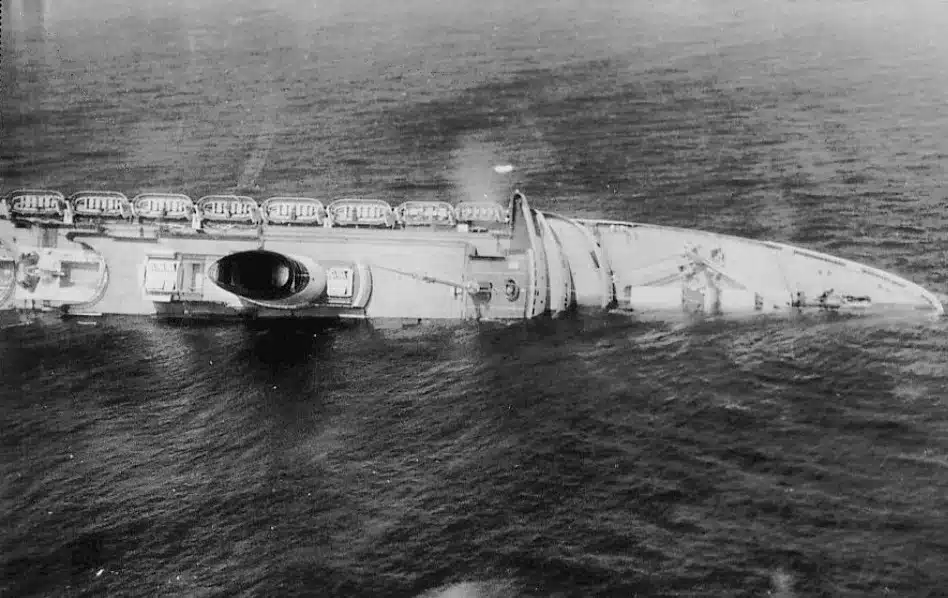
The Andrea Doria, taking on water after a collision with the Swedish ship Stockholm slowly disappears off the coast of Nantucket in July 1956.
Photo Credit: Harry Trask/<i>Boston Traveler</i> via Wikimedia Commons
For "Touring With the Locals" (season 4, episode 10), Weekends with Yankee cohost Richard Wiese visited Provincetown, Massachusetts, to meet with a maritime treasure hunter who made a surprising discovery on a sunken pirate ship. Learn more about five famous New England shipwrecks.
New England was built along the sea — and in many respects, it was built by the sea. We marvel at its beauty and partake of its bounty, and many have become wealthy navigating its waters. But life on the sea is fraught with danger, too. Hundreds of ships and many lives have been lost off the New England coast. Here are a few of the region’s most famous shipwrecks. — Joe Bills
After a collision with the Swedish ship Stockholm, the Andrea Doria slowly sinks off the coast of Nantucket in July 1956.[/caption]
U.S. Navy Historical Center images show a 1939 McCann rescue chamber similar to the one used in the U.S.S. Squalus rescue, and a cutaway illustration of the space inside.[/caption]
Gold coins recovered from the 1717 shipwreck of the pirate ship Whydah, off the coast of what is now Wellfleet, Massachusetts.[/caption]
This 1895 illustration of the steamship Portland was drawn by Samuel Ward Stanton in 1895. In 1912, Stanton was among those lost aboard the Titanic.[/caption]
5 Famous New England Shipwrecks
[caption id="attachment_137892" align="aligncenter" width="948"]
After a collision with the Swedish ship Stockholm, the Andrea Doria slowly sinks off the coast of Nantucket in July 1956.[/caption]
S.S. Andrea Doria: New England’s Titanic
The 697-foot Andrea Doria was a superstar ship of the 1950s. Decked out in luxurious furnishings and sporting an unprecedented three outdoor swimming pools (one for each passenger class), it was a premier luxury liner of its day. Launched in 1953, the ship had completed 100 transatlantic voyages by July 25, 1956, when human error set it on a collision course with the icebreaker bow of the Stockholm off the coast of Nantucket, Massachusetts. The impact left the Andrea Doria taking on water and listing so sharply to the side that half of its lifeboats were inaccessible. Other ships in the vicinity responded quickly and were able to rescue all but 46 of the approximately 1,700 people on board (five people aboard the Stockholm were also killed). Just after 10 o’clock the next morning, the giant ship disappeared into the sea. The Andrea Doria now sits in 240 feet of water and has become a popular, if perilous, diving destination. Since it settled to the ocean floor, the ship has claimed the lives of at least 16 divers. In a 1984 TV event, the safe used by first-class passengers yielded not the multimillion-dollar haul of valuables that some had predicted, but rather a small cache of mostly paper currency. [caption id="attachment_137891" align="aligncenter" width="1000"]
U.S. Navy Historical Center images show a 1939 McCann rescue chamber similar to the one used in the U.S.S. Squalus rescue, and a cutaway illustration of the space inside.[/caption]
U.S.S. Squalus: The Greatest Submarine Rescue of All Time
When the Navy submarine U.S.S. Squalus disappeared beneath the waves off the New Hampshire coast on the morning of May 23, 1939, all was going well. The submarine had already successfully navigated 18 test missions, and the 59 men aboard saw no signs that the 19th would be any different. Four miles beyond the Isles of Shoals, the Squalus had descended to a depth of about 60 feet when water started flooding through the main air induction valve. By the time the crew was able to close the valve and seal off the flooded portions of the sub, 24 men were lost. The Squalus had taken on too much weight, and it slowly descended to the ocean floor. In the short history of the U.S. Navy submarine fleet, no rescue attempt in water deeper than 20 feet had ever succeeded. The Squalus was resting at a depth of 240 feet. With the clock ticking, the Navy deployed for the first time a type of diving bell called a McCann rescue chamber. Ten feet high and seven feet wide, the two-chambered vessel could be attached to the sub with a rubber seal and take on passengers. The process was slow, but over the course of several hours the diving bell made three successful trips. On its fourth and final ascent, however, the diving bell’s guide wire failed and it had to be lowered to the ocean floor while repairs were made. Two divers were nearly lost in the process, but after four terrifying hours the diving bell was reconnected and the final survivors were pulled up. Unlike the other famous shipwrecks on this list, the Squalus would sail again. The submarine was raised on September 13, 1939. Repaired and recommissioned as the Sailfish, it went on to sink seven ships during World War II. The sub’s conning tower is on permanent display at the Portsmouth Naval Shipyard. [caption id="attachment_137893" align="aligncenter" width="1000"]
Gold coins recovered from the 1717 shipwreck of the pirate ship Whydah, off the coast of what is now Wellfleet, Massachusetts.[/caption]
Whydah: A Relic of the Pirate Era
The 110-foot Whydah was commissioned by a London slave merchant in 1715. On its maiden voyage in 1716, the three-masted galley ship sailed first to Africa and then to the Caribbean, trading both goods and humans along the way. In February 1717, loaded up for its return to England, the Whydah was captured near Cuba by “Black Sam” Bellamy, who made it the flagship of his pirate fleet. Bellamy sailed the Whydah up the colonial American coast, capturing ships as he went. On April 26, 1717, the Whydah was caught in a violent storm and slammed stern-first into a sandbar about 500 feet from the shore of what is today Wellfleet, Massachusetts. Although they were within sight of land, only two of the Whydah’s crew survived. At the time of the crash, the ship was rumored to be carrying the accumulated treasure of more than 50 looted vessels. The Whydah and its treasure eluded discovery until 1984, when the wreck was located submerged under 14 feet of water and buried in about five feet of sand. In the years since, more than 200,000 artifacts have been recovered from the wreckage. A museum dedicated to the Whydah, the only fully authenticated Golden Age pirate shipwreck ever discovered and one of New England’s most famous shipwrecks, opened in 2016. Learn more: Barry Clifford and the Whydah Discovery | Brief History of a Cape Cod Pirate Ship [caption id="attachment_137894" align="aligncenter" width="1000"]
This 1895 illustration of the steamship Portland was drawn by Samuel Ward Stanton in 1895. In 1912, Stanton was among those lost aboard the Titanic.[/caption]