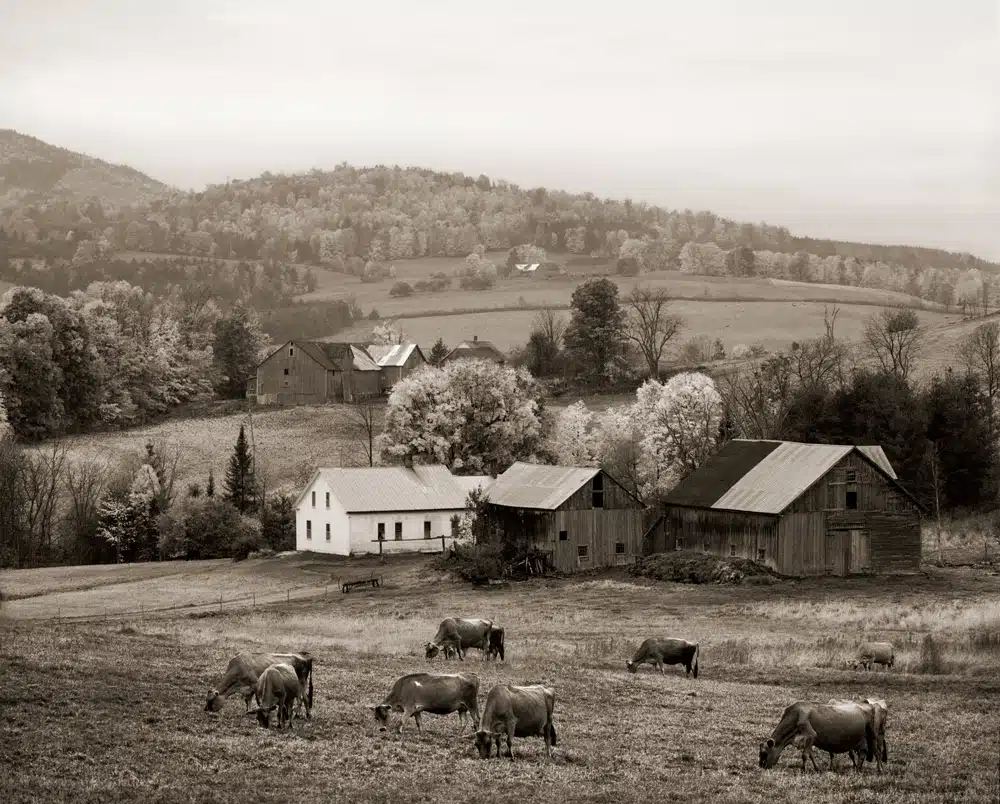
Locke Goss Farm, Barnet, 1971. Small family farms and rolling pastures like these were prevalent throughout northern Vermont when Brown photographed the region in the 1970s and ’80s.
Credit: Richard W. Brown
Theron Boyd was the kind of Vermonter that Richard Brown appreciated. An aging farmer with a few heifers and a cornfield he still harvested every autumn, Boyd lived alone in the same Quechee house where he was born in 1901. When Brown, then a struggling young photographer, met Boyd in the mid-1970s, he found a man leading a life more in tune with the 19th century than the 20th. Boyd didn’t own a car; his home had no electricity or running water.
“Everything about him was from a different time period—even the way he talked,” says Brown. “He’d be telling me how he had to get the corn in before it snowed, and he would say, ‘The snow hinders.’ Nobody talks like that. I’d get in my car in Peacham and it was 1978; when I got out at his place, it was 1878. I was enthralled.”
The Northeast Kingdom that Brown, a Massachusetts native, found when he moved there in 1971 was still a patchwork of small farms where men and women worked the land much as their ancestors had. They milked maybe 20 cows, not 200. They preferred animal power over machinery. But it was obvious to Brown—and probably the farmers, too—that this way of life was coming to a close. So, over the next decade and a half, he made documenting it the focus of his work.
Get Our FREE Yankee Best New England Vacations Guide!
“I looked for markers for the right farm,” he says. “If there was smoke coming out of the chimney in the middle of summer, you knew they cooked with wood. Or you’d see the draft horses around the farm buildings. Those are the places I searched out. And a lot of those people became my friends.”
Brown later found work that would take him around the world, shooting elaborate gardens for lavish coffee table books. Yet it’s still those thousands of black-and-white photos he made in his adopted state, often with his bulky 8-by-10 camera, that he’s most proud of. And with the help of his wife, Susan McClellan, a graphic designer, he finally realized his dream of compiling them into a book, titled The Last of the Hill Farms: Echoes of Vermont’s Past (David R. Godine, Publisher).
“I hope readers will see I had such high regard for the people I photographed,” says Brown, now 72. “I really liked them and felt that what they were doing was a beautiful thing, even though I don’t think they thought of it that way. I miss that period and the people back then who were a part of my life.”
The Last of the Vermont Hill Farms
Early April, West Barnet, 1973. “One early morning I climbed up on a hill to take a picture of this farm, and [the owner, John Somers] comes out the back door,” Brown recalls. “I thought for sure he was going to tell me to leave, but instead he said, ‘When you’re all done, come on in and have some breakfast with us.’ That’s how they were.” Credit: Richard W. Brown
Somers’ Hill Road, West Barnet, 1972. John and Gladys Somers’s farmhouse sits on a hill in the distance; their son Hezzie’s house is in the foreground. “There were always grandchildren around John and Gladys’s home,” Brown says. “It was just a very welcoming place.” Credit: Richard W. Brown
Gladys and John Somers, West Barnet, 1971. “John was missing a few fingers from different farming accidents,” Brown recalls. “He would always hold his hands up to show you, like he was kind of proud of it. It didn’t slow him down much.” Credit: Richard W. Brown
Locke Goss Farm, Barnet, 1971. Small family farms and rolling pastures like these were prevalent throughout northern Vermont when Brown photographed the region in the 1970s and ’80s. Credit: Richard W. Brown
Filtering Syrup, Barnet, 1977. When Brown saw Katherine Roy filtering maple syrup at her farm, “all I could think of was Vermeer and his paintings, because of the light,” he says. “It was so beautiful.” Credit: Richard W. Brown
Light Brahmas, Peacham, 1975. This was Brown’s re-creation of a 19th-century image he’d seen years before, of a deceased great blue heron pinned to the side of a barn. Brown butchered the chickens himself and notes, “They eventually got eaten.” Credit: Richard W. Brown
Coffee with Grandmother, Quechee, 1977. Theron Boyd with a portrait of his grandmother, Mary Cowdray, who raised him and left him the c. 1786 homestead in her will. Though Boyd rebuffed offers from developers, at the end of his life he turned his property over to preservationists; it’s now a state historic site. Credit: Richard W. Brown
Frank Foster and Nick, Walden, 1974. “If somebody showed up at my place and asked me to stop what I was doing so they could take a picture, I would have said no,” says Brown. “But Frank and so many others were happy to do it.” Credit: Richard W. Brown
Stove Wood, Topsham, 1973. As with many of the farms Brown photographed, the buildings on this land are long gone, the property overgrown. “You wouldn’t even know it had existed,” he says. Credit: Richard W. Brown
Stablemates, Quechee, 1978. “I’d taken Theron to the grocery store that day. He always wore his fancy hat when he went into town,” says Brown. “SpaghettiO’s—he’d buy probably 20 cans of those. It’s what he loved to eat.” Credit: Richard W. Brown
Spring Plowing, Danville, 1974. Everden Randall’s farm in North Danville became a favorite stopping place for Brown. “He had tractors, but if he could use his team he would. His straight lines—they were a work of art. It was as though he had his horses on remote control.” Credit: Richard W. Brown
Housekeeper, Kirby, 1973. “People think these images just happen,” says Brown. “Not at all. For this one I asked the housekeeper to come out and pose for me. I figured out where I wanted her to stand, but then the sheep, being curious, wanted in the scene. I wanted them in the background. So I got some grain and poured it out, then ran back, vaulted a fence, and clicked the shutter. I had to move fast because the sheep ate fast. It took a few times.” Credit: Richard W. Brown
Ian Aldrich is the executive editor at Yankee, where he has worked for more for two decades. As the magazine’s staff feature writer, he writes stories that delve deep into issues facing communities throughout New England. In 2019 he received gold in the reporting category at the annual City-Regional Magazine conference for his story on New England’s opioid crisis. Ian’s work has been recognized by both the Best American Sports and Best American Travel Writing anthologies. He lives with his family in Dublin, New Hampshire.
When I was discharged from the military in early 1971, I rode around with my grandfather and he took me to remote farm houses in CT and RI to visit with his old friends he had known since grade school. These photos look very much like those places and people.
The Spring Plowing, Danville 1974 is evocative of an earlier time. This photo could be taken back in the 18th century and not just in Vermont. I think of the April morning in 1775 where many a farmer, including many of my ancestors, left his plow to answer the alarm. The elm trees at the top of the rise, complete the picture…An absolutely timeless photo…
Since I not have the opportunity to visit New England and am not familiar with the social-economic factors that occur in time, what has taken place for so many of these homes that are tributes of generations past, to disappear? Some might question their validity for still existing, but to me they silently speak of mothers, fathers, aunts, uncles, etc. who were family whose sense of belonging were priceless. Changes must come, but sometimes the footprints of those came before need to be revisited for our own future.
thanks for the these post on the farm. I was raised on a farm in the 50’s. my daddy was the hired helper and we were given a house to live in next to the farmer who own the farm. we had apple orchards in the field, we did maple syrup in the sugar house, wild strawberries. pond to swim when the cows whern’t there. there was about 6 kids then so we had plenty to play with. remember riding the wagon why they were haying. had fresh milk, fresh fruit and good home made meals. I lived in Vermont until I was 19.
Thanks for this story on hill farms. I remember visiting such places while living in Vermont in the 1970’s. These places have disappeared more slowly in other poorer sections of the northern tier between Lake Ontario and coastal Maine. Appreciating the hill farm is not a matter of nostalgia, for they may also foreshadow a future in which we are faced once again with the possibility of living in “a world made by hand.”








When I was discharged from the military in early 1971, I rode around with my grandfather and he took me to remote farm houses in CT and RI to visit with his old friends he had known since grade school. These photos look very much like those places and people.
The Spring Plowing, Danville 1974 is evocative of an earlier time. This photo could be taken back in the 18th century and not just in Vermont. I think of the April morning in 1775 where many a farmer, including many of my ancestors, left his plow to answer the alarm. The elm trees at the top of the rise, complete the picture…An absolutely timeless photo…
Wonderful stuff. A passing culture nicely recorded.
Since I not have the opportunity to visit New England and am not familiar with the social-economic factors that occur in time, what has taken place for so many of these homes that are tributes of generations past, to disappear? Some might question their validity for still existing, but to me they silently speak of mothers, fathers, aunts, uncles, etc. who were family whose sense of belonging were priceless. Changes must come, but sometimes the footprints of those came before need to be revisited for our own future.
thanks for the these post on the farm. I was raised on a farm in the 50’s. my daddy was the hired helper and we were given a house to live in next to the farmer who own the farm. we had apple orchards in the field, we did maple syrup in the sugar house, wild strawberries. pond to swim when the cows whern’t there. there was about 6 kids then so we had plenty to play with. remember riding the wagon why they were haying. had fresh milk, fresh fruit and good home made meals. I lived in Vermont until I was 19.
Thanks for this story on hill farms. I remember visiting such places while living in Vermont in the 1970’s. These places have disappeared more slowly in other poorer sections of the northern tier between Lake Ontario and coastal Maine. Appreciating the hill farm is not a matter of nostalgia, for they may also foreshadow a future in which we are faced once again with the possibility of living in “a world made by hand.”