Walden Pond: Thoreau’s Sacred Place
View a slide show from photographer Smari’s book on Walden: A Year. If you come early enough on a summer morning to Walden Pond in Concord, Massachusetts, you get a sense of where Henry David Thoreau lived, and what he lived for. Light slants through the towering pines on the southeastern shore, glittering on the […]
By Jim Collins|Jun 09 2008|

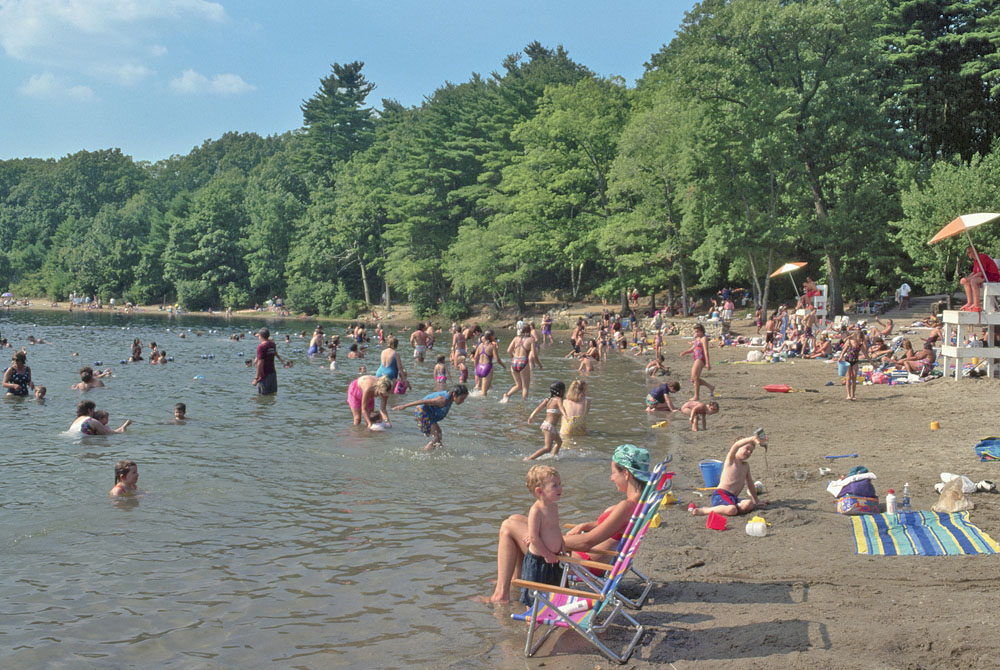

Credit: Monkman, Jerry & Marcy
 But in the early morning you still get a sense of Thoreau’s pond, even when you become aware of the incessant buzzing of inbound traffic out on Route 2, even when the commuter train rattles along the far southwestern shore, as loud and startling as a jet engine. The trains rattled by in 1845, too. Thoreau heard the whistle and thought of screaming hawks and meditated on commerce and restlessness and the human condition, and used the cleared causeway when he walked to Concord village. The trees, though — pine and oak, mostly — are no longer being cut for railroad ties or to fuel the steam engines. They fill the shoreline even more fully than they did back in the day, and the surrounding woods have been protected from development.
The scene, the play of light, all the edges, are lovely and peaceful. And I know I’m a romantic to say so, but I do sense a touch of sacredness here. My friend Elliott, standing next to me in the cool early-morning shade near Main Beach, asks me, “Do you think Walden Pond made the book special, or did the book make Walden Pond special?”
I read Walden for the first time as a college freshman. I can still picture the forest-green cover of that paperback edition, can still see the pages peppered with my handwritten notes. But I couldn’t find the book when I looked for it in the barn the other day. I was curious about what my 18-year-old self made of Thoreau. In truth, I didn’t need to see the notes to know. A few years after graduating, I lived alone in a simple one-room cabin I’d built myself, with no electricity or running water, at the edge of a small New Hampshire pond.
I didn’t choose to live where or how I did because of Thoreau, but I felt compelled by the same forces he did. “Both place and time were changed,” he wrote, “and I dwelt nearer to those parts of the universe that attracted me.”
For many of us, our sense of place is personal — enriched by childhood memories, family stories. In New England, though, where so much human history is so close to the surface, where so much reflection has been recorded and passed down, our attraction to certain places goes beyond the scenic or the personal. In some places — where the writing has been transcendent — that attraction becomes mythological, perhaps universal, and connects us all. At Walden Pond, thanks to a book written a century and a half ago and a landscape that remains, in many ways, recognizable, we resonate with something deeper.
But in the early morning you still get a sense of Thoreau’s pond, even when you become aware of the incessant buzzing of inbound traffic out on Route 2, even when the commuter train rattles along the far southwestern shore, as loud and startling as a jet engine. The trains rattled by in 1845, too. Thoreau heard the whistle and thought of screaming hawks and meditated on commerce and restlessness and the human condition, and used the cleared causeway when he walked to Concord village. The trees, though — pine and oak, mostly — are no longer being cut for railroad ties or to fuel the steam engines. They fill the shoreline even more fully than they did back in the day, and the surrounding woods have been protected from development.
The scene, the play of light, all the edges, are lovely and peaceful. And I know I’m a romantic to say so, but I do sense a touch of sacredness here. My friend Elliott, standing next to me in the cool early-morning shade near Main Beach, asks me, “Do you think Walden Pond made the book special, or did the book make Walden Pond special?”
I read Walden for the first time as a college freshman. I can still picture the forest-green cover of that paperback edition, can still see the pages peppered with my handwritten notes. But I couldn’t find the book when I looked for it in the barn the other day. I was curious about what my 18-year-old self made of Thoreau. In truth, I didn’t need to see the notes to know. A few years after graduating, I lived alone in a simple one-room cabin I’d built myself, with no electricity or running water, at the edge of a small New Hampshire pond.
I didn’t choose to live where or how I did because of Thoreau, but I felt compelled by the same forces he did. “Both place and time were changed,” he wrote, “and I dwelt nearer to those parts of the universe that attracted me.”
For many of us, our sense of place is personal — enriched by childhood memories, family stories. In New England, though, where so much human history is so close to the surface, where so much reflection has been recorded and passed down, our attraction to certain places goes beyond the scenic or the personal. In some places — where the writing has been transcendent — that attraction becomes mythological, perhaps universal, and connects us all. At Walden Pond, thanks to a book written a century and a half ago and a landscape that remains, in many ways, recognizable, we resonate with something deeper.