



The 5 Best Stargazing Spots in New England
Escape from cities and suburbs, where light pollution robs us of true nighttime, and visit the best stargazing spots in New England.
By Kim Knox Beckius|Aug 03 2018|


Jordan Pond footbridge under a starry sky.
Credit: Vincent LawrenceWant to see stunning starscapes and feel re-anchored in the celestial sea? Escape from cities and suburbs, where light pollution robs us of true nighttime, and visit one of these picks for the best stargazing places in New England.
Our List of Best Stargazing Spots in New England

Credit: Kristi Rugg
Acadia National Park | Bar Harbor, ME
The passage of a local ordinance rarely attracts notice, much less thousands of visitors. But Bar Harbor’s 2009 “Light and Glare” law, designed to preserve the Eastern Seaboard’s inkiest night sky, has made the island town best known for Acadia National Park a stargazing mecca. At 9 p.m., typically on summer Wednesdays and Sundays, spread your blanket on Acadia’s Sand Beach, lie back, and allow a park ranger to take you on a one-hour celestial journey.

Credit: Cait Bourgault
AMC Highland Center Lodge | Bretton Woods, NH
See the Dark events hosted at this quiet location in the middle of the White Mountains invite you to experience the region’s deep, dark night sky. On various weekends throughout the year, join experts for a full slate of programs and astronomy sessions at the Appalachian Mountain Club’s Highland Center Lodge in Crawford Notch. Peer through the lodge’s high-powered Celestron telescope to see solar activity by day, and celestial bodies at night. An indoor planetarium ensures astronomical education is weatherproof.
Credit: Courtesy of Frosty Drew Observatory & Sky Theatre
Frosty Drew Observatory & Sky Theatre | Charlestown, RI
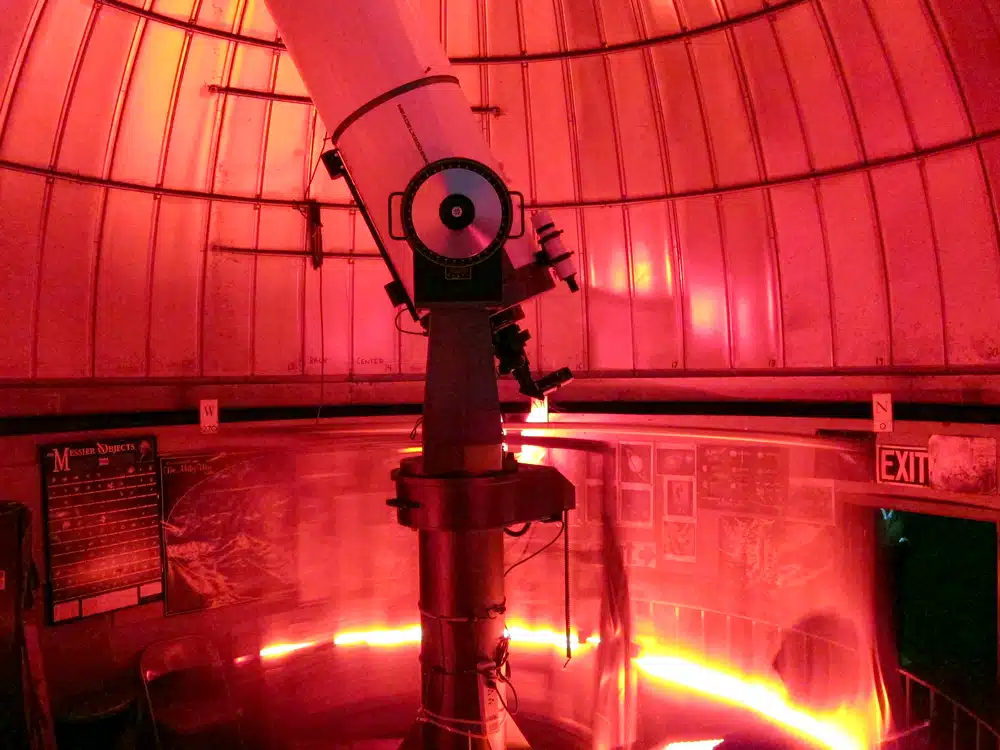
There are hundreds of people here to see the hottest stars. Some are chillaxing in the “Lunar Lounge,” watching the moon projected live on the side of the theater. Others are mesmerized by “Sky Evangelists” waving their “lightsabers” at constellations. There’s animated chitchat; everyone’s really digging the scene. Your significant other just asked a profound question, revealing a depth of character as yet unseen. No, this isn’t some Hollywood party. It’s a peak-summer Friday night within the sea breeze–chilled recesses of Ninigret Park—the darkest spot between New York City and Boston—where, yes, you can see the Milky Way ripping across the sky.
The lines at the viewing stations can get long, especially for a look through the 24-inch PlaneWave, the big telescope inside the dome. But passionate astronomers and volunteers often stay until the late-night end, so everyone gets a turn. Friday stargazing nights are actually a year-round phenomenon that attracts astro geeks from as far away as Washington, D.C.

Maria Mitchell Association’s Loines Observatory | Nantucket, MA
To look at deep-sky objects through the largest telescope routinely open to the public, you’ll have to travel to Nantucket—that speck in the ocean shrouded in black velvet by night—on a Monday or Tuesday late May through September. The Stargazing Open Nights program offers two ticketed sessions each night, weather permitting.
The Loines Observatory, located near Prospect Hill Cemetery, where America’s first female astronomer Maria Mitchell rests, has two domes. If you’re impressed by your view of bright planets and double stars when you peek through the antique 8-inch Clark telescope, just wait. The 24-inch research telescope’s eyepiece is your ticket to spying on planetary nebula (the remnants of exploded stars), our neighbors in the Andromeda Galaxy, and globular clusters (masses of hundreds of thousands of stars born simultaneously). Suddenly, anything heavier than gravity weighing on you will seem awfully small.

Credit: Courtesy of Northern Skies Observatory
Northern Skies Observatory | Peacham, VT
On the Bortle Dark-Sky Scale, a “1” (out of 9) is absolutely, naturally dark—the darkest skies on earth. The Northeast Kingdom Astronomy Foundation’s observatory was built in a place so rural, nights here solidly score a “3.” Some are as good as a “2.” And that means you’re in for a stellar experience.
This research and education facility, known for the data captured by its powerful 17-inch robotic telescope, invites curious observers to stop by for a star party, often held once per month June through October, when you’ll be squinting through a half-dozen smaller telescopes positioned on the lawn. The team behind this purely donation-driven organization is devoted to sparking young imaginations, to showing off quasars as far as 11 billion light-years away and shadows cast right here by the Milky Way, and to providing night-sky therapy for all.


Wonderful article on stargazing in New England.
One should learn and take in the Stellafane VT. Quoting from their web page:
We are The Springfield Telescope Makers, Inc., an active Amateur Astronomy and Telescope Making club located in Springfield, Vermont. We put on the annual Stellafane Convention in July or August, hold Mirror Making Classes in the Fall and Winter, and usually hold a few Public Star Parties each year (check our Events calendar). Founded by Russell W. Porter in 1923, and considered by many to be the “Birthplace of Amateur Telescope Making”, we have a rich History.
People come from countries around the world. The site informs about conditions this year. John Pierce was one of the founders and taught my mechanical drawing class at SHS about 1955. Get a chance to visit when open, amazing what’s happening in Spfld VT and nice sky observing.