



Slow-Roasted Beef Tenderloin with Shallot-Port Sauce
Cooking at a low temperature takes longer, but it guarantees a completely even doneness with minimal effort. Try it once and you may never go back.
By Yankee Magazine|Nov 02 2018|

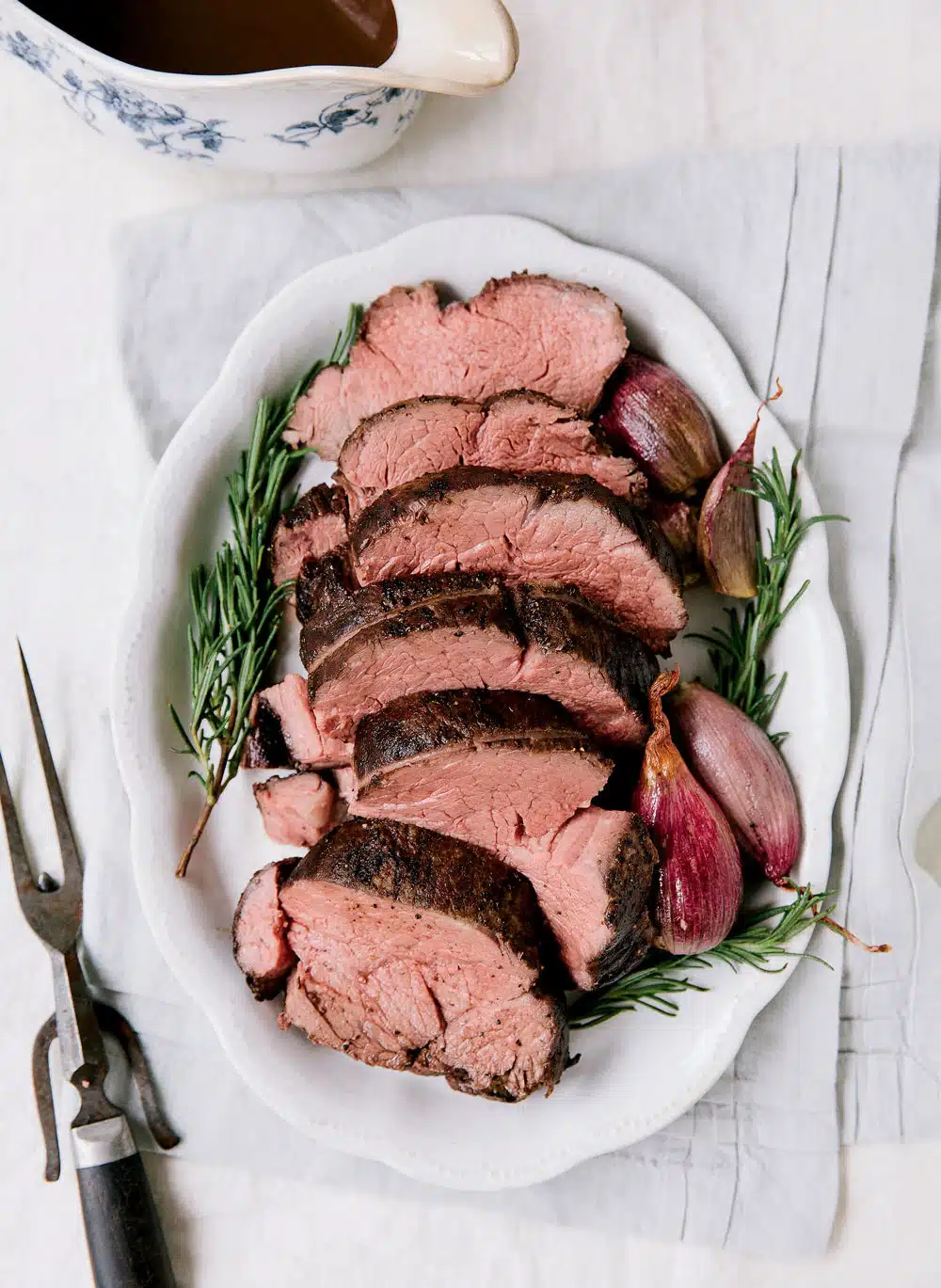
I was first introduced to the technique of reverse roasting by chef Tony Maws of Craigie on Main restaurant in Cambridge, Massachusetts. Rather than first searing meat on top of the stove and then transferring it to the oven, as I had learned to do, he showed me how he cooked it to just below temperature in the oven first and seared it on the stove to develop a crust. The result: more control over the final level of doneness. Meanwhile, Kenji López-Alt was popularizing a similar roasting technique at even lower temperatures, first at Cook’s Illustrated and later in his popular “Food Lab” column for SeriousEats.com. (His best-selling book of the same name is well worth a read.) It’s now my favorite way to cook meat. Cooking at a low temperature takes longer, but it brings the interior of the meat to a completely even doneness with minimal effort. Try it once and you may never go back. A simple port-enriched pan sauce is the icing on the cake.
Yield
8 servings
Total Time
2 1/2 hours, plus 8 hours salting time minutes
Hands-on Time
40 minutes minutes
For the roast:
Ingredients
2 1/2 pounds center-cut beef tenderloin, trimmed
2 teaspoons kosher salt
1 teaspoon freshly ground black pepper
3 medium shallots
Garnish: coarse sea salt such as fleur de sel, rosemary sprigs, roasted shallots
Instructions
The night before roasting (see Notes), tie up the tenderloin with twine at 1-inch intervals so that it has an even thickness. Sprinkle all over with kosher salt and pepper, set on a wire rack in a roasting pan, cover loosely with plastic wrap, and chill for up to 24 hours. (If you skip this step, simply season the meat before roasting.)
Remove meat from the refrigerator and let sit, covered, at room temperature for an hour before roasting. Preheat your oven to 250° and set a rack to the middle position. Put the whole shallots in the pan (throw in 4 more for a garnish, if you’d like) with the tenderloin and transfer to the oven. Roast until an instant-read thermometer in the center of the tenderloin reads 125°, 11/2 to 2 hours. Remove from oven and let sit at room temperature for 10 minutes. Cut and remove twine. Finely chop the 2 roasted shallots (leave the ones for the garnish whole) and set aside.
Set a large skillet over high heat and add 3 tablespoons of butter. Add the tenderloin and brown all over (including ends), turning as you go, about 1 minute per side. Remove meat from pan and transfer to a serving platter.
Notes
A whole tenderloin is a pricey, special occasion cut and it deserves special treatment. Salting the meat the night before you plan to cook it improves the flavor and texture. You don’t have to do this step, but you’ll be glad you did.
For the sauce:
Ingredients
3 tablespoons plus 2 tablespoons unsalted butter
2 medium shallots, minced
3 cups beef stock
1 1/4 cups port wine
1 sprig rosemary
Instructions
Reduce heat to medium-high. Add the remaining 2 tablespoons of butter, along with the minced shallots and the chopped roasted shallots. Cook until fragrant and lightly golden, about 6 minutes, then add the beef stock, port, and rosemary. Bring to a boil, then reduce heat to a simmer and cook sauce, stirring occasionally, until reduced to about 2 cups, 10 to 15 minutes. Pour sauce through a strainer into a gravy boat. Sprinkle the tenderloin with sea salt and garnish the platter with fresh rosemary sprigs and roasted shallots. Serve immediately, cut into 1/2-inch slices, with sauce on the side.

This was a GREAT way to cook the roast. We took the roast out of the oven at exactly 125 degrees. The internal temp of the meat did not continue to climb so even after browning, the meat was very rare. When I do it again, I may cook to 130 degrees. (We needed a couple of “more well done pieces” so we just put a couple of slices in the fry pan we used to brown the meat for a very brief time. Everyone was happy.) There were no drippings to add to the gravy and we weren’t thrilled with the port wine sauce. That part of the recipe was not a keeper but we will absolutely do the slow roast again. (And YES, salt and pepper the night before.)
Made this for Christmas dinner in 2016. It was delicious and got rave reviews. 2 people who had dinner with us last year called to get the recipe so that they can make it this year. We will be serving it again this year. (I never would have thought to cook the beef at such a low temperature.) It was perfect!