



Mel Allen’s Letter from Dublin: Signs of the Times
Spring has finally returned. And in his latest “Letter from Dublin,” editor Mel Allen looks back on what it took to get here.
By Mel Allen|Mar 17 2021|

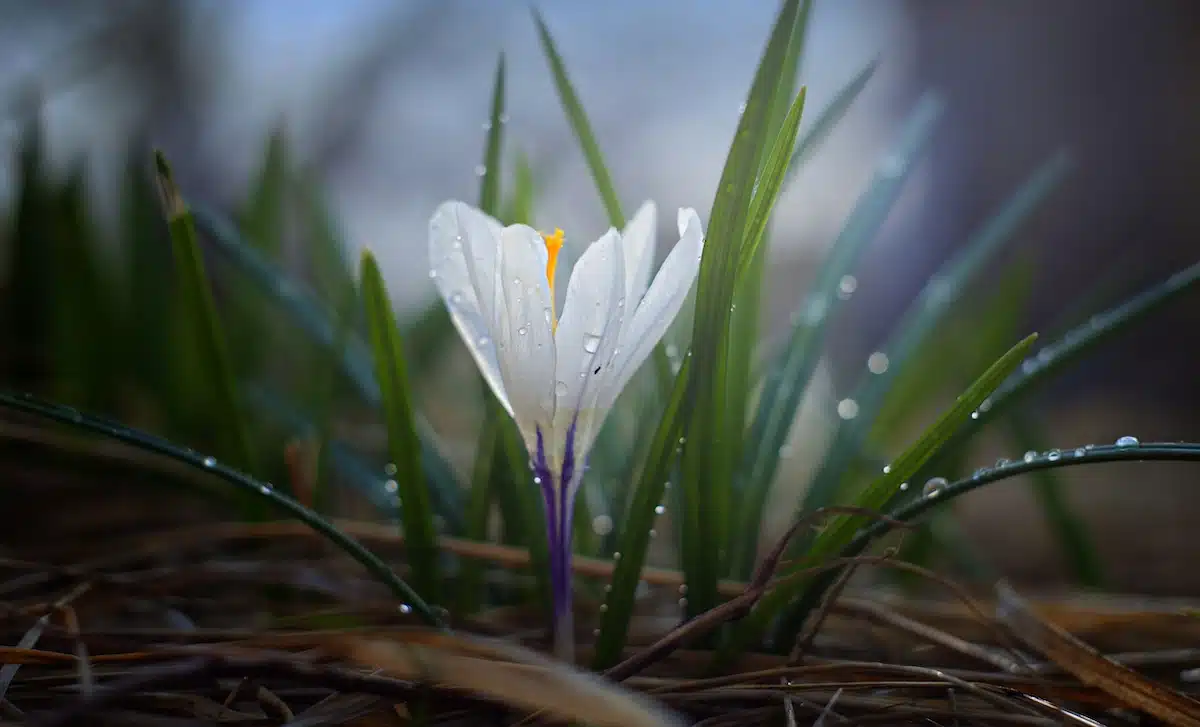
Spring crocus
Credit: Aleksey Kutsar/PixabayIn 2020, the arrival of spring coincided with the rise of an unprecedented American public health crisis. As it did in other nations fighting the coronavirus, life here profoundly changed — and for how long, no one knew. Throughout the pandemic year, Yankee’s longtime editor, Mel Allen, has posted regular dispatches from our home in southwestern New Hampshire. Now, as we finally begin looking forward to a post-pandemic life, Mel will continue writing “Letter from Dublin” as a column in Yankee magazine, separate from the archive below.
March 18, 2021: A Year Like None We Have Known
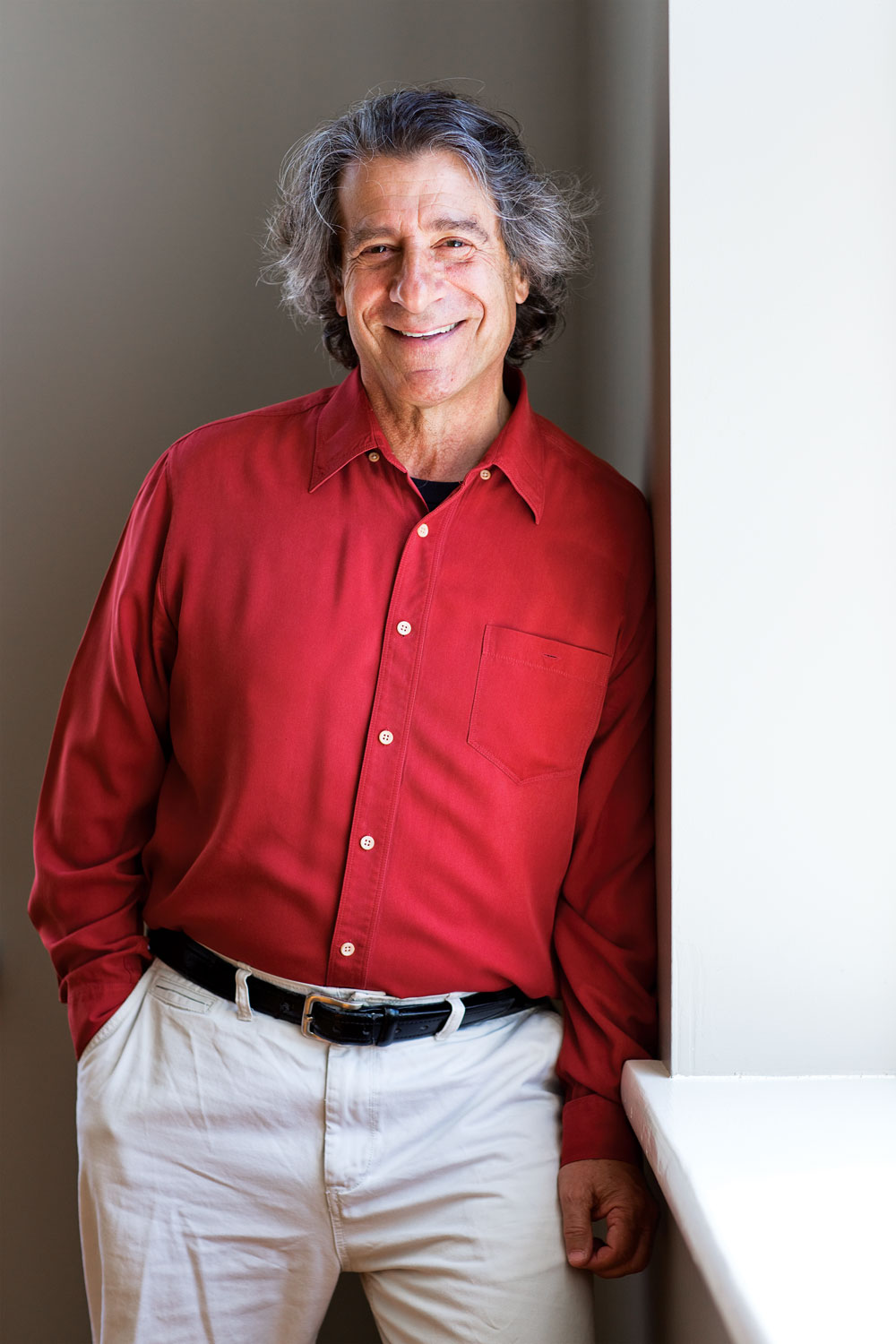
Credit: Jarrod McCabe
Rudy, our Jack Russell, comes to work with me each morning. By that I mean he walks behind me up the stairs to my second-floor office, which looks out one window to the road, the other to the river. There is a wicker basket against the wall behind my desk. He jumps into the basket, lined with a blue blanket, and in our now-year-long ritual, I cover him with an orange fleece, a pullover that once I called my own but which now and forever belongs only to him. He is 12, and his lifespan has passed the three-quarters mark. I am certain the fleece will follow him from this life to the next.
Rudy burrows deeply into his office attire this way. Most of the time only his snout shows when, now and then, I turn away from the screen to see what he is up to. Mostly different stages of sleep. He snores lightly through many of our Yankee online meetings — and occasionally I hear the excited whimpers that mean he is no doubt dreaming of summer days when he monitors the backyard for chipmunk and squirrel intruders. I do not understand how, even this past winter with the windows shut, he somehow knows when Gizmo, his mortal enemy from next door, a big shaggy white dog who outweighs him at least sixfold, ambles by — and at those times, often twice a day, Rudy’s growl starts low and erupts into a full bark as if sounding an alarm from our roost.
What he knows of this most terrible year — a year that has taken much from all of us, and everything from hundreds of thousands — is that he is now attached, branch to trunk, to the two people who live here, seemingly with the purpose of taking him on several jaunts a day (even if only to the backyard), to keep the woodstove burning for his after-office-work repose, to say “good boy” a dozen times a day.

Credit: Annie Graves
For the first time ever, I have burned all the firewood laid aside for the fall, winter, and early spring. Four cords. When I stacked it last April, I never guessed that the weeks and months of staying home would spill past summer into fall, then winter; that I would be here, first light to last, stoking the stove. This weekend I raked the woodshed floor, gathering deep scraps of bark and wood splinters, which startled the red squirrel who rents a loft there, and who is not accustomed to my being around for more than a few minutes, as I fill my arms with wood or split kindling on the chopping block. This, however, was a more prolonged visit.
After a few days that teased us with 60 degrees, the north wind dashed in and single digits said “Remember us?” I was curious if I could keep a fire burning and heating the house with the detritus I’d swept up off the floor. No, I could not. But the effort felt right. The woodshed was bare except for empty stacks of walnut shells that lined ledges where the squirrel had picnicked. In a year where the most ordinary of things — “Please wear a mask when entering our store” — became a point of tension and, at times, worse, scraping a dirt floor bare seemed somehow imbued with meaning. A way to tidy up what had been messy.
What does it mean to anyone, I wonder, when we say “last year”? These past few days I have read numerous stories from people who are marking the one-year anniversary of a lockdown, or when a loved one fell ill. I am no different.
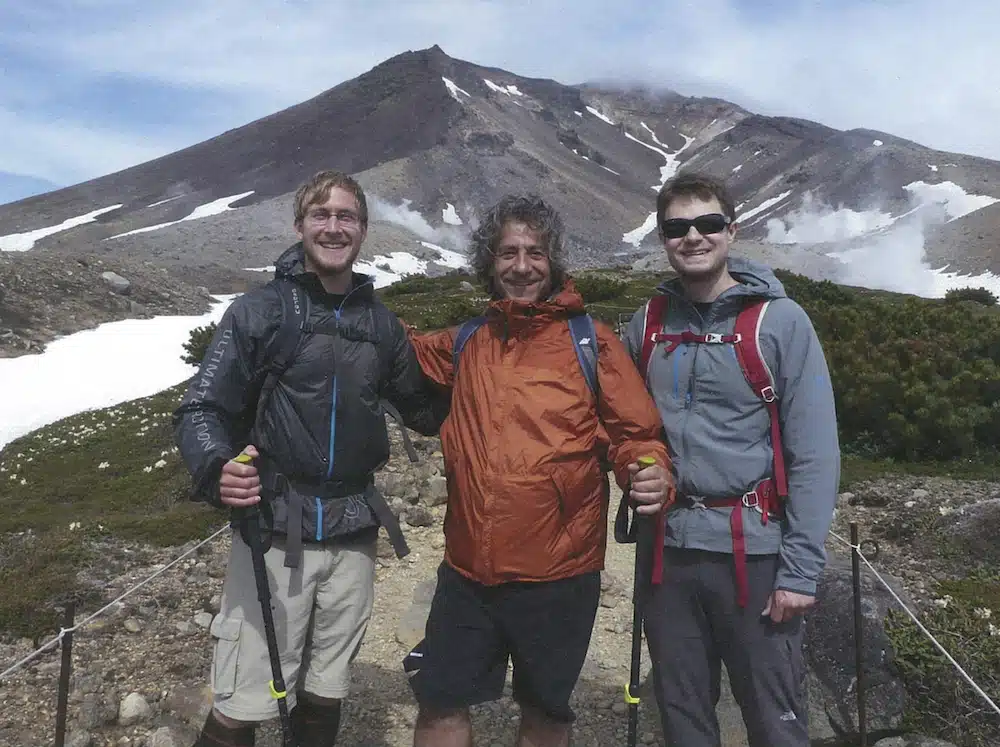
One year ago, I said good-bye to my two sons after an early March week in the Colorado mountains. The virus was in the news, but nobody had been reported ill in the state. Our last night we even went to a movie. We’ll meet up in July, we said, and then in the fall. We call these “Allen boys adventures” — an echo from when they were young and we climbed Monadnock and Mount Washington, stayed up into deep darkness to watch meteors. One week after I came home, New Hampshire’s governor closed businesses. Until May, he said, and that seemed like a long time. Surely, we would find a way out of this by then.
And that is when I began writing these letters. In one sense, they were meant to connect our Yankee world — even if we were scattered and working from our homes in three different states — with you, our readers. It was our way to say, We are in this strange, unexpected, scary, uncertain world together. We know you are going through what we are. I felt that what I observed in my small corner of the world might resonate with others, wherever they might be. But in truth, I realize I have been writing these for me more than anyone. Each one reminds me, This is important to remember.
Credit: Annie Graves
There are days that seem to have no beginning or end — simply a rippling from one to another. I don’t know if you have ever stood in a doorway and felt, even if for a moment, the strange sensation of being in both past and present. This year, I have. The familiar seems to belong to another time and place. It is not unlike when I look at photos from when my boys were small — photos that line my walls.
I see Dan, his legs poking out of my backpack, in the Florida sun when he was one year old. It was October. I had just buried my mother there, and we had taken a few days afterward in Sanibel Island. I see the photo above my desk and I am back in time and place — but I am no longer that much younger dad, he is no longer the little boy just learning about his world. But there inside that frame: I am, he is.
Last week my friend and colleague Jenn Johnson cut and pasted these letters from the first one, last March, to the latest, last month, and arranged them in chronological order. Then she printed them out, 44 pages clipped together.
The first one began: The snow fell heavy and wet on Monday night, and we woke up to trees wearing a blanket of winter white. It was really quite lovely, and even though spring had arrived and I would have welcomed having grass to mow and a garden to till, there was something comforting in being out at 7 a.m. shoveling. The sheer normalcy of flinging snow off the car with my mittened hands and clearing a landing spot in the yard for Rudy, our fiery Jack Russell terrier, made the world seem, for that hour or so, quite ordinary. And for that I was grateful.
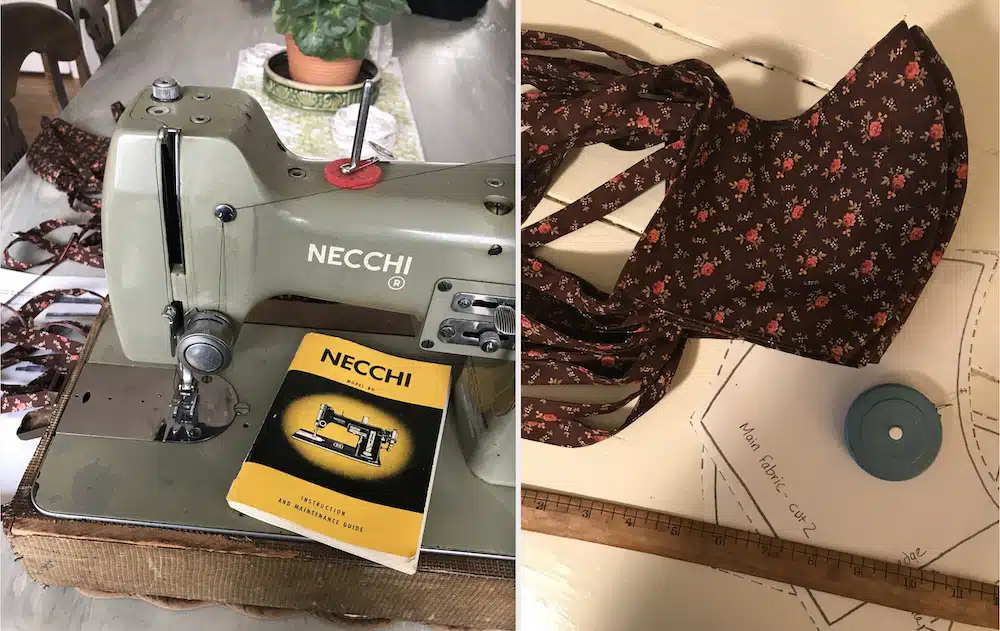
And then for many weeks, in my letters I tried to make sense of a world that seemed so foreign. My walking into the house to find Annie sewing masks on the machine her mother once used. My discovering a box of discarded Yankees from the 1930s and 1940s outside the library. Watching the town bridge be taken apart by huge machines we had not seen here before. Feeling the sense of community when a high school graduation was celebrated house by house with posted signs of encouragement. Taking more delight than I thought possible by plunging into a clear lake on a hot day. Feeling the conflict when seeing so many cars from distant states parked by mountain trails. A year compressed into 30,000 words.
Credit: Annie Graves
This will be the last “Letter from Dublin” in this format: strung together here, spooling out present to past, letting you rewind a year, able to stop anywhere. I will continue to look around and write about what I see, but we are now in a new springtime. Many of us have signed up for a vaccine. This is a good time to unbuckle from pandemic mode, and see what comes next.
Early on, I wrote about finding a box of blank journals put out by the local historical society with the hope that residents would record their lives, and then at the end of the pandemic give the accounts to the society for future generations to know what it was like, when life seemed both so still and so turbulent. I hope the children of today will come read these journals when they are ready—maybe in 20 or 30 years, when they have families of their own. They will see what all of us know to be true, even on a hard day: In time the ground settled, and we learned what we are made of. They made it through. We made it through.
We are. We did. This is how it was, one year gone by in a small New Hampshire town where every morning a little dog followed me into my office and snuggled under covers waiting for me to get up and play.
Readers, we’d love to hear from you. If you want to share your thoughts with Mel directly, drop a note to editor@yankeemagazine.com. Otherwise, click the link below.
Leave a Comment on “Letter from Dublin”
February 17, 2021: Life After Mary’s Farm
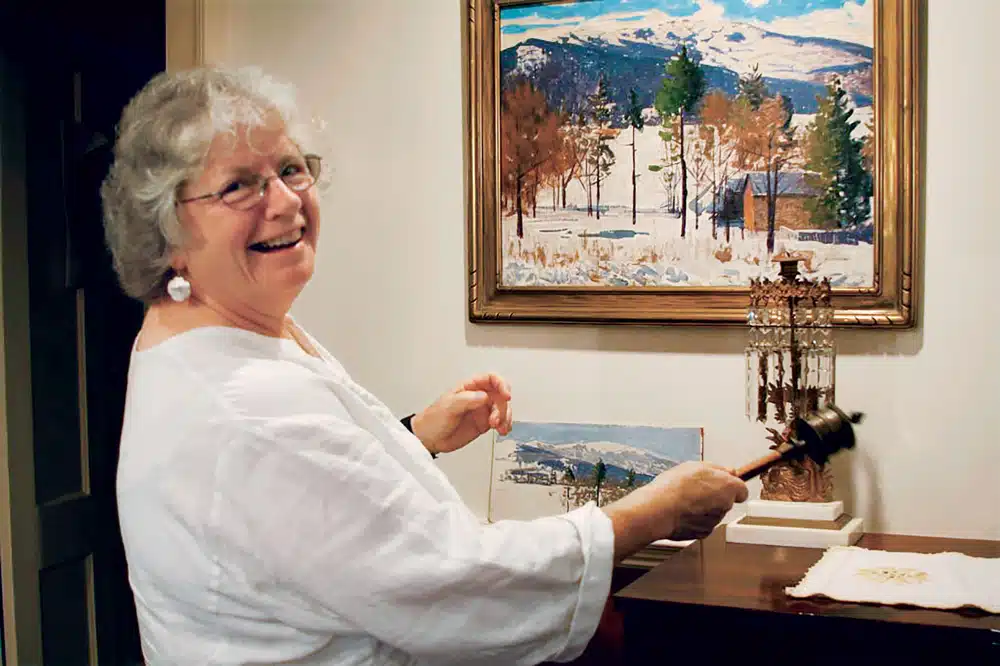
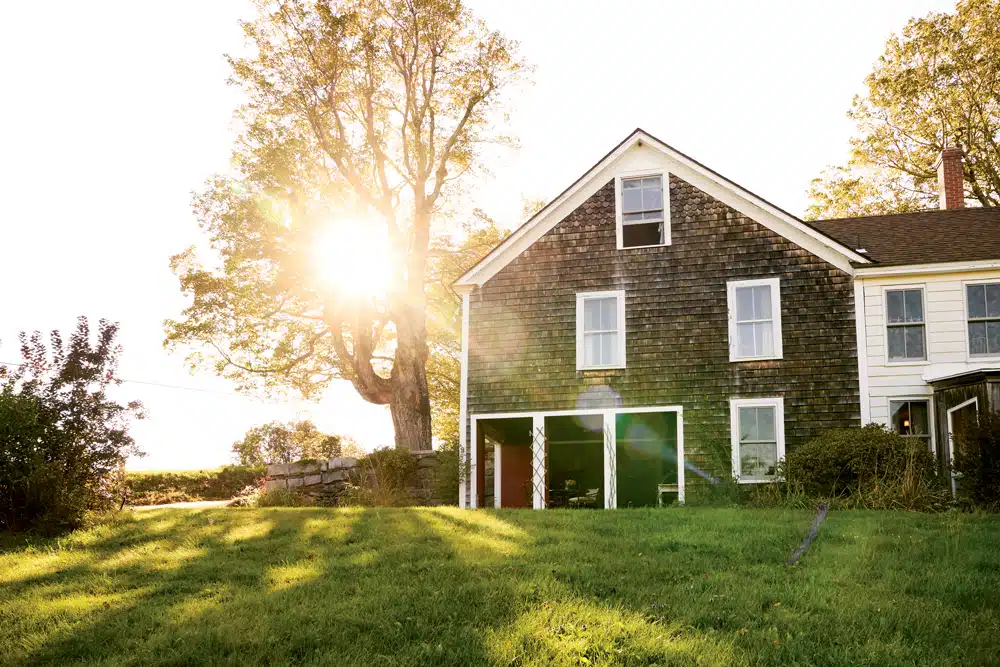
Edie Clark, Yankee’s beloved “Mary’s Farm” columnist, thinks it was five years ago, maybe more, when she first blacked out for a moment and fell. After that, she would tell me every now and then that she had fallen again, but even as her friends prodded her to see a doctor, she was adamant she was fine, it was likely her chronic Lyme disease causing mischief. Then one night she fell and could not get up, and an ambulance took her to the hospital and doctors discovered she had been suffering a series of mini strokes; she would need rehabilitation and long-term care. In 2018 her beloved farm, the beautiful setting for thousands of words that detailed the simple moments in her rural world, was sold. I wrote about her final visit to the farm from her new “home,” a nearby nursing-care facility.
When that story appeared in Yankee, her fans responded. “Edie, I’ve learned so much from your writings. I have pored over your books many times now,” one wrote. “To me, you’re a teacher. The subject? Courage. It’s as simple as that.” Another reader said, “I was certain she wrote just for me.” And this, from another fan: “I feel like a bright flame in my life is being extinguished.”
Credit: Ewa Buttolph
Edie’s devoted readers still write to her. Their words of encouragement and thanks arrive at the Yankee office, and before Covid I would collect them and bring them to Edie’s room every few weeks. Her eyesight has been growing increasingly worse; she said I appeared to her as if through gray gauze. So I would read to her. If it was a special-occasion card, I would give it to Edie and she would hold it almost touching her face to see. When I read, Edie would laugh, grow teary, swell with pride — sometimes all within one heartfelt letter. We kept a box of the ones we knew she would want to re-read as the years passed by. This one from a reader in Litchfield, Connecticut, is one of those.
“Edie Clark raised me — not in the parental sense, as heaven knows two other stalwart Yankees had that merciless job, but in the literary sense — raising my awareness of the New England world around me through her stories. Her constancy of word saw me through teenage angst, college finals, and all that life presents, while balanced by her innate optimism and hope. Her unwavering curiosity and excitement in small observations enriched my own view of things.
“The back story is simple: My parents had subscribed to Yankee for as long as I could remember, so Edie’s stories were truly my first go-to when each issue rolled in. A cup of black tea, a deep warm armchair, and Edie’s latest discoveries fed my love of language, image, and simplicity. She proved you didn’t need to be Homer to find truth in quiet things and near perfection in the often overlooked.”
When Covid arrived, visits to Edie’s nursing-care facility stopped, and we were left with phone calls. I could not see her face, but as I read the letters she might murmur, “That is so nice,” or “I have to save that one.”
Credit: Mark Fleming
Last night we talked, and I had a small pile of envelopes from her readers to open. But first, Edie said, she wanted to tell me about an idea for a story she wanted to write for Yankee. An old friend had sent her what he called “cheaters,” simple inexpensive glasses that magnified print threefold — maybe more, she said. She was able to make out the local biweekly newspaper, and she had just read about a famous white ash tree that had come down in a winter storm at Pickity Place, a well-known eatery and gift shop about 15 miles away. The owner wanted to honor the tree by hollowing out the massive standing trunk and making it a free book exchange. “I want to get back,” she said. “I want to write stories again.”
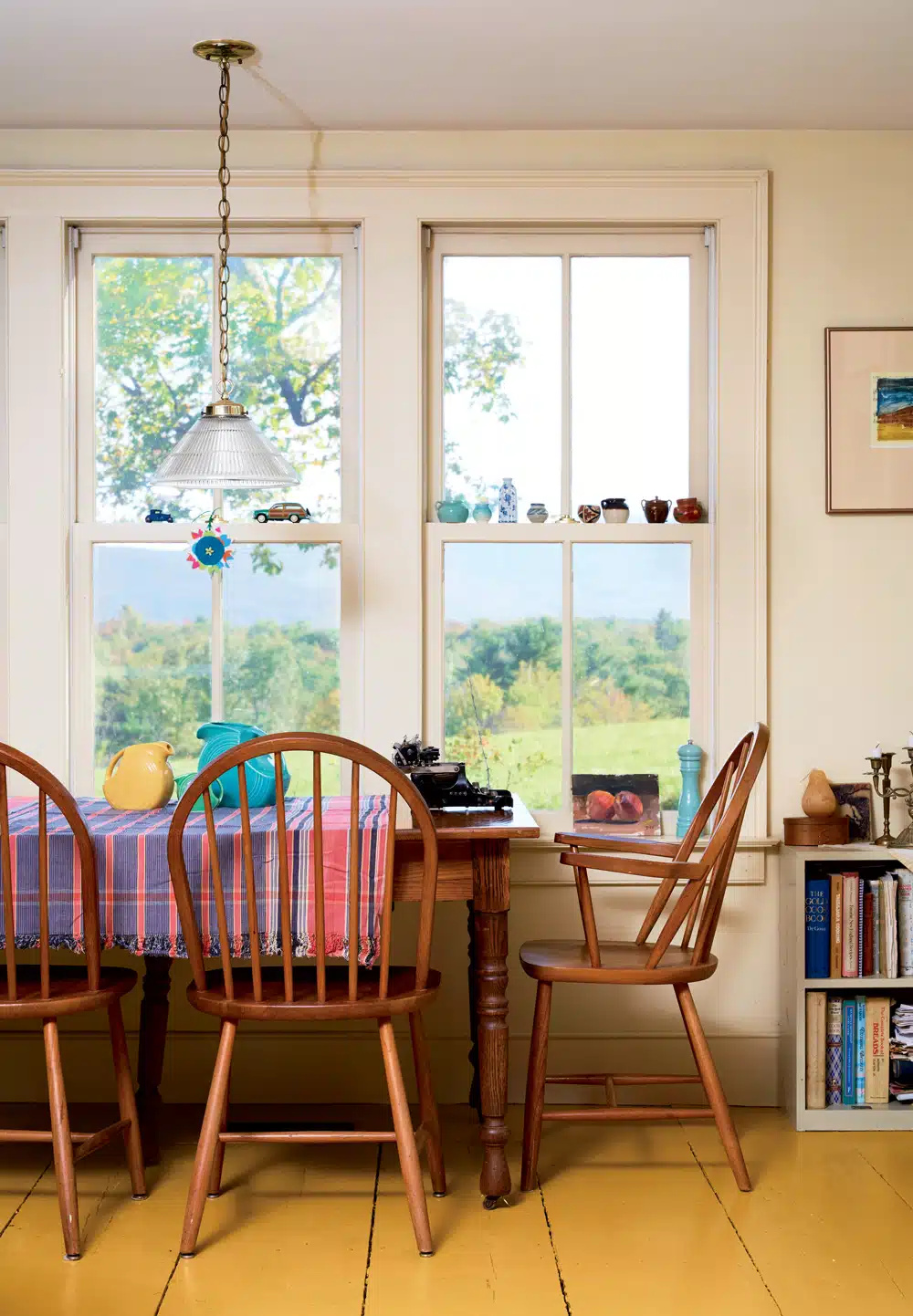
I asked how she would do that. She spends most of her day in a recliner, and when she needs to move about, she is helped to a wheelchair. “I’ll rent a car,” she said, knowing she would not and could not. But the words still spill around her head. She is awash in stories to tell, mostly about the days before the falls. Often now, about long ago.
“I write in my head,” she said. “Lately I’ve been where I grew up in New Jersey. I grew up watching my father create his lawn, and that was a huge thing in his life. We had three acres, and two brooks ran through the land and we built a bridge across them. All summer I played by the stream and looked for frogs. It was so lovely. He built a stable for my donkey. I was four or five. I helped put up the fence. Now I get to go back and walk on those paths.”
Not long ago Edie sent to friends a letter she had dictated, a voice from a tiny room beyond Mary’s Farm.
Credit: Mark Fleming
“I’m grateful for everything I find here…. There is forecasted to be a large snowstorm tonight, and I find myself thinking about what I would be doing if I were home. I would be filling jugs of water in anticipation of a power outage and making sure my shovel was ready for the morning. I would be getting out candles from the drawer in the dining room. And I would be sure that all the wood boxes were filled for my many stoves. And I know that most of my friends would be saying something along the lines of ‘Thank God I don’t have to do that anymore,’ but not me. I miss it very much. Just thinking about it is somehow oddly satisfying. I imagine that my beautiful stoves right now are cold and no one is feeding them any fuel. Nostalgic thoughts like that keep me very busy.
“I’ve been in and out of lockdown, isolation, and quarantine since March. If nothing else it has been interesting. I wish I could write because I would have written all kinds of things about this year. It has not been as painful as I would have thought. My little room I have figured is roughly 8’ by 16’. In it I have a bed with a pump that continually brings air into the mattress and two bureaus and a wide-screen TV which I could not do without. And a bookcase where I store everything you could think of. I have a large window that looks out on the parking lot, alas, not the fields or the mountain. Snowstorms come and go without my notice. I wish I could shovel it. I miss that little burst of activity that would have broken up my little pocket of isolation here.
“I miss everything: trips to town for groceries and daily trips to the post office. Most of all I miss my wood stoves, the cheerful penetrating heat that I came to rely on for comfort. In summer I miss my porch and the cooling afternoon breezes. And I miss my dog, Harriet. Most of all I miss my friends. I apologize to all of you who have been so kind in sending me cards and letters. These have been a daily joy. I long for visits….”
January 12, 2021: What the Winter Birds Can Teach Us
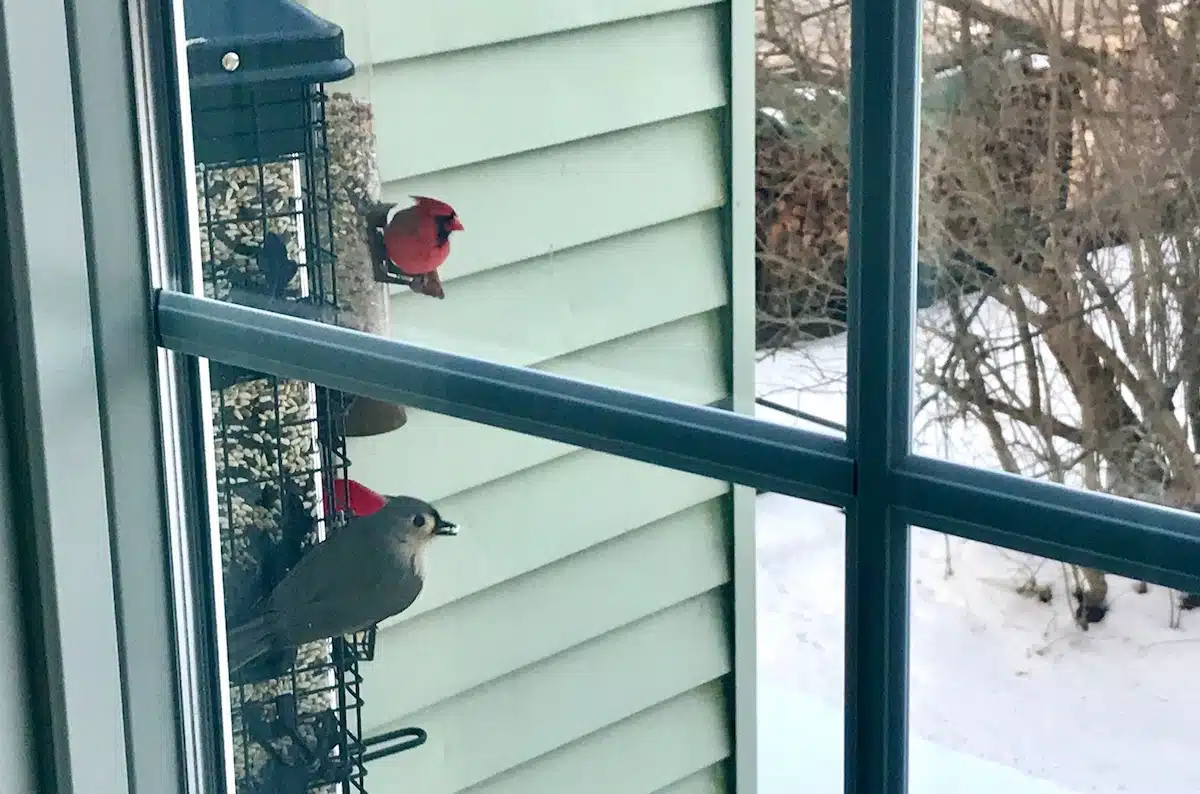
The best Christmas gift that Annie and I gave each other is the show that begins every morning outside the windows facing the river, and does not end until just before dark. Two birdfeeders filled with seeds, and a third with suet, have convinced every cardinal, blue jay, nuthatch, tufted titmouse, chickadee, woodpecker, and others (whose names I am still searching for) that this is the neighborhood takeout banquet. They have become the loveliest scenery imaginable.
By the dozens they perch on the rose bush or the trees, and then, by some secret messaging known only to them, they flutter to the feeders, each in turn, peck furiously, and fly off just as another wings in. There is a chair by the window, and I sit and watch as the swirl of wings and frantic beaks and bright colors come and go, the birds somehow never intruding on each other, understanding, in the way that wild things do, that if they get along during the hard days of winter there will be enough for all.
On Tuesday, January 5, we at Yankee had “laydown” for our March/April issue. This is when ads are placed on pages, and we get to see exactly what the readers will see; it is one of the last steps before the pages leave Dublin on their way to the printer. During this plague year, we all have had to rethink what is “normal,” and laydown was no different. We watched the pages turn on our screens, some of us in the Dublin office, some not. And then we got ready to turn our attention to the coming issue.
Credit: Annie Graves
The next day, Annie and I took a short walk with Rudy to a pretty cemetery about a half mile from our house. There is an upper and lower section, both bordered by trees, and gentle rises here and there, and I see why the townspeople chose to make this their final resting spot. The headstones span the 19th century to today, and as we walk I notice familiar names that I also see on buildings and street signs in town. We rarely come across other people, and we walk upper to lower and back in about half an hour. We were returning home when, at 2:34 p.m., a message popped into my phone from a colleague: How are we supposed to get work done? I did not know what she meant. And then a few minutes later when I turned on the news, I did.
The day melted into night and into the deep dark of early morning, and then the next day and the next. Even the weekend did not offer respite from the grim news of Wednesday, with warnings that the unrest was not about to end. I was in my Yankee office on September 11, 2001, and I was reading at my desk when a colleague rushed in and announced about the planes. I remember how the quiet and disbelief seemed to stay in our offices for days. This was the first time since then that felt the same.
Once I was on a flight to Washington, D.C., that experienced trouble. The pilot announced there would be extreme turbulence ahead. He said, “Strap in.” Then the plane shook and did that deep, sudden fall that seems to send your belly to your knees. Then oxygen masks dropped down. Someone behind me let out a cry. In that situation, there is an instinct to panic, yet there is no flight-or-fight response possible. There is nowhere to go. You know the pilot is using all his expertise to steady the dive. You know that sometimes that is not enough, because when it is not, we read about it. What you have, all you have, is hope and trust, and maybe prayer, that things will be OK.
My son Dan’s longtime girlfriend works inside a state capitol, and today came an FBI warning that armed marchers could descend on all 50 state capitols in the next week. Whether it happens or not, we won’t know for another few days. And if it doesn’t happen now, will it a week later? Or two? Sitting here in my cozy wood heated home, I can do nothing to change the course of what lies ahead any more than I could bring that plane out of its dive. But I can wrench myself from the turbulence and look around. Find out what I can do.
I can finally take down the 2020 calendar from the refrigerator and put up the 2021 one, using souvenir magnets we bring back from trips. Before I tucked last year’s version into an obscure shelf, I turned the pages. Those little boxes with short notes embedded within told a story in miniature — a year interrupted as suddenly as if it had been erased by something unfathomable. Which of course it had.
Credit: Annie Graves
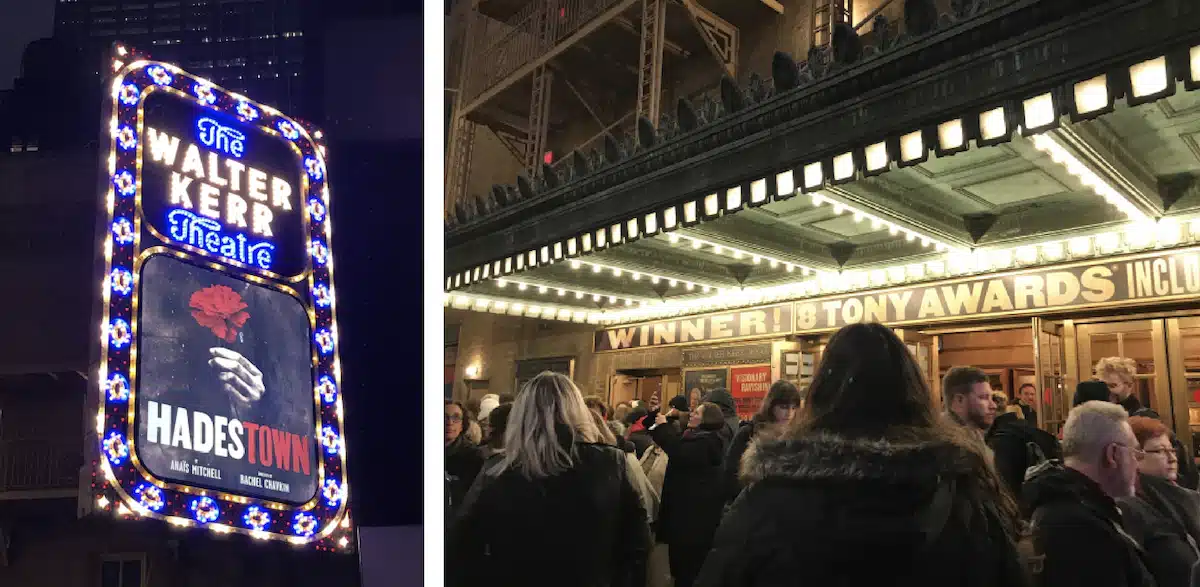
I see that on January 5, I flew to Utah to see my sons, and flew home on January 11. A few days later, Annie and I went to New York City, where I was a judge for the National Magazine Awards. Before returning home, we saw the glorious musical Hadestown, written by Anaïs Mitchell, the Vermont songwriter and performer who had brought her creation from obscure Green Mountain stages to Broadway.
On February 11, we joined neighbors who crowded into a small room in Town Hall to plead with officials to help with flooding on our street caused by ill-designed storm drains. That weekend, the calendar reminds me, Annie joined an animal tracking workshop.
On March 5, I flew to Colorado to again see my sons, returning home on March 12. And then the words, the plans written confidently in ink, they just stopped.
We retreated from offices, from outings. The future became this strange place that we did not know or understand. Nothing was as it was. We started living life at low throttle.
But my colleagues figured out how to keep making a magazine and a website and even a television show. A virus invaded every village, town, and city in the country, and still medical workers possessed the will to help many survive even as they lost more patients than they had ever before. As I write this, my mother-in-law is scheduled for a vaccine in a few days, a vaccine that was created faster than any in history. Distribution is proving harder than anyone knew, yet today I read that football stadiums and baseball fields will soon be staging arenas for thousands.
So, like most of us, I am holding my breath, watching birds survive cold and snow and ice by figuring out a way to get along. And I am waiting for the voice of calm and reason to bring us out of the dive, to say, “OK folks, I know it was a scare. Be careful, but you can now move around the cabin.”
December 16, 2020: A Village of Lights
The first significant snowstorm of winter (I know the solstice is on December 21, but when I light the woodstove by 7 a.m. and darkness settles by 4:30, that to me is winter) fell on the first weekend of December. We had eight inches here in Peterborough and double that in the northern mountains. Saturday night, the lights in the house flickered a few times, nothing more — but when I awoke and checked the news, I learned that thousands had lost power, not only in New Hampshire but throughout the region. The snow was wet and heavy, tinged with ice that clung to branches and broke limbs off trees. We have a crabapple tree in the front yard, and slender ribbons of ice built up on the twigs.
It is the irony of snow mixed with ice that it has the capacity to create exquisite beauty as well as damage. I have never seen more unforgettable landscapes — like visions from another planet — than during the ice storms of 1998 and 2008. We lost power for days; some people, even weeks. Roads were impassable, with trees that bent and then broke beneath the weight. Yet we all surveyed the wreckage with cameras, to capture the sun glinting off the trees wearing that beautiful and sometimes deadly blanket of ice.
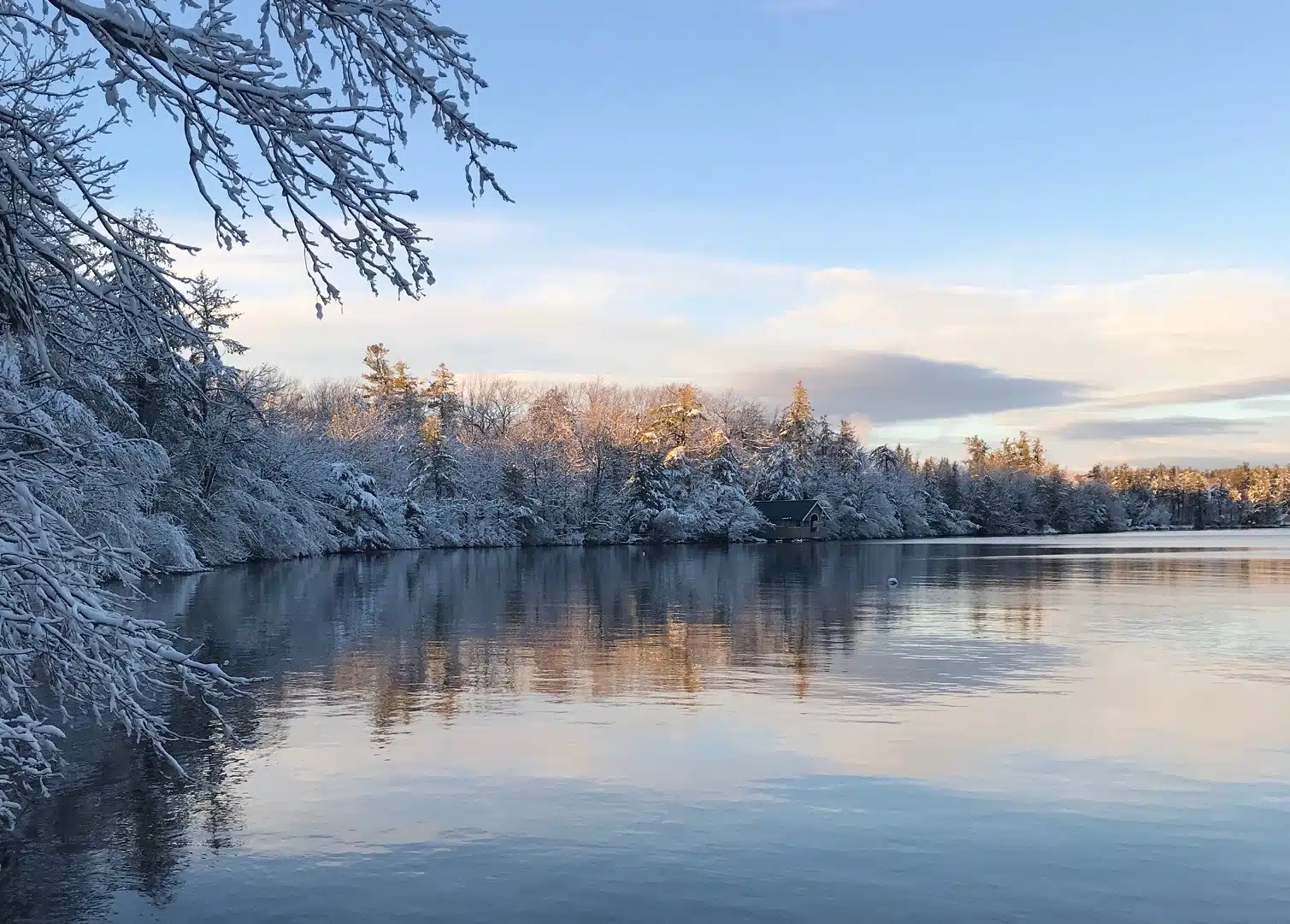
Sunday morning I shoveled the driveway, and the wet snow made it feel much deeper than it was. Every shovelful I carried from sidewalk to the wall by the garage, where I sent it thudding to the yard below, seemed heavier than the last. In the afternoon we drove to Dublin and walked Rudy around the lake where we had enjoyed so many swims last summer. The trees along the shore shimmered in the sun, and the lake was calm. In summer, cars often lined both sides of the road, but now we were alone and it was quiet, broken only by Rudy’s barking to alert us that workers had arrived in a utility truck and were eyeing bent trees branches near some power lines. In the subdued winter light, it was like seeing a different lake.
Credit: Annie Graves
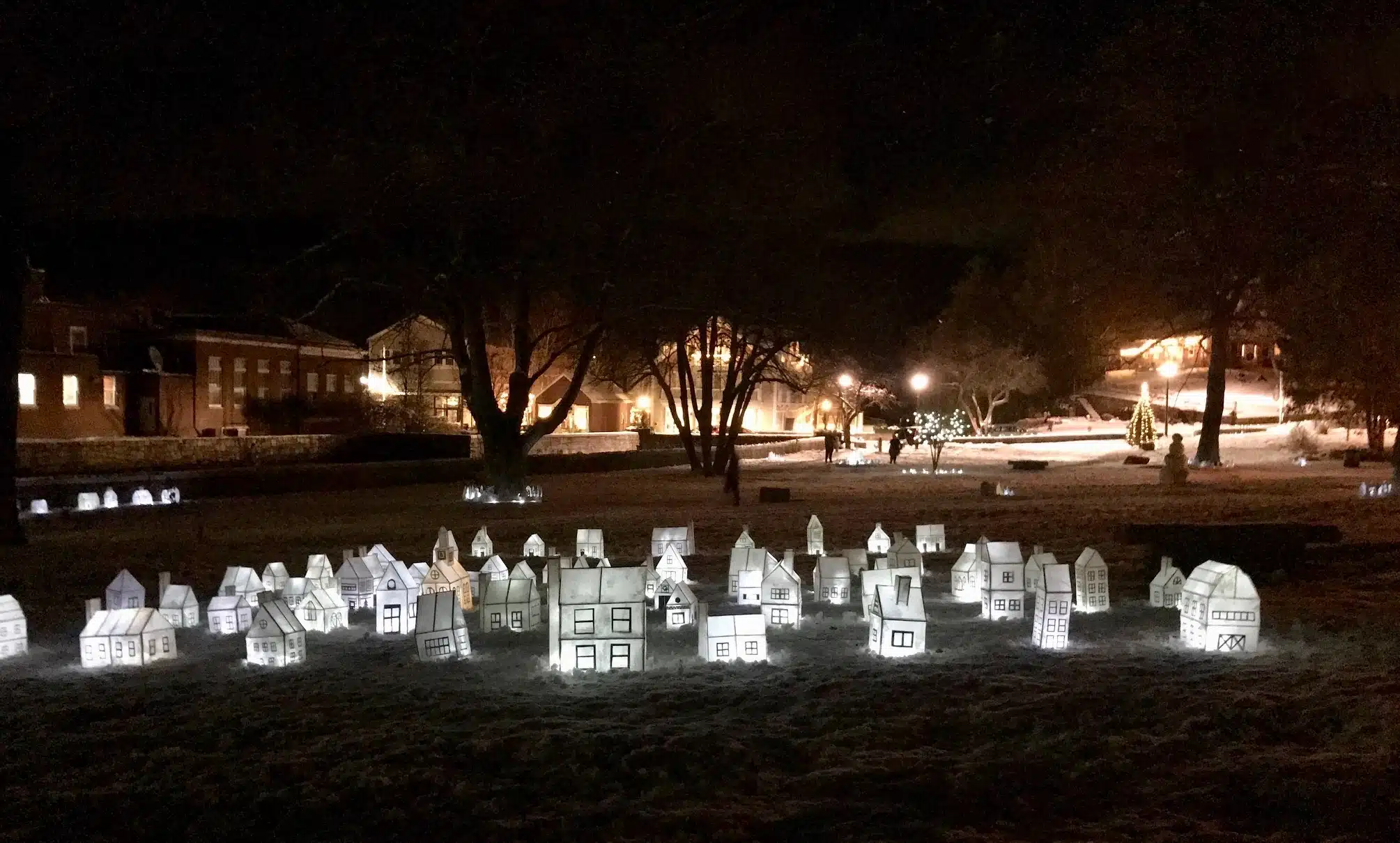
Around 7 that night we drove to Putnam Park in the center of Peterborough. I had read in the local paper that a special Christmas display had been built there, but I did not expect what we came upon: a magical wonderland with multitudes of lanterns and luminarias and twinkling lights, and what looked like a lighted New England village for tiny woodland creatures. Trees and bushes in the park were draped with lighted stars, and everywhere you looked there were miniature buildings — houses, church, town hall — each shining against the dark. Even the hill on the far edge of the park was lit with tiny stars, and if you’ve ever been in a valley town and looked at the distant glow of mountain houses, that is what it was it looked like, in this scaled-down world.
Credit: Annie Graves

Credit: Annie Graves
As we got ready to leave, I saw Terry Reeves with a few other women standing, masked and distanced, by the stone wall along the street (and even here there was light: dozens of mason jars, each holding a candle, lining the wall). This display was their inspiration and creation, and now the three-night show was ending in a few minutes and the lanterns and stars and all those little houses would go dark and be packed up. Terry is one of those people who arrive in a small town from away — in her case, the deep South — and over time become so ingrained in town events and institutions, from museums to public gardens to art fairs, that it is hard to imagine a time when she was not here. And if she ever left, it would at first be as if the river had dried up.
I called Terry later to find out how this lighted display had come to be. As we talked, I learned a story about the best of us in these last days of 2020, when so often we have felt caught in a fog that won’t clear. It goes like this:
Terry was one of the organizers of a Christmas lantern walk that for the past two years had brought people together to stroll through town carrying lanterns. A new tradition was beginning. But soon after last year’s stroll, we started hearing news about a mysterious illness too distant to be much concerned about, and then within a few weeks all that changed. This year, there could be no third lantern stroll.
“I said, ‘OK, what can we do?’” Terry told me. “People were in serious need of magic and light and joy.”

Credit: Annie Graves
The plan would be to turn the park into an art installation, spread the audience out over three nights, and for a little while bring a sense of normalcy to us all. Terry knows a lot of people, and many are artists and folks who like working with their hands and, just as important, making things happen. She wrote to them, saying, “I know you will love doing this.” A team of about 15 people signed on; the first meeting happened in late September. Terry and her husband, David, turned their two-car garage into a maker space, where four people at a time could stake out a corner and help build a lantern village. “David and I couldn’t use our garage for months,” she said. “But people love making light.”
The garage filled with scrap wood, coffee filters, glue, papier-mâché, corrugated plastic, and cardboard, and day by day the lantern village emerged: cottages with doors and windows and even tiny pets inside. In their own quiet, head-down way, this group of people was saying, Here is what we can still do. We can make beauty in the midst of darkness, we can make everyone feel a little less alone, we can make a village of lights grow in a little park, a Christmas miracle if ever there was one.
November 18, 2020: Holding On
More than two weeks have passed since we waited in the chill to vote, standing in a line whose calm and quiet was all the more noticeable after warnings about the disruption that might happen everywhere. We did not know how deep the disruption would be after the votes were counted, and how it would still be stirring all these days later, one of those storm systems that refuses to blow out to sea.
And in just this blink of time we have seen virus numbers that a few months ago would have seemed inconceivable — even here in New Hampshire, a place that until now has suffered less than almost anywhere else in the country. Thanksgiving awaits, and health officials are warning of how easily the virus will spread when friends and family get together, and wine and conversation flow. My colleagues do not know how long their children’s schools will continue having in-person classes, and unlike when schools closed last spring, the cold will make things tougher on everyone. Some days, it all seems more than we can handle.
We found a glimmer of hope this week in news of vaccines; experts say there is light ahead, if only we can endure a few more months, perhaps a bit longer. The child that lives in all of us wants to hear “We promise,” but that is not how cautious experts talk. Every morning, I wake up and hold my breath as I scroll through the news, aware that everything we once knew as normal can change in an overnight tweet, and that our task is to hang on and wait.
With all this going on, a lone red apple clinging to its branch stopped me during our walk a few days ago. The tree stood on a slight knoll in Boccelli Garden, a tidy patch of town green that shoulders a stone wall on Grove Street in Peterborough, across the street from the post office, and a bigger park overlooking the Nubanusit River. Rudy often holds a tennis ball in his mouth during our walks, and sometimes Annie and I stop by the garden, wrestle the ball free, and toss it for him to chase as it bounces along the grass. Last month, the tree in the garden was filled with apples, and as the days passed they fell in a pile at the base of the trunk. One day Annie gathered one, and when she bit into it, she smiled. It was juicy and firm, and we said we would bring a bag the next day. But we never did, and later I saw the apples had been swept into a pile by the wall. Now the tree was November bare … except for one apple that held on and caught my eye against the blue sky.
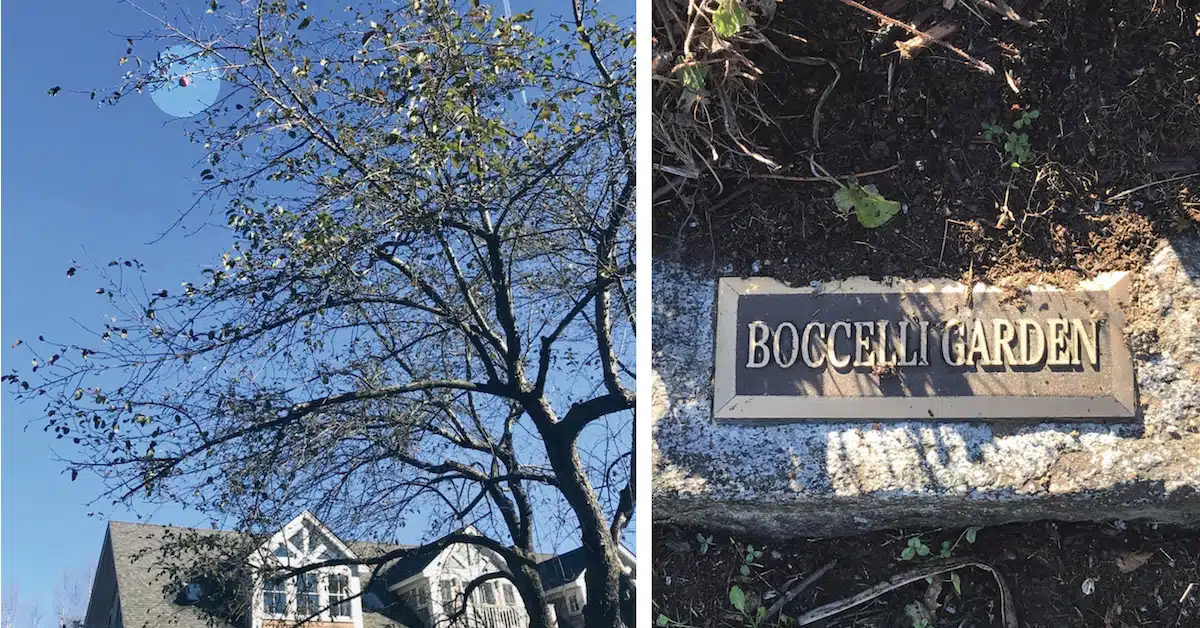
Credit: Annie Graves
I said something about the apple symbolizing something — I wasn’t sure what exactly, tenacity perhaps — or maybe it was nothing more than an unknowable quirk of nature. When we walked home, Annie stopped by a house a few doors down from us. A woman stood outside, and Annie asked her what kind of apple tree her grandfather had planted years before — meaning the same tree that had caught my eye. “Macintosh,” she said.
Annie has lived in Rome and San Francisco and Washington, D.C., but she returned to where she grew up, and again I realized that where I see buildings and shops and streets, she sees stories. I knew the name of the tiny park was Boccelli Garden because of a plaque placed in a corner, but Annie knew about the family, and that our neighbor’s grandfather Michael had come long ago from Italy and had been a cobbler. Furthermore, his cobbler shop had been in a little building on School Street that Annie’s parents had bought when she was a child, and she remembers the cobbler’s bench that sat in the back room. Her parents had spruced up the building and shingled it, and people say it looks as if it had been dropped into downtown from the Cape. A women’s clothing store called Alice Blue is in there now, and the little building has been in Annie’s family for 60 years. She tells me about the long list of small businesses that have passed through, a small-town genealogy that only those with roots here will know.
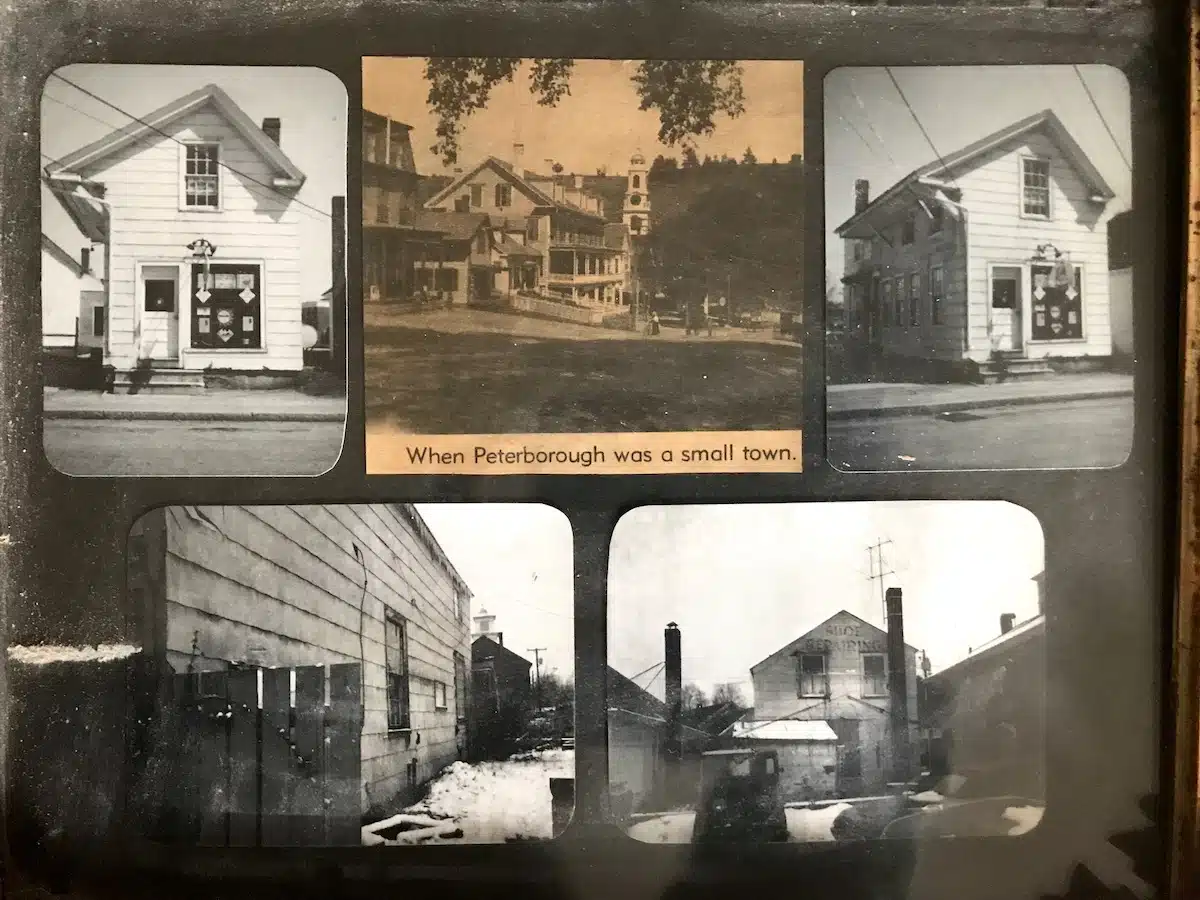
Credit: Annie Graves
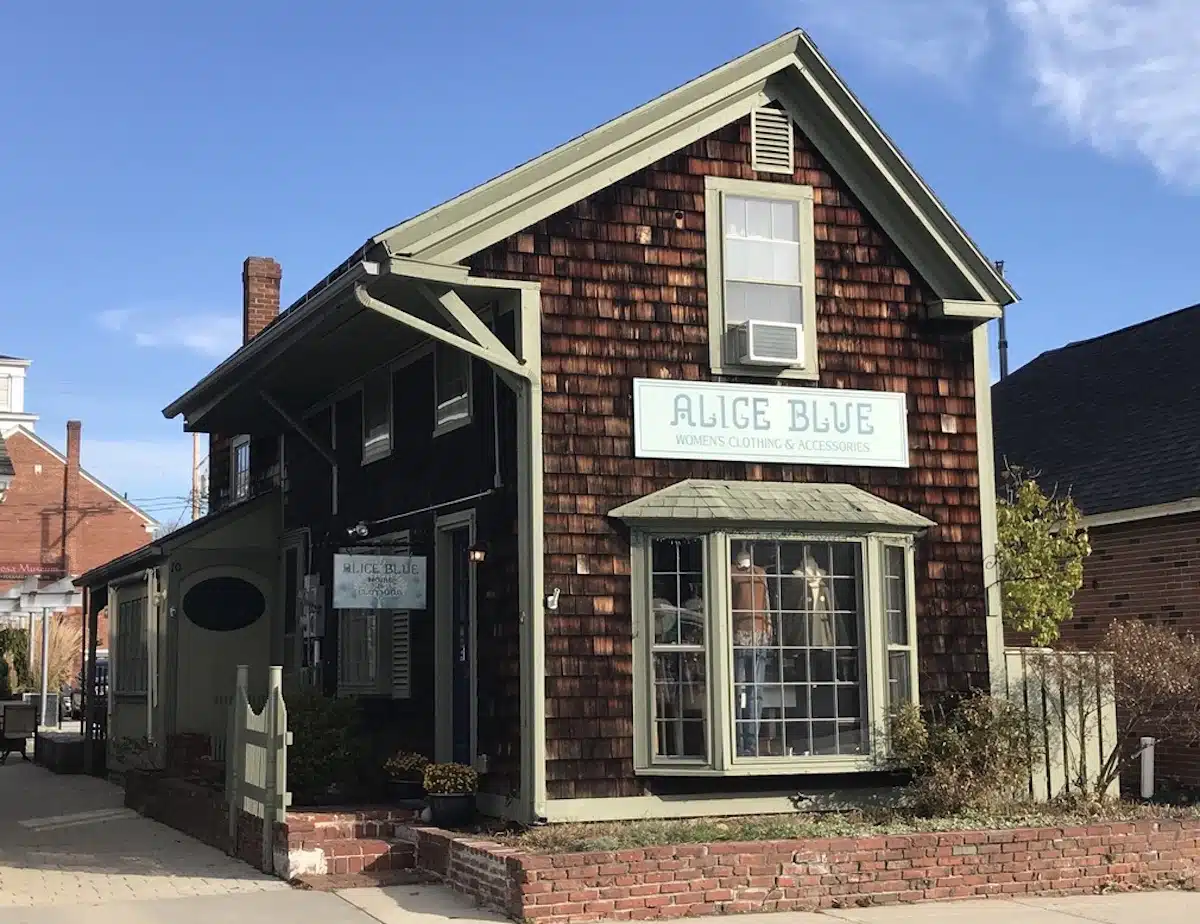
Credit: Annie Graves
Most days, we cross the makeshift pedestrian bridge into town as deep construction whirs beneath us and bulldozers dig craters and tons of steel are laid in place for a new bridge, and people, mostly older, stand transfixed at the railing, staring at the commotion. One man with a white beard is there nearly every day, and I wonder who he is and Annie tells me, and that his son was a policeman in a nearby town. She tells me stories about working in the old hardware store that is no longer in business, and about hearing about the trains that once rumbled through town (they stopped just two years before she was born).
The wood man brought another truckload to our house on Saturday, and he always carries the local news too. He said that a house in a nearby village went on the market for $290,00 and “it sold in two days,” his voice incredulous. “And they paid $310,000. And I’m telling you, it’s a dump.” He said the people who bought it live on Boston’s South Shore. We hear this all the time now, about the migration to towns like this, not only in New Hampshire, but in Maine and Vermont, people looking for a simpler life, not unlike what happened in the ’60s and ’70s, when back-to-the-landers put down roots.
Though I have lived here more than 40 years, the stories I know are mostly what I have heard, like a relative once removed. But now I know a new one, since I stopped to wonder about an apple that refused to fall. I like to think that in the spring, I’ll be sitting on the bench in Boccelli Garden — which will be lovely, thanks to the volunteers who care for it — and people who are new to town will stop by. The apple tree will be in bloom. I will tell them about a young man who came from Italy when he was 28, worked as a gardener for local families, and in time sent for his wife. They not only raised a family but also boarded many Italian laborers in the enormous 19th-century house that once stood where we are now.
He was the town cobbler, I will say. His shop was two blocks away. He planted this apple tree long ago. “Macintosh,” I will say, and they are still good to eat.
October 28, 2020: The Calm Before the Storm
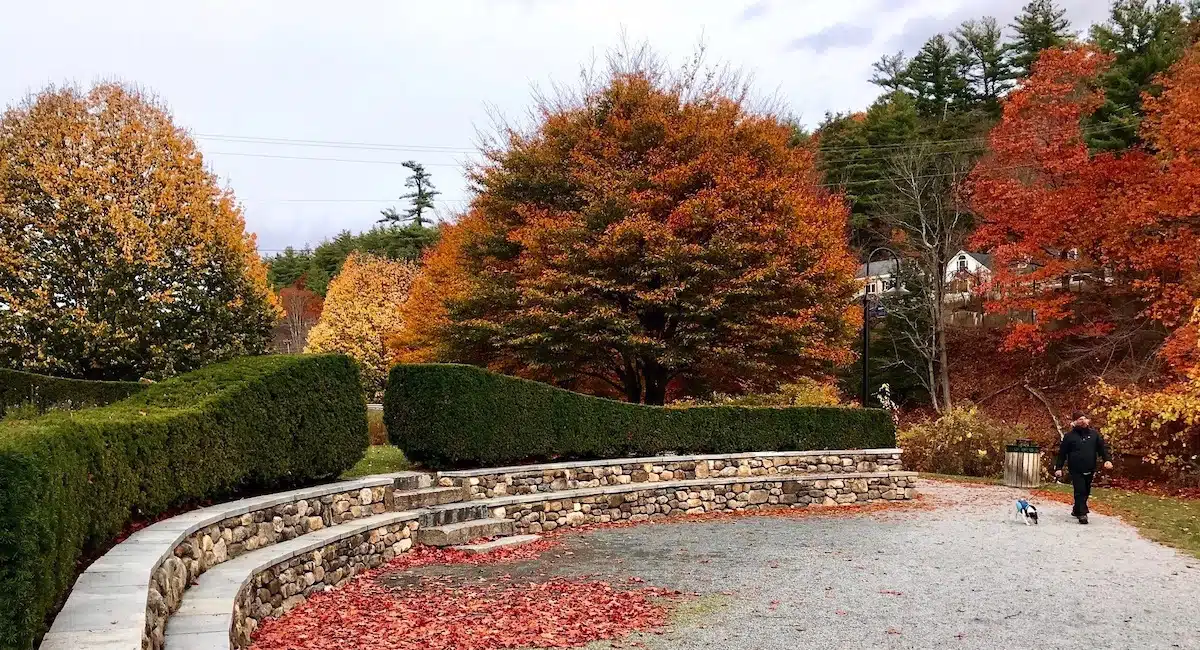
I hope that when I look back on these final October days, I will remember the leaves that held on to the oldest maple in town, which stands in front of the bank, and the carpet of red that covered the grass beneath its branches. I want to remember the black walnuts that drop with a thud in our backyard (when I rake, I am always waiting for the startling flick of pain when a falling walnut finds me en route). That walnut tree is bare now, its fruit and leaves strewn across the ground near the woodpile. The walnuts are green and look like limes; their scent is akin to citrus, and when we scoop them by the dozens to take to the composting heap at the recycling center, our hands are fragrant with walnut. The small stone wall that separates our backyard from the church parking lot next door is littered with broken shells, the aftermath of red squirrel picnics, as if the animals had been shelling peanuts at a ballgame. Every day we sweep the wall, cleaning up after our guests. The squirrels seem to take it as an invitation to return.
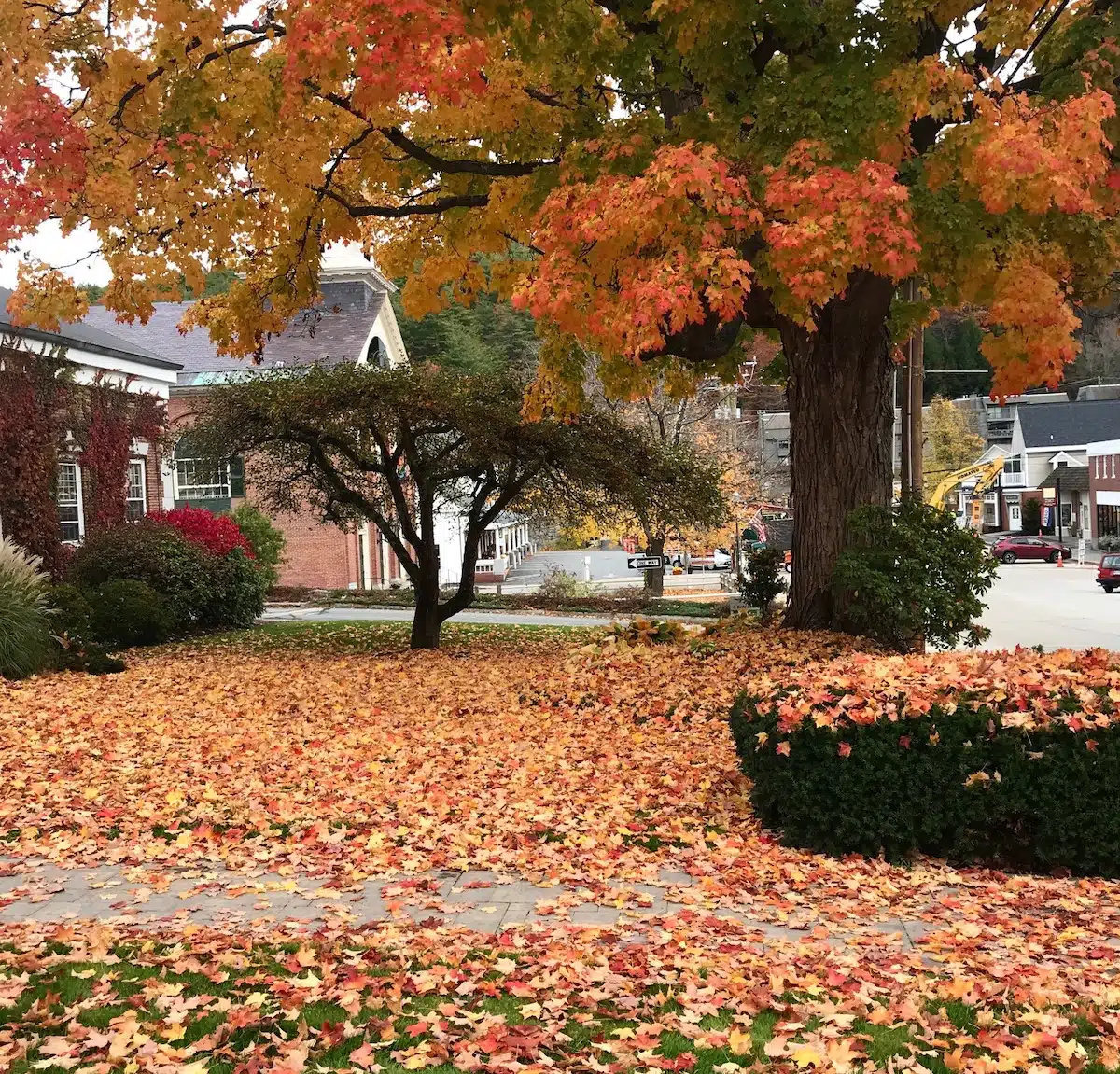
Credit: Annie Graves
I want to remember the annual task of raking leaves into tall piles, then gathering armfuls into tall brown bags that we toss, along with the walnuts, into the compost mountain; by late spring those leaves and nuts will be black soil to feed new plantings. For me, raking is a quiet exercise — a few steps forward, a few back. I think about things when I rake. Each time I scrape the tines across the grass, I drag dozens of acorns along with the leaves. For the chipmunks that dart across the yard and tease Rudy with their chittering, the yard provides takeout service. Some mornings I enter the woodshed to find a feast of acorns tucked between pieces of wood, hidden in corners, filling their pantry against the coming cold. The oak that grew the acorns still has a third of its leaves. We have filled at least 20 of those brown bags, and more await. Some years ago for a Yankee story we asked a forester to estimate how many leaves an oak held. He said 100,000, maybe more. I figure I still have about 30,000 to rake and gather while Annie puts the gardens to bed, giving the phlox their winter buzz cut.
I want to remember the crimson burst of the Japanese maples we see on our walks through town and up the hill where the pretty houses line the quiet street. The town has its own Facebook page, and Annie says people have been posting their Japanese maples, a message of brightness sent to neighbors to ward off the coming days of lessening light.
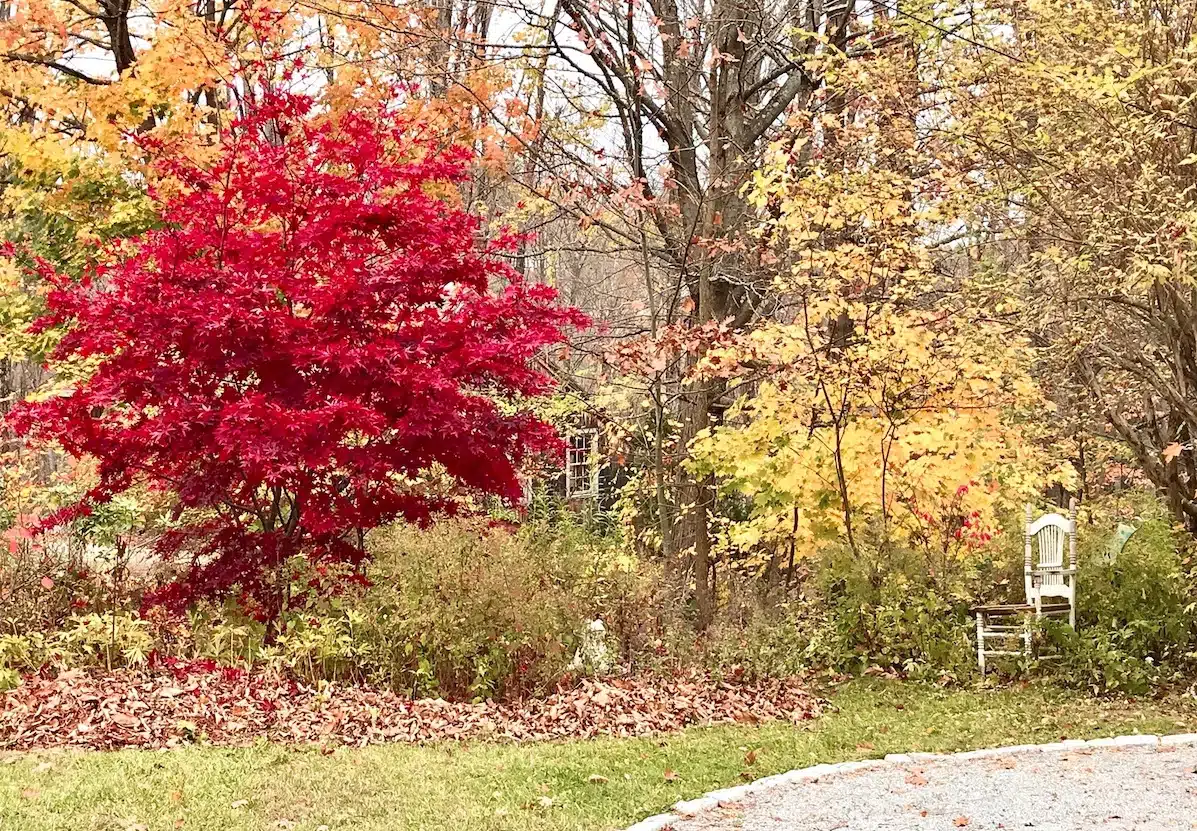
Credit: Annie Graves
There are many things I hope to remember from these last days before November, before we turn back the clocks, before the too-early dark, as if we don’t already have enough on us. In less than a week there will be an election, and I cannot remember any in my lifetime — and I doubt in the lifetime of anyone today — that our nation has anticipated with more anxiety, even dread. We are all jittery, living on edge, not knowing what awaits. We fear a brewing storm, one we may not be able to board our windows against. I read the other day that dentists are seeing an epidemic of cracked teeth. So many of us grinding our teeth in fitful sleep, waiting for something, anything, to give us hope that we will find our way to a semblance of normal.
Credit: Annie Graves
The agitation felt across the country seems distant, and yet also near. Voting in this town until now has always felt communal, and I wonder if the national mood will infect us too. In Peterborough we vote in the former armory, now the town community center. On either side of the walkway will be people, many of whom we know, holding signs. We nod, say hello, enter. We follow an arrow that leads you to a row of tables, and we stand in line according to the alphabet. I have never waited more than 10 minutes. Often I will know the person who looks at my driver’s license, checks my name on the roll, then hands me a ballot and pen. I go to a narrow voting booth, fill in spaces beside the names of those I hope will lead us, then walk a few steps to where Phil Runyon watches me deliver the ballot into a machine that whisks it away. He is a former circuit court judge and has practiced law in town for over 45 years. He smiles and thanks each person when they insert the ballot and makes sure they pick up an “I Voted” button. Then we follow the signs out the door, past the people holding signs, past the people waiting to enter.
Each day I read about people standing in line to vote for hours, about tens of thousands of people unsure if their ballot will even be counted. It seems as if we are living one reality here in this small town, and just beyond is this roiled fragile elsewhere. And knowing that the elsewhere is so close is what makes me jittery and agitated, fearful for what may await us, and no doubt why a piece of tooth chipped off last week.
October 14, 2020: A Glimpse of Normal Life from 3,165 Feet
For seven years, I shared a view with Mark Twain. I lived in a rental apartment on the 19th-century estate of a Boston publisher whose house and meadow here looked out to the east flank of Mount Monadnock. Like many writers and artists, Twain was drawn to Dublin’s pastoral nature, and in 1906 he spent several months on this same estate. Hanging on a wall inside the main house was a photo of the great writer, dressed all in white, taking his leisure in a rocking chair on the porch, cigar in hand, looking out across the grass to the mountain beyond. The owner and his family would sometimes be gone for days at a time, and now and then I would sit alone on the porch, gazing at the exact view that Twain had once described:
From the base of the long slant of the mountain, the valley spreads away to the circling frame of hills, and beyond the frame of the billowy sweep of remote great ranges rise to view and flow, fold upon fold, wave upon wave, soft and blue and unworldly….
At night, the howling of coyotes echoed across the hills and valley, and my dog Scout would prowl restlessly from room to room. When I let him outside at night, I went too. The sky there was the darkest I have known, and when meteor showers came along, I spread blankets on the knoll by the house and my two boys and Scout and I would lie on our backs, and the only sounds were the coyotes as the bolts of light streaked through the sky.
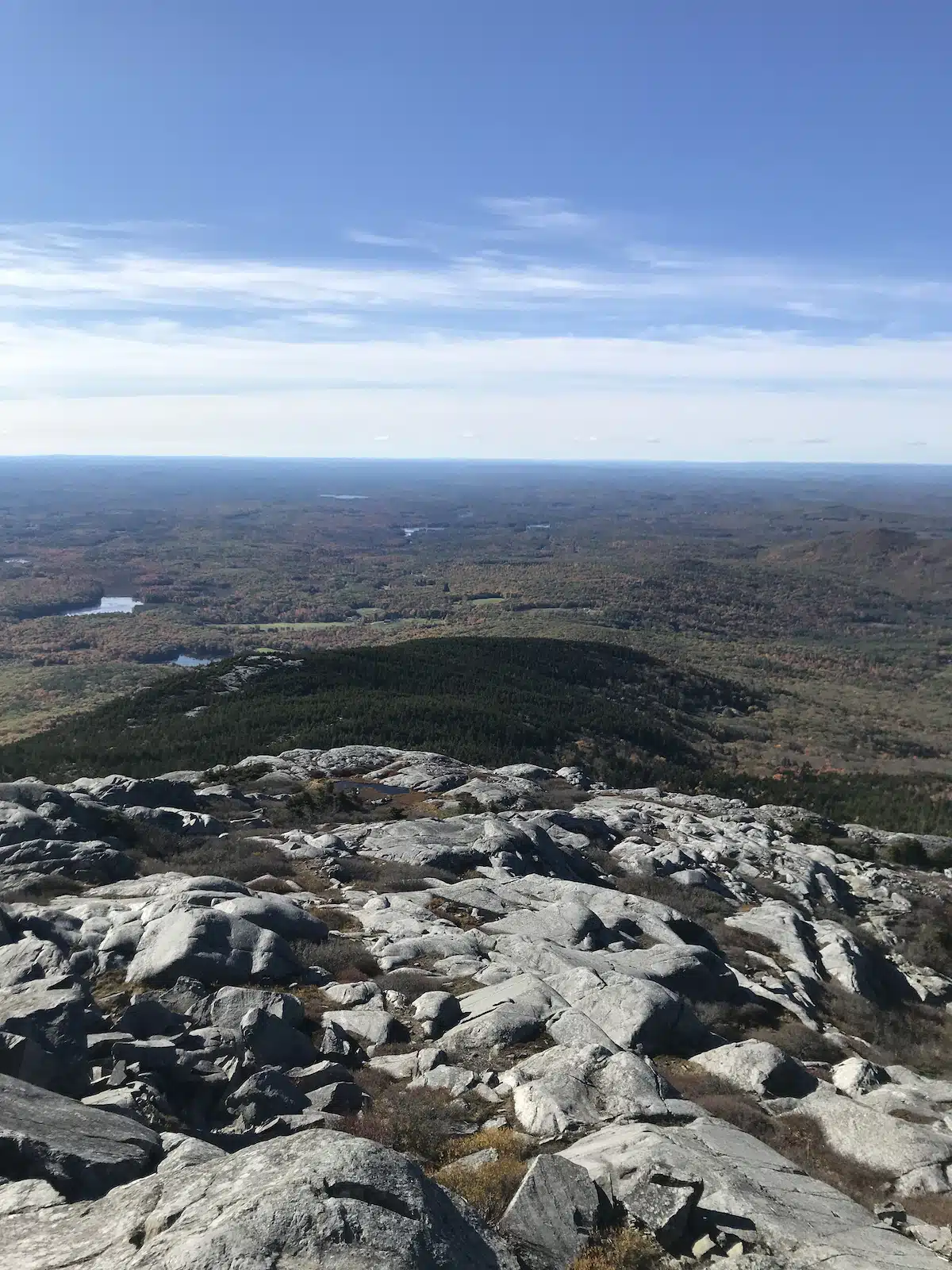
If we had lived here among the farmers long ago, the howling we heard would not have been coyotes but wolves. They preyed on the livestock of the farmers, who in the 1820s set the mountain ablaze to rout them from their dens. The wolves fled, and the mountain was left forever barren across its high slopes — bad for wolves, but good for hikers. The tree line ends quickly on the ascent, which means that within an hour’s hike, expansive views of lakes and villages and valleys accompany each step across the cairn-strewn, bouldery paths leading to the 3,165-foot summit.
Credit: Ian Aldrich
This bald peak, people say, is the only place where you can see all six New England states at one time. I have climbed the mountain alone and with friends and with my sons many times, however, and I have never had that experience. On clear days, I am certain I have seen the outline of Mount Washington, and once I might have convinced myself there was a glint of sun reflecting off the John Hancock building in Boston. Maine? Connecticut? I do not know what Rhode Island would look like, actually. The smallest state — maybe a speck of high ground hoping to be included?
Thoreau and Emerson and Whittier wrote about Monadnock long before Twain, and their words enticed droves of men and women from Boston and Hartford and New York to the villages nearby. The mountain became so famous it gave its name to the region where I now live; when asked where we are from, many of us here in the towns and villages that look out to it simply respond “the Monadnock Region,” the way I imagine someone might say “Tuscany.”
Supposedly it is the most- or second-most-climbed mountain on earth. I’ve read that five million people have climbed this modest peak. Some 125,000 hikers are said to visit annually, and in past years an estimated five percent of them arrive during the same time, the long Columbus Day weekend, to take in the peak foliage. For a day or two, those several thousand hikers strewn across the summit, taking photos and picnicking, would make Monadnock one of the most populous places in the region. But that was before Covid, and, like everything else, changes had to be made.
Credit: Ian Aldrich
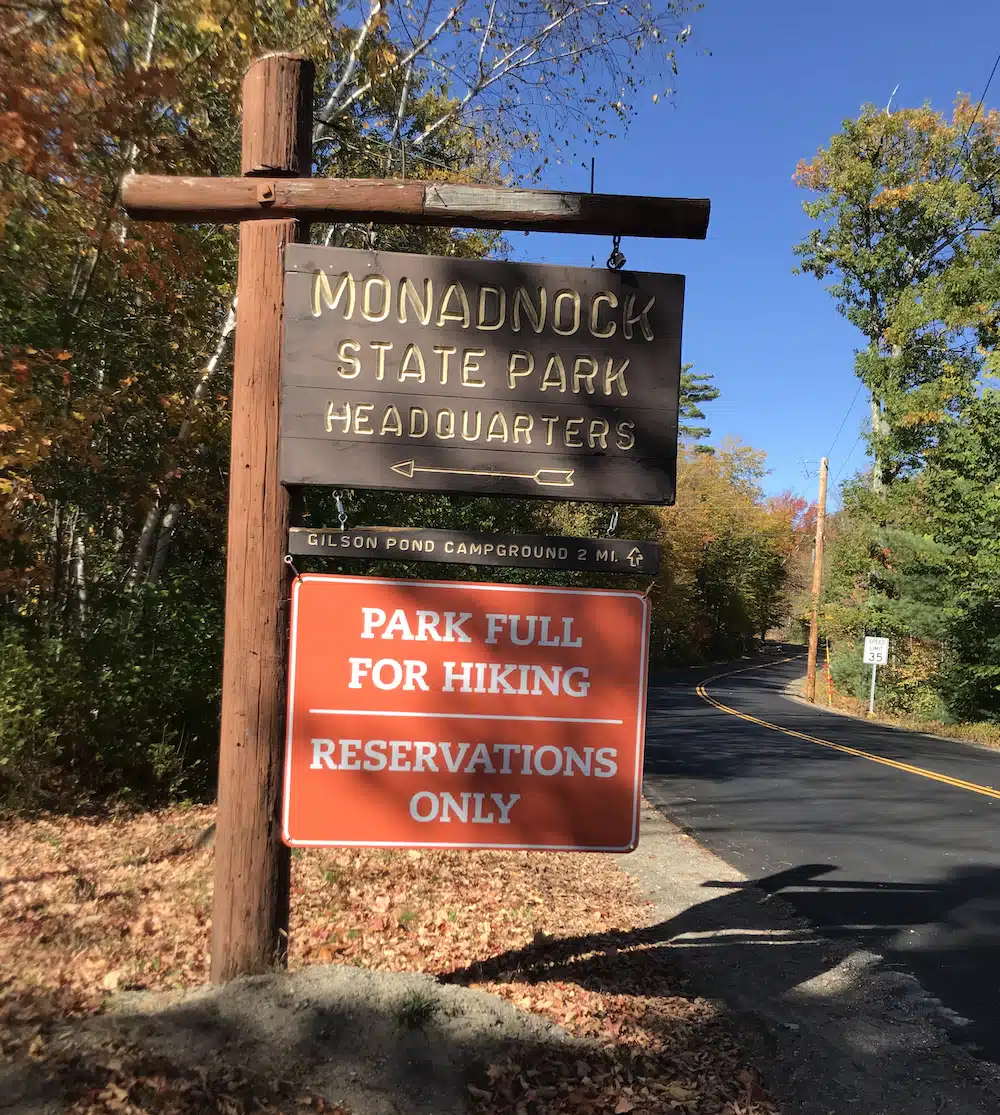
This past Columbus Day weekend did its best to let us forget, if only for a little while, how many of the simple pleasures we’ve lost. The sky was blue, clouds were light, temperatures were in the 50s and low 60s. If you wanted perfect conditions for climbing a mountain, this came close. I have been on Monadnock on previous Columbus Day weekends and seen the summit as crowded as a summer beach, but this year park rangers set a limit of 250 cars for the parking lot at the main entrance, where the most popular trails begin. And for the first time I can recall, the dozens of cars parked along the country roads near the side trails had tickets on their windshields. The rangers wanted to keep the numbers down for safety; the hikers were too eager for views and freedom to be easily deterred.
Annie and I did not add to the crowds this year. Instead, we drove the roads circling Monadnock’s craggy slopes, and now and then we’d pull over, with the shadow of the mountain looming close by, and I would look through binoculars to see how many people might be up at the top, scattered across the granite.
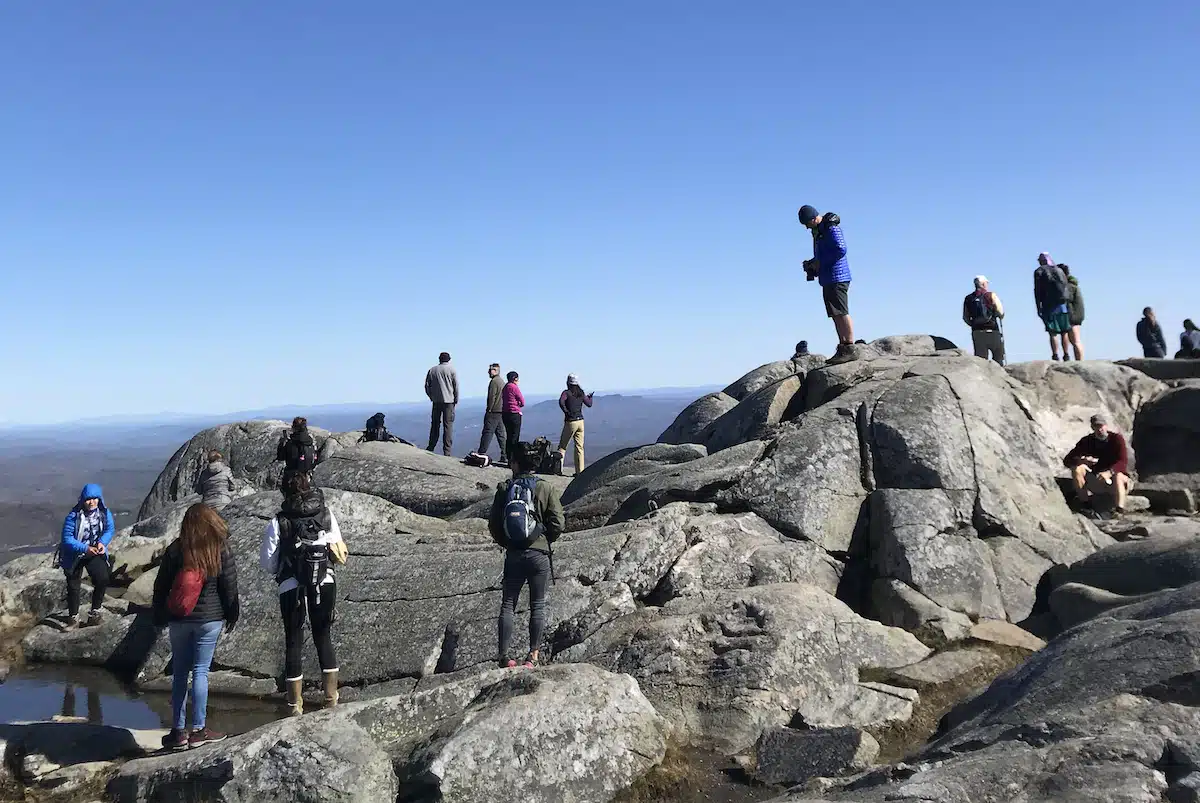
Credit: Ian Aldrich
One of my Yankee colleagues, Ian, was on the White Dot Trail by 7 a.m. Sunday. He was joined by photographer Corey Hendrickson, and together they spent hours on the summit talking with people who had reached the top. There were visitors from many places, of all ages and backgrounds, and when I looked at the photos that came back from their day, I saw what must have been hundreds of people looking out to the magnificent views I have seen many times. It doesn’t matter if you see six states or far-off peaks; there are peaceful villages, steepled churches, farms, lakes, houses. As the hikers gazed out from that mountaintop, some bundled against a fall wind, others in shorts, they must have felt life was back in sync. They must have wanted to stay there as long as possible, until the fading light made them head back down.
September 30, 2020: “This Is Fall. You Will Never Forget It.”
“The slow fire spreads from the blazing maples to the gold of the birches on our high slopes. The threat of winter is not yet upon the land, but rather a sense of awakening from the sultry bondage of summer—and the Red Gods call….” —From “October” by Ben Rice, Old Farmer’s Almanac 1945
This past Sunday, I was supposed to be in Hawaii to see my son Dan for his 35th birthday. Instead, I drove to Vermont with Annie (Rudy perched happily on her lap) in search of a gift. Dan first went west to attend college in California, then kept going, across the Pacific. Over the past decade I have gone four times to Hawaii, and plans for the fifth visit were made early last winter, before a mysterious illness on the other side of the world became our own.
Dan was born the day that Hurricane Gloria howled through southern New England, drenching us on its way north and leaving two million people without power. The windows of the hospital here in Peterborough were boarded up, and no light peeked through during my wife’s 20-plus hours of labor. (A nurse wondered if maybe the baby knew a hurricane was afoot.) I crushed ice into nuggets and drizzled honey over them to keep us going, and then in the early afternoon, Dan’s first cries signaled the storm inside the room had ended. A week or two later I put him in the tiny pack I wore around my chest and walked through the leafy neighborhoods of Keene, where we lived, and picked up maple leaves and held them against his face. This is fall, I said. You will never see it like this anywhere else. You will never forget it.
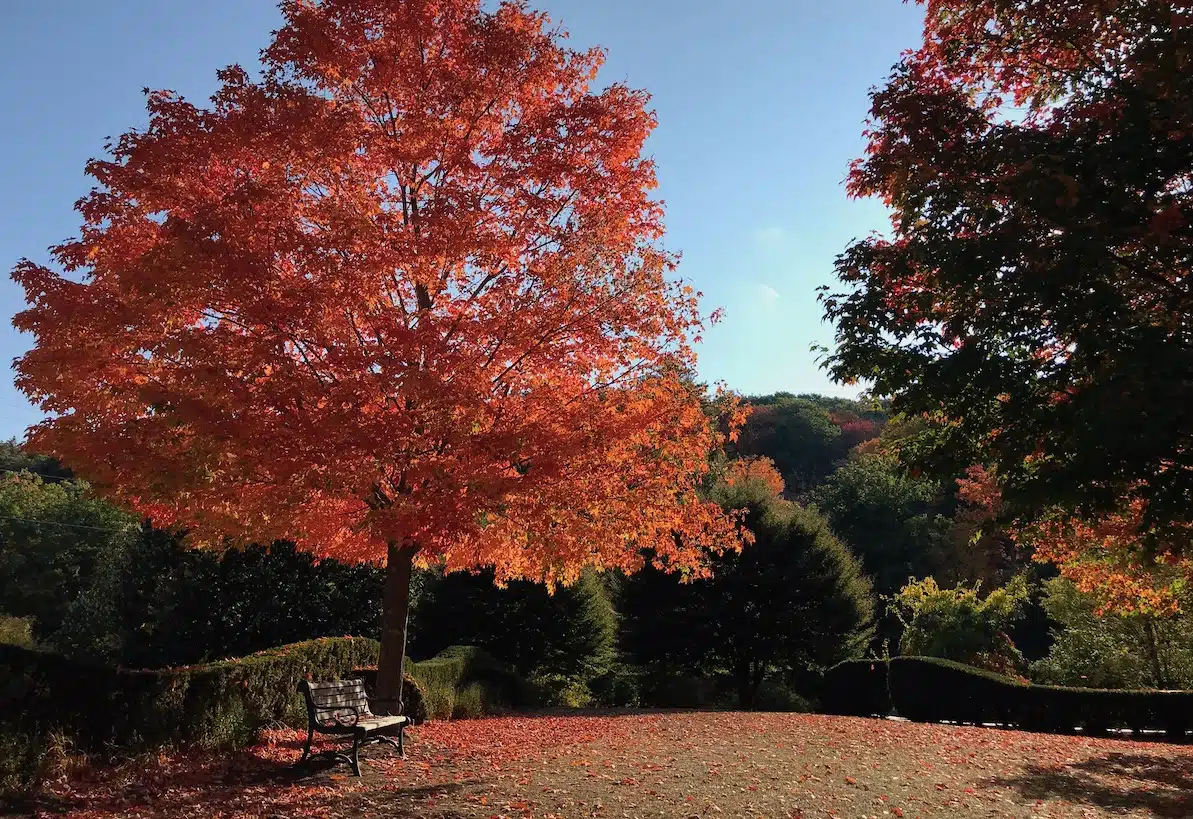
Credit: Annie Graves
The drought has caused the trees here in Peterborough to turn early by at least 10 days, and when we walked Rudy through the park on Sunday morning, they were so stunningly scarlet and yellow it was as if you could breathe the color. In fall we use active verbs to describe what I like to call New England’s own Mardi Gras. We say the foliage explodes, erupts, pops, bursts, blazes — and sometimes it is hyperbole, but not now. On this last weekend of September, the trees in town are all dressed up for the ball.
Annie asked if I was hearing how the wind blew through the leaves — the rustling, rippling of leaves shaking against branches. “It’s a time of good-byes,” she said. “All this color means they will soon fall, and you won’t hear the wind blowing through them anymore.” And it’s true. Where summer lingers and winter feels endless, brevity is the timeless paradox of autumn. We love it, then it disappears. The leaves change color seemingly overnight, then after a week or two you see a few leaves fall, then some more, and then a cascade, falling in a slow twirling dance, and the pavement and yards are soon draped in leaves, already browning at the edge, and when the wind blows through the bare branches, it simply passes through, nearly soundless. We know this is also a time of good-bye to long hours of light, and we wish it could just slow down.
Our drive took us west on 101 through Dublin, past the Yankee offices, past lake and mountain, and after a few curves we came to a pull-off by a reservoir. Outside a car with New York plates stood a woman holding a small child; from across the road her husband bounded over, camera in hand. “It’s spectacular,” he said. I told him it was early because of the dryness, and that usually it doesn’t look like this until Columbus Day weekend. He shook his head in amazement. “It’s spectacular,” he said again. A mile or so later, we pulled over again to photograph cows grazing in a field banked by a hillside of color, and after a minute the New York couple stopped here too. Annie crossed the road with her camera, and the man followed — strangers on the same mission.
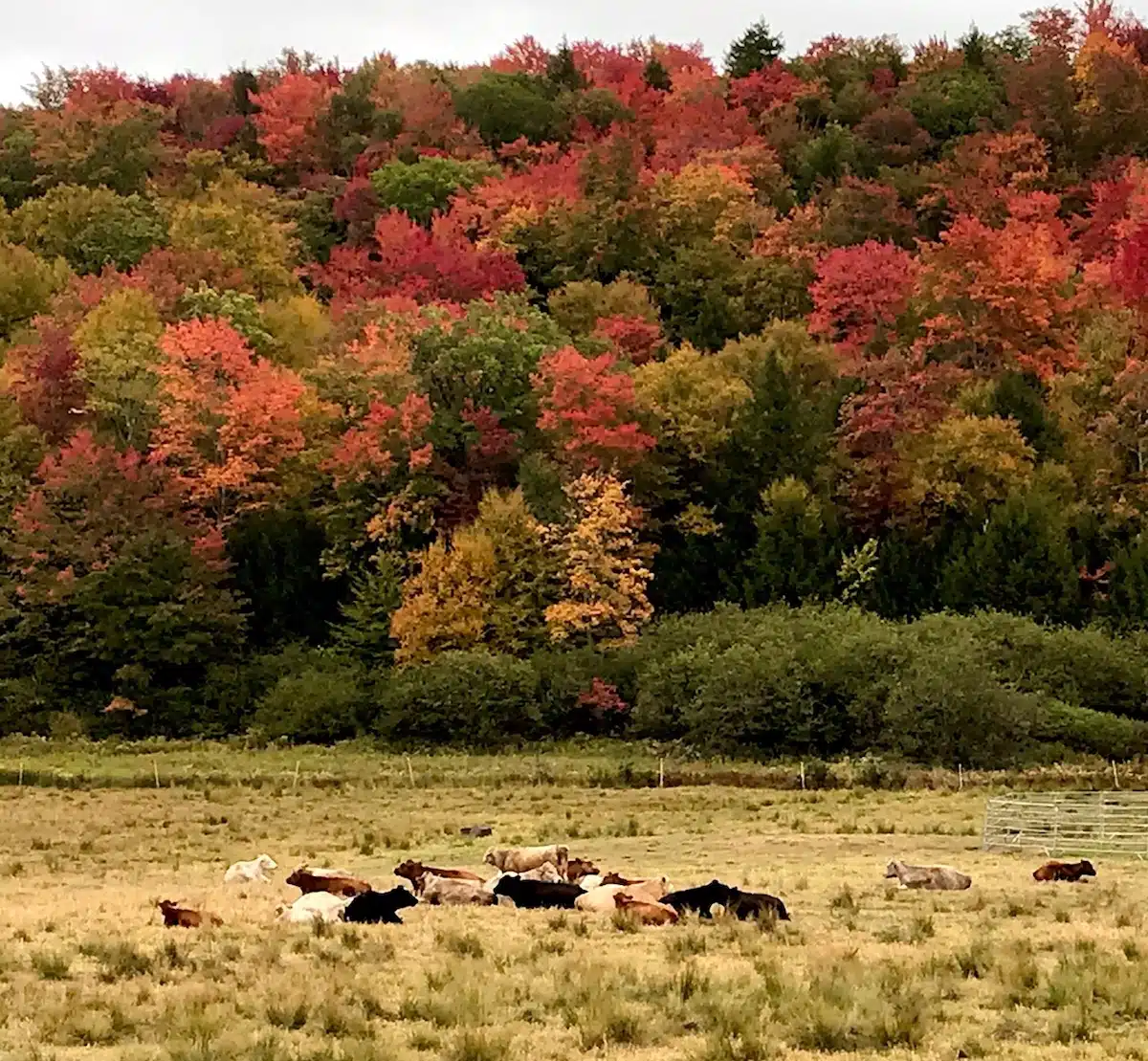
Credit: Annie Graves
But as we drove west just a few more miles to Keene, we saw the green still holding on, the trees not ready to yield to the shorter days, the colder nights. It was proof once more that there’s no one perfect time to find “peak” color. It’s not an elusive animal that you can catch only in the right place in the right time. The “right time” was only 10 minutes behind us, and would likely not be here for another week, maybe longer.
We continued on to Vermont, my first time leaving New Hampshire since March. It was still more green than not until we reached Brattleboro and turned down Black Mountain Road and then Kipling Drive on the way to the apple orchards at Scott Farm in Dummerston. The drive is only a few miles, but we could have taken an hour, just stopping to look at the pastures flowing to hillsides full of color, with just a tempering of green for contrast. The air was warm; it was that time when two seasons converge. As we reached the farm, we saw people carrying bags and walking out into the orchard to pick apples, and everything seemed almost normal, except they wore masks.
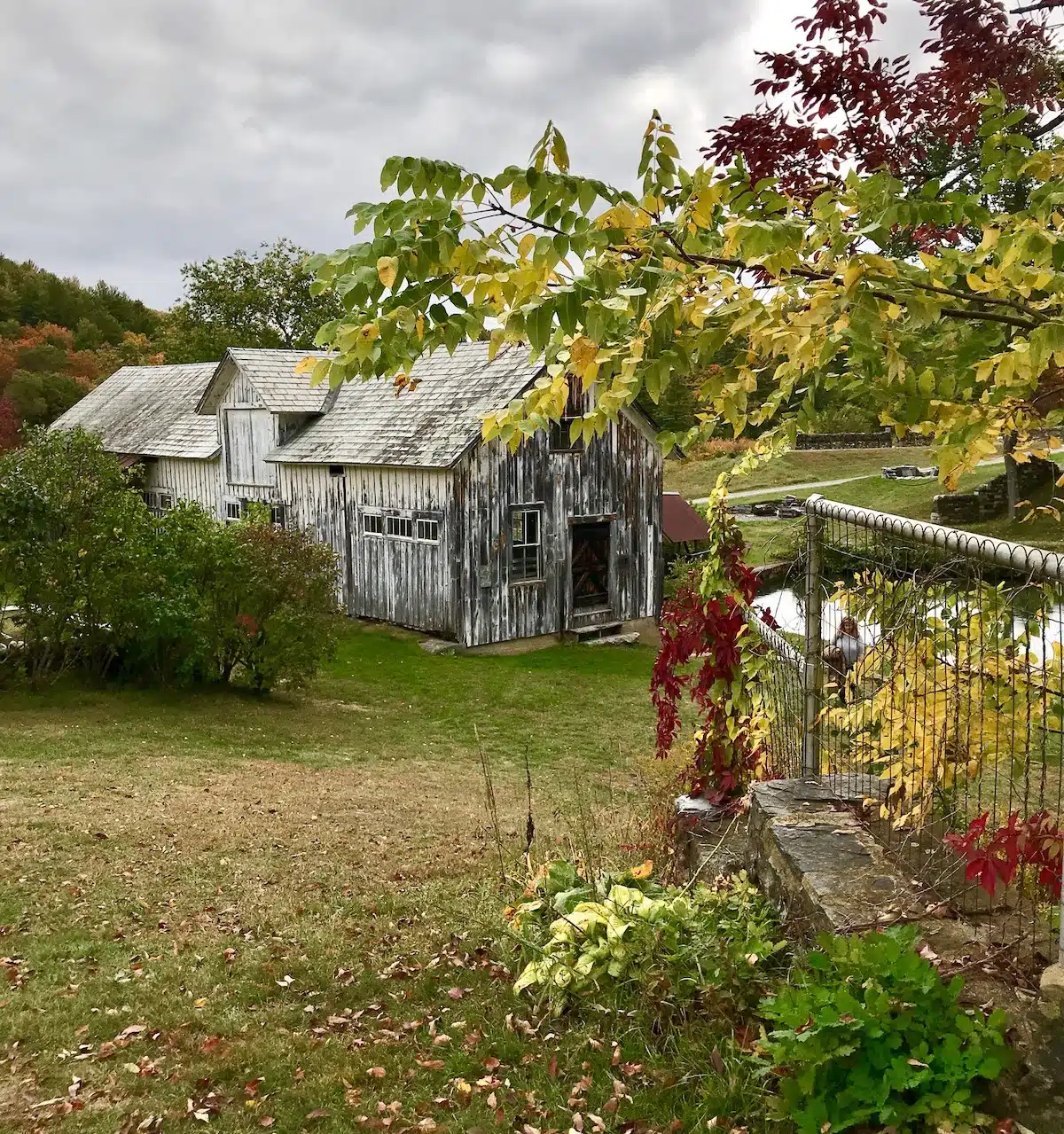
Credit: Annie Graves
We had come not to pluck from the orchard, where only a few of Scott Farm’s famous heirloom apple trees are available to the public, but from the rows of bins at the open-air stand. More than 100 varieties of heirloom apples are cultivated here, and the names on the bins seemed to belong in a secret woods, or in a Harry Potter novel: Allington Pippin, Ananas Reinette, Ashmead’s Kernel, Duchess of Oldenburg. We filled three bags, and then I bought two half gallons of apple cider, a blend of maybe a dozen or so of these apples. (A week earlier, a writer from Boston.com had interviewed me and asked what was my favorite taste of New England. I guess he expected me to say lobster roll, or fried clams, or maybe even whoopie pies. I did not hesitate: “The heirloom cider from Scott Farm,” I said.) We sat outside at a picnic table, I unscrewed the cap on the glass jar, and we drank.
We headed home then, and when we reached Peterborough we walked Rudy through the park next to Depot Square, his reward for waiting patiently in the car at the orchard, with only a few bursts of barking to scold us. I had the gifts to express-mail to Dan — a quart of maple syrup and a great hunk of Vermont cheddar — and here, at a single brilliant red maple by the river, I found one for me. It was a memory of a walk after a storm when I carried my son against my chest and showed him the leaves and said, You will never see it like this anywhere else. You will never forget it.
It goes so fast, and one day becomes 35 years. Remember to look at the leaves while they hold on.
September 9, 2020: The Boy Who Walked on the Moon
“What difference would it make, would my teaching make, in their grown-up lives?” —James Herndon, the late writer and educator, in his book The Way It Spozed to Be
I am writing this on Tuesday, the first day of school here in the Monadnock Region, and though this is also town voting day, I hear little talk about that, and much about school. To be or not to be. That question seems to have a different answer every day.
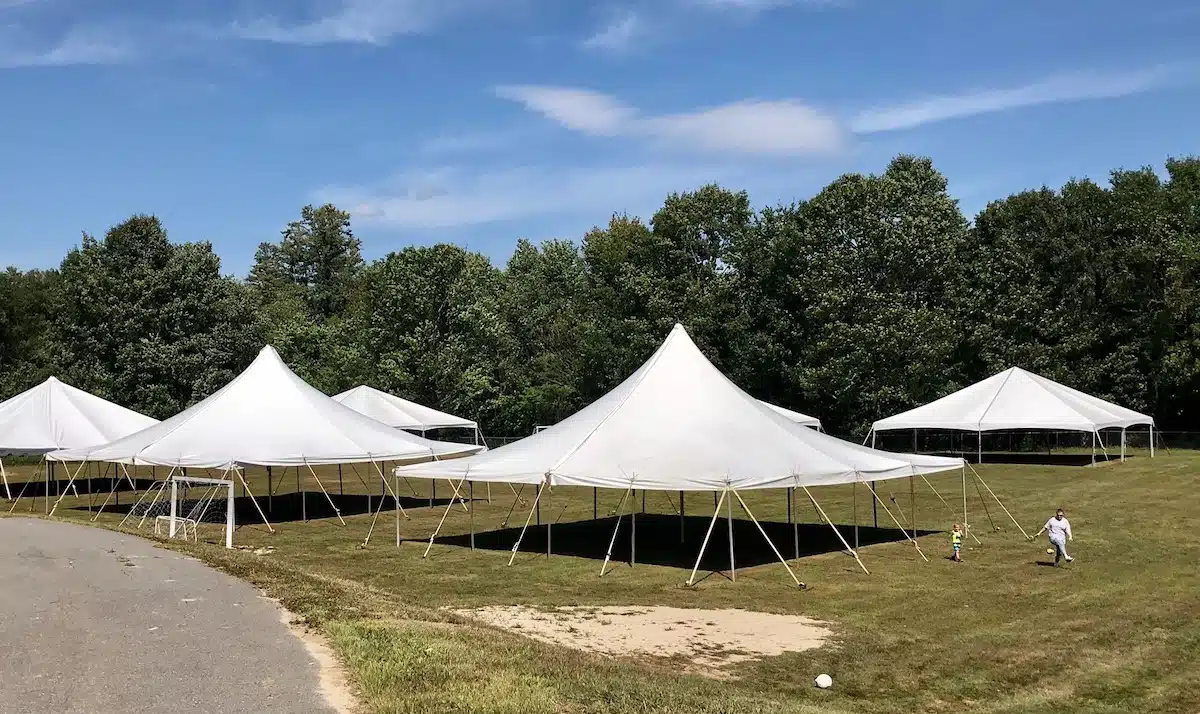
We have three public schools: a high school, a middle school, and an elementary school. Yesterday Annie and I strolled the elementary school grounds, where taut white tents sprawled across the front and back lawns and spilled onto the soccer field, as if a circus had come to roost. Up the road from our house, dozens more tents splay across the upper school playing fields, now quieted by the virus. Most of these, too, are white, with a few pink tents here and there.
Credit: Annie Graves
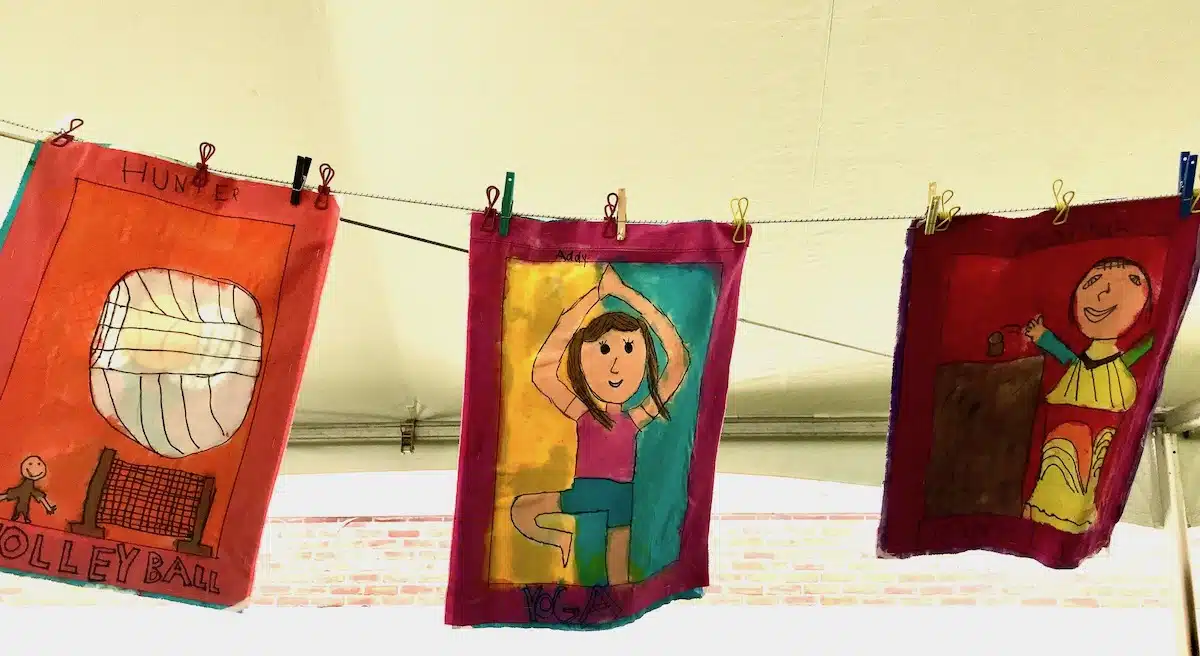
At the elementary school, teachers have decorated some tents with artwork and “Welcome Back” signs, their goodwill efforts to make this strangest of back-to-school weeks as normal as possible. We can see that our schools are opting for ingenuity and optimism, hoping for the best for as long as they can. In this new territory, everyone is a stranger with many questions and few answers. So all around us you can almost feel the collective holding of breath.
Credit: Annie Graves
Most of us likely have a handful of first school days that we remember. My own will stay with me until my last day. They were when I stood at the door of a fourth-grade classroom during the three years I taught in Gorham, Maine — nervous, curious, hopeful that maybe what happened inside for the next year would make a difference in a life.
I was 24 years old when I taught my first class, and the only experience I brought was that once I had been 10 years old. I was hired because the district wanted a man for a class that had frustrated every teacher in each successive grade. I had just returned from the Peace Corps, and the thinking seemed to be that if I could survive living in an equatorial mountain town, I could tame 27 country kids with attitudes.
I taught 80 children during those three years, and today they are all on the far side of 50. Once a year, with a mix of curiosity and nostalgia, I Google their names. Jennifer, painfully introspective as a child, owns her own marketing firm in California; Petra, who once sat beside me crying because she thought nobody liked her, has been featured in The New York Times for her home in the tower of one of Seattle’s tallest buildings; Brad, the best athlete in the class, has retired as chief executive of one of the largest grocery store chains in the Northeast; Jon, whose father built a cozy “cabin” inside the schoolroom where children could escape to draw or read, lives on a farm near the Maine coast and posts lovely photos of his produce on Instagram.
Occasionally I get the urge to see my former students one more time, because I once knew them when they were young, and I never forgot them. And maybe, I want to know if they remember too.
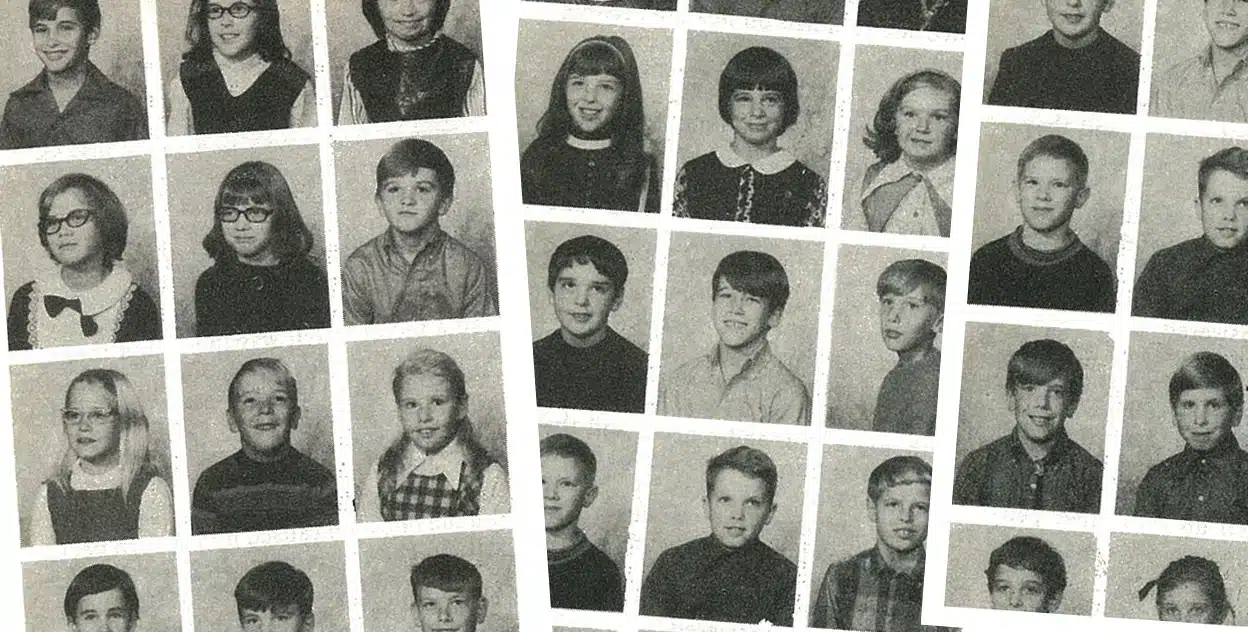
Back then, their stories sometimes kept me awake at night.
One day, several months after the year had started, there was a knock on the classroom door. A woman stood there, and beside her a boy. She said he was from a town 30 miles south and now he had come to live with a foster family. He was short, sandy-haired, unsmiling. He said his name was Faron. The class looked on in silence, aware there might now be a shift in the class dynamic.
I asked him to write his name on the blackboard. He stood still, unmoving. I thought he was shy and said I’d walk with him to the board. He did not move. He motioned for me. I leaned down and he whispered, “I don’t know how.”
This was when instruction still was done largely in groups separated by ability, especially in reading. I had the first “open classroom” in the district, and when I met with each group, the others worked on personal projects or read in the cabin. Faron and I became a group of two, and each day we sat together “reading” stories I wrote for him. They were only five to ten pages long, written with ink on white paper, stapled together, and they came with bold titles in black magic marker. Faron flew with Neil Armstrong and Buzz Aldrin on Apollo 11, and as Armstrong stepped onto the lunar surface, so, too, did Faron. He fought through frigid winds and ice-choked waterways to plant a flag at the North Pole with Admiral Robert E. Peary. He stood with Edmund Hillary on top of Everest. He set sail from Plymouth, England, aboard the Mayflower. He was a scout with Lewis and Clark. He found his way to this little Maine town where he was brave enough to tell me what he did not know.
I don’t know whether he learned to read that year or whether, as I suspected, he memorized the stories and the words flowed. Soon he was reading his stories aloud to a larger group, and a few months later the school year ended, and Faron disappeared from my life.
Not long ago, I typed his name into Google. What I found was a grave marker with his name and, beneath it, the year 2002. He had not yet reached 40. I looked deeper and discovered he had died on a street in Portland. Maybe he kept those stories for a while. Maybe not. Teachers rarely change lives, but sometimes — if they are lucky — they can change a few months here and there, when even a little boy with so much stacked against him can be a hero, when he reads aloud about the night he walked on the moon.
August 26, 2020: The Boomer’s Dilemma
Even though this summer continues to be a gift of lake swims, and Annie’s garden is erupting with tomatoes sweeter than any I have known, today I am thinking about mortality. Every day numbers fill our screens, and always the numbers increase, sometimes by thousands. I am careful, I am masked and socially distanced and well scrubbed — but I have no illusions. I read that 70 percent of those who do not survive the coronavirus are baby boomers, or older. In early March, before the severity of the crisis had sunk in, a young colleague joked that millennials had given the virus a nickname: “boomer remover.” By late March, the jokes had stopped.
So for me it is time to consider what if? My two sons live far away, and of all the legacies I could pass on to them, the one I do not want is to make them return home to paw through the sediment of my life. I am not being morbid — simply practical, with a dash of compassion. I grew up with two parents, a brother, and a sister. I alone remain. My sister left a husband and a grown son to do the sifting and storing and cutting loose, but it became my task to deal with what my mother and father and brother left behind. I had to decide what to keep, what to give away, what to drive to some obscure place that took things that no longer belonged to a home. I had to pretend to not know that some of it would likely be crushed in a dumpster. I do not want that burden to be a legacy I leave.
Spurred by those thoughts this past weekend, I ventured to a place I had been too timid to visit for so many months I could no longer recall my last time. A place I knew could disrupt my life for weeks, even months, could even haunt me a bit while I slept. A place I have avoided because I know that beyond its door lies my personal black hole.
Credit: Yankee Staff
I am talking about my storage unit. For years I have paid $105 every month for a sturdy 10-by-10-foot metal and concrete square that sits about two miles north of where I live, among hundreds of other similar units in one of those storage neighborhoods that take root on otherwise barren land. This cold, cell-like structure holds stuff that once filled the lives of my parents and my brother. After my former wife, Carole, a professional photographer for many years, died, I emptied thousands of photos from her file cabinets into boxes and brought them here too, where they all teeter rather haphazardly. When our sons, Dan and Josh, moved away and sold their mother’s house, their collections and video games and mementoes from proms and sports — all this squeezed into nooks and crannies too. And then we come to the crux of the matter, and why I knew the time had arrived for me to take action: my own stuff.
I keep things. I am not a “hoarder,” because that implies a sort of aberration. I do not hoard. I keep things that should not be discarded. Some years ago a friend told me he gave away his mother’s furniture but kept everything that told a story: a knitted wool hat, a scarf, a miniature porcelain swan boat. I understood. But what do I do when so many things here hold stories for me? Stories that likely hold little interest to anyone else?
Which is why I have not gone to see it all for so long. I know the time is long past to trim it all back, to put this storage space on an austerity program. So even though I do not know where to begin, on Saturday I found the key, and opened the lock.
Credit: Yankee Staff
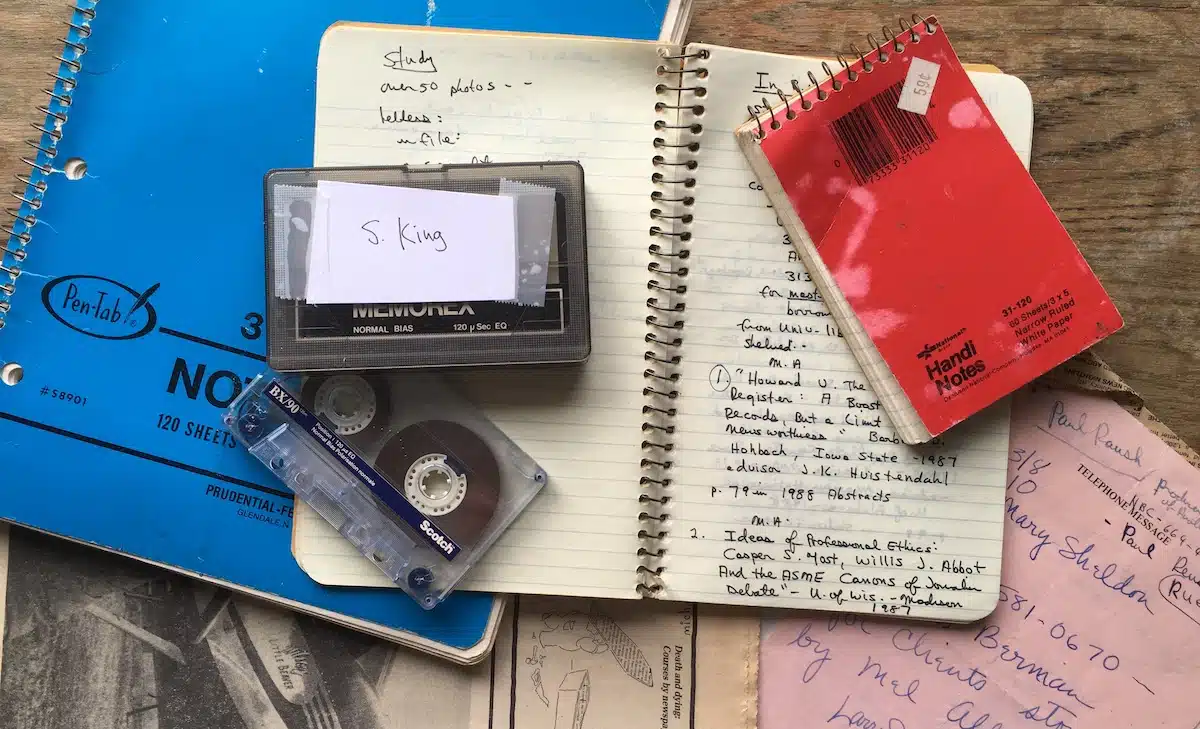
The door is heavy and seems to groan as I raise it. Inside, I stare into what to my eyes seems to be a chaotic land of boxes and crates. My first instinct is to close the door, retreat. I need a friend to take this all away, the way a friend will take your dog to the vet when it is too painful for you to make that final ride. Annie has long hinted at this solution, offering to be that friend. Her mantra is if you have not looked at any of this for months, for years, you will not miss it. You will feel lighter. You will have $105 each month that now simply goes to a closed door. And I know she is right. But I hold on. This stuff once meant something to people I cared about. I hold on to my own boxes and boxes of notebooks and newspaper clippings, and interviews of writers ripped from magazines, and more boxes of audio tapes, because they were the tools of my life’s work.
But I cannot have it both ways. I cannot leave the chaos to be sorted out by others. So I lifted one box and placed it in the trunk of my car. Then another, and another, until the trunk was full and then the backseat too. I drove them home and carried them into the sunny backyard. To prepare, I had gone to two stores and bought 10 plastic storage crates that hold manila folders, and two large clear plastic crates for mementoes: I labeled these “keepers.” I bought a box of folders and index cards and scotch tape. I set a large container for discards beside the table. I began.
Credit: Yankee Staff
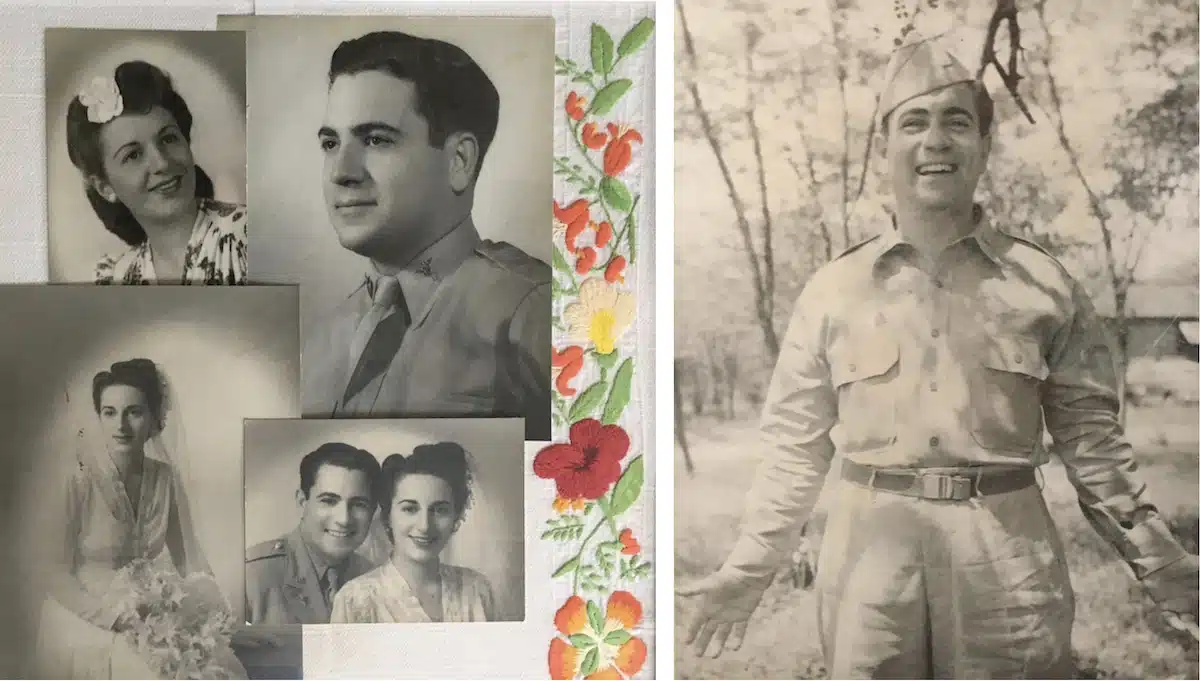
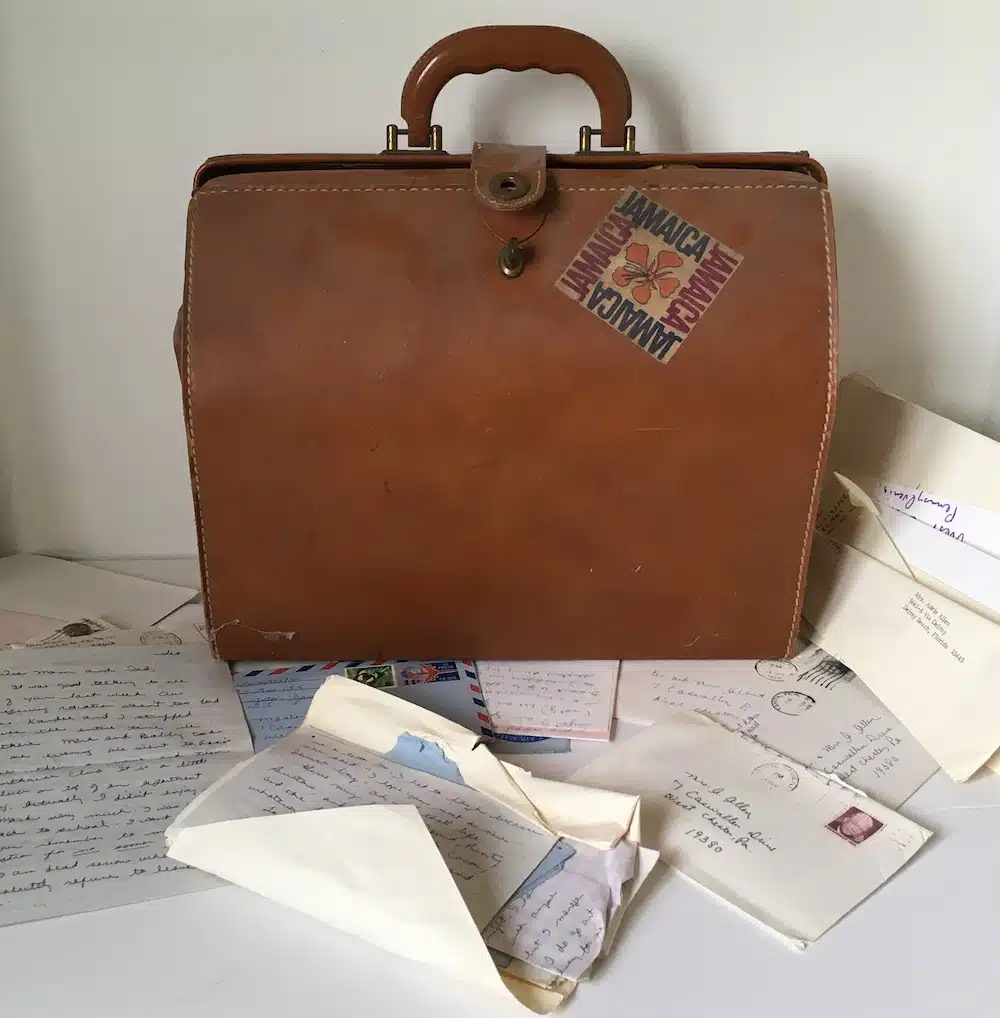
I opened a box, and inside was a framed photo of my dad in his Army uniform from World War II. He is only a few years older than my sons. Beneath it was a framed collage my mother made long ago showing them on their wedding day. My sons never knew them. I have nowhere to hang these things. I place them in a “keeper” crate. In another box I find an old dusty brown leather satchel. Inside are large manila envelopes that have not been opened for decades. One holds letters my father wrote to my mother during the war; another holds his Army papers. When I leave this earth, nobody will ever want or need to see them. I am supposed to be thinning the herd so my sons do not need to. But these, too, go into the “keeper” crate.
I have been to many flea markets where the displays include framed portraits of men and women and children, families staring into a camera from a long-past era, and I have wondered how those photos ended up being sold and bought by strangers. Will the photo of my dad, his arms flung open, one day perch on a flea market shelf, a symbol of a GI off to war?
Credit: Yankee Staff
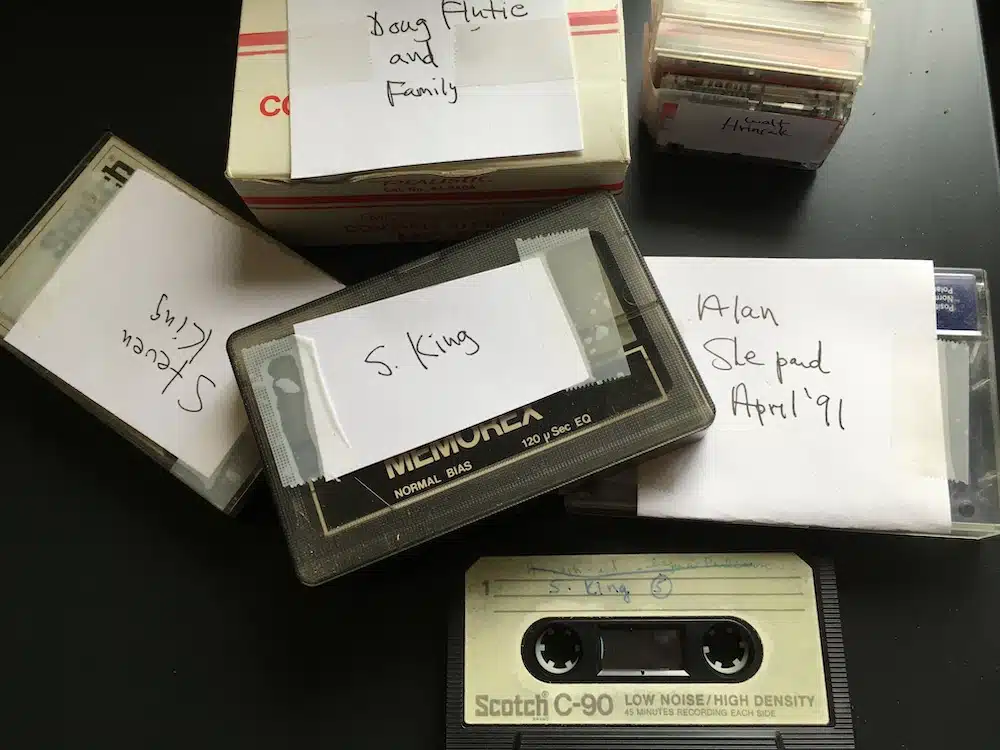
In another box I found a set of audio tapes with my handwritten scrawl: S. King. Hours of Stephen King talking to me about his early life and his first novels from 40 years ago. Another set read Alan Shepard. An hour passed, and all I had accomplished was to stack dozens of tapes into a crate, each cassette filled with the voice of someone whose story I wanted to tell, and did. In another box was the notebook I used for my first story for Yankee, a profile of Ma Dudley, the wife of a Maine potato farmer who would feed a dozen farmhands every day and who opened a small restaurant in her Aroostook County homestead after her husband died. I started reading those notes, and another 20 minutes passed. The notebook found its way into a “keeper” crate too.
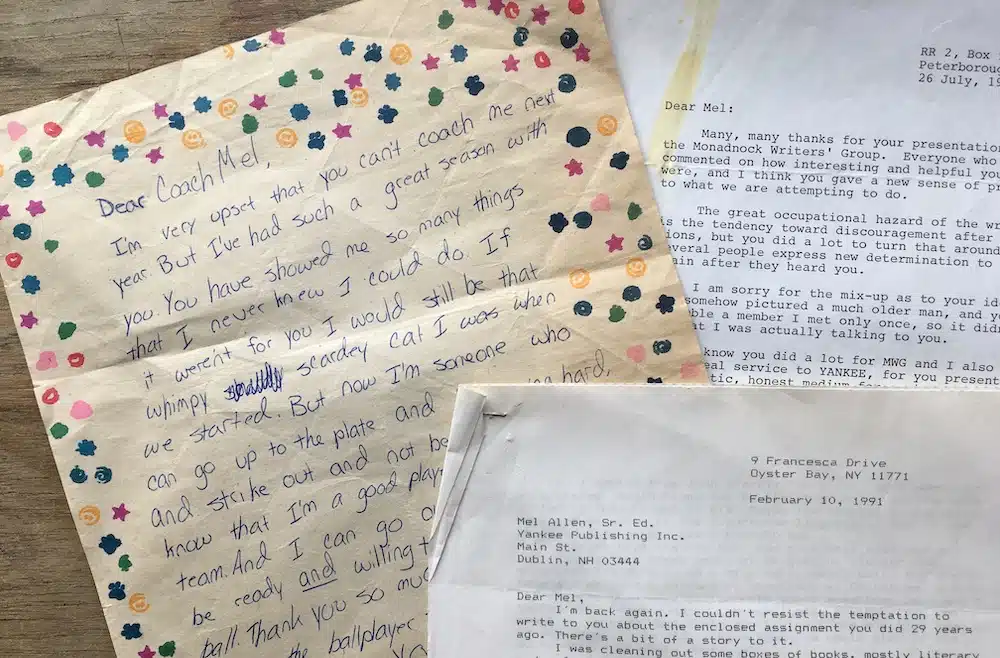
I discovered a yellowed paper, slightly crumpled, beneath a few notebooks. It was a handwritten letter from a girl named Jamie. She would have been 8 or 9 years old when she wrote to me. She was on a youth baseball team I coached in the early 1990s in Keene, New Hampshire. There were only a few girls who played then, and she had been unsure she fit in. I read: “You have showed me so many things that I never knew I could do. If it weren’t for you I would still be that whimpy scardey cat I was when we started. But now I’m someone who can go up to the plate and hit, swing hard and not strike out and be upset…. Thank you so much for getting me to be the ballplayer that I’ve dreamed of being.” She had decorated the top and bottom and both sides of the paper with colored stars. Tell me, how do I put that in the discard pile, even if I have not seen it for over 25 years? Because now I have, again, and it fills me with the same flush of pleasure when I read it long ago.
Credit: Yankee Staff
Maybe, in the end, I will make peace that I did my best. That each day I will carve an hour or so to sift through all the papers, keeping only the ones I could not bear to not see ever again. Which, as of today, four days into the project, is nearly everything.
Have you had to tackle clearing away the leftovers of a lifetime? I’d love to hear your story. Drop a note to editor@yankeemagazine.com.
August 12, 2020: When Distant Visitors Come Calling
Heat moved in over the past few weeks, with a short break between the two waves — the kind of heat that leads the news on radio and TV with “advisories,” the announcers full of cautions about what could happen, as if we somehow have forgotten what to do beneath a broiling sun. Every summer there is always a spell or two, when the air is this heavy and the body feels on a slow burn, when I cannot imagine being anywhere else but here.
My younger son moved west to the Rockies some years ago, because I made two parental mistakes if I wished him to live closer: I encouraged him to seek his passions, and I encouraged one of those passions to be skiing. Today he looks out to 12,000-footers and snow-capped peaks into early summer — but he lives where drought defines everyday life and where glacier-scoured lakes are hundreds of miles away. If he needs cooling, he has to go to a creek, and step cautiously on rocks while his dog soaks them both. So I send him photos of my summer to remind him of where he grew up, and what he could find if he ever chooses water over high mountains.
The Monadnock Region of New Hampshire is studded with rivers and ponds and lakes, and when you drive west from Dublin along Route 101, the road curves along the shore of Dublin Lake. Cars snug up against the tree-lined shoulders all around the lake, their owners having launched kayaks, canoes, and often themselves into the cool depths.
Every day, Annie and I park at the boat launch in the early morning, when the water is as still as glass, and I swim to where the shore curves slightly: 20 minutes that begin my day with a head-clearing rush. On weekends the scene is both joyful, with children and splashing dogs and sailboats and kayaks and people dangling from inflatables, and also a bit intimidating, with social distancing impossible until we have stroked past the happy crowd.
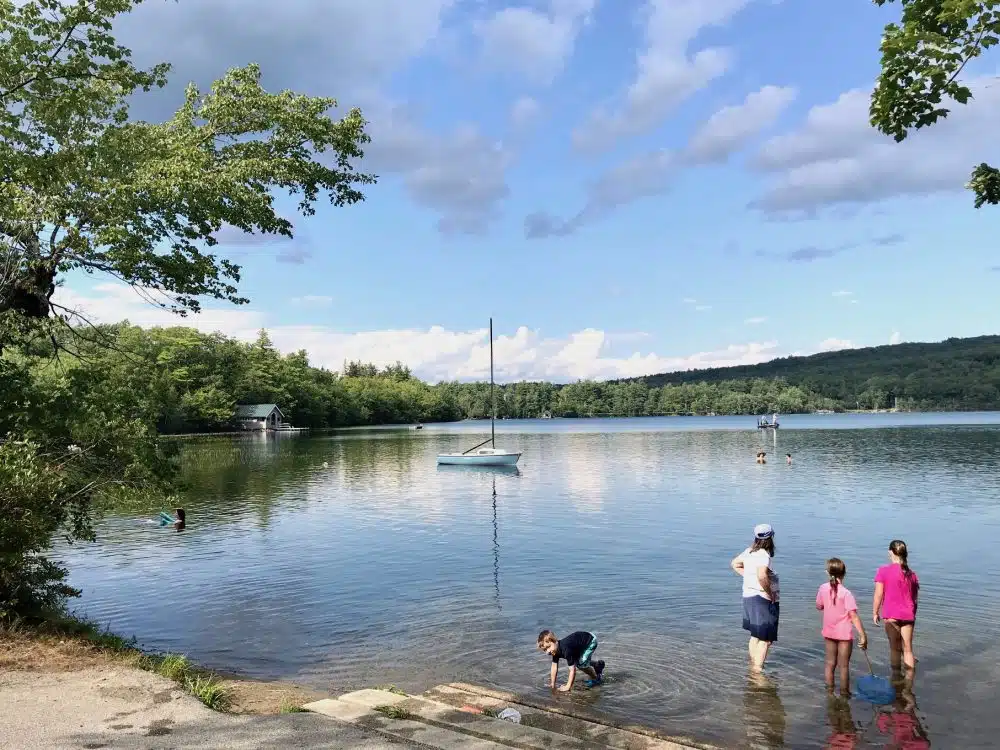
Credit: Annie Graves
Mount Monadnock frames the lake to the south, and if you take a left onto Lake Road, where one of the most popular trails to the summit begins, more cars, sometimes several dozen, line up as tightly as on city streets. Only a handful of the cars bear New Hampshire license plates. Monadnock is the second-most-climbed mountain in the world, and its easy access to urbanites in Massachusetts and Connecticut is a big reason why.
This presents a kind of dilemma shared by so many in New England’s vacation spots, whether we live on islands, in seaside towns, or tucked away in the mountains or lovely forested valleys — places so desirable that anyone would want them for a hideout while an insidious virus seeks yet another host. I get the allure, but still I wish sometimes there was a cosmic fence between wherever others call home and this piece of earth. It’s a wish that carries regret. Is sharing one’s natural setting and safety not as important as sharing food if others are hungry? These hard times make such a question hard to answer, especially when so many people seem impatient to get on with life even as the virus powers through communities.
The news this past week brings the threat of outsiders close to home, too close for many. On Friday, a religious group called the Last Reformation is coming to New Ipswich, a town of about 5,000 close to my hometown of Peterborough, for a 10-day tent revival on the property of a state representative who welcomed them.
There may be several hundreds coming — the number varies in different reports — including many from Illinois, a state with nearly 200,000 confirmed cases of coronavirus. According to online chat groups as well as the local newspaper, members of the Last Reformation do not adhere to mask wearing or social distancing; they have been encouraged by event organizers to camp in a nearby state park and to shop and dine in local towns.
The conversation threads become more insistent each day as the group’s arrival grows closer. Late this afternoon, the governor announced a mask mandate for any gathering of more than 100 people. It feels as though a showdown that has been brewing across the country may play out in our backyard. It reminds me of the tension that builds up in High Noon when the train holding Frank Miller and his compatriots bears down on Gary Cooper’s Marshal Kane, and everyone in town knows trouble is coming.
Yet there are other kinds of visitors heading this way, too. Well, they are headed many places, but Annie and I will see them this week in the dark of midnight from a quiet causeway across MacDowell Dam. We do this every August when the Perseid meteor shower flames across the sky. The word shower does not do justice to what we see on a good night. No matter how many times I have seen it, lying on my back on a blanket in the wee hours, when a streak of flame flashes in the sky, one, two, then another and another, it seems as if all earthly troubles are small, and now is the best time I know to find awe when a distant visitor comes calling.
July 29, 2020: Pandemic Lessons from a Lighthouse Keeper
As I write these words, the nation is again gripped with dueling fevers: a virus that threatens any normal life and the human need to bolt back into the swing of things, to rejoin friends, to embrace the lives we led before this spring. The fact that we are again talking about a possible lockdown, the need to shelter in place, speaks to the power of the virus to thrive on our impatience to get on with it.
All this made me think of one of the most remarkable people I have met doing this work of talking to people about their lives. Her name was Connie Small, and she spent more than 20 years of her life as socially distanced as a person can be. And then, over time, she told thousands of people how beautiful and unforgettable such a life could be.
She had grown up on the coast of Maine, about as Down East as you can be before crossing into Canada. She once had dreamed of being a painter, but at age 19 she married Elson Small, and he was destined to be a lighthouse keeper on remote Maine islands, and she was going to be beside him.
Connie’s life of virtual isolation began in 1920 at Channel Light, in the swirling waters between Lubec and Campobello. After a few years there, she and Elson moved to Avery Rock Lighthouse in Machias Bay, then Seguin Island Light at the mouth of the Kennebec River, then St. Croix River Lighthouse. Their final assignment would be at Portsmouth Light in New Hampshire, after World War II.
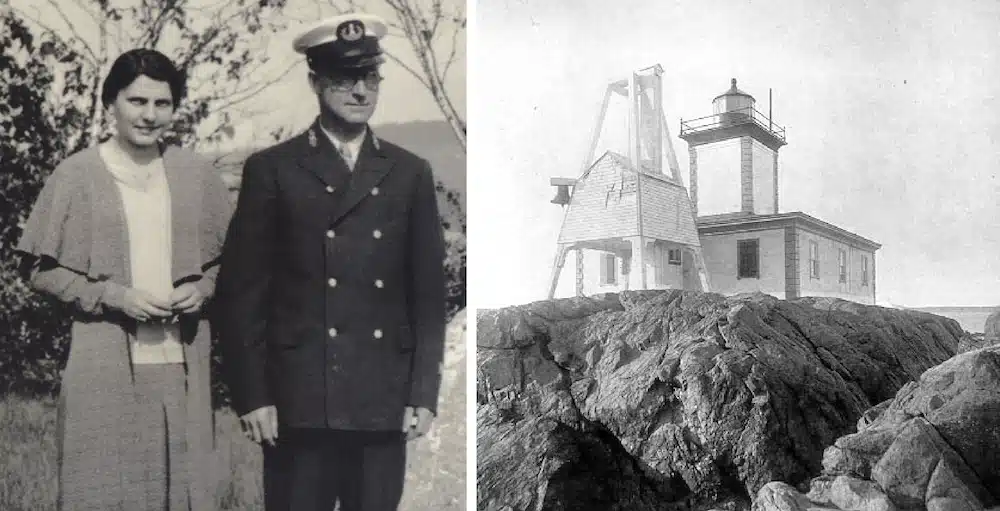
Credit: Portrait courtesy of LighthouseDigest.com
When I met Connie in 1982, Elson had been gone for many years and she was living in a small apartment in Kittery, Maine. And — as she would hundreds of times, to groups and historical societies and lovers of lighthouse lore, until she died at age 103 in 2005 — she told me a story of how rich your life could be if you could find a way to love the life that you had, in the place you had to be. “I went on Avery’s Rock the tenth of October 1922,” she told me, “and didn’t get off until the last of April….”
She described her life there when she was only 21, and this is what I wrote all those years ago:
“Avery’s Rock was three miles out in Machias Bay. There was no earth, only a half-acre of boulders and a wooden plank leading from the house to the boat slip. There was no phone, no electricity. Rain washed off the roof into cisterns stored beneath the pantry. The lighthouse tender brought coal once a year. If you ran out, there would be no more. Every two weeks Elson rowed to shore for supplies. But the light couldn’t be left alone, so Connie stayed. She saw only Elson, and at night while she knit socks or sewed quilts or bedding or clothes, she’d twist the radio dial, hoping to hear another voice, however faint…. She found her social life with pen pals, writing to lighthouse families around the world. ‘I’d wrack my brains trying to write something from off that rock,’ she says. She put the letters she received in a big box lined with oil cloths. Years later, leaving another island and unable to transport it, she buried it. ‘I felt better then. I wasn’t destroying something that was precious to me.’”
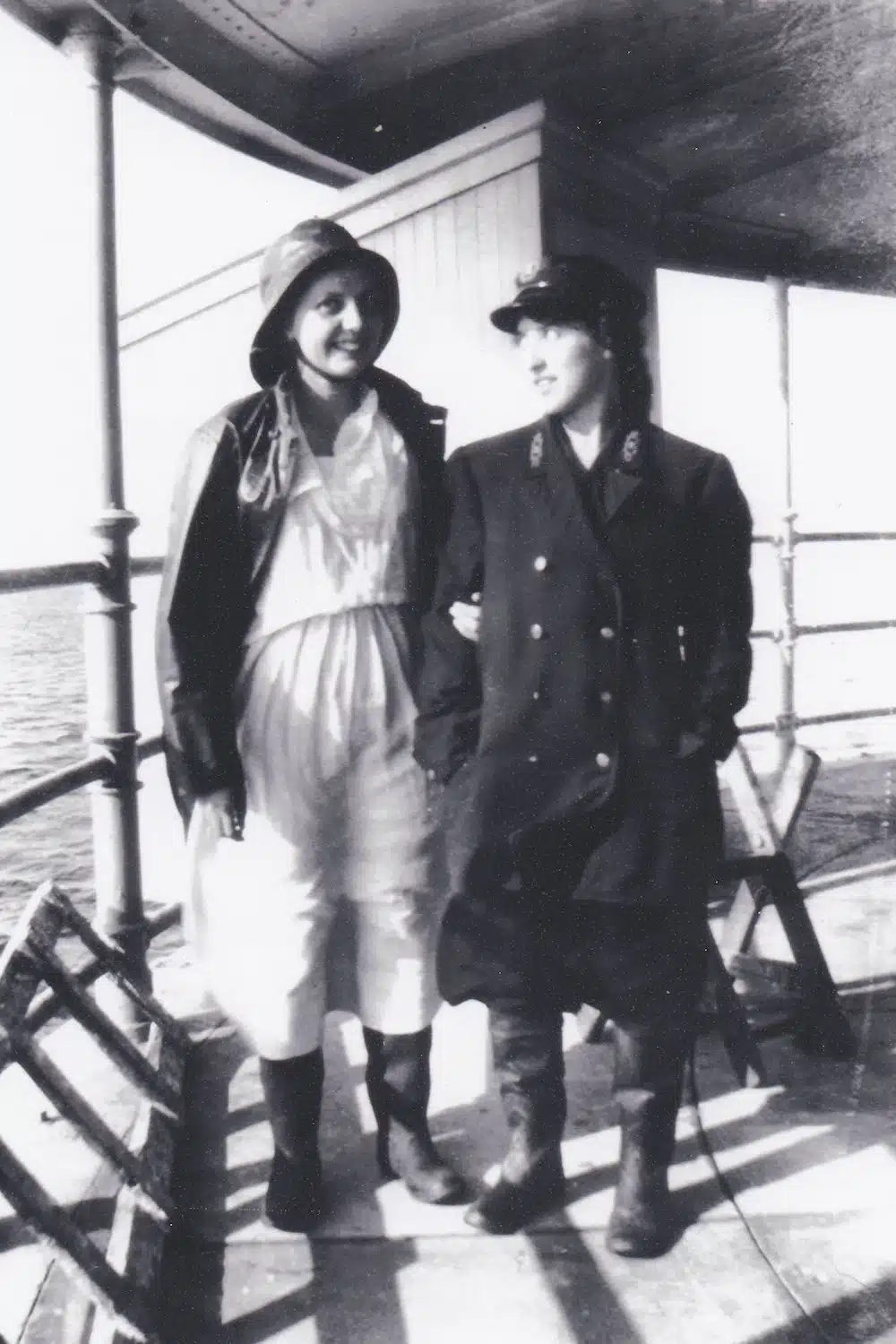
Credit: Courtesy of LighthouseDigest.com
I have a storage locker that I have not visited for far too long. In there, in a box buried among too many other boxes, is a sheaf of letters I had received from Connie Small for years after the Yankee article. She had told me that people never tired of her stories, the way she described the life that so few could imagine: how once there was three weeks of fog and the horn never stopped. At night seabirds crashed against the tower; in the morning she buried them.
She told me that when she talked to groups, people always pressed her to write a book. So she did, and a few years after I wrote about her she published The Lighthouse Keeper’s Wife. Readers around the world wrote to her. When she turned 100, the American Lighthouse Foundation threw her a party she called one of the great honors of her life. She was ushered into the party by Coast Guardsmen, who drove her in a limousine as if she were royalty.
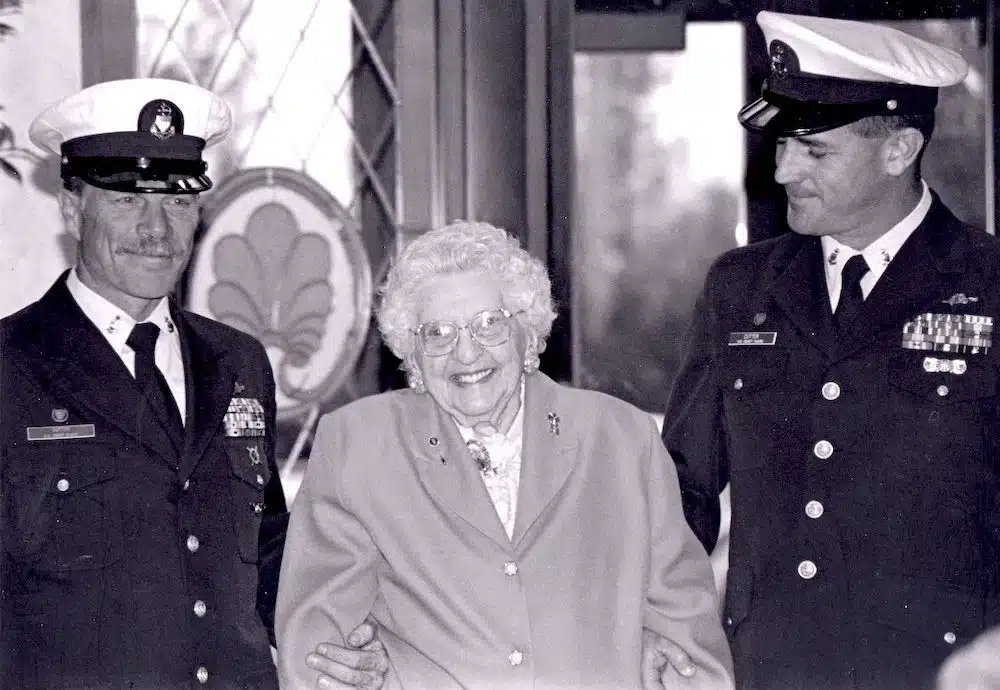
Credit: Courtesy of LighthouseDigest.com
Over the last two decades of her life, Connie was featured in countless newspapers and documentaries about living on chunks of granite surrounded by ocean where the sky was so dark and keeping the light lit was a mission that made any sacrifice worth it, because she and Elson knew that lives depended on them. Before I left her that day in 1982, she told me that she still woke at sunrise, “stirred by tasks that no longer need her doing — extinguishing the lamp, shining brass, baking Elson’s pies.” When fog moves in, something builds up inside of her; if sleeping, she’ll wake with a start. “There’s always the feeling that we have to get the bell going. That there’s someone out there who needs the bell.”
That is why I think I’ve been thinking of Connie Small these days. There are millions of us, tens of millions, who are out there in this fog, peering into the night, riding out these waves. We really need to figure out that there is no miracle around the bend, no magic spell to weave, that if we could only be each other’s keeper, stay apart for just a few weeks, all of us, and make sure we ring the bell and keep the light burning, then maybe, just maybe, we can make our way to land.
July 16, 2020: Why I Haven’t Retired
A few weeks ago a writer I have known for more than 20 years asked me, “When are you going to retire?” I suppose after you have put in enough time with your job — or your job has put in enough time with you — people figure the logical next step is to simply stop. On Sunday a former colleague who moved to upstate New York came to town to visit her son. We met to catch up in the park: first masked, then not, trusting the summer air and the length of the picnic table to keep us safe for another day. Within five minutes she asked, “Why haven’t you retired?”
I’ve been thinking about how I should respond the next time the question comes my way. I think I’ll just say, “Séan Alonzo Harris.” Or “Joel Woods.” Or “Becky Tuttle.” Because I am in a position to find those with the gift of storytelling — whether with camera or words — and to be able to share their work with everyone I know and thousands of people I will never know. How many people get to do that? Who would not want to?
A few years ago a writer friend emailed me to say she had seen astonishing photos on the Facebook page of a Maine fisherman. His name was Joel Woods. She sent me a link so that I could see them as well. Three days later I was sitting in a small living room in a house Joel rented a few minutes away from the sea in Rockport.
Journalism is an odd sort of business: You enter the lives of total strangers for a few hours, sometimes much longer, and if you’re lucky they open up their lives, open their hearts, and the words they speak are like reading their private journals or looking at their family albums. People will tell you details of their lives that they may not tell anyone else. It’s because writers need to listen — that is what we are there to do — and most people do not have anyone who listens to them totally.
On that afternoon in Maine, while I looked at photos taken at sea by this deep-sea fisherman who had never known an art class or photo workshop — photos that would stop you cold were they hanging from a gallery wall — Joel told me his story. How he had grown up tough and raw, and how “fishing was for me the biggest, baddest, the most hard-core thing I could do. That’s why I was drawn to it. I wanted to prove myself.” He began taking photos of the life at sea swirling around him. “I was seeing the fisherman’s world with brand-new eyes,” he said.
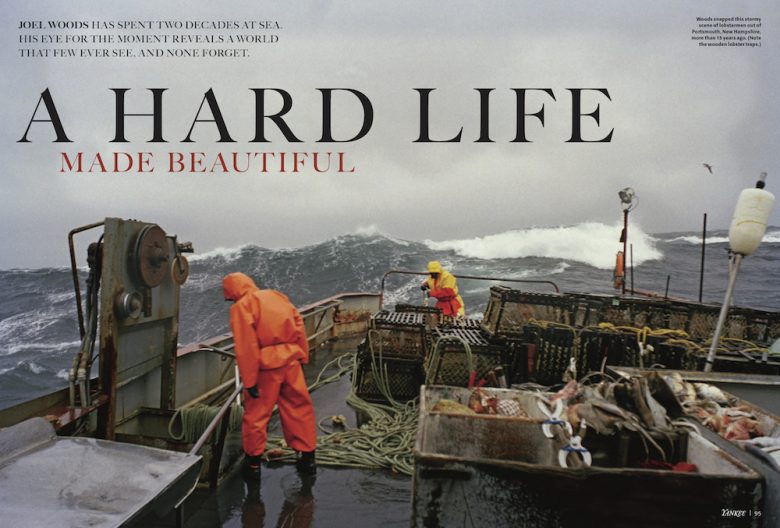
We ended up collecting a number of Joel’s images into a photo essay titled “A Hard Life Made Beautiful.” At the end were his words: “If it wasn’t for photography I wouldn’t be the human being I am.”
A few months after we published that photo essay, I entered it in the annual City and Regional Magazine Association contest, to be judged against the photos by professionals across the country. Joel Woods took first place.
One of the early stories I wrote for Yankee was about the Tuttle Farm in Dover, New Hampshire, then the oldest family farm in America. Since 1632, Tuttles had farmed on this single tract of land. When I saw the farm, Hugh Tuttle, the family patriarch, told me, “I keep having this feeling when I’m walking across a freshly cultivated field. I’ll suddenly think, My God, my ancestors have put a foot right there, where I’ve put mine. Would they approve of the way I’m treating the land?”
When I was there, I found a story nobody else had written about. Rebecca, Hugh Tuttle’s youngest daughter, had wanted to do nothing but farm. “When I was growing up,” she told me, “I always felt it would be my farm, because I obviously was the one who cared the most about it. I would follow my father around, and I’d say, ‘Willy doesn’t seem very interested in the farm. What about me?’ And he’d chuckle and say, ‘Little girl, you’ll just have to marry yourself a farmer.’”
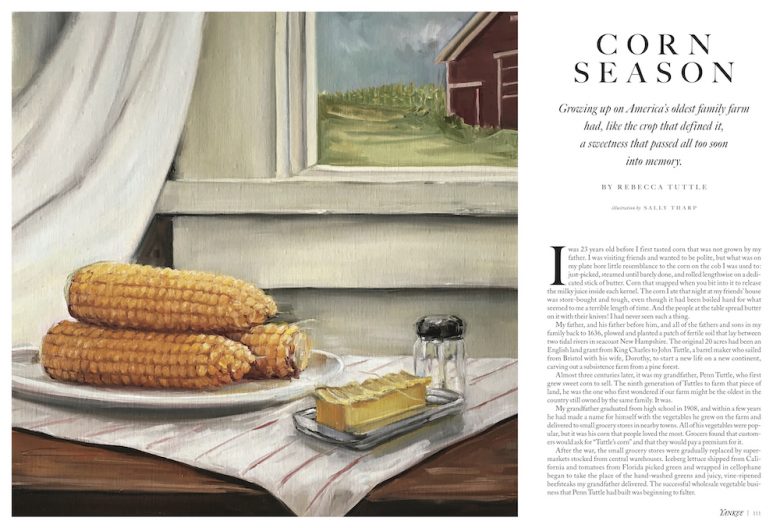
Two years ago an essay popped into my email inbox by Rebecca Tuttle Schultz. The farm that was the passion of her life had been sold by her brother Will. Her essay was both elegy to the farm that was and a bittersweet reminder of what could have been, if only she had been given the chance to be the farmer she knew she was meant to be. It was titled “Corn Season,” and it began like this:
“I was 23 years old before I first tasted corn that was not grown by my father. I was visiting friends and wanted to be polite, but what was on my plate bore little resemblance to the corn on the cob I was used to: just-picked, steamed until barely done, and rolled lengthwise on a dedicated stick of butter. Corn that snapped when you bit into it to release the milky juice inside each kernel. The corn I ate that night at my friends’ house was store-bought and tough, even though it had been boiled hard for what seemed to me a terrible length of time. And the people at the table spread butter on it with their knives! I had never seen such a thing.”
Rebecca had never published before this essay appeared in Yankee two summers ago. As I had with Joel Woods’s photo essay, I entered “Corn Season” in the City and Regional Magazine Association contest, in the highly competitive Essay category. It, too, won first place.
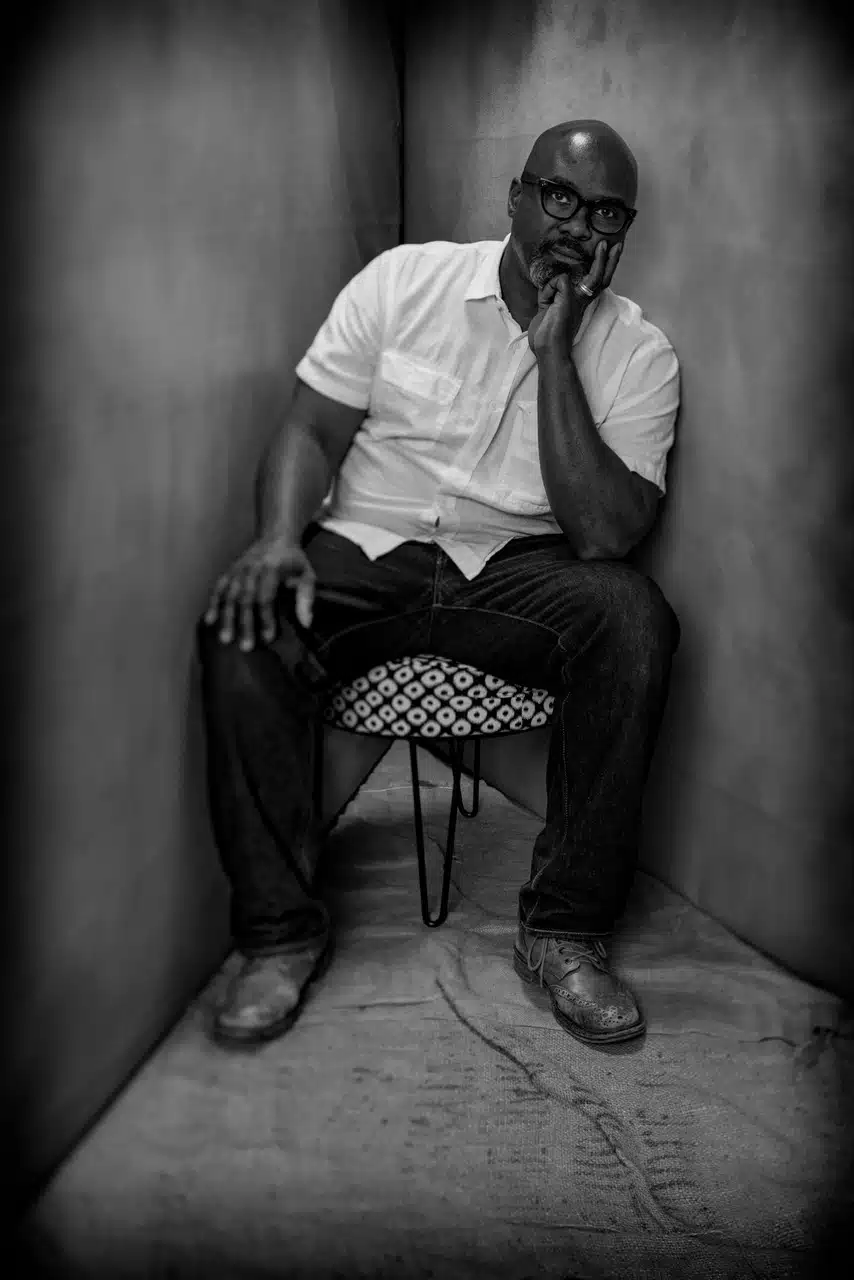
Credit: Séan Alonzo Harris
Which brings me to photographer Séan Alonzo Harris. I have not met Séan, but over the past two weeks we have spoken three times on the phone — lengthy conversations that lead deeper each time into his life story and what stories he wants his camera to tell. He talked about being seven years old and his grandmother giving him a plastic camera. He was living in Cambridge, Massachusetts, visiting his father in Washington, D.C, after his parents divorced. “I took photos of all my family there,” he said, “and when I was back in Cambridge, I’d look at them and it kept my father close to me. That was how I learned to love photography.”
Séan is now in his early 50s and has lived in Maine for more than 20 years, making his way as a Black photographer in one of the whitest states in the nation. He shoots every day, rarely knowing what he will return home with. For the past few years he has documented the Kennedy Park neighborhood of Portland, the most diverse in the state. “The people I’ve photographed are proud, intelligent, beautiful people. But also almost forgotten,” Séan said. Then he added, “When I photograph, I think of my own place in the world. The most obvious thing is to be human and show respect. To have honest communication with people. To show their humanity.”
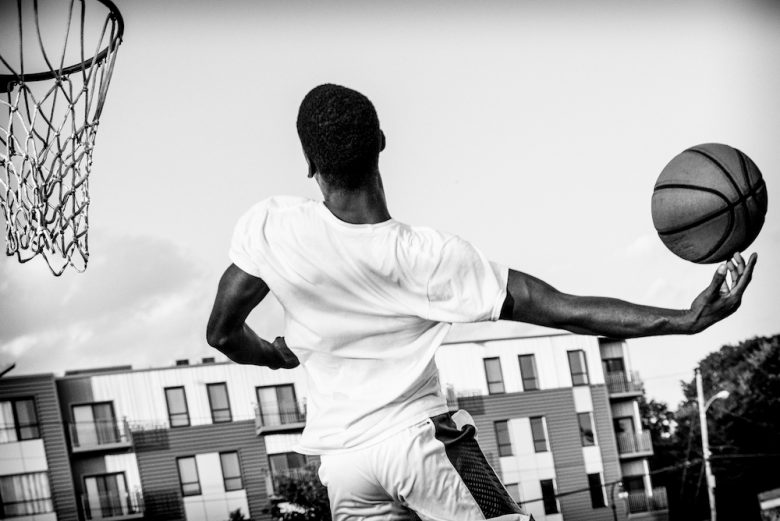
Credit: Séan Alonzo Harris
The people of Maine have seen Séan’s work in galleries and at art shows; much of the world has not. For centuries, artists have prevailed through the harshest of times, their need to create being more powerful than the obstacles of nature or man. We are all living through a harsh time. I am living through this harsh time. When I look at Séan’s work, I remember how I felt when I sat beside Joel Woods in a small living room in Maine and he described what he saw through his camera that no one else was noticing. Now I could see it too.
In a few months, Yankee will publish a Séan Alonzo Harris photo essay. I will be able to share his work with everyone I know and thousands of people I will never know. How many people get to do that? Who would not want to?
And that is why I am not retired.
July 2, 2020: A Backyard World
There are so many big things filling our lives, it is easy to feel small in the world, and so finding pleasure in familiar tasks, just taking care of things, brings a comfort I would not have imagined a summer ago. I bought my first new lawn mower since I can remember — in fact, every mower I have had since coming to New England in 1970 has been a castoff from somebody who was happy to take $25 or $50 for a machine they had all but run into the ground. As a young teenager I mowed everyone’s lawns in a new residential development, $5 a yard no matter how large, and I learned early not to ask a mower to do more than it was built for. I have written many stories in my head while walking behind a mower, seeing the fresh-cut grass drift in the air, leaving the scent of summer as it landed. Here, with my new machine, I felt almost giddy firing it up the first time, back in May. When I finished, Annie said the yard looked like a park. The young teenager who lurks inside me smiled with pride.
But then the dry spell came, and lingered. Now the word “drought” regularly crops up on the news. Conversations with a neighbor often begin with “Sure could use rain.” Annie is in the yard early each morning, watering. She has a hose for the front flowers, a hose for the tidy lettuce garden on the side of the house, and a sprinkler for the raised beds beside the river. I can sit outside and just watch the sprinkler, losing myself for a few minutes as the spray undulates back and forth. Every few days she clips tender leaves, and then we drive two miles to the beautiful gardens of Rosaly’s Garden and Farmstand. It is the oldest certified organic garden in the state, and we fill a basket with more greens and early vegetables, and we eat from garden home and away, as if we had gone out.
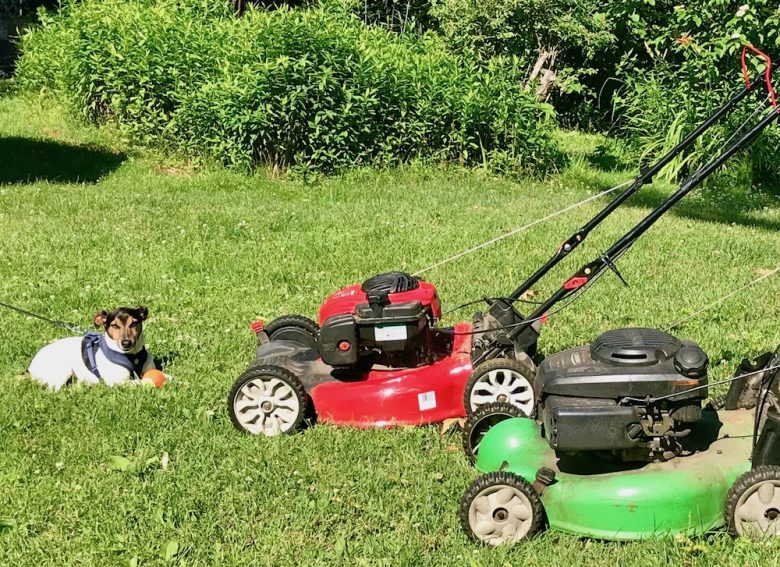
Credit: Annie Graves
I don’t cut the grass when it is this dry. Already, in places, the lush green has taken on that burnt brown of straw. So I’ve let the tiny oak sprouts gain a toehold. If I were to leave the house for a few years, when I returned there would be a little forest spreading from house to river. It’s a dilemma, not to cut, because this is tick season, and there are deer, and where deer live, ticks thrive. A trim lawn is not just for show — it is what experts say keeps you safe.
When Annie was a child here, a drought settled in, and people talk about it in the same way they speak of historic snowstorms. Wells went dry, livestock perished. Police responded to calls from neighbors reporting that someone was washing their car. There was the sense that everyone had to get through together by following the same precautions. As I type these words, thunder rumbles, close. Two days ago we had a cloudburst in the early evening, and we were in the car and it was hard to see; the rain poured over the road and the car shimmied as it splashed through. Now we could talk about rain for just a bit. Over the Fourth of July weekend, I will mow.
The dryness has one upside for me: It accelerates the seasoning of my woodpile. When I first moved to Maine, my wood came in eight-foot lengths, $25 a cord. I was young and reading Scott and Helen Nearing and We Took to the Woods by Louise Dickinson Rich, so splitting cords of wood with ax and maul made me feel kinship with these literary heroes of mine. Now my wood arrives cut and split, and our task is to stack and, when cold comes, carry and burn.
Karl has been bringing me wood for over 20 years. You can hear his old red truck rumble down the road before he appears. He lives beside the church in Dublin, and parks his truck in a small lot behind Yankee’s offices. His truck has no sides, just a frame in the rear. If he stacks the wood with precision, the truck bed is full; he says it holds three-quarters of a cord. I order four cords each spring, and he makes many trips — sometimes with a full truck, sometimes not. Trust with a woodsman builds up over many years, and when he finally delivers what he says is four cords, I figure we are pretty close. He spends his days alone in the woods with chain saw and splitter, and when he is not in the woods he is haying. The other day I drove into Dublin and there was Karl sitting atop one of the largest tractors I have ever seen. He was driving it up a country road I have walked hundreds of times, and I had no idea where he was going. In a time when adventures are few to be had, I was tempted to follow at 5 mph just to see where we ended up.
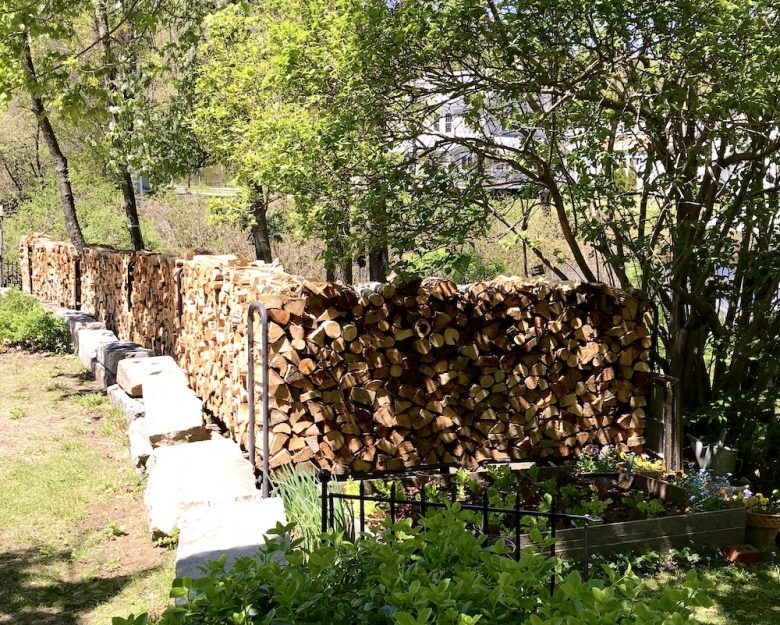
Credit: Annie Graves
My woodpile stretches across the back of the yard, at least 50 feet. I have dry wood from last winter piled in the woodshed, and on the driveway, a stack just shy of a cord gets the morning sun. I glance at woodpiles in the yards of others when I drive, and I’ll admit feeling envious when I see they have let their wood dry for an extra year, so it is dark as charcoal and will be nearly weightless when they carry it inside. My wood weathers by the week, cracks appearing as it dries, nature’s art as time slowly ages the once-blond maple and oak; by winter it will be brown. I know I am putting more on a woodpile than it was meant to give, but I see it as a voice from the future, six, seven, eight months from now, when it will burn bright in our stove as the night presses down.
In a summer when the yard and the river have become work space, dining room, even vacation getaway, I spend more time watching than I ever have before. A deer with three legs made its way along the river a week ago. I remember seeing in the local paper’s police log that in April someone had phoned to say a three-legged deer was walking along the road. The caller was worried. The report said that the officer saw the deer, but it seemed able to get along fine, so he let it alone. There are many rocks in the river and the water is low, and the deer, with its missing hind leg, stumbled along, but when it reached an embankment, it made its way up and disappeared behind the trees.
A family of Canada geese has been visiting nearly every day, usually in early evening. Silently, all of sudden they’d appear, feeding on the grass along the river. Two adults and four goslings, dining alfresco, as Annie and I were, maybe 25 feet away. I enjoyed their presence even if I had to clean up after them, enjoyed knowing they felt safe in the yard even if Rudy was tethered close by.
Credit: Annie Graves
Three days ago they came back, but now there was only one adult. Although there are many possible reasons why, the most likely is that we have foxes and coyotes, and even bobcats sometimes are spotted along the river. The story in my head is the adult who did not come to dinner this time fought to save the little ones. Early every summer at Cunningham Pond, we’d see a Canada family just like this, the babies swimming after their parents, and as the weeks passed there was usually one fewer until only the adults remained. There are snappers in the pond, and I imagine the parents never even saw the danger, just a frantic splash.
There are so many big things happening all around us, sometimes a small thing can make all the difference. Right now, on the cusp of the Fourth of July, I’d like to see the geese come back and feed on the grass. I’d like to see the deer with three legs come splashing through the water, before it makes its way up the embankment to wherever it goes where shelter awaits.
June 18, 2020: Yankee’s Yankee
When your world narrows — as it did for me in late March, when many of us retreated to our homes — then narrows even more with each passing week, you think about people you once saw nearly every day who now might as well live in another country. And in a sense they do. Which is why yesterday I phoned Jud Hale, Yankee’s longtime former editor, under whose watch the magazine became an icon of New England. When I asked how he was, he said he was OK. “I’m not supposed to,” he said, “but I’ve been sneaking out to go to the post office.”
Jud lives in a retirement community only two miles away with his wife, Sally, in a pretty cottage set amid woods and by a river. He is stepping gingerly into his later 80s now, and the past few years have forced him to shed some of the most important fixtures in his life: the island home on Lake Winnipesaukee, where his three sons and later his grandchildren felt a summer day had no end; his home in Dublin, where he wrote in a tower room; his “House for Sale” column, which he wrote as “The Moseyer” for decades; his decades-long succession of golden retrievers, various mutts, and finally Murphy, a long-haired dachshund, whom Jud carried with him on journeys until Murphy, grown deaf and blind, could not hang on any longer.
Before the pandemic sent us all home, Jud still came to the office nearly every day. In winter, the parking lot can get dicey, no matter how urgently it is plowed and salted. For several years we have urged Jud to park in a reserved spot by the front door. The more we asked, the more he dug in and refused, deliberately, it seemed, choosing to park as far away as possible. He once spent three years as a tank commander in Germany, and whatever residue remained from those days roared back at our efforts to tell him that we worried.
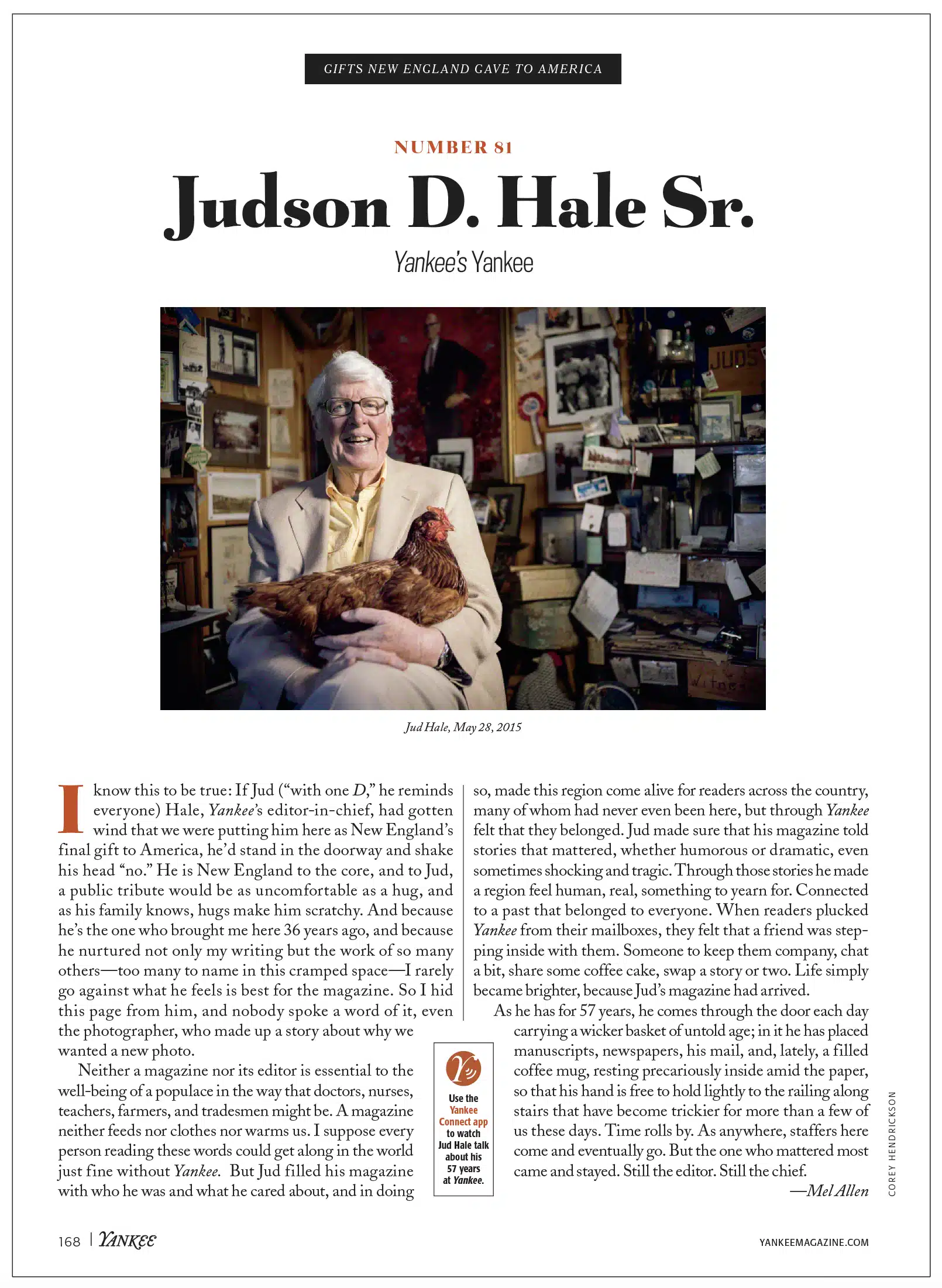
He’d arrive around 10:30, give or take a half hour, chat for a few minutes with Linda, our receptionist who has been with Yankee for over 50 years, before climbing the stairs to his second-floor office, clutching his wicker basket that held a Boston Globe, a mug of coffee, and pieces of mail. We could hear him walking down the hall as he called out to each person in their office: “Hi, Janice… hi, Tim… hi, Ian… hi, Heather… hi, Joe…” If the New England Patriots had played the day before, he would linger outside the office of Joe Bills, a former sportswriter, and deconstruct the game. Which was notable, since Jud cared so much about the team he could rarely bring himself to watch. He’d then sit at his desk, drink the coffee, read the newspaper, open his mail, and make a few phone calls, his voice booming down the hall.
After an hour or two, he’d walk back down the hall, basket empty, down the stairs and out the door. To an outside observer, he had achieved little. To those of us in the office, he had shown us how what we do stuck to him like a burr, how the meaning of this work remained, and he just wanted to be part of us, even on days of ice when we looked out the windows as he made his way across the pavement.
He attended our Thursday editorial meetings, and we began each one with what we called “Jud’s Three,” during which he would read or talk for three minutes about some quirky or historical New England tradition or tale. He has been with Yankee since 1958, when he joined his Uncle Robb’s magazine as a do-everything assistant editor, and he had a lifetime of anecdotes to pass down. He was — and remains — a storyteller. He wrote three books, and his best, The Education of a Yankee, makes clear where the stories began.
Though born to Boston wealth, his parents moved the family to the wilderness village of Vanceboro, Maine, on the edge of the Canadian border, where they lived on 12,000 acres of both farm- and timberland. His father employed every logger for miles around, and his mother started a Waldorf school based on the teachings of Rudolph Steiner. “When I dream, I always dream of Vanceboro,” Jud once said to an interviewer.
He always told his writers that storytelling mattered above all else, that we had to make readers feel. Make them laugh, or cry, or be amazed, but they could never be bored, and if they felt emotion they would want more. You wanted to write for Jud the best story you had in you, because he believed you would.
I would not be writing this letter if it were not for Jud. When I met him in 1977, he had taken over the reins of both Yankee and The Old Farmer’s Almanac a decade earlier. John Pierce, the new managing editor of Yankee, brought me to Jud’s office after softening him up a bit by saying that he had read stories I had been writing for Maine newspapers, and that Jud should get to know me.
Credit: Ian Aldrich
Few people enter Jud’s office without getting a tour of what he calls “Jud’s Museum,” and so before I talked story ideas, I was brought into a small world that is best described as something akin to one of those strange roadside collectible places, except this curator was a tall, blond-haired man, educated at Choate and Dartmouth, who took delight in setting a banana peel on a shelf to see how long it would take before it dissolved.
He showed me a safety pin from the first flight over the North Pole, and a piece of cloth from Lindbergh’s Spirit of St. Louis, pebbles from Red Square, a photo of Red Sox legend Ted Williams, and a letter rescued from the Titanic. Over the years, I never learned of anything that was removed from the museum, just more “treasures” he wanted us to know about: seats from Fenway Park that were removed during renovations, and a humble jar labeled “Einstein’s Brain.”
When Jud read that the doctor who had performed Einstein’s autopsy had kept the brain to study, he wrote asking if he could have it in his museum. He added he would respect it and care for it. The doctor wrote back. He had promised Einstein’s family it would not go on display. Jud wrote once more: He would keep it out of sight in a drawer. The doctor never answered. Undaunted, Jud created “what his brain would have looked like,” as he’d tell everyone who looked at the jar in wonder. In time it became hard to know whether the museum reflected Jud’s idiosyncratic tendencies, or whether in his efforts to keep himself entertained by all that surrounded him, he became its most original artifact of all.
Credit: Ian Aldrich
That day when I met Jud I came with a list of 28 story ideas. He said he wanted 25. He and John Pierce assigned me a story each month, $600 apiece. To make my life easier, they gave me a contract so a check would arrive early each month. To a freelancer, this was like finding a hidden door. A year later, my dad, who had retired to Florida, discovered that the back pain he had complained about was lung cancer. The more time I spent seeing my dad, the more I fell behind to keep up with the monthly stories. John and Jud then told me they had retroactively changed my story fee to $800, so I was caught up. There are gestures one does not forget.
A few months before my father died, Jud asked me to join Yankee full-time. I told my father as he lay on his bed, his eyes glazed by opioid painkillers. The lessons of the Depression had burned into him, and he had long fretted that my freelance life was a precarious way to live.
“I’m going to Yankee full-time,” I told him.
“Benefits?” he asked.
“Yes,” I said. He smiled, one of the last I can remember, said, “Good,” and then he closed his eyes and slept.
It is easy to look back on my years with Jud and to play the game of where I would be if he had not wanted so many of my stories; if he had lost patience with a young writer who could not fulfill the deal he made. Sometimes I give a talk to some group that wants to know about Yankee. I always begin by saying, “This is a story I heard from Jud Hale.”
He and his wife, Sally, were somewhere around Tamworth, New Hampshire. Sally had an upset stomach. At a general store Jud stopped to get her some Tums. As he entered the store he noticed an old fellow sitting quietly in a chair next to the door. Jud walked up to the counter and asked the proprietor for Tums.
“I’d like the cherry flavor, please,” Jud said.
“We don’t have the cherry-flavored Tums,” the man replied.
“Well, do you have the orange flavor?”
“No, we don’t,” said the man.
“Well, then,” Jud said, a little exasperated, “I’ll just take the plain Tums.”
After paying for it, he was walking out the door when the old fellow in the chair looked up at him as he was passing by and said…
“Looks like you’re gonna have to rough it.”
The audience always laughs, and I bask in Jud’s light for a while. We are all roughing it now, and we don’t know when life will smooth out. But it will, and when it does, I’m going to ask Jud to make it five, not three minutes, and to make us laugh, maybe cry, to remember the power of a good story to pick us up no matter how often we fall.
June 11, 2020: New Issue, New Era
I suspect that many of you reading this have had moments, or even days, when it feels as if you are living in two realities at the same time. We are coping with a pandemic and its ensuing financial free fall, and now the tidal wave of protests sweeping across the country over the death of George Floyd. It is hard to know where to find firm footing. Fear of falling is all around. And yet, we still play with our children, still search for quiet walks, still wonder what we should make for dinner.
Yesterday the afternoon was hot, and I drove Annie to Dublin Lake, where on the far side, away from the slender town beach, there is a boat landing for anglers and paddlers. The lake is icy cold, 100 feet deep in places. She swims in cold water that I will not feel for weeks ahead, but I go with Rudy and we watch. Driving over, the funeral service for George Floyd played live on NPR. There were passionate speeches and sometimes a song, and though I could not see the images, you could feel the tears.
And then we parked by the lake and Annie waded out and soon was in the cold deep blue water. Not 30 feet from where I stood, a loon swam by and then dived deep and I did not see it again. When we came back to the house, I took work to the table outside and a merganser flew along the river, so low it seemed to stir a ripple. It was Tuesday, the day the local Monadnock-Ledger is popped into the mailbox, and on the cover was the photo from the second peaceful demonstration along the nearby highway, now swelled to double the previous week.
As I write this on the 10th day of June, I am told the July/August issue of Yankee has left the printer in Saratoga Springs, New York, and will be in Dublin tomorrow. In normal times, when the new issue arrives, the boxes are stacked against a wall in the mail room and on a black wooden bench in the reception office. Each box holds 50 magazines, and in all my years here I have never actually witnessed someone wheeling them in on the dolly. It’s a bit like magic; I come down the stairs and there they are, the way from one day to the next plants seem to suddenly emerge from soil.
The policy is we are not to open the boxes until copies have been placed in our mail slot. This usually requires the patience of a few days’ wait. But someone, I’m not saying who, usually bends the rule and spirits away a copy or two under the cover of, well, waiting until everyone has left for the day. Even though we have worked on the issue for many weeks, by the time it lands in Dublin I have all but forgotten its contents — we are so deep into the next one — and so sitting down with it at home in the evening, slowly turning the pages, is like discovering anew what we did, and for the first time I can read it for enjoyment, telling the critical voice that lives inside my head to leave me in peace for a while.
But, of course, these are not normal times. The July/August Yankee will be the first in our nearly 85 years to be produced without any of us being in the office. When we all quickly packed up in the last days of March, our new art director, Katty Van Itallie, had settled in for only three days. She barely had time to know us, and then she had to pack up her computer and hope that our technical experts had aced their tests, and that, yes, our text and visual files could zip here and there, back and forth, without any being derailed. At first, we all held our breath.
I know that many of us at times have misgivings about how intrusive technology can be in our lives. I believe that the anxieties that cling to nearly everyone I know are fomented partly by the bombardment of constant images, news, blogs to read, Facebook posts, videos to click on — a nonstop elbow in the ribs saying “you must look at this.” It is why the vacations we most yearn for often promise no Internet, give permission to just turn it all off. But technology is the only way we could have put out this issue of Yankee, and we did it well. And as tempting as it may be, do any of us have the right or the luxury to turn off now, when the world seems to demand we be more attentive than ever?
Tomorrow I will pop into the Dublin office for two minutes, just long enough for my evil twin to slice open a box and extract a handful of new issues. Katty lives down the street now; Jenn, our managing editor, lives a few blocks farther; and I will leave Yankee on their doorstep, tempting them to settle in, as I will, to a world both with us and seemingly beyond our reach at the same time.
Inside this issue is a story about the tranquil Blue Hill Peninsula in Maine. This is where E.B. White lived and where he wrote Charlotte’s Web. I have been to nearly every village in Maine, and there are few places where sea, forest, and hills twine in a way more lovely than here.
There is also a story about the North Shore of Massachusetts, where Gloucester and Rockport have learned how to make fishing culture a lure for travelers. And for anyone who has been beguiled — or maddened — by the audacity of seagulls, there is a story about why researchers both love them and also wear helmets so they are not concussed by diving birds. That is what we worked on throughout the spring, while the world as we knew it dropped away, and a new reality of face masks and ambulance sirens and the visuals of riot police filled our lives.
Tomorrow I will settle in with these summer pages that speak of waves and gulls and the promise of sitting outside at a lobster shack. With little time, we ripped out a story and replaced it with vignettes of people who had endured hardship and tragedy with uncommon resilience, courage, and a refusal to lose hope.
Even in the pages of this magazine, two realities live side by side. And when I finish, I’ll bring Rudy to the edge of our river. Annie saw fresh deer tracks there this morning. A family of Canada geese climb each night to our lawn and leave their gifts. I will scoop those up in the morning, then come upstairs where I write this and get back to work. The virus remains. The protests continue. It is possible the narrative about racial inequality may be changing forever. People are volunteering to have unproven vaccines put into their bodies so that we can live without fear. Summer is just beginning, but in our Yankee world it is autumn. Photos that were taken when we knew nothing of what was ahead show us trees of beauty, mountains ablaze with color, apple orchards bursting with fruit. There is still wonder. Loons dive deeper than we can imagine, but they always find the surface.
June 4, 2020: Pebble by Pebble
It feels different this time. What is happening around us will not recede with the next news cycle or the day’s spin. We sense our country is at a turning point, and which way it will turn we do not yet know. So we are holding our breath. Waiting. A mix of anger, fear, determination, and hope fills the air, like a humidity that clings to us wherever we live.
Right now, early Thursday morning, June 4, the birdsong comes in so loudly through my open windows it is as though I have speakers outside. The sky is blue, the river quiet, and with the day expected to reach the 80s, it feels as if summer has stopped teasing and is ready to settle in. It smells like summer now, lilacs everywhere, and roses starting to wrap around our trestle. The trees along the river have never looked so green. I bought a new lawnmower and the freshly cut grass inspires Rudy to roll on his back, his legs pawing the air in what can only be joy, and I envy his delight.
I live on the main road to Concord, and the traffic, especially trucks, has picked up as businesses begin to reopen all around the state. And if I lived without any news, in a quiet insular world of my own, it might seem that life as we knew it before the pandemic was finding its footing again. But the news floods in, more than most of us can absorb. A friend told me the other day he was struggling to focus on what he had to do. I knew what he meant. I imagine the exception will be anyone who is not torn apart and searching for words and actions that make sense.
I do not know as I write this what today will bring. Or tomorrow. Events beyond this pocket of mountains and forest and lakes and villages where I live feel both distant and close at the same time. When the virus overwhelmed cities only a few hours away, we felt its approach. We followed the numbers. Just two weeks ago our conversations seemed to be about one thing: the pandemic. Would this state and the rest of New England reopen in time for summer? Could tourism survive without summer travelers pouring in? If not, the region’s resiliency would be tested as it has not been in our lifetime. That is what we read and talked about.
Credit: Photos by Ben Conant/Ben Conant/Monadnock Ledger-Transcript
Then Memorial Day came and changed what we talked about, what we thought about. That morning, a black man named Christian Cooper who was strolling, birdwatching, in Central Park asked a white woman to please obey the signs and leash her dog. As she threatened instead to call police and claim she was in danger from “an African-American man,” he calmly recorded the interaction. Soon after, his sister posted the video, and the shock of what people saw and heard sped around the world. Viewers reacted with anger, shame, and the recognition that this is what black men understand can happen to them anywhere, anytime.
Later that evening, George Floyd, a 46-year-old black man, was killed in Minneapolis by a police officer named Derek Chauvin. We not only know that he died, we also witnessed how he died, because a 17-year-old held up her phone and recorded one man taking the life of another. George Floyd’s gasps of “I can’t breathe” now echoes in our history. The cruelty and barbarity of the knee against his neck for 8 minutes and 46 seconds — even as, suffocating, he called for his mother — has shaken this country, an emotional earthquake with aftershocks that repeat day and night. In the news coverage, what we see most often are scenes of destruction and chaos; we have seen those scenes before, and as always the violence of a minority of protestors as well as of police threatens to steal the profound reality of a country stopping in its tracks, saying, This is another virus to kill.
At noon last Saturday a few hundred people, with the blessing of local police, gathered on both shoulders of Route 101 in Peterborough. They stood together, beginning at the main traffic light, a few feet apart, most wearing masks, hoisting signs: Black Lives Matter, Heartbroken, Remember George Floyd. Children stood beside adults, and they lined the roadside flowing west for a few hundred yards. Seven miles away in Dublin, the scene repeated, all ages standing along both shoulders of the road, faces masked, signs held aloft. It was not a protest march to make national news. But in that shared hour, neighbors said to neighbors, We can’t be quiet. No matter where we live, we have to play a part.
I have a friend who lives an ocean away, and when I told him about the outpouring of shared feelings in these small towns, he asked how that could make a difference, especially since so few people of color live here. I understood the question. New England is one of the whitest regions in the country. Vermont, Maine, and New Hampshire are three of the four whitest states in America. Except for a few urban pockets — Portland and Lewiston in Maine, Burlington in Vermont, and Manchester in New Hampshire — many residents here in northern New England will live their whole lives without working beside someone who is not white, someone who has lived the bitter truth and consequence of racism. Within this bubble, it can be easy to draw a curtain against a reality far from one’s own.
I am the editor of a magazine whose very name lends itself to a stereotype: The word “Yankee” conjures up the face of the Maine fisherman, the Vermont farmer, the wilderness logger, the maple syrup maker, the flinty citizen at town meeting, all of whom are likely white. This has been one of the challenges I have not yet succeeded in meeting.
People have always read Yankee in part because they find comfort in it. The world is so complex, so often unsettling, and we give them beautiful images of lakes and coasts, fall foliage and snow-capped mountains, lobster shacks by the rocky shore, winding country roads. People have told me they feel their blood pressure being lowered as they read; they look elsewhere for commentary on social and political crises. Even when we write about complex issues facing the region — whether rising seas, or intrusive pipelines, or opioids, or asylum seekers putting down roots in an old mill town — Yankee remains in the minds of many the magazine of a New England that is always lovely, always inviting.
Credit: Courtesy of the Virginia Military Institute Archives
But there is both an old story and a new one being told right now. Old to black people, new to anyone to whom “Black Lives Matter” felt abstract, belonging somewhere not here. There were other victims of police violence in just the few weeks before George Floyd died, and their names, too, are spoken at protest rallies, but the unbearable intimacy of watching what happened to this man made it about here, wherever here may be. The curtains can’t be closed again, no matter what business we are in.
So I think about the question from my friend overseas. Do a few hundred people on a New Hampshire roadside move even a pebble’s worth of the mountains of pain and hurt felt by people of color? Probably not. But there are hundreds of these gatherings now, and within them moments that provide both inspiration and hope. Scores of people, so many of them young, lying face down on roadways and in parks, their arms clasped behind their backs, in total silence for 8 minutes and 46 seconds. White people standing, kneeling, marching, yelling, crying alongside black. In Connecticut, a state trooper holding hands with a black protestor. Police everywhere being photographed kneeling beside protestors, police chiefs across the country saying, This is how change will happen. There will be no turning back.
My son Dan once attended an elementary school in Keene, New Hampshire, named for Jonathan Daniels, who had grown up in that small city. Daniels was a seminarian at the Episcopal Divinity School in Cambridge, Massachusetts, when he joined many others to fight for civil rights in the deep South. He was 26 years old, when, in a small Alabama town, he tried to enter a store with two black teenagers to buy them a soda. A local deputy sheriff aimed his shotgun at one of them, Ruby Sales. Daniels pushed her to safety as the gun went off, killing him instantly. Martin Luther King Jr. said, “One of the most heroic Christian deeds of which I have heard in my entire ministry was performed by Jonathan Daniels.” Ruby Sales, who is now in her 70s, went on to found the Spirit House Project in honor of the man who saved her life. The project has documented more than 2,000 state-sanctioned deaths against black men and women, nearly all of whom were unarmed. She has dedicated her life to his death, and her work now ripples through the Black Lives Matter movement. How many pebbles did Jonathan Daniels move before he was killed? How many does Ruby Sales continue as she keeps on with her own mission?
It feels different this time. If this is not a crossroads for America, then I do not know what that might look like. The irony is not lost that George Floyd lost his life on Memorial Day, a day when services honoring the men and women killed in wars end always in prayer and always, always with the words: We will never forget.
May 27, 2020: Signs of the Times
Time is starting to diffuse; I awake with daylight and sleep when it is dark, but the hours in between become harder to discern. Recently I asked Annie what day it was, and she replied, “Noneday.” That seemed about right. I cannot recall another period in my life when nearly everything seems to be so ripe with metaphor. The most ordinary events, things I once took for granted, whether food shopping or waving hello to a passing motorist, seem to carry deeper messages now, or maybe they always did and I am just now paying more attention. Despite myself, as someone who is always hurrying to the next project, I am trying to look a day in the eye and hold its gaze for just a few moments. I am learning patience.
A year or two after we moved in here, we planted a crab apple tree on the front lawn. It was a newborn, tiny and spindly, reaching barely to my knees. Each year it sprouted higher, and now it stretches far above me, well over 15 feet. With the sun and warmth of May the buds opened, and just last week glorious white blossoms filled the tree. These blossoms tease you with their beauty, because soon after that burst of brilliance, petals rained down and laid a carpet of white on the newly mowed grass. When I walk Rudy to the backyard, we have to pass beneath the branches, and the fluttering petals in a breeze must seem to him like flying insects, and he snaps his head trying to corral them. In a few more days the tree will be leafy green, and weeks later tiny apples will emerge, no bigger than almonds. In fall the tree will shelter flocks of trilling cedar waxwings, who feast on the sour fruit. And when the cold comes the tree will be bare, waiting, like all of us, for light and warmth. Nothing I can do will alter that rhythm of beginnings and endings.
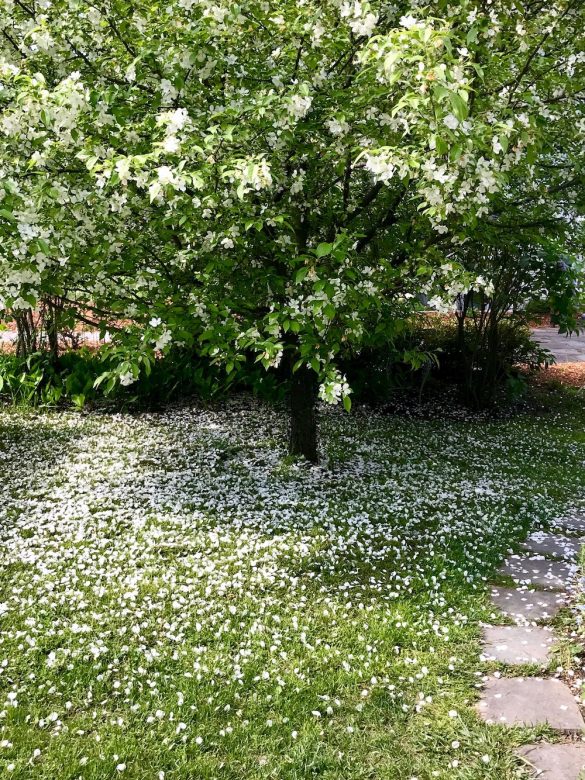
Credit: Annie Graves
It takes us five minutes to walk from our house to the center of town. To reach town we cross a 75-foot-long bridge that spans the Contoocook River. Well, we used to cross the bridge. No longer. The bridge was built in 1940 to replace another that was destroyed in the Hurricane of ’38. We have been hearing about the big bridge replacement project for some years, and now the due date has arrived. The quiet beauty of a small New England town has given way to a hub of noise and fierce machines that chew up concrete and dig deep into earth, a scene to hold any 6-year-old kid transfixed for hours. We are told this will be a two-year project, and because it is all new to the eye, we always pause and watch.
Our favorite perch is by the library wall, where you see the river rushing below and the huge bulldozers, bucket loaders, and cranes towering over the scene. On the riverbank rests a lone dinghy that I assume is there on the off chance that a worker will lose his footing and tumble into the cold water and need to be hauled back in. But it seems more likely that after the workers leave for the day, a curious (and foolish) bystander will find it irresistible to explore what the day’s work has uncovered under decades of dirt, and a dunking will be the consequence. Last week when we walked at twilight we saw two women taking selfies while sitting in the bucket loader.
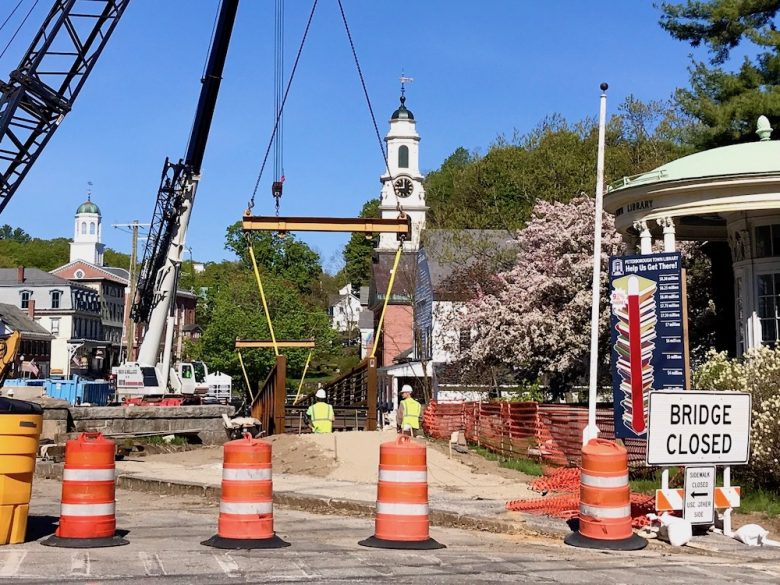
Credit: Annie Graves
We say hello to the workers when we walk by and they nod in return. Their ages seem to span from 20s to 60s. They notice that Rudy walks with a tennis ball wedged in his mouth — a Jack Russell pacifier, I call it — and the other day when he did not have it, one worker yelled out, “Hey, he forgot something.” They will be with us for many months, through heat and cool and then cold, and when they are finished we will have a wider sidewalk, a wider street, and a spanking-new bridge with some of the original stone facing so that we feel we have the same familiar structure, only better.
We watched one recent morning when the temporary pedestrian bridge was being lowered into place, since the sidewalks are now impassable. It has been a lifetime since I was that six-year-old kid, but we both watched the deftness of the crane operator as he had to capture the structure, lift it into the air, and place it ever so gently in place. It took a long time — nearly an hour, it seemed — and it was like watching mechanical surgery, a piece of hard-hat theater many of us never see playing out in our town center.
When we walk past the workers on our way to the park, they politely slide a few steps over, mindful of our concern for distancing even as they stand shoulder to shoulder all day. Two days ago, for the first time, we saw two workers with face masks; I do not know if they were new to the site or new to masks. I have a good friend who for years has worked construction as a blaster. He is now in his mid-60s and feels his age and reads the statistics about who is most vulnerable to this virus, so he wears a mask wherever he works. He says he is the only one. I am as perplexed as anyone over how this simple ask that has been shown to be one weapon we all can employ in this fight has become yet another way we divide.
Some years ago I met the wonderful writer Sarah Wildman at a writers conference in Quebec City. Her daughter, Orli, then was perhaps 4, a beautiful wide-eyed child. She is now 11 and being treated for a rare form of liver cancer. Sarah and her husband brought Orli to Boston for a liver transplant, and then COVID-19 hit us all and here they remain. She wrote an essay about Orli, and this stood out to me. I wish it could be read by every single person who demands the right to not wear a face mask when out in public. It is both a plea and an anthem for looking out for each other, especially those among us who need the most looking after.
We are the people you’re being asked to stay home for. Yes, you’re staying home for yourselves, of course, for your children, your parents. But also for my daughter, whom you’ve never met, who was given a fragile second chance we are so desperate to shelter. And for her doctors and nurses — and for your doctors, and your nurses. The work the world is now doing, my family learned just a few months ago, is akin to building a small lean-to around a newly planted tree, the boards built of good intention and follow-through. They are terrifyingly wobbly.
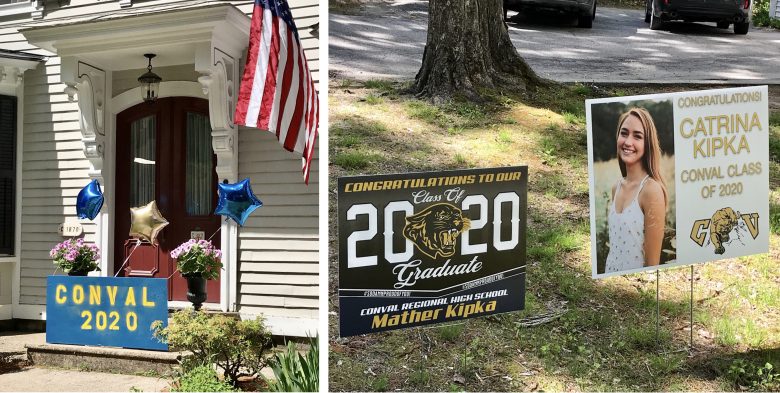
Credit: Annie Graves
There remain some certainties that still unite us, no matter where we live, no matter what we do, or what our politics may be. If you could have driven around the Monadnock Region over Memorial Day weekend, you would have seen what I mean. Contoocook Valley Regional High School (Conval) embraces nine small towns, and about 720 students from grades 9 through 12. Faced with the demoralizing prospect of seniors having neither graduation nor the sense of bonding that comes with it, parents and seniors created a “Seniors Graduation Celebration Drive Tour.” No matter where you walked or drove over the weekend, you would have seen blue and gold balloons, hand-painted posters, streamers, signs with photographs of students, and on Pine Street here in town, what looked like a theater set of an astronaut “reaching for the stars.”
Across the region a singular voice arose from storefronts and town commons and parks and homes: “We know this is hard, we wish it could be different, but we are behind you and congratulations.” These displays won’t help the students get jobs, or replace the once-in-a lifetime-sendoff from high school to whatever comes next — but it will remind them that they are not branches without a trunk. Others are looking out for them. Tiny skinny trees become beautiful and give shelter and food to birds; a bridge that a hurricane tore away, and then was rebuilt only to have time take its toll, is being built anew. It will take many months, and now it is messy and noisy and it is impossible to see all those months down the road when a new one will again stand sturdy across the river. That is what bridges have always done: They take us across those places we cannot go alone.
May 20, 2020: Memorial Day
The white wooden crosses bearing names in black letters, each aligned perfectly alongside a small American flag, suddenly appeared Saturday in the wedge of lawn between the town hall and the historical society here in Peterborough. Veterans remember their service and their comrades in many ways; these crosses and flags are how Richard Dunning, who was wounded in Vietnam, chooses to remember. When he was principal at the middle school, he and the shop students built the crosses and painted them white. With his wife and grandkids, he plants them each year, early in the morning, shortly before Memorial Day.
A lot of wars have called the young men and women of Peterborough: the American Revolution, the War of 1812, the Civil War, two world wars, Korea, Vietnam, Iraq, and Afghanistan. This year, 99 white crosses rise from the ground, one for each person who did not come home. They stand in the town center, as quietly powerful as any speech could be.
Last evening we lingered there, looking at the names on the crosses. I wrote some down, including three that seemed to echo another time: Philemon W. Cross. Gustavus A. Forbush. Henry C. Taggart. Later I learned that they were among 40 local men killed in the Civil War. Gustavus Forbush, for instance, was a carpenter, and he was shot just as he reached the top of Fort Harrison in the battle for Richmond, Virginia.
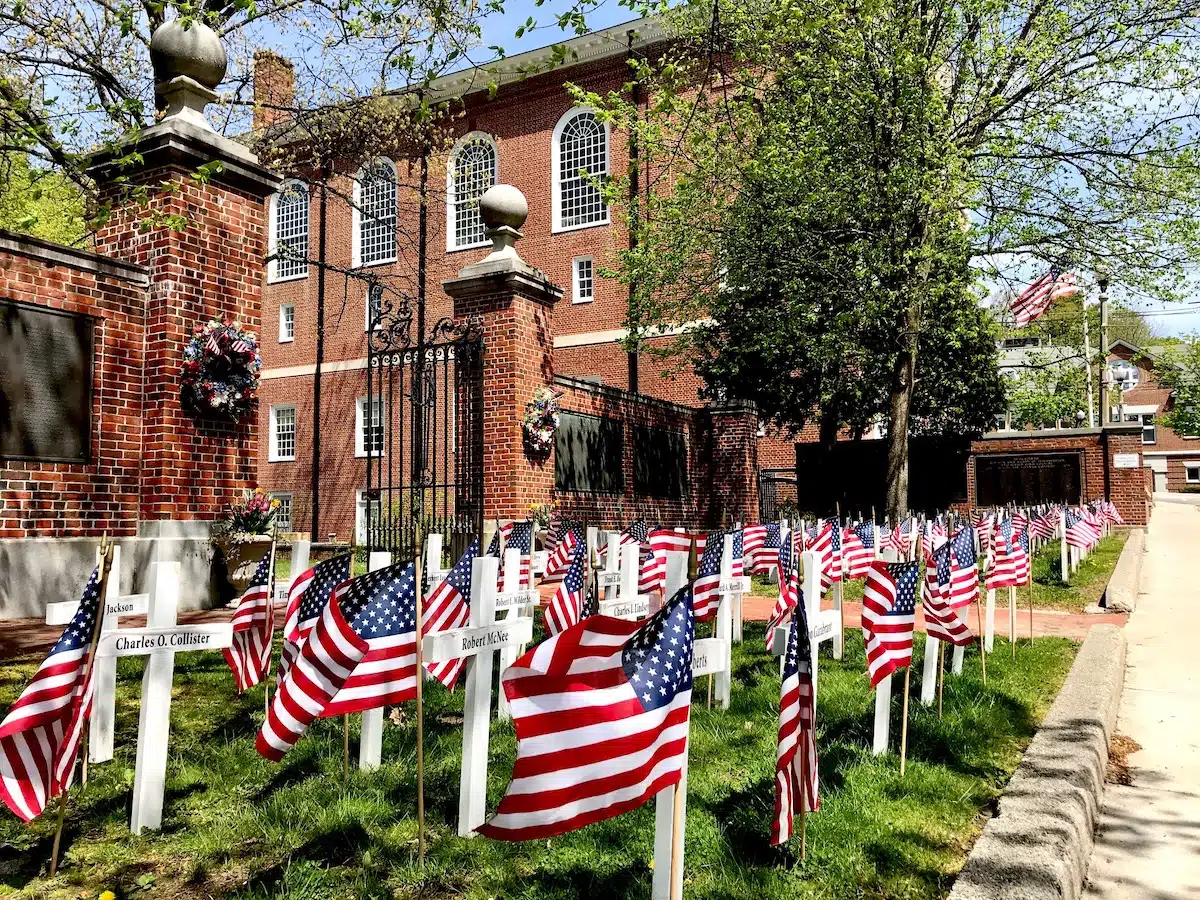
Credit: Annie Graves
I remember being at Arlington National Cemetery more than a decade ago, working on a story about a Maine wreath grower who brought thousands of wreaths to Arlington each December. People would travel from all over to place the wreaths against the headstones. I met a Virginia woman named Nancy Cox, who came here every year to do just that. “I say the names aloud,” she told me. “I say to myself, When is the last time someone said this soldier’s name out loud?”
I never forgot that, and last night I, too, said the names as I went down the rows: Philemon Cross … Gustavus Forbush … Henry Taggart …
On the brick walls that border the tiny green are plaques commemorating every local man and woman who has gone to war. As in so many small towns, Peterborough’s families have roots that stretch deep into the past, and there are names here that I’ve seen on street signs and storefronts. Annie grew up here, and now and then as she read a name, she told me she’d gone to school with that person’s son or daughter.
There is something about names engraved on a wall that holds the eye, and digs at the heart. Three years ago, on Memorial Day, we were at the Vietnam War Memorial in Washington, D.C. I remember the flowers, so many, pressed against the black granite. And the letters that loved ones had propped against the wall, many with photographs of young men who would today be pushing 70 and beyond. The image that everyone who visits the Wall seems to come away with is that of Vietnam veterans scanning the rows before stopping on a name … and then standing there. I overheard a woman who was looking at an older man running his fingers across the names. “They were all the same age then,” she said softly. “They are the same age now.”
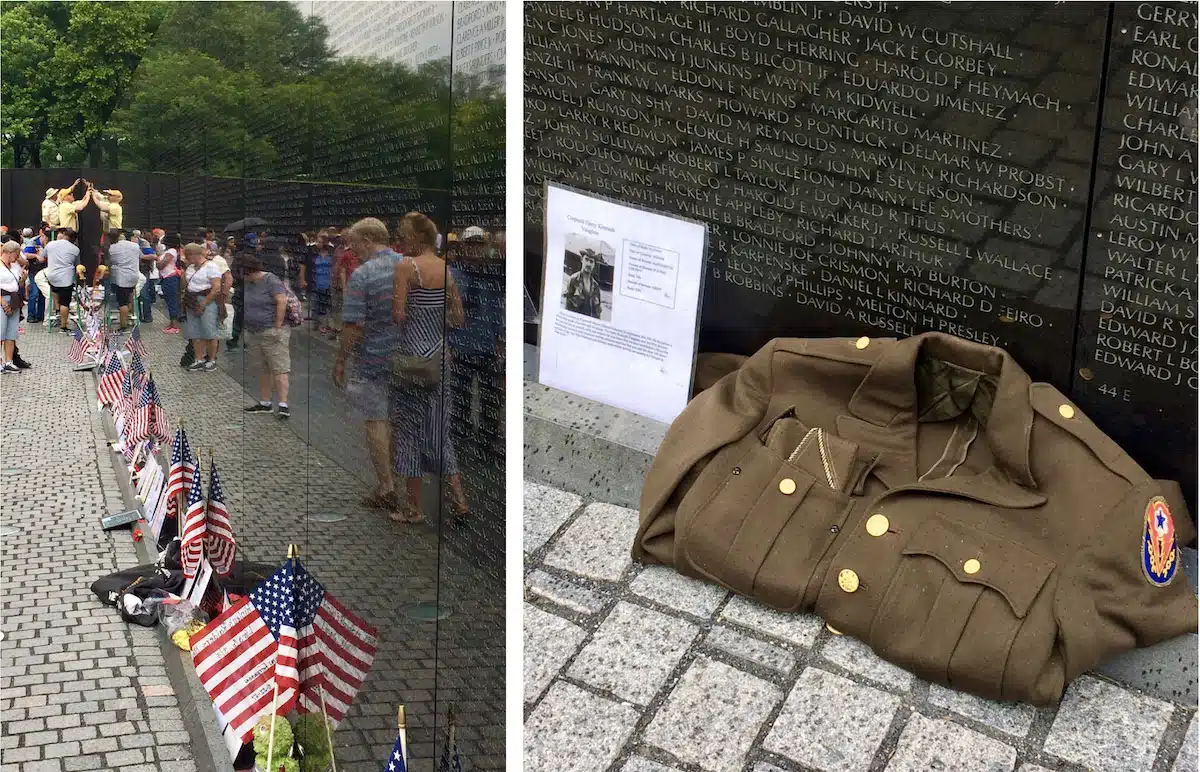
Credit: Annie Graves
This year, for the first time anyone can recall, there will be no Memorial Day parade here in town. A ceremony that brings generations together in a way unlike any other, it is when veterans march proudly, a few still able to wear the uniform they came home with. The school band plays with spirit, the notes of “The Marines’ Hymn” and “Anchors Aweigh” carrying through the streets, the drummer banging away for all he’s worth. Members of the American Legion carry their flag, and kids run to keep pace in their Cub Scout or Boy Scout or Little League uniforms. The long, mournful notes of “Taps” drift into the air, making even children feel the solemnity of the moment though they do not really know why.
But on Monday, even without the parade, we will still gather by the post office bridge, where a pretty park edges the river. Flowers will be tossed into the water, gunfire will crack through the air, and as always there will be a speech, a prayer, and the silent hope that no new crosses will ever need to join those on the lawn.
May 13, 2020: Turning the Page
This past week I learned that finding an unexpected treasure could make me smile, even laugh, one minute and then, without warning, make me shudder — and see with fresh eyes what is happening around us today. Here is what happened:
One evening we went on our usual walk into town, a route that takes us behind the library. Dating from 1833, the Peterborough library boasts it is the first tax-supported library in the country. (Being first in something historical is important in New England. Just a few miles west, in Dublin, where Yankee has been since 1935, the library has its own boast: the first free public library in America.) Despite its proud history, a good portion of the Peterborough library is now being taken down, to make way for an $8.5 million addition. A moving van has been parked outside recently, and while the library is currently closed to visitors, I can imagine the flurry of activity inside, with crates of books being packed for delivery to a temporary space across town.
We paused here for a reason. That morning, during Yankee’s online staff meeting, art director Katty Van Itallie had mentioned that her husband had found some of the earliest issues of Yankee apparently tossed out behind the library. She held up to her computer the magazine’s second issue ever — October 1935 — and said there were many others waiting in a heap.
And so they were: a pile of Yankee magazines on the ground, tucked up against the back wall. In fact, there was a whole collection of stuff lying here and there. It looked as if someone was clearing out the clutter from nearly 200 years and had started with the easy stuff: old furniture, metal racks, paperbacks, magazines that had not been read for decades.
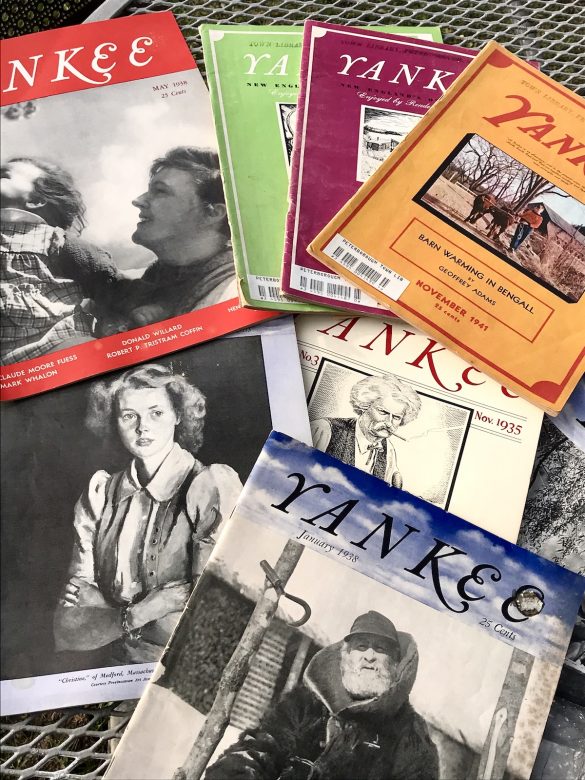
Credit: Annie Graves
Rain was forecast, and though they were under a roof, I felt oddly protective of these issues that Yankee editors long before me had put together. I picked them up — there were 40 remaining — and carried them home, no longer unwanted.
At Yankee’s Dublin office, there is a small room where you can find bound collections of every issue of the magazine, beginning with founder Robb Sagendorph’s first one, in September 1935. I cannot recall when I last browsed through these heavy, musty volumes. But when I spread my orphaned Yankees out on our living room floor and sorted them in order — from November 1935 to December 1941, when war arrived — I felt as if I had brought home a gift of times past, which is so welcome now that all thoughts, all conversations, are revolving around the present.
As evening came on, I sat down with these oversize issues in my lap (Yankee did not adopt its long-running “pocketbook” size until after the war, when paper shortages and costs made it the obvious choice for thrifty New Englanders), and one by one, I looked back. Paper pockets were glued to the backs of many of the issues, holding yellow library cards filled with the penciled names of those who had borrowed them. As I leafed through the pages, I imagined the people behind the names, who had lived here in the depths of the Great Depression and just before the war that likely changed them forever.
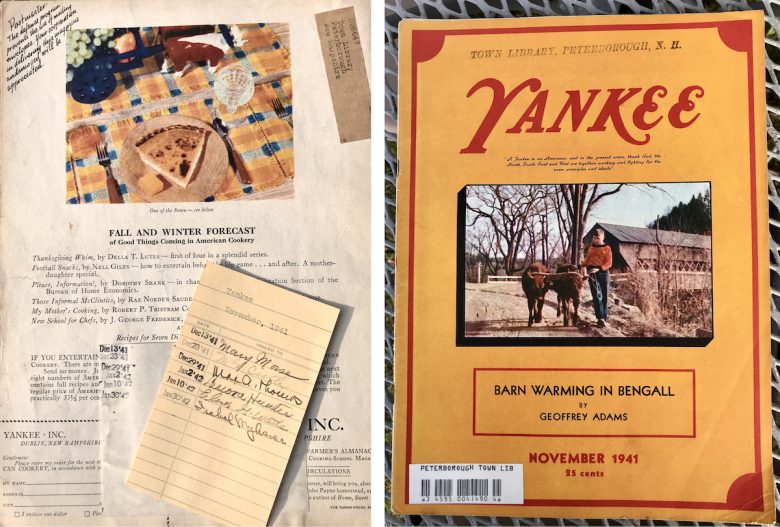
Credit: Annie Graves
The November 1935 issue had a portrait of Mark Twain on its cover, in honor of the 100th anniversary of his birth. There would have been about 600 readers of this issue, and it did not warrant many more: It would be another few years before Yankee’s idiosyncratic humor showed up, along with popular features like the Swoppers’ Columns.
Many of the Swoppers’ listings held the kernel of a short story whose ending we would never know. From January 1938: Would discuss Thoreau and swap nature notes with beautiful blonde, not over 5 feet 4, send picture. February 1938: Wanted by gal, a portable typewriter. In swop one untanned deer hide (shot this fall) and a prize springer spaniel who barks incessantly but is swell with kids. And another: Yankee bachelor maid with an itchy pen and a love of life will swop letters that really are letters with a man-about-town or -about-country.
I turned a page, and saw the future lit up in this 1938 dispatch: George Proctor, New Hampshire’s Game Warden, told the story about New Hampshire State Trooper Fletcher Forsythe who had a special harness made for his Irish Setter that he covered with reflector ornaments. He suggested bike riders and walkers at night should come up with something too.
Credit: Annie Graves
By 1938, even in the pages of a magazine devoted mostly to rural life, the threat of Hitler was becoming impossible to ignore. One of the best-known writers in the country at the time was Gladys Hasty Carroll, a Maine novelist whose debut, As the Earth Turns, had recently been a Book-of-the-Month Club selection. In 1938 she wrote a series for Yankee on her travels to Europe. Her writing on Germany is both lovely and full of foreboding:
Uniforms are everywhere, five, six, and eight on each street corner, long gray coats flapping over their swords, faces grave and fair, Hitler’s portrait in colors graces the windows of the finer shops.” In a toy shop she sees “Half the dolls are boys in uniform; girl dolls are nurses. How does a child cuddle and tend a Red Cross nurse?… Where are the people who made the music and spun the stuff of fairy tales? In Cologne, seeing the Cathedral with the moon behind it, I could have cried. It was so beautiful and so alone…. Down in the street under my window, it rains hard; and men in gray are marching past. Why? I cannot say. Where? I have no idea. I’m only an American, staying overnight in a German hotel, and realizing I have never heard soldiers on the march before.
And then I left the rumors of war and lost myself in the comfort of Yankee’s ads, which told stories of their own. Here was a 12-room house with 90 country acres: $10,000. A century-old Vermont homestead with eight rooms, porch, fireplace, large barn, chicken house, 1,500-foot elevation, 50-mile view, brook, 25 acres: $3,800. I looked at photos of maple syrup jugs: a gallon for $2. A room at New York’s Langdon Hotel, on Fifth Avenue at 56th Street, a smart address and not expensive: $6 double. There are ads for canned codfish cakes, known for their delicate flavor, and for the burgeoning sport of skiing where the snow never fails.
At the end of the night, I had come to the last months of 1941 and the brink of war. I had thought I would just glance through these Yankee relics but instead found myself reading entire stories, thinking, My mother was 20 then, she did not know that in three years she would marry my father on an army base, and there my sister would be born. This was her era. My dad’s era. The only way I would know it was here, turning these pages.
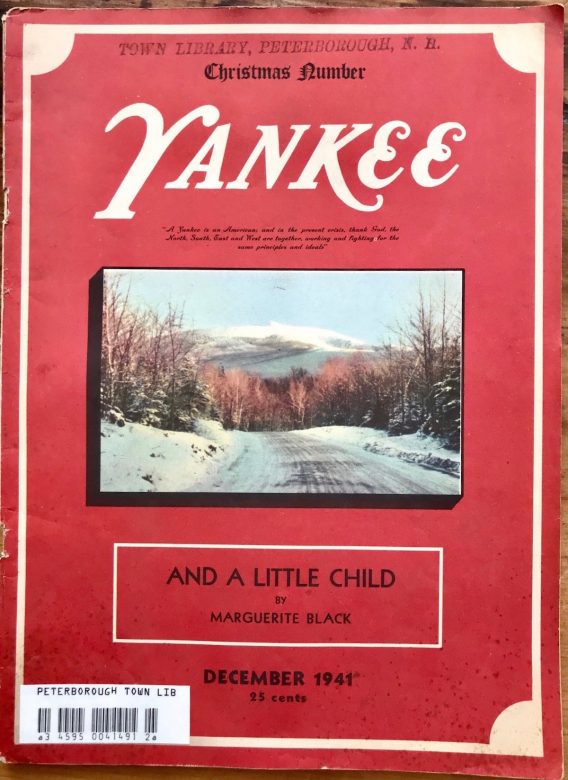
Credit: Annie Graves
On the December 1941 cover were these words: A Yankee is an American, and in the present crisis, thank God, the North, South, East, and West are together, working and fighting for the same principles and ideals. And yet, on the pages inside, I noticed something in the small print for many inn and hotel ads. An inn on Nantucket: Restricted. A hotel in Hyannis: Restricted clientele. Four lodges and inns in New Hampshire: Selected clientele … Restricted … Selected clientele … Christian clientele only.
Looking up these phrases on the Web took me down a path I had not expected: “Restricted clientele” meant no Jewish clientele. I paused. Not long after this issue was published, my father became one of roughly half a million Jewish soldiers serving in the U.S. armed forces. I asked Google another question, and found out that some 4,000 Jewish soldiers had landed at Normandy. Not one of them would have been able to vacation at these places advertised in Yankee, if and when they returned. I wish I could go back in time and be in the room when these ads, so removed from the cover’s “same principles and ideals,” were being accepted. But I cannot.
Here is the thing: Yankee did eventually stop taking those ads. Many of those same inns and hotels are still here, and I doubt today’s owners and staff could even envision an era when guests were turned away. Today we say we have never been so divided — we can’t even all agree to wear a mask to care for each other’s health — but at the same time I learn every day about acts of kindness and courage and concern that take my breath away.
The world of December 1941 is long ago, and yet still with us. Again we are in the fight of our lives. I know what Robb Sagendorph put on the cover back then seems beyond our reach: in the present crisis, thank God, the North, South, East and West are together, working and fighting for the same principles and ideals. And I wonder what someone will think of the 2020 issues of Yankee if they find them 80 years from now, tossed out when a local library clears out its clutter. I hope they will see that these are the stories from a time unlike any we had known, stories about how we kept believing in the best of us. Because the virus of restricted clientele died out. And we never stopped looking and finding the beauty all around us, and we never forgot what got us through, not once, not ever.
May 6, 2020: That Island Feeling
Summer arrived here on Sunday. The sky was blue, the sun hot. The thermometer read 80. My wife, Annie, and I live beside the Contoocook River in Peterborough, and for the first time this year we set up the table on the lawn and the outdoor furniture, cranked open the umbrella, and let the day drift along like the river. Our house was built in the 1820s, with two huge fireplaces in the basement where food was once prepared. Historical records suggest it housed factory workers for a good part of a century, and I picture them on a Sunday, watching the water flow, just like this.
In our 12 years here, we have seen a bald eagle in our oak tree, great blue herons skimming low, kingfishers on the hunt in the evening, a family of Canadian geese that every fall use the grass as their feeding station, a beaver that gnawed its way through our young trees, bobcat tracks, a bear track, a moose track. Sometimes when I walk outside late at night with Rudy, our Jack Russell terrier, he will begin to bark wildly into the dark and pull on the leash with ferocious urgency. I know at those times there is something close by that is best to avoid.
Right now I have a complicated feeling, even a trace of guilt, about living here in this pretty town, beside this pretty river, heating my small house with the wood I keep stacked on the edge of the yard. I know that millions of people cannot step outside and see the sun sparkling on the water as we do, going about our day, Annie planting lettuce and I picking up hundreds of acorns before they all sprout into a miniature forest. In the news I see images of beaches packed with people of all ages who are willing to risk their health and that of their fellow citizens just to be outside and soak up the ocean air. I want to think I would not be one of those people — that this collective cabin fever would not lead me to ignore the health experts and scientists when they plead for us to stay in. But here I am, with my tidy yard, a river to watch, the promise of a heron streaking by. So, I don’t have to find out.
Credit: Annie Graves
I have the same complicated feeling now when we walk into town, and always to River Street, the prettiest lane in Peterborough. This week, the magnolias and cherry trees were in full blossom. I know that fall foliage is New England’s signature season — our very own Mardi Gras — but when spring truly comes alive here, I can’t think of a more beautiful, more welcome time. So, I understand why license plates from distant places are suddenly everywhere in town.
I have not paid attention to license plates this closely since I was a boy sitting in the backseat with my sister as our father drove us on some road trip. We’d call out license plates we spied from states that seemed as mysterious as a foreign land: “Nebraska!” “Arkansas!” “Utah!” Now, though, it is very different. Yesterday as I was turning in to our driveway, three cars in a row with Massachusetts plates passed by. At the local supermarket on Saturday, I saw Massachusetts, New York, Connecticut. Then there was the young woman we saw unloading suitcases from a car with Texas plates and taking them into an apartment we’d seen being cleaned a few days earlier. And overlooking the river is a pretty Airbnb where I’ve seen New York, Illinois, California, and Connecticut plates over the past several weeks.
If I lived in one of the states hit hardest by the coronavirus, I’d want to be here, too, in a town where you can walk or bike and never feel crowded. There is a part of me that wants to say to visitors, Welcome, be well, be safe. And there is also a part of me, deep down, that shares the fears of many others in rural areas, and wants to say: We don’t know you. We don’t want to be unwelcoming, but can you go back home?
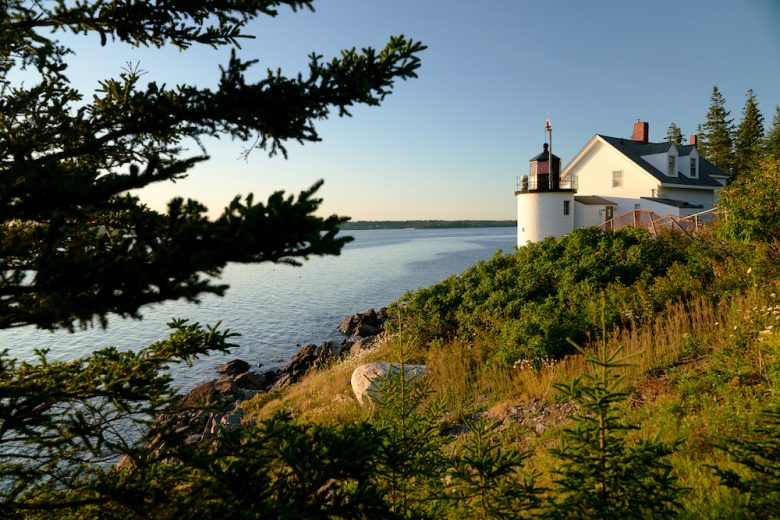
Credit: Mark Fleming
Today, a woman phoned me from the island of Vinalhaven. She had seen one of our e-newsletters touting beautiful Maine islands for readers to daydream about — including hers. She was worried that people would do more than daydream; they would come to see the island for themselves. “We are the oldest population in the country,” she said. “You can’t believe how on edge we are.” I do believe it. In some ways, we are all islanders.
Where I live, we have always welcomed people from away. When we see them sitting outside the Waterhouse restaurant where the river hurries along, or strolling in and out of shops in Depot Square, or on the trail climbing Mount Monadnock, we see our gifts reflected back to us. I want that feeling back. I don’t want to look a license plate from New York with a twinge of concern. I want to stop and say, “You won’t see it in a guidebook, but walk along River Street, and see if it doesn’t make you want to stay.”
April 29, 2020: Our Town
I don’t know the names of the two young women I saw walking from the pond beach to the nearly empty parking lot at dusk last Saturday. I wish I had asked if they would mind if my wife, Annie, took their photo. But I hesitated, thinking it was too intimate a moment for us to interrupt, and by the time I realized that maybe they would want to share it with others, they had climbed into their car and driven away.
It had been a mild day, 50s, the last weekend in April, and after a day of chores — stacking firewood, raking fallen branches and brambles and leaves from the yard — we had gone to our favorite local spot, Cunningham Pond. There are few summer days when we don’t go there after I come home from work, and we stay until the sun sets behind the trees. The pond is only 34 acres, 18 feet at its deepest point, and so pristine that for years it supplied our town’s drinking water. When Yankee wrote about it, we called it “Elizabeth’s Gift,” because local writer Elizabeth Marshall Thomas had bought the pond with proceeds from her best-selling book, The Hidden Life of Dogs, and bestowed it upon the citizens of Peterborough (with the provision that a second, smaller beach be set aside for dogs).
This Saturday I knew the pond would be Maine-ocean cold, the cold that seems at first to burn. We had come not to swim but only to see it, for the first time in months: the rippled water, the lifeguards’ pretty cottage, the path where blueberry bushes crowd close in July. Mostly, we went to remember the ease of summer.
Credit: Photo by Annie Graves
As we walked down to the beach, we saw the two young women headed up. I thought at first they had wrapped themselves in towels, and I shouted over, “Did you go in the water? Was it freezing?” One shouted back, “No, it’s our prom night!” And when I looked again, I saw they were wearing beautiful long gowns, and that everything about them was elegant.
Of course prom had been cancelled, here and everywhere, which means so many thousands of high school students had bought or made dresses only to have nowhere to wear them. So, two friends came to this lovely pond and made a memory they will surely talk about long into the future. Maybe if they read this — or someone who knows them reads this — they will send us the photos I am certain they took of themselves, looking happy and proud, with the sun glinting on the water.
This is the kind of story that our local paper, the biweekly Monadnock Ledger-Transcript, writes about. Like so many small-town newspapers, it has been around for generations. Entire lifetimes play out in its pages: a birth notice … youthful achievements on athletic fields, or in band, or in theater or 4-H clubs … honor roll mentions … graduations … news from college or the military or trade school … a wedding notice … more birth announcements … and one day, the final notice, when a person has passed. Countless households here have scrapbooks filled with clippings from the Ledger, some no doubt going back decades, telling the story of a family in one yellowed swatch after another.
Credit: Portrait courtesy of Kirsten Colantino
The newspaper also reports on the things that matter only here: a road paving project, a zoning petition, what band is playing Friday at Harlow’s, who is signing books at the Toadstool. It’s the steady voice that connects all of us who live in the Monadnock region, and it is needed now more than ever.
On Tuesday, the front page told us about a solitary trout fisherman who is living his social-distancing dream on the Souhegan River. It also reported that our famed summer theater, the Peterborough Players, has cancelled the season. And then, in a narrow column running down the side of the front page, I saw a name I knew: Kirsten Colantino. A friend and former colleague at Yankee, Kirsten is 53 and lives in Dublin. She is a hiker and a runner who had not been sick for a decade. But after returning home after a trip to Florida with her daughter in March, she soon felt ill. It was COVID-19. “Like being hit by a freight train,” she told the reporter. As to why she was sharing her recovery battle, Kirsten said, “I thought it was important to get a personal voice out there.”
Local newspapers rarely have circulations of more than 10,000, and most have half that at best. Yet they are with us, week after week, no matter what: a crippling ice storm, a two-foot snowfall, a pandemic. We rightfully extoll the frontline doctors and nurses and EMTs and everyone who works under the most hazardous and stressful circumstances to help others. They are the ones for whom whole cities cheer, every night, and they deserve all the thanks we can give. But I want to also praise the reporters working long into the night to bring the stories of their towns to the rest of us.
With restaurants and shops closed, there are precious few advertisers putting money into newspaper pages. For the first time, the Ledger has reached out to the public for donations; there are many other newspapers facing the same odds. We need them. Those two young women in their lovely prom dresses one day may have another chance to celebrate a special event, and I want a local newspaper to be here to tell about it — a story for family and friends and fellow townspeople, so far from the affairs of the world, and never more important than now.
April 22, 2020: On Childhood
It’s a strange feeling to realize that a story my father told about living through the 1918 flu epidemic is now becoming my story, and the story of my two sons, and the story of all of us, a century later. Then 11 years old, he was living with his parents, two brothers, and a sister in a cramped second-floor apartment above the used-clothing store his Russian-immigrant father owned in Philadelphia. The flu hit the city hardest in the fall, and soon all schools were shut. Before the epidemic abated, more than 12,000 had died. It was one of the heaviest tolls in the country.
I doubt I paid much attention to what my father said when he told me that story. We were likely looking at the only photo I remember seeing of him as a boy: He is sitting on a pony in the middle of a street, for some reason. And I haven’t thought about my father’s experience in that epidemic for decades. But now I am. I don’t know what his family did to survive — there is no one left to ask. Maybe just knowing that they did survive is enough, and that the little used-clothing store and that crowded apartment were both still there when I was growing up.
Thinking of my dad at age 11 makes me think of children today. I wonder what they will remember, what stories they will tell. Many have computers and video games; they have cellphones. They are confined but not cut off. Still, this is a time they will never forget. My generation came of age when nuclear war was not abstract. A bell would ring at our elementary school, and we’d scoot beneath our desks and huddle like turtles, hands over our ears so that (we were led to believe) the sound of the blast would be muffled. But no blast came. And as years passed, we no longer crouched waiting for the unthinkable. Today’s children will no doubt prove to be the most resilient of all. I can only imagine the collective sound they will make when once again they can romp on playgrounds and ball fields, and run out to recess. We adults may need to hold our hands over our ears as their joy cascades across our towns.
What started me down this path of thinking about children was a message that Amy Traverso, our senior food editor, sent out to the Yankee staff a few weeks ago. With all nine of us now working at home, we’re using a platform called Microsoft Teams to stay connected, send files, collaborate on projects, and also, from time to time, get playful. Amy announced she was launching a series of challenges under the heading of “Yankee Fun Times,” something to give us a laugh and keep alive the bond we shared daily in the office. Think of it as small talk in a world with so much talk about big things.
For this week’s challenge, we all had to dig up a favorite photo from our childhood. When I first saw this request, I sighed; I just couldn’t find the time to wedge in one more project, no matter how frivolous. But then there was Amy, giddily playing in ocean waves; Heather, our photo editor, on a Shetland pony named Pepper; our deputy editor, Ian, on a swing, his face full of mischief. There were also no fewer than four photos of future editors in tutus. I scrolled through the photos and realized I had been wrong. Looking at who we once were and knowing who we became, I saw the thread through time. A story on its inevitable loop.
Every Thursday morning, we have an editorial meeting by way of video conference — which to me is mysterious technological alchemy. Our senior digital editor, Aimee Tucker, has a 2-year-old daughter named Vivien, who often joins our meetings sitting on her mother’s lap, looking wide-eyed and intently at what must seem a strange set of talking heads onscreen — as if we are simply living in some secret chamber in her house, only to pop out once a week. She doesn’t disrupt what we do. She patiently shares her mother’s attention with us. I do not know what Vivien will remember from these weeks and possibly months. Maybe none of it. Or she may have a glimmer that her mother was always there, even as voices and faces popped up unexpectedly before vanishing in a flash.
One day I want to tell her, “Vivien, your mother woke so early, even before you, and she stayed awake late, long after you, so she could do what she knows connects thousands of people to New England.” I will want her to see the photo of her mother when she was a little girl, when she dressed up and danced, because that is what children should always do, even when their parents worry about an uncertain future. “Vivien,” I will say when she is older, “there was danger, yet you were protected. You made your mother laugh. You made a whole group of editors smile. That is how life continues.”
April 15, 2020: Missing Scenes
I have taught writing for 20 years — first at UMass, now in the MFA program at Bay Path University in Massachusetts, as well as at a number of workshops. I have no magical words that I pass on to help students reach their potential. So much depends on how deeply they want to work on the craft, how widely they read, how keenly they observe the world around them, and how well they understand the music of words. But I do always tell them this: To make their stories live on the page, they need scenes. Life happening, people talking, people reacting, movement, conflict, choices, resolutions. Every story I give my students to read is rich with scenes.
Last evening my wife, Annie, and I walked into town. It was nearly 7. It was cool, the light soft. And nobody was around. We walked up the hill, past the waterfall, through neighborhoods where now and then we stirred a dog to bark from inside a house. Forty minutes passed, and we saw only two other people.
It hit me then — in our small town, with spring poking its way through, with grass greening — that it was if this place had been stripped of scenes. I know from the news that there is immense courage and sadness everywhere, that makeshift hospitals now rise in New York’s Central Park, that healthcare workers are reaching their breaking points, that governors and mayors lie awake over how to balance saving lives against preserving livelihoods. But here, in this moment, that all seemed elsewhere. I listened to the barking, the wind slapping the trees. The scenes were inside these trim homes, and the doors were shut for the night.
But then a car stopped. Two windows rolled down, a black dog poking its head out the back. Greeting us from the front was Beth Brown. She is the granddaughter of Edith Bond Stearns, who founded the Peterborough Players summer theater in 1933. She is the daughter of Sally Brown, a force of creative will who kept the Players alive through the years, bringing it to where it stands today, one of the premier summer repertory playhouses in New England. As for Beth, she came aboard as the Players’ director of advancement last year.
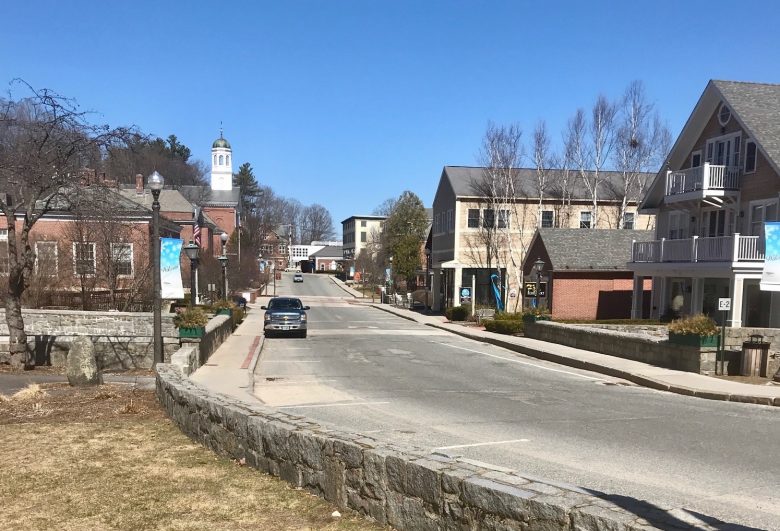
Credit: Annie Graves
There were no cars on the street, so Beth simply parked in the middle of the road. I asked if the Players would close for the summer. She sighed. “We don’t know,” she said. “We say to ourselves, ‘Maybe we could do one show. Or two. We could sit people in one row and not the next.’” She shook her head. “We have always found a way. We have to hope the people know how important we are, and they will stand by us.” Then she told us that performers from past seasons, including NYPD Blue star Gordon Clapp, had recorded short videos of hope and appreciation — called “Bright Spots” — that were posted on the Players’ website.
When I arrived home, I clicked on the video from Clapp, who had performed as Robert Frost in a one-man show at the Players. He said he was currently in Vermont, where he was living “in a safe and beautiful place” while the virus roiled New York. He finished by reciting “One Step Backward Taken,” a poem written by Frost after he saw a bridge washed out in a storm, a car teetering on the edge. It ended with these lines:
I felt my standpoint shaken
In the universal crisis.
But with one step backward taken
I saved myself from going.
A world torn loose went by me.
Then the rain stopped and the blowing
And the sun came out to dry me.
Afterward, I thought again about that sense I’d had, that I was living in a place without scenes. I remembered a few mornings ago, Easter Sunday. We live across the road from our town’s lovely stone Episcopal church. At 10, the church bells began ringing out hymns, and then I saw people gathering on the church lawn — not many, maybe 20 — standing apart from each other but still joined, not singing, simply standing in silence, listening to the hymns. After a half hour or so, the group gradually melted away, and soon the lawn and the parking lot were empty, leaving only the flowers on the church steps to stand sentinel.
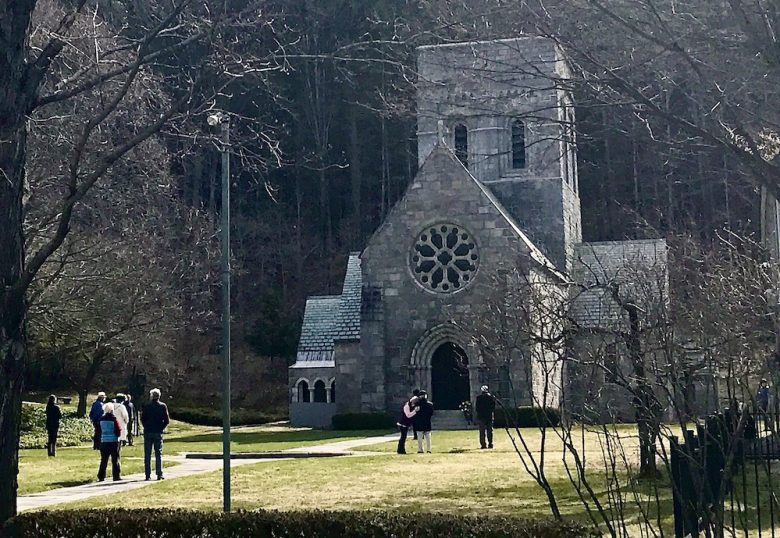
Credit: Annie Graves
Late that afternoon we went to see Annie’s mother at Summerhill, the assisted-living home where she resides. Like so many families with relatives living in these facilities, we can’t visit. Nobody can visit. It is necessary, but difficult. Mary opened the window as we stood outside; because her mother is hard of hearing, Annie spoke to her on the phone even though Mary hovered just a few feet above our heads.
Mary is an artist, and each day she draws fantastic images, her hand still steady at age 93. The form is called Zentangle, and it can be a sort of meditation put to paper. Each piece takes about three days. She will often awaken in the middle of the night and go to her desk, grab her pen, and begin. She has had an art exhibit of her drawings at a gallery and also at Summerhill, and today she held up at least 10 for us to see. She did this in utter silence. Her art has become a world within a world for her.
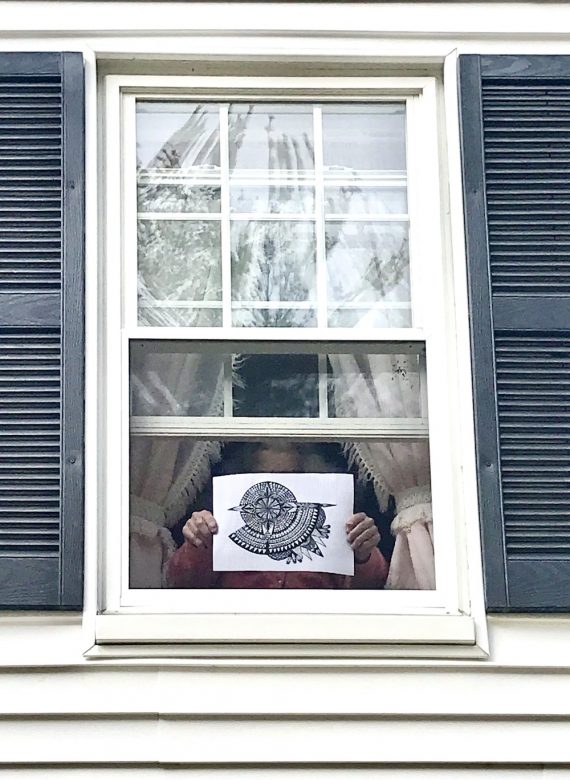
Credit: Annie Graves
Even as I write this, I realize I will have to adjust my advice to writing students on the importance of scenes. Don’t just look at what is happening in front of you, I need to tell them. Think of what you can find by paying attention. Think of how the simple act of saying hello when a car stops can lead you to an actor reading Frost, or how hearing a bell can let you witness faith when church doors are shut, or how showing up beneath a window can let an artist have her own show for those who matter the most.
April 8, 2020: Carrying On
In the summer of 2017, I traveled to Bucksport, Maine, to give a speech about the importance of community. There, I found a town that was facing the end of a way of life it had known for generations, as the local paper mill had shut down with little warning. I spent a number of days among those whose lives had changed so swiftly, and later I wrote their story for Yankee. I called it “The Town That Refused to Die,” and it began like this: You learn what you’re made of not when life is good, but when the ground beneath your feet gives way, and you are left afraid and uncertain of what to do.
I’ve been thinking a lot about those words lately. The ground beneath our feet is unsteady, with each day bringing fresh tremors. Yet everywhere I look, I see people carrying on, finding their way.
There are nine people on Yankee’s editorial team, and as with most offices across the country, we are scattered: one in Massachusetts, one in Vermont, but most of us right here in the Monadnock region of southwestern New Hampshire. We connect through words on a screen, and we see each other on video calls. Four of us are within a few minutes’ walk of one another, yet we ask how everyone’s day is going as if we were all living in far-off places. In a sense, we are.
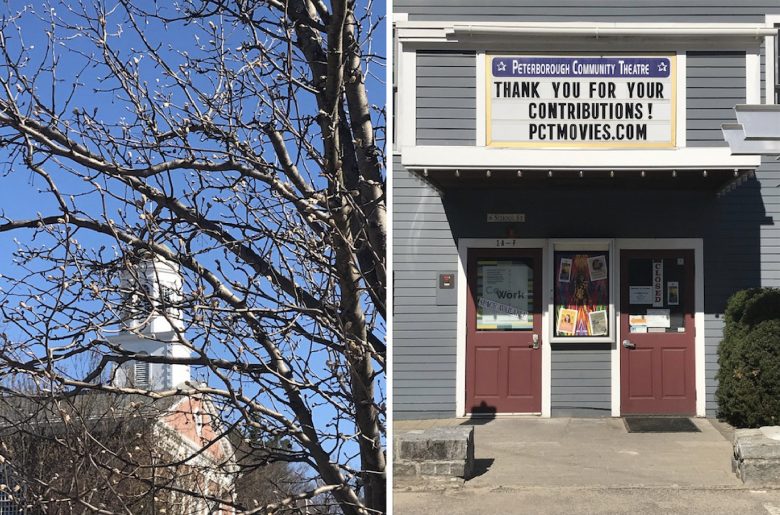
Credit: Annie Graves
I am noticing small things more than before; I imagine this is happening to many of us. The other day, I counted my steps as I walked the perimeter of my backyard, which ends at the bank of the Contoocook River. If the time comes when we are not allowed to walk freely in town or along the bike path, or on the forested trail, I know that 20 laps around my backyard will get me a mile. Over the weekend, my wife, Annie, and I took our dog for a walk in the woods behind the high school, and in the empty parking lot two young parents were giving their son what looked like his first bike lesson. He was laughing, and that was as welcome a sound as the peepers in the small pond, who in the quiet seemed as loud as geese.
And I am noticing the people I see walking past our house and on the sidewalks downtown. There’s a young woman who walks past our house every morning at roughly the same time. She seems shy and is usually looking at her phone. A few days ago, Annie and I were walking on one side of the street, by the shuttered town library, and the young woman was on the other side. We were the only people in sight on the main street of a town of 6,000. And we waved, and she saw us, and a smile lit up her face. I imagine we will always wave from now on, and maybe she will always smile.
Neither of us wore face masks that day. Yesterday, we both did, along with nearly everyone else we saw: the grocer, a woman by the post office. We nodded at one another, fellow wearers of masks. And in a small town, recognizing neighbors — whether with a nod in passing or a wave from across the street — feels for that moment that we are connected by something bigger than each of us.
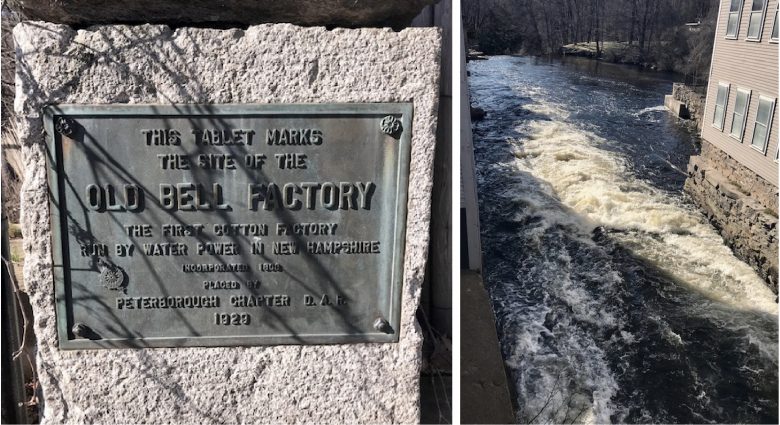
Credit: Annie Graves
These walks mean more than exercise. Nearly every day when we were at Yankee, several of us followed a nearly two-mile loop: up a steep hill, past stone walls, onto a dirt road bordered by trees, then spilling out onto the leafy campus of a private school. Those walks were for getting out, clearing the mind. Now, walks are for looking closely. I noticed that a magnolia tree overlooking the river is about to blossom. For the first time in years, I paused to actually read the historical sign by the thundering waterfall that marks the site of the first water-powered cotton mill in New Hampshire.
Today Annie and I saw a box outside the back entrance of the town library. It sat beside a container filled with hundreds of homemade masks, all waiting to be distributed. Inside the box were dozens of copies of a 40-page stapled booklet titled “Socially Distanced/Connected by Community: A Personal Journal of the COVID-19 Pandemic in the Monadnock Region.” Free for the taking, these blank journals are being offered by the local historical society, which hopes to collect residents’ accounts of these shared days and weeks. According to the sign on the box, organizers hope that one day, long into the future, “the people of the Monadnock region will be able to hear our voices, learn the ways the community pulled together (while staying six feet apart!), experience our disappointments and triumphs, and see the ways we persevered.”
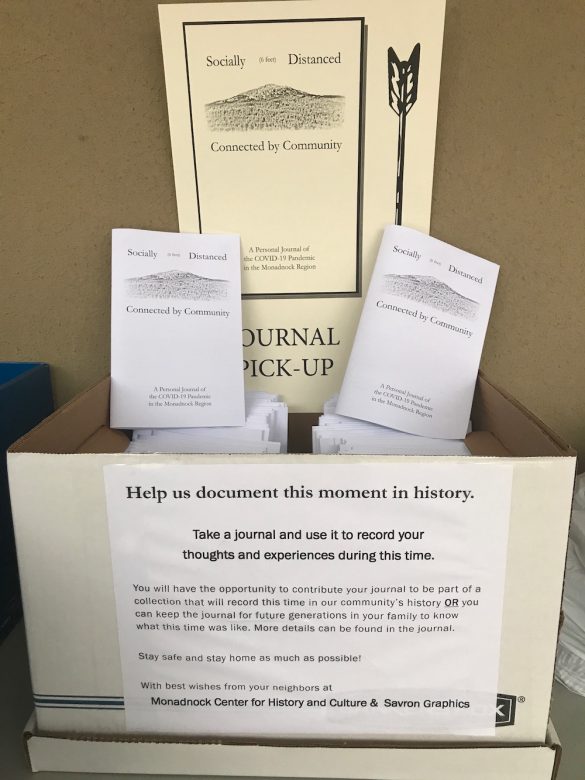
Credit: Annie Graves
I hope the children of today will come read these journals when they are ready — maybe in 20 or 30 years, when they have families of their own. They will see what all of us know to be true, even on a hard day: In time the ground settled, and we learned what we are made of. They made it through. We made it through.
April 1, 2020: And So It Begins
It was nearly dark when I finally left the Yankee office last Friday. New Hampshire’s governor had ordered all nonessential businesses to close until May 4, and even though in our hearts we feel our work is essential for anyone who finds solace in stories about the spirit and beauty and endurance of New England, we understood. And our staffers are continuing to tell those stories — though now from our homes, each of us connected through what I am convinced is sorcery.
By late afternoon Friday the parking lot was all but empty, yet I lingered. I had stacked a small mountain of Yankee volumes beside the copier and was picking through them, looking for those stories whose inspirational message would never grow old. Our associate editor, Joe Bills, hung in there with me, carrying volumes to a second machine to help copy my selections. In the end, when I drove away I had a box filled with stories of endurance and resilience that I hoped would brighten not only readers’ days, but also my own.
When I walked into the house carrying the box, there was a sound coming from the living room that I had not heard for a few years: the purring thrum of the Italian-made Necchi sewing machine that my wife’s mother had bought in 1953. And behind which now sat my wife, Annie. (“The machine weighs as much as a small car, and there was a fair amount of shoving and a dangerous moment of lifting, before it came to rest on the dining room table,” Annie wrote later on Facebook.) Beside the machine, she had laid a small pile of brown calico decorated with flowers, which she had retrieved from her mother’s box of fabrics and was using — like many others here in town and around the nation — to sew masks for hospital and nursing home employees.
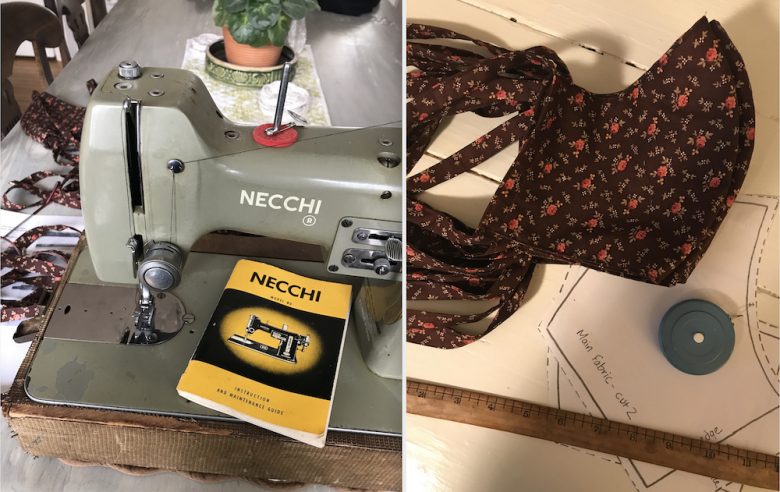
Credit: Annie Graves
The next day, I learned that a local man who had once fixed up and sold vintage sewing machines had come out of retirement during this crisis and was repairing machines throughout the area at no charge. Now, the sound of that antique Necchi downstairs from my home office reminds me that even when we feel helpless to control the big stuff, we can still find our voice to say, “This is what I can do.” And when millions find the same voice, it does make a difference with the big stuff.
My wife’s mother, Mary, is 93 years old and lives at an assisted-living facility called Summerhill about a mile from our house. Our routine for several years has included a short Sunday drive with her to a local eatery, usually a diner. Of course, that has ended for now; the residents of Summerhill can no longer leave their rooms. It is hard on them, hard on their families, but everyone knows why this is needed.
After snow fell in New Hampshire last week, the community relations coordinator at Summerhill, a woman named Jean Kundert, started making snowmen for the residents, whose windows provide their only link to the outdoors. When Jean finished a few hours later, 42 snowmen faced those windows. Later, on her nightly phone call with Annie, Mary laughed as she told about seeing the snowmen, her voice sounding light as a child’s — which for a few minutes that day she was.
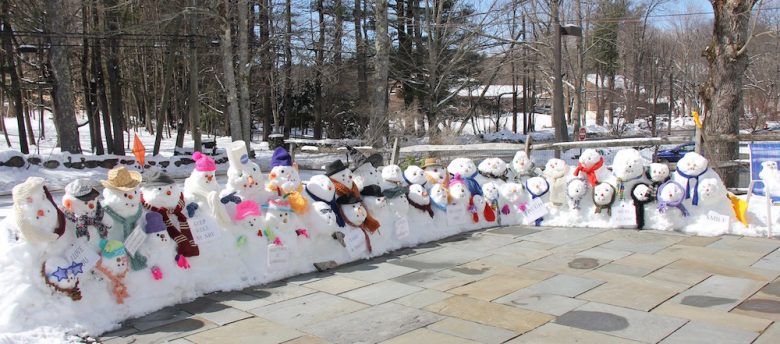
Credit: Annie Graves
Stories of hope, and of people going to extraordinary lengths to help each other, are our lifeline to a more normal future, whether that lies a month ahead or two, or well into the days of summer heat and tomatoes ripening in our gardens. For today, my sign of hope is an amaryllis plant. Annie brought it home three years ago from the recycling center, where it had been dumped into the compost heap out back. She placed it in the sunlight, beside windows facing east and south. She watered it, believing in the power of nurturing. The green shoots grew — one foot, two, three — but never a flower.
Last night? Well, last night this is what happened.
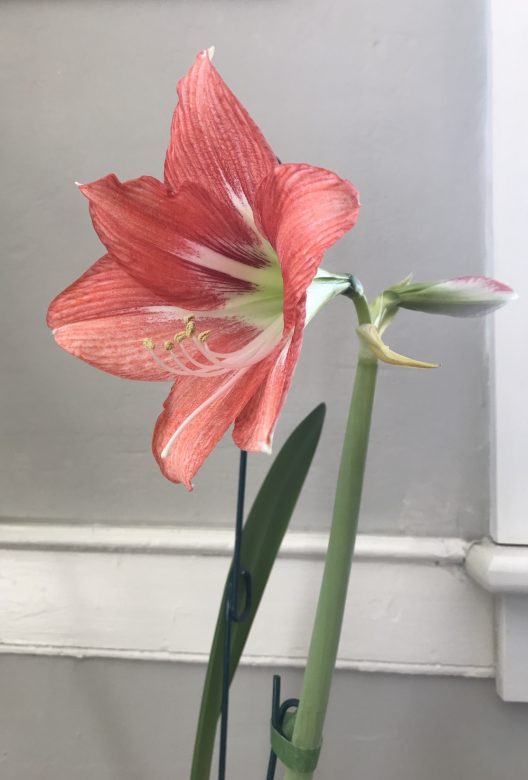
March 25, 2020: Blessings of Ordinary Life
The snow fell heavy and wet on Monday night, and we woke up to trees wearing a blanket of winter white. It was really quite lovely, and even though spring had arrived and I would have welcomed having grass to mow and a garden to till, there was something comforting in being out at 7 a.m. shoveling. The sheer normalcy of flinging snow off the car with my mittened hands and clearing a landing spot in the yard for Rudy, our fiery Jack Russell terrier, made the world seem, for that hour or so, quite ordinary. And for that I was grateful.
My colleagues here at Yankee are now working on our July/August issue, and our daily newsletters, and our constant outreach on social media. Sometimes it may seem as if this stuff just happens, as if by magic, but it doesn’t. And I want you to know the names of two of the people working hard behind the scenes: Aimee Tucker, our senior digital editor, and Katherine Keenan, our associate digital editor. They understand that they are building a bridge that spans the country, even farther, and whenever someone takes joy in making a recipe they send out, or scrolls slowly through the beautiful New England photos they feature on Instagram — well, in moments like those, they have given all of us a kind of landing spot.
The May/June issue, which we finished last week, will soon arrive in mailboxes around the country, filled with stories about paying a visit to Atlantic puffins on their rocky Maine island home, experiencing the magnificence of a windjammer under sail, celebrating the tradition of New England summer theater. These stories seem as if they belong to a different place, another time. And we all know they do. When we planned the May/June issue so many months ago, we talked in the halls about the summer ahead, the Red Sox, and whether Tom Brady could win one more Super Bowl.
So here we are. We remain at our post, but our task has shifted. We are looking for that delicate balance between acknowledging that we all feel anxious about what happens next, while still working to bring the beauty and blessings of ordinary life to you, wherever you are.
A few days ago, I heard from one of Yankee’s contributing writers who lives in northern Vermont. He wrote that he saw the year’s first red-winged blackbird in his yard, and that the maple sap was still running, and that a friend who was anxious about the headlines also had lambs on the way—and lambs won’t wait until the world is on an even keel again. This writer was saying when you simply look around, you can find timeless comforts even in the most trying times.
I also recently came across a Facebook post by a gifted local singer-songwriter, Wendy Keith, who plays all through the Monadnock region and beyond. Her new CD just came out — Wendy Keith and Her Alleged Band — and yes, I plugging her record here. Why? Because when my wife read her post, tears welled in her eyes and she shook her head, and I realized that even these dark days bring unexpected bursts of light. Here is some of what Wendy wrote:
It’s been 30 years, no, maybe 40 since I rode a bike. I’m not sure. It’s been a long while.
Today, here on Sanibel Island in Florida, where although it’s the month of March, it feels like July back where I come from in New England.
But today I made the little extra effort to do something that frightened me, and I know this sounds a bit silly, but hey, I’m 65 and almost 66, and falling has greater ramifications than it did when I was 20 or 30 or even 40.
Today I felt like I was 10 or 12 again and I tried something that felt virtually new again. I got on a bike and rode. And it’s true; it’s just like riding a bike.
When I was a child, my dad taught me how to ride the amazing two-wheeler…. He talked me into feeling confident, gave me a running push, and did the hardest thing parents ever have to do, he let me go. I was feeling so excited and adventurous that once I got going, I spontaneously thought I might get tricky and began to waggle my handlebars back and forth. I vaguely heard him say I shouldn’t do that because I might fall, when the pavement came suddenly up to meet me…. Boom — I crashed. This I remember well. I don’t remember getting up again, but certainly I did. I lived to ride another day.
Somewhere along the line, I stopped riding bikes. I grew up, went through college, met a man, married, and had children. I taught children how to ride bikes, how to drive cars; they grew up and moved on.
Now I am older. I have a grandchild who has yet to ride a two-wheeler. He will before too long and sometime he may fall.
And this season is radically different…. Radical and unfamiliar changes are taking place constantly, daily, minute to minute. Courage, faith, and simple daily tasks have become challenging, and being far from home right now is surreal and unsteadying….
We are in a small, private cottage on a long-planned trip, taking precautions to isolate and physically distance ourselves to the best of our ability. We drove on this trip, which gave us a sense of security and control at least over our transportation. Not much else has been normal. Restaurants are shut down now and an order has just been given to close all lodgings in the Florida Keys, not far from here, so we could be next to be told to pack our bags and go home.
But today we put on some sunscreen … and went outside and got on bikes and went for a ride. In a remarkable way, I was suddenly 12 again. I felt the wind on my face. I pedaled and balanced and loosened my grip and rode down the road like a pro…. I found myself riding all around the neighborhood, then down the bigger road and all around and around the nearby neighborhood. And it had a bell. I rang the bell.
Life is often so much about context and perspective. You, my friend, can draw any conclusions you like from this tale of my day in this troubled time. Today I got back on that bike.


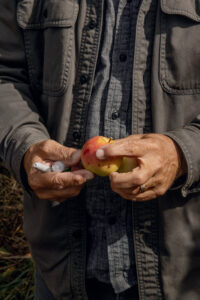
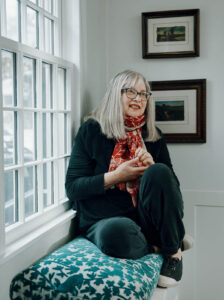
This is Ethel’s husband, Gerry. I recall walking the beach on Sanibel, collecting a few shells, enjoying the Gulf air, with our 90 year old aunt who wintered in Tampa.
I wonder if, at 87, I could still ride a bike. I fear not.
I look forward to your weekly updates! The first thing I read when I get my Yankee Magazine is anything written by Mel Allen…..keep up the great writing , I love your magazine ❤️
Beth I thank you for this generous comment. The entire Yankee team knows that more than ever the stories from New England matter to people wherever they live.
Just read your column and Wendy’s words. Like your wife, I welled up, hugged myself and sighed. We are “cocooning” here in Texas as well, my husband of 50+ years and our Golden, Sasha. We’re lucky to have family close by and know that we are being looked after with care packages on the front porch and kisses through windows. This too shall pass. Scary, YES, absolutely! But I know that God is still on the Throne and that He will never leave us or foresake us. I believe that this country will be a different but better place when this is over. Families will remember this time with joy mixed in with the sadness. Thank You!
Dear Texas reader. I thank you for these words. I agree that down the road we will be kinder and more thoughtful to each other and just maybe be able to see the shared humanity in all of us.
Dear Mel, Please keep that “…other place and different time” alive for us . It’s still there, just beyond the door, waiting.
Carolyn, I will do my best to keep all of us connected because we can all walk through that door together.
Thank you so much for sharing Wendy’s letter.
She is amazing. Her simple story of having the courage to get back on that bike will be one we all should remember as there will be all types of bikes for us all to remount in the days, weeks, and months ahead.
A big high five to both Aimee and Katherine!!!
I can only imagine how busy they are working behind the scenes. Thank-you both for building that bridge and bringing some normalcy into our lives.
Oh, how I’ll look forward to your letter from Dublin! Thank you, Mel.
And thank you to Wendy for her very uplifting letter.
Be well, everyone!
Thank you for the emotional lift !! I ventured out this early am ! I live on Cape Cod !! Needed to feel in control again after eye surgery ! Can only see out of my right eye right now but the Cape has many shades of gray and blue and I will always enjoy seeing those colors even if for a time it’s only with my clear vision on one eye !!!
Dear Mel, thanks for the update on Yankee from Dublin,NH. I lived in Antrim NH for 15 yrs.,back at home in Ohio. But that little part of the world, NH was so special. The people, the towns, visiting Yankee Mag. on top of the hill in Dublin, with the flag waving-a wonderful picture in my mind. And Dublin lake, with the sailboats floating across, sails raised high-
Thanks for what you do to keep us connected and remembering in these bad times, the good times. We need to pray and thank God for the blessings we have,family and friends that stay connected (even if its thru our wonderful technology.) And another thing that nobody has mentioned: Laughter-it is the best medicine -even if we have to fake till we make it. There is healing in laughter as well as in tears. Put on a laugh tape, find a site on the internet and LAUGH or watch old reruns of Lucy, Johnny Carson and even the three stooges. Why-read Norman Cousins work: Anatomy of an illness. It will explain the health benefits.
And as I end this note, I will promise to keep my Yankee subscription in force permanently Thank you, Madeline L. Dusky Keep praying , smiling, being kind and laugh till you cry. Blessings MLD
All your letters brought tears to my eyes. We are staying in here in WA State, but I always miss home, which for me is N.H. and Greenfield MA. Thanks everyone.
I could feel myself on that first ride in the deep sand patch in the driveway but My uncle rode my brand new white and blue Schwinn girl’s bike first and I was certainly not allowed to show my anger at him taking over MY bike and being first to ride on the sand driveway of that small Wisconsin farm.
This made me dust off my long forgotten bike, put air in the tires and take a spin around my sunny California cul-de-sac and reminisce about my long-ago happy New England childhood. I didn’t fall! Thank you for the memories during this time of staying home and social-distancing. Linda S.
Thank you Mel for a brief escape from these tempestuous times. I love your writing and Yankee magazine which is always a beautiful escape but never needed as much as now!
Love your stories. Please keep them coming.
I went to Dublin School from 1968-1972. I remember Annie well. She was there the last two years I was there. Talk about a blast from the past. We used to ski on the North Slope and the South Slope on Old Harrisville Road. Lots of good memories. This nightmare will end eventually. Tell Annie I say “Hi!”.
Thank you for this wonderful message. I’m not riding bikes anymore but it made me feel like I could. This to will pass and life will go on again. For now I bake more often, clean more often, (closets draws etc.), get in touch with old friends, think of the days long ago in Westminster, Ma. and living on Wyman’s Pond. For now I live in Florida waiting for all this to end watching others ride their bikes past my house.
I always love reading your articles and updates, Mel. Keep them coming! We need your very reassuring hopefulness now!
Wow, that Necchi brings back memories! My Noni did all of her sewing on one that looked very much like the machine in your picture.
Everything happens for a reason…this is a moment in time…a time to downshift…re-discover the meaning of simplicity and thoughtful living…a time to scale back the frantic pace of life that was launched by the Space Age in the 1960’s…it’s been a long time coming and now we have it…
Your messages are so enjoyable in this time which needs a little lightening. Thank you.
Thank you. There may be “Letters” where it is more difficult for the lightness, but hopefully they will all give you a dose of reading pleasure.
Thank you for making me feel full instead of withered. It is raining in N.C. while I am reading your truly wonderful article as I look out at the heavy rain. It is part of Spring, and lets me know that everything will soon be blooming and lovely, even in the midst of isolation. We are able to visit our two daughters and sons-in-law who live nearby and can maintain appropriate “social distancing” in their driveways. It is more than many others have, and it is very good.
Indeed, those of us whose children live in distant states feel a collective envy of your driveway visits. Thank you for reading and may you and your family stay well.
Once again, thank you Mel.
I so enjoyed today’s letter. I can picture many things in my mind, and loved the church Easter photo.
Annie’s Mother is so talented..her drawing brings a wondrous smile to me. Maybe she will show us more sometime?
Be well.
Thank you for sharing and making us feel we are not alone during this chaotic time. I passed along the Journal idea to our historical society in hopes of our community journaling how our town of 1,100 (Worthington, MA in the foothills of the Berkshires) has been effected during the COVID19 pandemic for future generations to read about.
Thank you and be healthy and safe.
Together we will persevere!
Thank you for reading, and what a nice ripple effect if your own town can do its own local history of this terrible time–yet filled with stories from your neighbors of their determination to persevere.
Dear Mel~
I love your words and your town. The Peterborough Town Hall provides some great music, most recently The Ghost of Paul Revere. I am fortunate to live near St. Anselm’s. My husband and I take walks to hear the bells. Walks give me a proactive zest. My cheeks get red. I breathe the cold deeply, except when I see someone. Do the molecules of the virus hold still in the air?
The bells ring on St. A’s campus…it’s a sound of consistency. Time has always marched on. It is a calming sound, my god above me in the tower of higher education and the tweet of the cheeseburger birds. Cheeeseburger…cheeeeeseburger…
A cardinal undulates through campus. I have seen one everyday of my furlough. We know leaving the suet out is a draw for bears but the joy of seeing downy or red belly woodpeckers, chickadees, nuthatches and grackles is a sacrifice I just cannot make right now.
I would love to take your course. Your letters in Yankee are the first I read and I sure do miss Edie Clark.
Nancy
Bedford NH
Nancy, thank you for your note and for letting us see your own lovely moments.
I’ve subscribed to Yankee Magazine for two (three??) years and it transport me to the New England States of which I’ve never been. I’ve gifted a niece her copy for the second year now. She vacations out of the country every year, however, after retirement she plans to first vacation in the New England states. She, as well as I, have fallen in love with the way of life portrayed in the magazine. your Letter From Dublin-?: I read your very poignant letter on line tonight. If it were a book I would have read it far longer and then hugged it to myself. It is saved in Favorites so that I can read it again. I read Yankee Magazine from cover to cover including the ads. Your casual smiling face and smiling eyes are as a warn welcome back w/each edition. You’re like family. I so enjoyed your walk w/Annie and would have loved to see a picture of you and her walking together in the near empty streets where you could hear and feel the heaviness of silence. We have been chosen to be here at this time in history. A part of us will somehow remain in the annals of every country on planet-earth as they each will record this historic event for posterity. What an honor to be chosen in this time of history. We will come through a better people for it; most definitely stronger yet humbled; more appreciative and grateful for the minutest of blessings. As you and Annie saw things never noticed before hopefully we all will embrace the before things…now seen; the people before not seen…now seen. Every small thing is a part of the whole.
Tracy, your words mean a lot to me. My thanks
As a recent retiree, I now have “time”, that was my gift to myself. I love reading your articles; they capture me so deeply and I escape as it helps me believe there is still so much good in our world — even thru these trying times of uncertainty. I agree with the comment above about everything happens for a reason; time to downshift; live simple and have time for our family lives. I see so many families now out together walking. Your articles continue to make us stop and reflect what life is all about. Thank you
My son and his family used to live in Dublin NH and it was absolutely the best when we went to visit. Many fond memories of Peterborough as well…..is the ice cream store still there? Thanks for your weekly message..Love it!
The articles and the comments are the most meaningful items I have read in this time of isolation and reflection. I reread what I had written about my uncle riding my new bike first, and for the first time in maybe 70 years I chuckled and thought – as an only child that was the one time I experienced sibling rivalry!
Have had subscription for years really enjoyed reading how your new life is going and learning how with modern technology one is able to continue staying connected, in comparison to 1918. My mother was born 2 years later celebrating with the community will not be possible June 2nd she will be 100 a gathering 6’ apart in the field in front house will sing Happy Birthday. Again feel blessed for time and reading what you printed above. May we all find a purpose to arrive in these uncertain days.
Thank you, Mel. I thoroughly enjoy reading your weekly column. And all things New England where I grew up (now live in California). Jane
I have missed your Yankee Magazine since my last receiving in October 2019, I let my subscription laps and thought I could do without. Well this day I called the Yankee 800 telephone number and reconnected with New England, my mother and her family were from Manchester, New Hampshire, your reflections provide me to savor memories of a little boy who would visit and hold on to my memories that were given to me in the 1950’s, a gift, precious with much appreciation of someone’s love to me. Thank you. George Singletary, Basking Ridge, New Jersey
Mel, you mentioned that none of your family is around but their is “ your” family so tell them what you remember , good times and bad but let them carry the memories to their families eventually so nothing is forgotten or traditions are lost. Also I wish we had Yankee magazine all twelve months. So don’t forget family is everything, yours and Yankee.
Thank you for bringing a lovely distraction from the weight of the world today. Just for a few moments, I went on that walk with you, and breathed the crisp air of early spring. Just for a moment I felt the promise of a brighter tomorrow, a day treasured and a moment in time preserved be a sweet Memory. Thank you for thoughtful beautifully written story.
Hello Yankee……I am a displaced New Englander living in the. Northwest and always homesick for the Northeast. Thank you so so much for these New England stories of courage,kindness and resilience. That is what New Englanders do isn’t it. The day my Yankee magazine arrives, nothing gets done til I have devoured it cover to cover. All that said…..a heartfelt “thank you “ and hopes that you and all your family stay happy and healthy, from a homesick Mainer,Carol
Mel, Just got thru reading your article. always a pleasure. I just lost my
Mel I just finished reading your latest column and it brought back many happy memories. I was born and raised in Rumford, ME but currently live in Littleton, MA. I just lost my husband of 58 years in January and thankfully it was before the virus quarinteen hit so I was able to visit him while he was in hospital, rehab, and back in hospital. Your letter brought back many of our happier memories. I look forward to your more of your articles. Yankee never fails to raise my spirits.
I was born in Peterboro in 1934. My dad had a greenhouse along the river and which went down the river in the flood of? I was baptized in the stone church. I have a bathroom sink that my husband bought when the hotel was auctioned off. I remember a path over the hill which led down to the back of the stone church. I went to Miss Lindemann’s pre-school. My aunts, Esther and Mary lived and died in Peterboro.
What great fortune to have found those magazines. Note: I don’t say old magazines, indeed they are treasures. Can they be reproduced somehow to give them a second life? I so value my “Best of Yankee” book with the memories.
As a baseball fan going back to the mid 40s, I can’t help wondering if you are related to the Mel Allen known as the “Voice of the Yankees”?
My eyes are filled with tears after reading your letter. One of our favorite day trips is to Peterborough……miss them now.
Thank you
You have brought tears to my eyes in writing that one day people will read about these times. I hope we are resilient enough to endure and carry on. So many people have been lost. Thank you for your beautiful writing.
Thank you (and everyone here who shared thoughts. We really have one choice, to be resilient and to care for each other, and in so doing we care for ourselves. I write these “Letters” for all of you who by reading give back to me.
Dear Mel
Thank you for your wonderful tribute to our lost ones on this Memorial Day. So good of you to say each of those names aloud..brings a tear to my eye. May they all rest in beautiful peace.
We love your letters from Dublin.
Mary, thank you for reading, and especially thank you for letting me know the words touched you. That is all a writer can ask.
I don’t ever remember not reading Yankee. As a kid, my favorite things were “Plain Talk”, and also trying to identify the strange item each issue teased us with. My mother contributed my Great Aunt Selma’s recipe for Rhubarb Sauce, which Yankee publishes each and every year. But I am delighted with your weekly letters, Mel. Even more than Earl Proulx’s knowledge and wit. I’m fascinated with your mind and how you see the world. I may not always agree with everything you say, but I love the way you say it! The thought occurred to me this morning that if each of us wrote one weekly story about life as we’re living it, it would become a great legacy to our families one day. I am working on my family tree and have recently found relatives in Holland with actual stories about ancestors I’ve only heard of – from letters written by them. It’s astounding how this changes the way you think of them. Instead of one-dimensional names on a page, suddenly they are living, three-dimensional people . Your letters will not only log these times we’re struggling through, but will keep you alive for generations to come. Everyone who reads them will wish they’d known you, been your neighbor, or your friend. The town of Peterborough must be thrilled at the way you’ve lovingly described and immortalized it. Thank you so much for touching our hearts and souls.
Anita, what a wonderful note for me to read. Earl Proulx is deeply missed by all of us at Yankee. My mother, who has been gone now for many years, always turned first to “Ask Earl.” Only after reading his dry wit and knowledge would she see what I had done. Your idea of a national oral history made up of many thousands of “Letters” from where the writers live is one I hope can happen. It would be a history of this extraordinary time written by all of us. Your generous words about my own certainly make me want to continue bringing this slice of the world to you.
Hello Mel,
As an “Old Englander” who has had the good fortune to visit New England many times, I have subscribed to “Yankee” for many years. I look forward to receiving my copy as it transports me the 3,000 miles across the Atlantic to a part of the world that my wife I love. Your “Letter from Dublin” is something else I look forward to as it gives a great insight into daily life in a New England town and it is so well written, it is a joy to read. Please keep doing what your are doing!
Mel, my heartfelt Thanks and appreciation for both your work and your words. Yankee has been a significant part of my life for over fifty years. My Mother had to have it, especially after we relocated in the sixties. Yet, heart, soul and spirit remained a Yankee Islander. While you have the Contoocook River, I had the Piscataqua, the Isles of Shoals, the Bluefin market and Warrens. Aye, these are just a snapshot of the many memories that crash though like surf on the rocky shore. Your words are gifts, a taste of maple syrup, the crack of lobsta’ shells, smells of fried clams, the views from Monadnock’s summit and a salty breeze bellowing in your face. Of course there is more, oh so much more as this heart of oak and granite spirit with sea water runnin through my veins will be till the end. Thank you Mel Allen for all you have put down on ‘paper’. And remember we have lived through this before and will again until everyone sees with with crystal clear unfiltered vision. Crispus Attucks died at the birth of this country almost 250 years ago, and he was Black & Native. Every “Person” has something to offer. History has shown the path to inclusion is teeming with pitfalls, yet none of those are ‘natural’, each and everyone has been man-made. We are now in the 21st century, Covid plagued and socially disrupted. As you queried about how would ‘Yankee’ today be viewed in 80 years – what will history say about how “We” as people navigated these times.
Thank you, Mel, for another thoughtful and thought provoking article! I love New England, it is where my roots are. I love it for many reasons, but you are right, it isn’t the most diverse place on earth. Many stereotypes need to be re-examined and thrown away. Thank you so much for telling us about Jonathan Daniels and about Ruby Sales. I will look up her wonderful organization and, hopefully, make others aware of it as well. We must NEVER forget. We have a lot of work ahead!
thank you for this beautiful piece Mel. I have been reading Yankee for more years than I care to count(except for the 2 years in AZ when reading it made me so homesick, I cancelled my subscription…but it made me realize that I needed to come home…first thing I did was reinstate Yankee!) These times are so difficult, your editorial today brought me some peace and solace. I appreciate it very much. Thanks again. Stay well, stay safe (seems to be the way many close their emails these days)
Thank you letting me know the words resonated with you. If our efforts with words and photos made you homesick for this little corner of the planet…well I call that a job well done. Yes, we must all stay well and thank you for the good wishes on that.
These weekly letters are a welcome change in what we read these days. Trying to stay informed but not panic is a delicate balance. Your letters acknowledge the situation but help bring a balance. We find much of New England to have a slower, more laid back atmosphere. That’s why we enjoy our vacations there. We are facing the possible loss of that time this year. These letters seem to bring that quiet we are craving. Thank You
Cheryl, I love that expression about seeking the quiet. Even in our homes now the world feels loud doesn’t it. I will continue to seek the balance, and I hope you will continue to find a few minutes of enjoyment with each one.
Thank you for bringing New England to me, I’ve missed it so. I was born a Yankee in Massachusetts 1928 . My traveling days ended with copd but sometimes I am back home when I dream. Reading Yankee is balm for my soul. It connects me. I have 16 acres in Swanzey occupied by beavers, they own it. I pay the taxes. Wendy’s tale of riding a bike on Sanibel Island brought memories of a happy week there. A friend rented a bike and I agonized over wanting to ride but I was 76 and the fear of broken bones won out. Now I wish I’d had Wendy’s courage. Now this Yankee lives in New Mexico, landlocked but also beautiful and there are beaver. near by the Rio Grande.
Virginia, just as you say these “Letters” give you pleasure, so, too, do notes like this. I laughed at your line that you have 13 acres, the beavers own it, but you pay the taxes. The laugh felt good. Thanks for that, and the kind words.
Thank you Mel Allen and the rest of the Yankee staff. I have enjoyed very much these Our Towns news letters. You touch our hearts. Even though we aren’t in New England anymore, you spark our desire to be there. Keep up your wonderful work. Soon this plague will be over, and who knows maybe this will be the year I can visit my beloved New England again.
When the “plague” is over, there will be no better place to breathe deeply and feel the world opening again. We’ll look for you.
Absolute poetry!
Thank you for that. After this coming Saturday’s “Our Towns” newsletter where my “Letter from Dublin” appears, my “Letter” will become bi-weekly and I hope you continue to find it.
All lives matter
Over the years (they’ve become many now) when my Yankee would arrive I would first turn to “Mary’s Farm” as Edie Clark’s words always had a way of bringing me back in touch with my life growing up in Rhode Island. I remember one essay about the apple trees on the farm that reminded me of the old Baldwin apple tree in my grandmother’s side yard and the things she could do with those apples. I wrote to Edie and told her about that memory and received a wonderful reply. My second stop was Judson Hale’s “House For Sale” column. I can remember sitting and reading about the wondrous places that exist in New England and thinking how it would be nice to have the money to purchase something like that house. And then there was the issue that came and I turned to “House For Sale” and it was Jud Hale’s home on the big lake. I actually shed a tear as I read that he felt it had come time to sell the place where he and his family had summered for so many years. And then Mary’s farm was for sale as Edie had become unable to stay there alone anymore. Now I have a new (well not so new, friend at Yankee and a new “column” to look forward to as part of New England Today. I hope that you will continue these letters in New England Today and maybe think about adding them to Yankee’s pages as well – in addition to your column that whets out taste buds as to what’s in the issue in our hands. Thanks for many years of reading entertainment, I look forward to many more – both my years (I’m now 75) and Yankee’s.
Bob this comment is meaningful on many levels. I will read it to Edie over the phone, and I will also be sure Jud sees it. These memories that stir within us when we read someone else’s writing is akin to magic really–we wonder where that memory has been living all this time, and thankful we found it again. I look forward to writing these letters for you. I will be going bi-weekly and I hope they will be worth the wait for everyone.
Thank you for your stories. As I read them, I imagine driving by Yankee, stopping at the Country Store for coffee and scones and then head east to visit the grandkids. This image brings me hope in these trying times. Thank you!
Thank you Jean. The Dublin General Store keeps open with its famous cookies and scones and is certainly a model of local perseverance. Hopefully the Yankee offices will be opening soon…be sure to beep hello as you pass by.
Dear Mel
You have touched my soul, yet again, and I thank you.
I hope to find Jud Hale’s Education of a Yankee. I’ll love to read it.
And I’ll be sure to be looking for your biweekly Letters from Dublin…
Thank you Mary. A writer can not wish for more meaningful words than “touch my soul.” There is so much happening all around us, I will try and keep finding the moments and stories that speak to all of us.
I love your letter, Mel! I remember you when John P hired me to work in the Yankee Public Relations Department. I used to help plan Jud’s Old Farmer’s Almanac publicity tours. One year my young daughter caught a caterpillar for him to take on tour, as he claimed it predicted the winter’s weather! Linda Greenwood
Thank you Linda. Because I have been at Yankee for four decades now, so many good people have passed through the corridors, and of course I remember you. Thank you for following along on this Monadnock Region journey.
I was surprised to hear about Mr. Hale talking about Vanceboro, Maine. That beautiful part of Maine gets overlooked. The next time you see him, ask him if he ever made it over to Lambert Lake, just a stone’s throw from Vanceboro; our family had a log cabin on that little lake for many years. Two weeks every summer on Lambert Lake with an occasional trip over to the big city for propane or milk or bread! Wonderful Washington County memories!
Roger, I think you would enjoy reading Jud Hale’s memoir, “The Education of a Yankee.” There is a good deal about Vanceboro in the book since it played an important role in shaping his life.
Thank you for your wonderful “letters.” I look forward to reading them each week. You have such an ease in expressing your thoughts that I always feel as though I am standing right next to you while experiencing your stories. Although I live outside of Pittsburgh, PA, you take me back to summer visits with my grandparents in the little village of Deposit, NY and how I always longed to be a part of their small town life all the year round.
Denise, when a reader tells a writer that it comes across with “ease” there is no greater compliment. I thank you for that.
I enjoy your musings Mel. I only wish there were daily doses to read every day! Marcy
Marcy, thank you for reading and for your encouragement. If only I could stretch a day to, say, 36 hours, I might be able to write “Letter” more often. You’ll see them now every 2 weeks–and hopefully you will continue to follow along. Readers like you certainly make it worthwhile. Thanks.
PLEASE, do not retire yet! I always love your columns and re-read them over and over. They take me back to the places I love.
Right up there with bringing special talent to readers as a reason I feel lucky to do this work, is hearing that my own words bring pleasure as well. I thank you for letting me know I should keep at it a bit longer….
I hope you never retire. Your words are a gift beautifully wrapped. Thank you.
Dear Mel,
What wonderful and special company you were to me this July 17, 2020 and your
letter of yesterday, the expressions are so very vivid to the readers mind as all of
your letters have been. I even was able to read the letter you wrote on July 2, which somehow I had missed. Your writings provide such comfort in these moments in time that we are in. In two weeks I will look forward to another special visit from you. Be well. Sincerely, George Singletary
As a long time subscriber I love your stories, Mel! They are not just essays or articles, they are a peek into a life, someone’s dream, the heart of a person. They are inspiring, leaving me wishing I personally knew the person you’ve written about, or making me more aware of aspirations I can reach for. Thank you for NOT retiring!
I loved Connie’s book….. I hope you continue to share all the “stories “ .l look forward to every one of them……never retire!
Beautiful story about a beautiful lady. She’s an inspiration to all of us right now. Thank you for sharing this.
OMG, Mel, what a lovely story about the woman’s life as lighthouse keeper. Isn’t being a writer an honor! I know because I’ve interviewed people like that (even a couple of articles for Collectibles Illustrated when it existed). It gets so I feel like I’m “interviewing” everyone interesting I meet because I’m so curious about their lives. And I always want to see people’s environments so I can visualize them later. Drives me crazy as my grandchildren grow up that I can’t visualize their surroundings and their daily lives. It’s like that classic way we as people question each other at the dinner table, “So how was your day?” We mean what did you do? Where did you go? Who did you see? What did they say? It’s a need to share in each other’s lives. Thanks to writers like you we can do that through Yankee.
WOW!!! As a writer myself, I related to so many observations, thoughts, ideas. I was taken to such lovely places to see physically through pictures, and through the words, and through my own experiences with both words and places I’ve been that have inspired me. During COVED it is the 3 preschool grandkids across the street who are here rather than in big city Ohio with it record number of cases. They are three preschool boys, active —– scooters, trike, two wheel bikes with and without training wheels, reclining in the ‘carriage’ behind uncle’s bike, pedaling so fast their legs almost become a blur, esp. the youngest one who traded the tricycle and the scooter and learned to balance within a two or three tries – and I think he’s two. Chuckling sure beats bemoaning the Trumpering that is so active. I’m sure the old man never had the intellect these 3 preschoolers have and definitely didn’t have the freedom of learning to have fun!!! And Connie memories – I learned of her within weeks of moving to Kittery from Wis – NY State, west of Philly, -from a GOOD friend of hers who was running the first Writing Group I found in Kittery. I have Connie’s book, both ladies are now in a place without politics, manipulation, etc. THANK YOU IMMENSELY FOR THE REMEMBRANCES, WANDERINGS OF THE MIND, PEOPLE, LOCATIONS, ETC ETC ETC. Really really special in a time that needs this comfort email – in contrast to comfort food. Judy Hollister, Kittery, ME
I loved the story about the lighthouse keeper. I will have to read her book. I especially loved your last paragraph. If only everyone would feel enough compassion for others to want to keep them safe. Once again you have so eloquently “hit the nail on the head”. Thank you, Karen
Karen, thank you for sticking with these columns that I hope will leave a trail of crumbs for some future readers who come upon them and can see what the day to life in a small New Hampshire town was like during one of the worst crises in the past 100 years. Compassion is the key here isn’t it? That trait needs to be nurtured as if our world depends on it. As it does.
Mel … (hope you don’t mind me calling you by your first name, but I truly feel like I have known you for so long … through my Yankee subscription over the years!) I have so enjoyed & looked forward to reading each of your letters since the pandemic has so changed our lives forever. Your letters bring me such hope & joy!!! Thank you for caring so much & sharing your thoughts with your readers!!! I personally hope you NEVER retire! Stay safe … stay strong. … stay healthy. ❤️ Claire DeSisto
I live near the Smoky Mountain Park; and every year in the spring and going on into autumn, tourists fill our streets and hills. I know the money they spend supports the local businesses, but I wish they’d give us a miss one year and let us enjoy the beauty around us.
COVID 19 has not stopped them. I think more than ever tourists are here, coming from all the other places where the virus is so rampant.
I’ll just stay tucked up in my little place on the hill and wait. At eighty-one, I’ve grown good at waiting, as I expect you have.
During the off season, have you climbed Monadnock? Edie Clark mentioned it several times in her columns, and the whole area sounds wonderful.
By the way, I hope that Edie is thriving at the nursing home. I would appreciate the address. I know you sent it a couple of years ago, but I can’t find it. Would love to send her a card for her birthday in December.
Thanks always for your columns.
Margie Orr
Good morning Sir. I have spent the better part of an hour reading your thoughts and observations of the world of New England. Being an Upstate New Yorker who moved to Michigan 39 years ago for a teaching position I must say that I eagerly await every edition of Yankee. My mother, a native New Jerseyian as she would say, granted me a subscription to Yankee my junior year in college. I have been a loyal follower ever since.
As finished reading your first essay on the visitors and your fears I began to think back to my time teaching history and thinking about how we and others dealt with fear of illness and such. Remember what my father spoke of when polio would be discovered in the neighborhood and how everyone would isolate that family and whisper about not playing with “those” children and such. I would hate to think that those attitudes and actions would happen again in this nation and in New England. We need to be aware of course, but we do not need to be fearful of “strangers” and such who are just Americans also. We have sadly become a very fearful nation of an unseen and mostly unknown agent, yet we know it’s cousin very well, the many Asian flues that we seen yearly and this one will be the same, it is not going away.
I hope that you will continue to write your essays and continue to bring to so many of us that independent attitude of New England monthly.
Mel, thinning the herd is never easy till it is easy
There will come a moment when the reality overcomes the emotions and you will make peace with yourself.
Nick I read this as coming from someone who has been there and back. Thank you.
To all going through the “sort”. Historical Societies love old pictures and memorabilia. If you donate, you know these items will be treasured for their historical value. Letters too are of interest- they contain a snapshot of life in a different era. So check with your local society before you declare your memories unwanted
I hope that one day my chronicling life here in the Monadnock region might be read by today’s children 20 years from now to remind them of a time unlike any we have gone through. And the local historical society is where i hope they read it.
I loved this week’s letter, Mel, and as a fellow fan of “not hoarding,” I would urge you to keep (in an organized, labeled way if it helps you feel more prepared) all the photos and letters that may someday provide precious, personal insight into your life and your parents lives. If not for your sons, for your maybe-someday grandchildren and great-grandchildren. (Also you look so much like both of your parents! Those photos are so special!)
Aimee, you have made the space for these “Letters” to find a readership, slowly but surely, and thanks for that. (*Aimee is Yankee;s senior digital editor and without her work “Letter from Dublin” would just be one more stack of pages on my desk.
I am Dave’s wife, Nina. I will share your story with him because he is loathe to do what you have done. He has two storage units and his dad, 92, is still with us in his apartment in NYC, loaded with furniture and his personal effects. My parents and a brother are gone and I have two sisters.
I went through all my dads stuff and my moms stuff and made packages for my sisters which they did not want. I also went through boxes of Christmas decorations. I lay two sheets open on the LR floor with walking space in between. I sat in the middle and one by one, placed the ornaments and decorations on one or the other sheet. One was to keep, the other to give away at an annual Scout tag sale. I let it all sit there in full view for a couple of days. I’d look at it, walk around it, make a few changes and then packed it back up. I brought the give aways to the tag sale and put the keepers back in the attic. I have one son who is married and lives on the west coast. I’m doing this mostly for him and use that sentiment to convince my husband that it is time, Past time, to go through the storage units and his stuff in the attic, quick before we no longer can climb up there!! Thanks for your story. Another Baby Boomer making hard thought decisions!
My mom, an old Vermonter, died July 11 at 98 years old. I treasure the items I received from her estate. The photos and some old letters she wrote to her mother when she was at UVM were found in a shoebox. I bought a really good photo scanner and am scanning all the photos and the letters. It takes time but I figure it’s a labor of love. Some libraries will do these as well. Our local one will scan photos and letters for free and give you a CD of them. It saves a lot of space!
Jane, first of all I know that no matter how many years you had with your mother, and no matter how expected it must have been, still we have but one, and that loss is felt deeply. Your advice is good and I will look into a photo scanner for sure.
I just read Boomer’s Dilemma and was blown away. Welcome to my world. I have traveled to many countries around the world and brought back things from each. I have an entire library (plus more) of books. When my stepmother passed two years ago, I helped my stepbrothers clean out the house she shared with my father and brought home many of his things too. I even have a few boxes from my own childhood….a talking Chatty Cathy doll (whose voice is silent, but the record is still in the slot in her side!), paint by numbers horse paintings that I spent many hours doing as a kid loving horses, some of my grade school reports (one on the five senses), and the THOUSANDS of family photos of my kids growing up. Very much like you, I keep putting them in the “keep box”. While I am trying to clear out most the kids clothes and toys I wanted to pass on to my grandkids (but my children decided they were too “old”), every time I pull out the teeny Ninja Turtle underpants my son wore to potty train, or the glitter dress my daughter wore on her first day of school, it makes it very hard. My son has jokingly said many times after we pass, he’s just going to “light a match”. Well, he might have to. 🙂 Thank you so much for sharing this with another Boomer!
Tara, this is so rich in detail. I can see the grade school reports and the description of the glitter–of course it fills you with memories that can’t be understood by anyone else. Our children do not seem to hold onto the same things that our generation did–and still does.
Dear Mel
As always, your “sorting things out” has touched me. I have been putting this project off for a very long time…
I do have a suggestion and request for you: Will you please gather all of your Letters from Dublin into a published book sometime in the future? You can be sure that, when the time comes, I will purchase it. It will always be a “keeper” for me.
Mary, you have said one of the nicest things a writer could ever hear. I have been thinking of putting together of my favorite and most meaningful stories from a lifetime of writing about people and at times myself. You have made that bee in my bonnet buzz louder today.
I had to go through this last year when my husband, a jazz pianist and public person, passed away. One of my solutions was to scan in all the photos and publicity stuff to the computer. Some of the newspaper clippings were 60 years old and very brittle. I was able to find a blueprint shop to digitize the over scale things. Then I got a couple of flash drives and made copies of those files to send to his brother and nephew. I supposed 50 years down the road, they will be making these same decisions. For the cassette, VCR tapes, etc., those too have been digitized so that all can have a copy. It’s not the “stuff” that we are attached to. It is the memories. Having these images to look at, even if they are on the computer, still evokes those memories. There were a few I had to keep – like Mike taking a bath in the kitchen sink as a baby – but it sure did reduce the amount of boxes and file cabinets I have to lug around. I’m getting ready to do the same to my trunks full of memories. This might be a good solution for you too.
Of all the “Letters” I have shared since I began this column in March, this one has evoked an outpouring of peoples’ hearts, and I so appreciate that. You have given me–and others here-such good concrete advice. And a meaningful perspective: it is not the stuff-but the memories. And the memories can live on in a thumb drive. Just think of that. A storage locker worth of memories that can fit in the palm of your hand!
Dear Mel, I have truly enjoyed reading your letters since the covid19 took over control of the world. There is freedom in the written word. I face the same dilemma as you. What to do with all this stuff? My son threatened to bring a dumpster to take care of it. So, I know I must do something. I would like to thank your other commenters too. So many helpful suggestions. Thank You.
I’d tell your son rather than a preemptive dumpster strike, to help you negotiate the ways we can secure our most precious things in the digital world–then once he has helped you, he can call me and I’ll welcome him here!
I am the oldest of 4 and facing what you are describing. I guess living a rich life means the accumulation of things that remind you of your past life and things that are the reminders of you parent’s past and long gone lives. I have no children and do not want to leave a mess for others to clean up. However, like you, when I sort through photos, notes, mementos, each ignites a memory of the past and I have a difficult time tossing them away. I am now 61 and have to get to work on a difficult task. The future is no longer as vast as it seemed just a few years ago.
Pamela, “the future is no longer as vast as it seemed just a few years ago,” is a lovely line and so meaningful today with so many of our futures growing more uncertain. Maybe everyone posting here should form a “legacy” support group and for every box we discard we get a digital shout-out of approval. Thank you for reading and adding to the discussion.
Mel,
As the Millennial child of a Baby Boomer who reads your columns, I can say- we’re all different, but if the people you are leaving your worldly belongings to have said they don’t want them, or that they’re dreading inheriting a hoard, please listen to them. If the storage units or spare bedrooms or basements full of sentimental stuff isn’t important enough for the owner to go through during their lifetime and it isn’t important enough for them to maintain and take care of as they expect it to be after their death, then it’s not fair or realistic for the inheritors to have to sift through someone else’s belongings with no context. At that point, yes, it’s all junk.
Your latest post struck a chord with me because my father passed away last month at 65, and my sister and I don’t have time to grieve because we’ve been sorting through two storage units worth of junk. My parents have been paying to store the unsorted accumulation of a lifetime and my mother is a sentimental hoarder who now can’t afford that $300+ a month price tag of the units. We’re in crisis mode to ensure she can afford to cover her basic needs, and the amount of resentment and anger dealing with this hoard has added to an already stressful time is probably not the legacy a parent wants to leave their children, nor is it worth the physical toll we’re paying from hauling heavy boxes and sitting in dusty, moldy conditions. Up until this happened, I wasn’t leaving my house during the pandemic because of my health. It’s never just dealing with the actual boxes of things when a person is gone.
So if you have a sentimental hoard, go through it (good on you, Mel, for starting). If there’s things like old family papers, scanning them is great – start a digital family archive online, if you’re willing to catalog everything. There are a multitude of museums and societies that would accept your family documents and treat them better than your inheritors will – find one that will take your stuff and either submit it now, or neatly box it and label it with the organization for later. Same goes with documents and pictures related to hobbies or careers. Again, if you don’t care enough to sort through it while you’re alive, why should your surviving kin care enough to go through it when you’re gone? All you’re really doing is irresponsibly foisting your own emotional and physical labor on them. So yes, a lot of us will be renting dumpsters.
My sister and I are going through those storage units to ensure no personally identifiable information is thrown out or donated; our mother is trying to fit the contents of those units into a small apartment while grieving her husband of 40+ years. To say that this could have been avoided is an understatement, but another thing it shows is a lack of self-reflection on our parents’ part. What is important to them? What do they want to do with their remaining years? How do they want to be remembered? My father lost his opportunity now, but we’re working with my mother on her own goals and beliefs, and her priorities now. If you truly care about your legacy, put the time in now to preserve it.
Jack, what a thoughtful, insightful and moving response to my Letter. As you read through the comments below, it is clear that what we leave behind for others is not to be taken lightly. You show all of us the toll that inaction takes on the people we love and would not want to hurt. Yet, by not tending to our accumulated “stuff”, we do. Thank you for adding to the dialogue.
Yes, I did the same thing with my mother’s possessions last fall, and while most of the furniture and kitchen dishes/pots & pans/small appliances went happily to a local shelter, the chain of personal items from several generations is in my basement. I’ll donate more and downsize before someone has to do it for me, but not today. A suggestion: what you see as ephemera; letters and pictures; is history of an important era future generations will need to learn about our collective past. A library collection or college history department should value them. Good luck, and it’s nice to see someone else embracing the gray and shaggy hair awaiting reopening of beauty salons, some day.
Thank you for adding to the conversation. A slew of emails have also come to me with storage tales of woe and whoa! so much stuff to do. It feels a bit presumptuous of me to contact an archivist and say, hey do you want 40 plus years of stories and notes and photos —–But today I took my first full box-$20 worth to the local store here in town that shreds. Nothing I treasured. I call it baby steps.
This article took me back to sorting out my parents’ things, my father’s writings, photos of bygone days. I too have wondered about what portion of my words or belongings could end up someday in a landfill, no longer of interest to my kids or grands. The age of things digital has come, relegating so much to minuscule storage, encased out of sight, potentially out of mind. I wonder at times why write, as there is such a plethora of words already written and so quickly forgotten in the world we live in today. Yet we must, leaving whatever mark we may. Time and history will all get sorted out eventually. Thanks, Mel.
Wendy, just as a tiny chip can hold the words of thousands of books, so too I realize could one hold the stuff of a lifetime reduced to some coded fragment that then appears as if by magic on a computer screen. If that is not mysterious and magic then what is?
Once again, as you did all during the spring months, you’ve hit on a topic that’s very present for me. We’re true Yankees, never throwing anything out, so after 40 years in the same place, we’re overloaded. Plus, we live in the country, so every time over the years that we ran out of room, we just built a new building! I don’t want to leave this all to our two boys to sort through, but how can we get rid of something we might need tomorrow? The items you talked about, though, are, for me, no-brainers. You keep them. They hold memories, emotion, history. I have to believe that your sons (my sons) will appreciate the thread (in photos, tapes, writing, etc.) that binds them to our lives. I also want to echo some of the other comments — please don’t retire. I look forward to your writing that always, and I do mean always, speaks to something in my own soul. Thank you.
Mona, after a day doing other Yankee work I try and reply to emails from readers as well as the Monas who take the time to so kindly and generously comment in this space. I wish every writer had a reader like you. The vision of you and your husband just adding on extra buildings for your stuff is perfect. Is there room for mine?
What an incredible and moving article. Growing up in New England, I totally understood about the fall changes. Beautifully written. Thank you.
Juned, I think it is so easy to take these autumns for granted, and forget that people from all over want to see what we do just by living here. I am not surprised to be reading the newspaper stories about how many people “from away” are seeking out what we have here, and looking for places to buy and settle. Thank you for reading and for commenting. If a writer reaches a reader, it has been a good day.
I so enjoyed this article, Mel. We used to reside in Jaffrey when we were innkeepers and one of the things I loved was when the sugar maple trees in front of the barn next to our inn would turn a golden yellow. We used to walk under them to get to the dirt road adjacent to the barn where we would walk our dog. I always thought of that time in autumn as walking through a golden arbor, it was so beautiful and so short! It goes so fast, the seasons do . . .thanks for helping me to remember it!
Once again you have brought me to tears. I hear so many people wishing 2020 away. But, as you said, “It goes so fast, and one day becomes 35 years. Remember to look at the leaves while they hold on.” Even in these difficult times, we must look at the leaves while they hold on, yes. Thank you for the reminder. It has been a precious fall.
Mona,
Yes these fall days have been more special than ever. I wish when this period of life is over, everyone who has read these columns could gather to acknowledge that we endured with the help of friends. Thank you for letting me know it connected with you.
Mel, thanks for a wonderful piece on Mt. M. Lynne and I live sort of in its shadow now in Walpole. Bill Reed (Misty Valley Books)
Love reading your letters both through e-mail and the Yankee. It is almost like reading from Mary farm
Eleanor McGreevy
Eleanor, Edie Clark’s “Mary’s Farm” has always been one of my favorite pieces to read and publish. That is as fine a compliment as I can ask for. Thank you.
Thank you Mel for your comforting autumn thoughts, I remember most my parents would burn the leaves and the aroma of the moment in the early and
mid nineteen fifties. Then life changed and we could not burn the leaves any
longer and would bring the leaves to the street curb for the leaves to be picked
up as street sweepers came to clean the street. Autumn, a wonderful moment
cherish, a different moment and gift to share, your words so expressive and
meaningful to be read and reread as the gift of time goes by. George
Such pleasant thoughts …we living here are blessed in many ways.Thanks.
Enjoyed the Letter from Dublin and the fine fall photos.
Mel, I look forward to your letters! I don’t live all that far away and hope that someday soon, I’ll meander up to Peterborough and see what you have so beautifully described. I’ve read Yankee for many years but about 10 years ago, had to cancel my subscription..I had moved to AZ and cried every time Yankee came…I was so homesick! Well, I’m home now and the first thing I did was resubsribe! Thank you for your letters and for a wonderful magazine! From Northboro MA
Thank you so much for the thoughts that you have expressed so well during this year of “chaos”. I look forward to reading your letter and wish that when this is all over that you would consider publishing them is a book that can be something we can read in the future and share with others to remember that we did survive and hopefully we will become better people for the struggle. Once again, thanks.
Dear Mel, It is almost Thanksgiving and I am thankful, thankful for the way you
write so meaningfully it stimulates one’s imagination, a gift you have given to
me every time I savor your gift of word, Happy Thanksgiving. George Simgletary
What a beautiful Holiday story this one is! And people do “love to make light”. Thank you and many Happy, Healthy, Wishes for EVERYone!
Thank you for sharing the story of the Village of Light. It touched my heart.
Mel’s January letter really touched me, first of all because our bird feeders on our deck backing on a recreational area in Omaha, NE, have also been a source of joy during this strange year. I was also moved by the remembrances of a year cut short, as we are also Broadway/theatre fans. I was in rehearsal for our local playhouse’s production of “Bright Star” when we were shut down last March for Covid19. But my disappointment paled in light of the devastation to so many who make their living as part of the NYC theatre industry. Our last trip to NYC was to see my brother when he was the percussionist for Come From Away. He was with the National Tour when they were shut down and has spent a year waiting for the word that the tour will resume and theatres will reopen. We had booked a New England/Canada cruise for last fall and had planned to see a show and baseball game in NYC before embarking. You may wonder why a Nebraska “girl” subscribes to Yankee. My trip planning was the main reason, but my interest in New England stems from my family roots. My grandmother traced her Babcock ancestors back to Rhode Island when she applied for DAR membership. When Ancestry came online, I did further research and discovered my Mayflower ancestors and learned more about my Babcock and Hubbard ancestors and their significance to the founding of the Seventh Day Baptist Church in Westerly, RI. I was planning a short trip to Westerly preceding our cruise and hoped to fit in a trip to Plimoth. All of that fell apart when our cruise was canceled. I also loved reading about Peterborough. I did research on the MacDowell Colony a few years ago, and made a pilgrimage to Peterborough before a Boston conference where I presented a lecture and song recital of music by composers who had MacDowell residencies. Great memories, inspired by Mel’s essay. I’m holding out hope that I will be in New England soon!
Thank you Mel for reminding us that we are all in this together and that we can find a way to live in harmony like the birds.
Thanks for your writing
Mel, As a former New Englander I really enjoy reading your essays which can be really poignant-something that’s really missing from your magazine which as a regional magazine is fairly generic in look and content. Don’t know if there is anyway to merge the two.
Hi Mel–Thank you for the heartfelt update on Edie Clark. She is one of the best New England has and we are grateful for her and you and all the folks at Yankee who have defined New England as the special place we all call home–in reality or in our mind’s eye. It is a special place with very special people. Thanks! Charlie Jordan
Charlie, thanks for these thoughts. I will be sure to read it to Edie. It seems a lifetime ago (it was!) when we were all working on various Yankee publications. I hope your own local paper is surviving this difficult time. These small town papers are the heart of our communities.
Edie, you are missed so much. Your column has brought such joy to your readers. We are hoping and praying that you’ll be able write again and not just in your head.
The crazy year of covid has been difficult for all of us. I think perhaps that my age group—the over eighty ones—feel the isolation the most. There’s so little time left for us to get out and about, see the daffodils one more time, and linger in the aisles of the grocery store.
Thank you for the update on Edie. Mary’s farm has always been my favorite part of Yankee magazine. Her joy in every day happenings and her story telling always brought a smile to my face. I think you should do a reprint of some of her best stories. Wishing her well.
Great to read a letter from you and Edie. I, too used to read her letter before anything else when the issue arrived. Same with your missive to my email.
Mel, as I sit preparing for a “midday respite” during this season of Lent with my church (via Zoom, of course) your column about Edie comes as a gift and a blessing. We are using a book called Walking in the Wilderness by Beth Richardson. Each week she asks us to focus on a spiritual discipline. This week’s disciple is “be present”. I have just realized that Mary’s Farm was, for me, always a time of being present in the moment. Edie’s writing and wisdom are so compelling that reading what she wrote tuned out everything else. I am deeply grateful that I can always return to my store of old issues for that same sense of being in the moment, with her writing and with Edie. Her pulse runs through every word! Thank you for your words and sharing of her today.
Kathy, what a wonderful sentiment to read this morning. Know that I will read this word for word to Edie.
Lovely, Mary’s pioneering life on her beloved farm have brought me many
Moments of pleasure. I’m 75 and went to an agricultural school in my 30s it was
The best time of my life. I became a landscape designer and derived much
Pleasure from the earth. Mary’s letters bring back some fond memories. Thank you.
It warms my heart to read of Edie in your latest “Letter”. I’ve never met her, but she is a most welcome, loved, member of my family.
I have read each and every Letter from Home and I cannot tell you what joy (and sometimes tears) they gave me! I love Yankee to the point than when I moved to AZ for a few short years, I had to cancel my subscription because it made me so homesick. I’m back now as is my subscription. Mel, I so love the way you write…thank you so much for helping to get us through this crazy year!
Thank you, but remember everyone who read my “Letters” and commented here helped me get through the year too.
Loved the Mel Allen letter…so descriptive.almost could taste the Vermont apples…hear that first bite…kick autumn leaves around…to bad it’s bad form to burn thoses autumn leaves…but I still have an aromatic memory of them…
The writing seems to me to be a preliminary scrpt for an animated short….maybe heavily using grand Ma Moses and Norman Rockwell images..i would volunteer to be a “voice over “, for one of the cows in the meadow..on the road to Keene..my birth place…
my mother , Helen and Husband Fred..lived in a little Cape, my grand dad built for them , on the far end of West. St…a big picture window..the view od Monadnock , filled the window…or nearly so…my Mom said, she knew she was home , when she could see Monadnock…
Martin Crosby
Ogunquit, Maine
Dear Mel, I will truly miss your beautiful letters from Dublin. I have read every one from the beginning. You have wrenched my heart, made me smile and made me feel grateful that we have someone like you to make our lives better for a while. You gave us an escape for the few moments it took to read your beautiful words. Thank you from the bottom of not only my heart but from my very soul.
Thank you, Joy
Joy,
The “Letter from Dublin” is not going away. It will just no longer be tethered to the 30,000 string of previous columns. There will be a link to those if anyone wishes to revisit. Going forward the “Letter from Dublin” will stand alone each month. Thank you for your kind and generous words.
Thank you for the articles you wrote this year. I have lingered over every one, finding comfort and commonality in your words. I am hoping that you will make the collection available, perhaps in booklet form that can be purchased through New England Today or as an addition to Yankee Magazine.
Thank you so much for your columns . Each one I read takes me right back to small town living, and makes me homesick as Mary’s Farm used to. I look forward to each month and go right to your column first as I receive my magazine. Blessings to you all for a great magazine.
Mel, thank you so much for recently writing about Edie. I think about her quite often and still read her stories over and over. Not surprised at all that she wants to continue telling us stories. I’d love to read another story by her regardless of the topic. I’m so glad she knows her work remains meaningful and that we keep her close to our hearts. So, I say yes…. Edie. We would love to read anything from you. Even one paragraph would be awesome. Looking forward to that. Again, thank you Mel, your story about Edie was an answer to a prayer.
Sandy, as soon as I finish writing this to you, I am phoning Edie to read it to her. I know she would want to thank you.